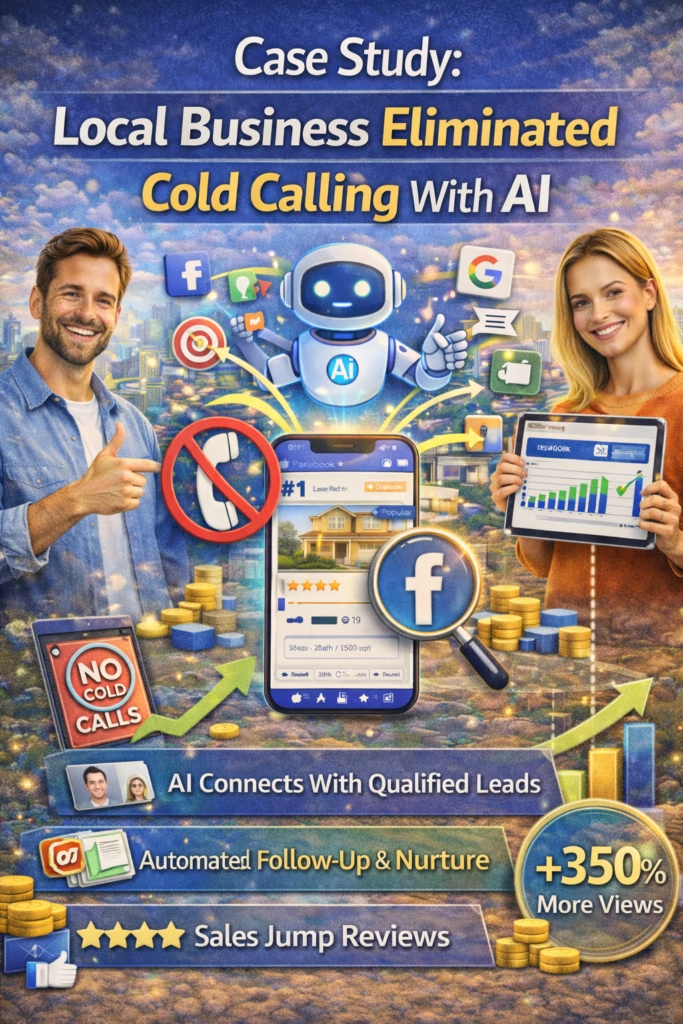
Case Study: Local Business Eliminated Cold Calling With AI
Case Study: Local Business Eliminated Cold Calling With AI explains the exact shift—from dialing strangers to generating inbound leads and converting them automatically with AI follow-up, qualification, and booking.
Note: This case study is illustrative and based on common performance patterns across local lead systems. Actual results vary by niche, market, and execution consistency.
Introduction
Case Study: Local Business Eliminated Cold Calling With AI focuses on a simple truth: cold calling is usually a symptom of a broken inbound system. When a business lacks consistent inbound leads, they compensate by dialing, chasing, and following up manually.
This case study shows how one local business replaced outbound calling with an AI-driven pipeline that creates inbound demand, answers leads instantly, qualifies buyers, and books appointments—while the team focuses on service delivery.
Big idea: The goal isn’t “more automation.” The goal is more conversations and more booked appointments—with less human effort.
Expanded Table of Contents
- 1) Case study overview (what changed and why it worked)
- 2) The “before” situation: why cold calling was required
- 3) The goal: eliminate cold calling without losing revenue
- 4) The AI system that replaced cold calling
- 5) Lead channels: where the inbound leads came from
- 6) The messaging framework (scripts that convert)
- 7) AI qualification: filtering tire-kickers automatically
- 8) Booking + scheduling workflow
- 9) Reactivation: turning dead leads into revenue
- 10) KPIs and results (what to measure)
- 11) Timeline: what happened week-by-week
- 12) Lessons learned + mistakes to avoid
- 13) Copy/paste templates: replies, follow-up, and booking
- 14) Copy/paste implementation checklists
- 15) 30–60–90 day rollout plan
- 16) 25 Frequently Asked Questions
- 17) 25 Extra Keywords
1) Case study overview (what changed and why it worked)
Case Study: Local Business Eliminated Cold Calling With AI is about replacing outbound “hunt mode” with inbound “response mode.” The business stopped chasing strangers and instead built a system that:
Created inbound demand
Listings and content were placed where local buyers already search, resulting in consistent inbound messages.
Responded instantly 24/7
AI answered leads immediately, keeping intent hot and preventing leads from shopping competitors.
Qualified automatically
AI asked the right questions early (budget, location, timeline, needs) to filter junk leads.
Booked appointments fast
AI moved conversations to scheduling within 3–6 messages.
Reactivated old leads
Leads that went silent were followed up consistently, turning “dead” conversations into bookings.
Why it worked: Cold calling is low conversion because it fights timing. Inbound + instant response wins because it aligns with buyer intent.
2) The “before” situation: why cold calling was required
Before AI, the business relied on manual outreach to generate any pipeline. Their “lead flow” looked like this:
- Inconsistent inbound inquiries (some weeks were quiet)
- Manual follow-up (leads went cold overnight)
- No qualification script (time wasted on poor fits)
- No reactivation process (old leads were forgotten)
- Team time consumed by chasing instead of closing
Result: Cold calling felt necessary because the business didn’t control demand or response speed.
3) The goal: eliminate cold calling without losing revenue
“Eliminate cold calling” sounds risky unless you define what replaces it. The goal was not to stop outreach and hope for the best—the goal was to create a predictable inbound system that can support revenue targets.
Success criteria
- Consistent inbound leads every week
- Immediate response to 100% of inquiries
- More qualified conversations (less time wasted)
- Measurable appointment volume
- Clear reporting and continuous optimization
Rule: Replace effort with system. If you eliminate cold calling, you must replace the pipeline inputs.
4) The AI system that replaced cold calling
The replacement system had five parts. Together, they removed the need for manual dialing.
| Component | What it did | Outcome |
|---|---|---|
| Inbound acquisition | Listings and content placed on high-intent local channels | More inbound messages |
| Instant AI response | Auto-replied within seconds, 24/7 | Higher conversation rate |
| Qualification script | Asked 3–5 key questions and tagged lead quality | Less time wasted |
| Booking flow | Moved qualified leads to a date/time and confirmed details | More appointments |
| Reactivation engine | Followed up with old leads automatically | “Free” extra bookings |
The core win: The AI didn’t “sell like a wizard.” It simply ensured every lead got a fast, consistent, structured response that moved toward booking.
5) Lead channels: where the inbound leads came from
Instead of chasing people, the business positioned offers where buyers were already searching.
High-intent marketplaces
Listings were optimized with keyword-first titles, strong photos, and response-speed automation to capture ready-to-buy traffic.
Local search & maps
Profile optimization and review velocity created steady inbound leads from local discovery (especially for service businesses).
Community visibility
Help-first community posts created warm inbound conversations without spammy selling.
Reactivation list
Past inquiries were re-contacted with seasonal offers and availability prompts.
Quick win: The reactivation list produced some of the fastest results because trust already existed.
6) The messaging framework (scripts that convert)
The AI followed a simple framework. It didn’t “pitch.” It guided the conversation to the next step.
The 4-step framework
- Confirm + welcome: “Yes, we can help.”
- Qualify quickly: ask 2–4 key questions
- Offer a clear next step: quote range or availability
- Book it: propose times and confirm details
Example: first response (copy/paste)
Yes — we can help 👋
Quick question so I can point you the right way:
1) What city/area are you in?
2) What’s your timeline (today/this week/this month)?
3) What’s the main goal (best price, fastest service, premium option)?
Why it converts: It feels helpful, not pushy—while gathering the info needed to close.
7) AI qualification: filtering tire-kickers automatically
Cold calling wastes time because you don’t know fit. AI qualification flips that: it gathers fit signals fast.
Qualification questions (universal)
- Location / service area
- Timeline
- Budget range (or price sensitivity)
- Need type (basic vs premium)
- Decision-maker status (if relevant)
Lead scoring (simple)
| Score | Definition | Action |
|---|---|---|
| Hot | Within service area, ready soon, clear need | Route to human + book now |
| Warm | Interested but unclear timeline | Offer options + follow up |
| Cold | Outside area, unrealistic budget, vague | Provide info + low-frequency nurture |
Result: Staff time shifted to closing hot leads instead of entertaining low-fit conversations.
8) Booking + scheduling workflow
Booking is where most systems fail. The AI fixed this by always proposing clear, specific time options.
Booking message template (copy/paste)
Perfect — I can get you on the calendar.
Which works better?
1) Today: 4–6pm
2) Tomorrow: 10am–12pm

And what’s the best name + phone number for confirmation?
Pro move: Offer two time windows. People choose faster than they “think about scheduling.”
9) Reactivation: turning dead leads into revenue
Cold calling tries to create interest from scratch. Reactivation is easier because the lead already engaged once.
Reactivation text (copy/paste)
Hey! Quick check-in 👋
Still looking for help with [service] in [area]?

We have openings this week and can share a quick price range if you tell me your timeline.
Follow-up cadence (simple)
- Day 2: short nudge
- Day 5: offer availability windows
- Day 10: “last call” / seasonal reminder
Result: Reactivation generated “extra” bookings that would have otherwise never happened.
10) KPIs and results (what to measure)
This case study is about replacing cold calling with measurable inbound performance. The business tracked these KPIs weekly:
| KPI | What it indicates | Target |
|---|---|---|
| Response time | Speed-to-lead competitiveness | < 5 minutes (best) / < 15 minutes (good) |
| Conversation rate | How many inquiries become chats | Increase weekly |
| Qualified rate | Lead quality + targeting accuracy | Stable or rising |
| Appointment rate | Ability to move to next step | Increase |
| Show rate | Confirmation and reminders | High and improving |
Reality: Most “AI lead gen” wins come from response time and follow-up consistency, not fancy language.
11) Timeline: what happened week-by-week
Week 1: Fix the inbound engine
- Optimized listings and lead capture points
- Standardized offer framing and first-response scripts
- Installed instant AI response + lead tagging
Week 2: Qualification and booking
- Added 3–5 qualification questions by niche
- Moved to two-option scheduling prompts
- Created missed-message follow-up triggers
Weeks 3–4: Reactivation + optimization
- Reactivated old leads and warm inquiries
- A/B tested listing titles, photos, and pricing
- Improved response-time coverage after hours
By week 4: cold calling was no longer the primary pipeline lever.
12) Lessons learned + mistakes to avoid
What worked best
- Instant response + consistent follow-up
- Qualification questions that filter fast
- Two-option booking prompts
- Reactivation campaigns
- Weekly optimization routine
Mistakes to avoid
- Overcomplicating the AI prompts: simple is faster and more reliable
- Not tracking KPIs: if you don’t measure, you can’t improve
- Letting humans respond slowly: AI can’t fix a slow handoff
- Ignoring listing quality: bad photos and weak titles reduce inbound volume
Key lesson: AI doesn’t replace business fundamentals. It enforces them consistently.
13) Copy/paste templates: replies, follow-up, and booking
Template: first reply (universal)
Yes — we can help 👋
What area are you in and what’s your timeline?
If you share that, I’ll send pricing + availability.
Template: qualify (3 questions)
Quick 3 questions so I can quote accurately:
1) City/area?
2) Timeline (today/this week/this month)?
3) Basic option or premium option?
Template: booking
Perfect — want to lock in a time?
Option A: [Day] [Time Window]
Option B: [Day] [Time Window]
Which works better?
Template: reactivation
Hey 👋 still need help with [service] in [area]?
We have openings this week — want a quick price range?
14) Copy/paste implementation checklists
AI “No Cold Calling” build checklist
[ ] Identify the #1 inbound channel for your niche
[ ] Standardize listing/title/photo templates
[ ] Install instant AI response (24/7 coverage)
[ ] Add qualification questions (location, timeline, budget/needs)
[ ] Add lead tagging (hot/warm/cold)
[ ] Add booking prompts (two-option scheduling)
[ ] Add no-response follow-up triggers
[ ] Add reactivation campaign to old leads
[ ] Track KPIs weekly (response time, conversations, bookings)
[ ] Run weekly A/B tests (photo, title, price, first lines)
Weekly optimization routine (60 minutes)
[ ] Review response time + missed leads
[ ] Refresh top listings (photo #1 + first 2 lines)
[ ] Run 1 A/B test (title OR price OR hero photo)
[ ] Reactivate warm leads (simple check-in)
[ ] Improve scripts based on real objections
15) 30–60–90 day rollout plan
Days 1–30 (Replace dialing with inbound + speed)
- Build consistent inbound visibility (listings, local discovery, community)
- Install instant AI replies and qualification
- Implement booking prompts and follow-up triggers
- Track response time and conversation rate daily
- Begin reactivation to past inquiries
Days 31–60 (Increase conversion and appointment volume)
- A/B test titles, photos, pricing, and first lines
- Improve qualification to reduce low-quality leads
- Optimize booking workflow (two time windows + confirmation)
- Build a weekly “proof” cadence (reviews, screenshots, wins)
Days 61–90 (Systemize and scale)
- Standardize scripts and handoff rules
- Create playbooks by niche/service
- Scale what works (more listings, more locations, more reactivation)
- Turn reporting into weekly habits
Outcome: Cold calling becomes optional because pipeline becomes predictable.
16) 25 Frequently Asked Questions
1) Can a local business really eliminate cold calling with AI?
Yes, if AI replaces the pipeline inputs: consistent inbound visibility + instant follow-up + qualification + booking + reactivation.
2) What’s the fastest way to reduce cold calling?
Improve speed-to-lead with instant replies and follow-up workflows so inbound leads convert at a higher rate.
3) What does AI automate in lead generation?
Instant responses, qualification questions, follow-ups, booking prompts, reactivation, and routing to staff.
4) Does AI replace salespeople?
Usually it replaces repetitive tasks. Humans still close high-ticket deals, but AI handles first contact and follow-up.
5) What KPIs matter most?
Response time, conversation rate, qualified rate, appointment rate, and show rate.
6) How important is response time?
Very. Fast response increases conversions without needing more traffic.
7) What’s the simplest qualification script?
Ask location, timeline, and need type (or budget range).
8) How does AI reduce wasted time?
By filtering low-fit leads early and routing hot leads to humans fast.
9) What’s a common mistake when implementing AI?
Overcomplicating prompts instead of building clear scripts and rules.
10) How do you keep AI from sounding robotic?
Use short, friendly sentences and ask one question at a time.
11) What channels work best for inbound?
High-intent local discovery and marketplace-style channels often work best, plus reactivation lists.
12) Can AI handle after-hours leads?
Yes—24/7 response is one of the biggest advantages over human-only systems.
13) What’s the best booking strategy?
Offer two time windows and confirm details (name + phone).
14) How do you follow up without being annoying?
Use short nudges with availability or value, and space them out.
15) What is reactivation?
Following up with old leads who previously inquired to capture missed revenue.
16) How often should you reactivate leads?
Monthly or seasonally, depending on the business cycle.
17) Does AI require a lot of data to work?
No. It requires clear scripts, rules, and a consistent offer.
18) How do you measure ROI?
Track appointments booked and jobs closed relative to system cost and time saved.
19) Is this only for service businesses?
No. Retail, rentals, and local trades can all use inbound + AI follow-up systems.
20) What if lead volume is too low?
Fix inbound visibility first: better listings, better channels, better offer clarity.
21) What if leads are low quality?
Improve targeting and add stronger qualification questions.
22) Can AI handle objections?
Yes—basic objections can be handled with short scripts and proof.
23) What’s the “best” AI workflow?
Inbound → instant reply → qualify → book → remind → reactivate.
24) How quickly can cold calling be eliminated?
Often within 2–4 weeks of consistent inbound and strong follow-up workflows.
25) What’s the biggest reason businesses keep cold calling?
They don’t have a consistent inbound system and they don’t follow up fast enough.
17) 25 Extra Keywords
- Case Study: Local Business Eliminated Cold Calling With AI
- eliminate cold calling with AI
- AI lead generation case study
- AI marketing automation for local business
- AI follow up automation
- AI customer support automation
- AI appointment booking system
- inbound leads without cold calling
- how to replace cold calling
- AI sales automation local business
- AI SMS follow up system
- AI messenger auto reply
- automated lead qualification
- speed to lead automation
- reactivation campaign automation
- AI lead nurturing workflow
- local business lead generation system
- automated follow up scripts
- AI outreach alternative to cold calling
- reduce sales labor with AI
- how to get inbound leads consistently
- AI pipeline automation
- local marketing automation case study
- AI lead conversion scripts
- no cold calling lead generation













