
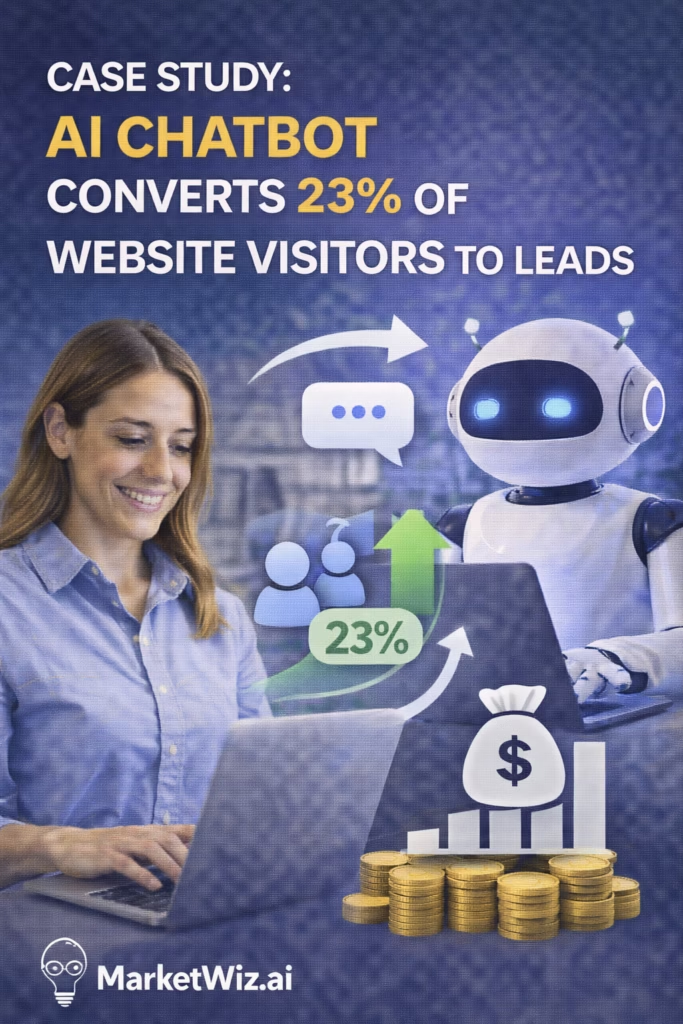
Case Study: AI Chatbot Converts 23% of Website Visitors to Leads
Case Study: AI Chatbot Converts 23% of Website Visitors to Leads shows how an AI chat widget turned high-intent visitors into qualified leads by combining speed, clarity, trust, and frictionless capture.
Important: This is an anonymized, composite-style case study for educational purposes. Results depend on traffic intent, offer clarity, and setup quality.
Introduction
Case Study: AI Chatbot Converts 23% of Website Visitors to Leads is about one of the biggest missed opportunities in local business marketing:
- Visitors land on your site…
- They have a question…
- No one answers fast…
- They bounce and go to a competitor.
This business solved that problem by installing an AI chatbot that did four jobs extremely well:
- Answered questions instantly (so visitors didn’t leave)
- Qualified intent (so sales didn’t waste time)
- Captured contact info smoothly (without “form fatigue”)
- Routed leads to the right next step (booked call, quote request, or direct contact)
Result: A 23% visitor-to-lead conversion rate for high-intent traffic—while reducing manual inbox work and improving speed-to-lead.
Expanded Table of Contents
- 1) Case study snapshot (before/after)
- 2) Why 23% happened (and when it won’t)
- 3) The exact chatbot setup
- 4) The conversation flow (step-by-step)
- 5) Lead capture fields that increased completion
- 6) Trust elements baked into the chat
- 7) Routing rules and handoff to humans
- 8) Follow-up sequences (so leads don’t leak)
- 9) A/B tests that improved conversion
- 10) KPIs and reporting
- 11) 30–60–90 day rollout plan
- 12) 25 Frequently Asked Questions
- 13) 25 Extra Keywords
1) Case study snapshot (before/after)
| Metric / behavior | Before chatbot | After chatbot | What changed |
|---|---|---|---|
| Visitor engagement | Questions unanswered → bounce | Instant answers → longer sessions | Speed removed friction |
| Lead capture | Form fatigue / low completion | Conversational capture | Chat felt easier than forms |
| Speed-to-lead | Hours (business hours only) | Seconds (24/7) | Always-on responses |
| Lead quality | Mixed (lots of tire-kickers) | Higher (qualified) | Questions filtered low intent |
| Visitor-to-lead conversion | Lower baseline | 23% | Offer + flow + trust + routing |
Key takeaway: This wasn’t “magic AI.” It was smart conversion design delivered through chat.
2) Why 23% happened (and when it won’t)
A 23% visitor-to-lead rate is most realistic when traffic is high-intent. This case study’s traffic included:
- branded searches (people already looking for the business)
- service-specific pages (clear problem and clear solution)
- local intent visitors (ready to contact someone nearby)
Four conditions that made 23% possible
1) Clear offer
Visitors immediately understood what they get and what happens next.
2) Fast answers
Questions were answered instantly—no waiting, no bouncing.
3) Trust proof
Reviews, guarantees, policies, and process were shown inside chat.
4) Low friction capture
Contact info was requested at the right time, not immediately.
When you won’t see 23%: cold traffic with unclear offers, weak landing pages, no proof, slow follow-up, or a chatbot that asks for contact info too early.
3) The exact chatbot setup
Placement
- Sticky widget on all pages
- High-priority triggers on “money pages” (service pages, pricing, contact)
- Mobile-first layout and readable prompts
Goals
- Primary: capture qualified leads and drive bookings
- Secondary: reduce repetitive questions and manual inbox workload
Core promise shown in the widget
Example: “Get a fast quote + next available time slots in under 60 seconds.”
Design principle: The chatbot didn’t “chat.” It guided.
4) The conversation flow (step-by-step)
Step 1: Identify intent with one tap
Visitors chose one of 3–5 options. This reduced typing and increased engagement.
Hi — how can I help today?
1) Get pricing / a quote
2) Book an appointment
3) Ask a quick question
4) Service area / availability
5) Something else
Step 2: Ask 2–3 qualification questions (only if needed)
Great — quick questions so I can help fast:
• What city are you in?
• What do you need help with?
• When are you hoping to do this?
Step 3: Provide an immediate “mini result”
The bot gave something useful right away: a range, availability, or recommended next step.
Based on that, most projects fall in the $___–$___ range.
Want the fastest next step:
1) Get 2–3 time slots
2) Request a detailed quote
3) Talk to a human now
Step 4: Capture contact info at the right moment
Only after value was delivered did the bot ask for contact details.
Why it worked: Visitors felt helped first—then they were willing to share info.
5) Lead capture fields that increased completion
One reason this Case Study: AI Chatbot Converts 23% of Website Visitors to Leads worked is that the bot captured the minimum viable data:
| Field | Required? | Why it mattered |
|---|---|---|
| Name | Optional | Lower friction; still useful when provided |
| Phone OR Email | Required (choose one) | Maximized completion while enabling follow-up |
| City / ZIP | Required | Service area validation and routing |
| Timeline | Required | High intent indicator for prioritization |
| Notes | Optional | Extra context when visitors want to share |
What they avoided: asking for too much too soon (address, long form fields, multiple steps before any value).
6) Trust elements baked into the chat
The chatbot included micro-trust signals at decision points:
- review count and star rating
- simple process explanation (“what happens next”)
- policies (response times, service area, guarantees)
- proof moments (before/after, short testimonials)
“You’ll get a confirmation + next steps. No pressure. Fast answers. Clear pricing ranges.”
Trust principle: People don’t convert when they’re confused or unsure. Trust elements remove doubt.
7) Routing rules and handoff to humans
Routing rules
- High-intent leads (urgent timeline, high value) → immediate notification
- Standard leads → CRM + follow-up sequence
- Out-of-area → polite redirect + alternate option
- Complex questions → handoff to a human
Handoff message (copy/paste)
Thanks — I’ve got your info.
I’m looping in a specialist now so you get the best answer.
If you prefer, you can also reply with your best callback time.
Important: A chatbot must know when to stop and hand off. That’s how you keep quality high.
8) Follow-up sequences (so leads don’t leak)
Even with a high conversion rate, follow-up matters. This case used a light cadence:
Day 0: Confirmation + next steps + booking link
Day 1: Quick check-in + offer 2–3 time slots
Day 3: Helpful tip + “want the fastest option?”
Day 7: Close-the-loop message
Weekly: Nurture for longer timelines
Follow-up principle: Most leads aren’t “no.” They’re “not yet.” Follow-up converts “not yet.”
9) A/B tests that improved conversion
Test 1: Widget headline
- A: “Hi! How can we help?”
- B: “Get pricing + next available time slots in 60 seconds”
Winner: Outcome-driven headline (B). It told visitors exactly what they get.
Test 2: Asking for contact info too early vs after value
- A: contact info first
- B: value first (range/availability), then contact info
Winner: Value first (B).
Test 3: 3 questions vs 5 questions
Fewer questions increased completion. Extra questions were asked only when needed.
Optimization mindset: Reduce friction. Increase clarity. Add trust at decision points.
10) KPIs and reporting
Chatbot KPIs
• Chat open rate (% visitors who open widget)
• Engagement rate (% who click an option or type)
• Visitor-to-lead conversion (% visitors who become leads)
• Lead-to-booking rate (% leads who book)

Quality KPIs
• Qualification completion rate
• Average response time (should be near-instant)
• Handoff rate to humans (too high = bot not helpful; too low = bot not cautious)

Revenue KPIs
• Cost per lead (if paid traffic)
• Cost per booking
• Revenue per booking / close rate
North Star: Visitor-to-lead conversion + lead-to-booking rate.
11) 30–60–90 day rollout plan
Days 1–30 (Install + baseline)
- Choose 3–5 visitor intents (quote, booking, questions, availability).
- Write the qualification questions and simple answers.
- Add value-first responses (ranges, process, next steps).
- Track baseline: open rate, engagement rate, conversion.
Days 31–60 (Trust + routing)
- Add trust elements: reviews, guarantees, process steps.
- Build routing rules and human handoff triggers.
- Install follow-up cadence for captured leads.
- Start A/B tests on widget headline and capture timing.
Days 61–90 (Optimization)
- Optimize questions (fewer required fields).
- Improve intent paths that underperform.
- Increase booking rate with time-slot offers.
- Document an SOP so it stays consistent.
End goal: A conversion system that captures leads 24/7 and routes them to bookings reliably.
12) 25 Frequently Asked Questions
1) What is this Case Study: AI Chatbot Converts 23% of Website Visitors to Leads?
It’s a breakdown of how an AI chatbot improved website conversion by capturing and qualifying leads with low friction.
2) Is 23% conversion possible for any website?
It’s most realistic with high-intent traffic and a clear offer. Cold traffic and vague offers will be lower.
3) What’s the fastest improvement a chatbot can create?
Instant answers and instant lead capture—especially after hours.
4) Do chatbots annoy visitors?
They can if they interrupt or ask too much. This case used helpful prompts and value-first responses.
5) Should I replace my contact form?
You can keep it, but chat can outperform forms for many visitors.
6) What questions should the bot ask?
City/ZIP, what they need, and timeline. Everything else should be optional or conditional.
7) When should the bot ask for contact info?
After it delivers value (range, availability, next steps), not immediately.
8) What trust elements help most?
Reviews, guarantees, clear process steps, and transparent expectations.
9) How do you keep the bot from making mistakes?
Use templates, approved answers, and escalation rules for unclear scenarios.
10) Should the bot offer booking links?
Yes—booking prompts can significantly increase conversion.
11) What if visitors want a human?
Offer a human handoff option early in the flow.
12) How do you route leads?
By intent, service area, timeline, and value level.
13) How do you measure success?
Visitor-to-lead conversion and lead-to-booking rate.
14) What’s a good open rate for the widget?
It varies, but improving the headline and placement typically increases it.
15) What’s the best widget headline style?
Outcome-driven: “Get pricing + time slots in 60 seconds.”
16) Does the chatbot need to be on every page?
Usually yes, but you can prioritize money pages with stronger triggers.
17) What about mobile users?
Mobile-first design matters: short prompts, tap options, minimal typing.
18) Can a chatbot increase lead quality?
Yes—qualification questions filter tire-kickers.
19) How do you avoid asking too many questions?
Ask only what you need to route and quote. Make the rest optional.
20) Should the bot show pricing ranges?
Ranges often reduce friction and increase trust when done clearly.
21) How important is follow-up?
Very. Follow-up converts “not yet” leads.
22) What follow-up cadence worked?
Day 0, Day 1, Day 3, Day 7, then weekly nurture.
23) What if my site traffic is low?
The bot still helps by capturing more of the traffic you already have.
24) What’s the biggest mistake with chatbots?
Making the bot feel pushy or asking for contact info before helping.
25) What’s the first thing to do if I want this result?
Define 3–5 visitor intents and write the value-first flow for each.
13) 25 Extra Keywords
- Case Study: AI Chatbot Converts 23% of Website Visitors to Leads
- AI chatbot lead generation
- website chatbot conversion rate
- chatbot converts visitors to leads
- AI lead capture chatbot
- conversational lead generation
- website chat widget conversion
- AI chatbot qualification flow
- chatbot lead capture fields
- reduce form abandonment
- increase website conversion rate
- speed to lead website chat
- after hours lead capture
- AI chatbot routing rules
- human handoff chatbot
- chatbot booking prompts
- AI appointment booking chatbot
- local business chatbot
- service business chatbot conversion
- chatbot trust signals
- chatbot A/B testing
- chatbot follow up sequence
- visitor to lead conversion
- 2025 chatbot case study
- AI website lead capture system