

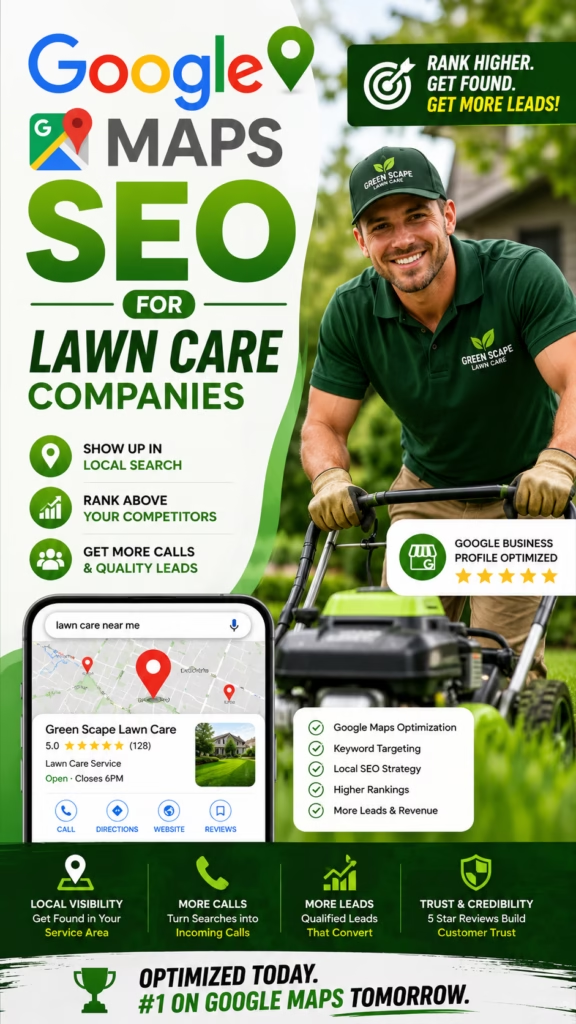
Google Maps SEO for Lawn Care Companies
Google Maps SEO for Lawn Care Companies helps lawn maintenance businesses improve local visibility, attract nearby homeowners, generate phone calls, increase quote requests, and turn Google Business Profile activity into recurring lawn service customers.
Introduction
Google Maps SEO for Lawn Care Companies is one of the most important local marketing strategies for businesses that depend on customers within a defined service area. Homeowners usually do not want a lawn company located several hours away. They want someone nearby who serves their neighborhood, understands local grass conditions, responds quickly, and can provide reliable recurring service.
When someone searches for lawn mowing, lawn maintenance, yard cleanup, mulch installation, seasonal cleanup, weed control, trimming, or landscaping help, Google often displays map-based local results near the top of the page. A lawn care company with a well-optimized Google Business Profile may appear before many traditional website results.
Google Maps SEO gives lawn care companies a chance to appear at the exact moment nearby homeowners are searching for service.
Strong map visibility is not created by adding a few keywords and waiting. It requires accurate business information, correct categories, relevant services, strong reviews, real photos, local content, consistent updates, service-area clarity, website support, and fast lead handling.
Lawn care businesses can use Google Maps SEO to promote weekly mowing, biweekly mowing, edging, trimming, leaf cleanup, spring cleanup, fall cleanup, mulch, shrub care, aeration, overseeding, lawn restoration, commercial maintenance, rental property service, and other services they genuinely provide.
The strongest strategy combines Google Business Profile optimization, neighborhood relevance, seasonal posting, service pages, review growth, photo activity, local citations, website authority, call tracking, and conversion-focused follow-up.
Main idea: Google Maps SEO for Lawn Care Companies works when Google and local homeowners can clearly understand who the business serves, what services it provides, where it works, and why it can be trusted.
Table of Contents
- 1) Why Google Maps matters for lawn care companies
- 2) How local lawn care searches work
- 3) Setting up the Google Business Profile correctly
- 4) Choosing the best primary category
- 5) Adding secondary categories carefully
- 6) Optimizing the business name, address, and phone
- 7) Setting accurate lawn care service areas
- 8) Writing a strong business description
- 9) Adding lawn care services to the profile
- 10) Using photos to improve local trust
- 11) Generating more Google reviews
- 12) Responding to lawn care reviews
- 13) Publishing Google Business Profile posts
- 14) Using seasonal lawn care content
- 15) Building local lawn care landing pages
- 16) Optimizing the lawn care website
- 17) Using local keywords naturally
- 18) Building local citations and authority
- 19) Improving calls and quote conversion
- 20) Google Maps SEO for recurring mowing
- 21) Google Maps SEO for seasonal cleanup
- 22) Google Maps SEO for commercial lawn care
- 23) Tracking local lawn care performance
- 24) Common Google Maps SEO mistakes
- 25) Final thoughts
- 26) FAQs
- 27) Extra keywords
1) Why Google Maps Matters for Lawn Care Companies
Google Maps matters because lawn care is highly local. Customers often search using phrases connected to immediate needs, nearby service, neighborhood coverage, and seasonal timing.
Common lawn care searches:
lawn care near me
lawn mowing service near me
weekly lawn mowing
local lawn maintenance company
yard cleanup near me
leaf removal service
mulch installation near me
commercial lawn care company
spring yard cleanup
local landscaper for lawn maintenance
These searches often come from homeowners who are close to making a decision. They may need a quote, want service this week, or be looking for a recurring provider.
Google Maps visibility can generate:
- Phone calls
- Website visits
- Quote requests
- Direction requests
- Recurring mowing leads
- Seasonal cleanup inquiries
- Commercial maintenance leads
- Review activity
- Neighborhood recognition
- Booked lawn service accounts
Unlike broad advertising, Google Maps often reaches people who are already searching for the exact service. This can create stronger intent than general social media exposure.
Google Maps helps lawn care businesses meet local demand at the moment homeowners are ready to compare providers.
2) How Local Lawn Care Searches Work
Local search results are influenced by how closely the business matches the search, how near it is to the searcher or service area, and how established and trustworthy the business appears online.
A lawn care company cannot control every part of local search, but it can strengthen relevance, trust, and authority through accurate information and consistent activity.
Important local visibility signals include:
- Correct business categories
- Accurate business information
- Relevant lawn care services
- Customer reviews
- Review quality and recency
- Real business photos
- Website relevance
- Local service pages
- Consistent citations
- Customer engagement
A complete Google Business Profile helps Google understand the company. A relevant website helps confirm the services and locations. Reviews and photos provide evidence that the business is active.
Local lawn care ranking is stronger when the profile, website, reviews, photos, and service-area information all support the same business identity.
3) Setting Up the Google Business Profile Correctly
The Google Business Profile should be complete, accurate, and based on the real business operation. Incorrect information can create ranking problems, customer confusion, or verification issues.
Google Business Profile setup checklist:
- Accurate business name
- Correct primary category
- Relevant secondary categories
- Current phone number
- Correct website link
- Accurate business hours
- Service-area settings
- Complete business description
- Full service list
- Real business photos
Service-area lawn care businesses should use the profile structure that accurately reflects how they operate. Businesses that do not receive customers at a location should not present a private address as a public storefront.
Hours should reflect when customers can realistically reach the company. Seasonal schedule changes should be updated when necessary.
A correctly configured Google Business Profile gives every other local SEO effort a stronger foundation.
4) Choosing the Best Primary Category
The primary category is one of the most important profile settings because it helps Google understand the company’s main service.
A lawn care company should choose the category that most accurately represents its primary business. A company focused mainly on recurring lawn maintenance may need a different primary category than a business focused mainly on landscape design or tree work.
Possible category considerations:
Lawn care service
Landscaper
Landscape designer
Snow removal service
Tree service
Irrigation equipment supplier
Property maintenance service
The category should match the actual core business, not the category that seems easiest to rank. Incorrect category selection can attract the wrong leads and weaken relevance.
The best primary category is the one that most accurately describes the company’s main source of customer work.
5) Adding Secondary Categories Carefully
Secondary categories can help represent additional services, but they should only be used when the business genuinely provides those services.
Secondary category decisions may depend on whether the company offers:
- Landscape installation
- Irrigation work
- Snow removal
- Tree trimming
- Property maintenance
- Commercial grounds care
- Landscape design
- Garden maintenance
Adding unrelated categories does not automatically improve visibility. It can make the profile less focused and create customer confusion.
Categories should be reviewed as the business changes. A company that expands into additional services may need to update the profile, website, photos, and service pages together.
Secondary categories should expand accurate relevance, not create a misleading list of services.
6) Optimizing the Business Name, Address, and Phone
The business name should match the real-world name used by the company. Adding unnecessary city names, service keywords, or promotional terms can create inconsistency.
The phone number should be active, monitored, and connected to a reliable response process. Missed calls can quickly become lost lawn care leads.
Business information best practices:
- Use the real business name
- Keep phone information current
- Use a consistent website URL
- Match major online directory information
- Update old numbers
- Remove duplicate listings
- Use accurate hours
- Keep contact details consistent
Consistency helps customers and search systems recognize that different online references belong to the same company.
Accurate business information protects trust and prevents valuable lawn care leads from reaching the wrong place.
7) Setting Accurate Lawn Care Service Areas
Service areas should reflect where the company actually accepts work. Lawn care routes are often affected by travel time, crew scheduling, minimum job size, neighborhood density, and recurring service efficiency.
Service-area planning questions:
Which cities are profitable to serve?
Which neighborhoods fit existing routes?
How far will crews travel?
Are recurring accounts required?
Are one-time cleanups available farther away?
Do commercial jobs have a larger service radius?
Which areas create too much drive time?
Where is the company actively seeking growth?
Avoid adding an unrealistic number of cities simply to appear larger. Customers may become frustrated if they request service in an area the company does not actually cover.
Service-area pages on the website can support local relevance when each page contains useful, original information about the services offered in that community.
Accurate service areas improve lead quality and help lawn care companies build more efficient local routes.
8) Writing a Strong Business Description
The business description should explain what the company does, who it serves, where it works, and what makes the service useful. It should sound natural rather than overloaded with keywords.
Business description structure:
Primary lawn care service
Main customer types
Key service areas
Recurring and one-time options
Seasonal services
Commercial or residential focus
Simple trust statement
Clear customer benefit
For example, a lawn care business may explain that it provides recurring mowing, edging, trimming, seasonal cleanup, mulch, and property maintenance for homeowners, rentals, and small commercial properties in surrounding communities.
Avoid unsupported claims such as being the best company in every city. Use specific, honest information that helps customers understand the offer.
A strong description improves profile clarity by explaining the business in language local homeowners understand.
9) Adding Lawn Care Services to the Profile
The service section gives lawn care companies an opportunity to explain their actual offerings. Each service should be clear and connected to real availability.
Lawn care services may include:
- Weekly lawn mowing
- Biweekly lawn mowing
- Edging and trimming
- Leaf removal
- Spring cleanup
- Fall cleanup
- Mulch installation
- Shrub trimming
- Aeration
- Overseeding
- Lawn restoration
- Commercial lawn maintenance
Descriptions can clarify whether the service is recurring, one-time, seasonal, residential, commercial, or available only in selected areas.
Service information should match the website. If the profile lists aeration, the website should provide useful aeration information and a clear way to request a quote.
Detailed services help Google and customers understand the full range of lawn care work the company provides.
10) Using Photos to Improve Local Trust
Photos show that the lawn care business is active and experienced. Real images can help customers evaluate the quality of mowing, edging, cleanup, mulch, shrub work, and property maintenance.
Lawn care photo ideas:
- Freshly mowed lawns
- Clean edging lines
- Before-and-after yard cleanups
- Mulch installation projects
- Leaf removal results
- Shrub trimming projects
- Professional crews
- Branded trucks and trailers
- Commercial maintenance properties
- Seasonal lawn transformations
Photos should be clear, current, and owned by the business. Avoid using only stock images that do not represent actual work.
Upload photos consistently rather than adding everything once and never updating the profile again. Seasonal images help show that the company remains active throughout the year.
Real lawn care photos build trust because homeowners can see the quality of the work before requesting service.
11) Generating More Google Reviews
Reviews are one of the most visible trust signals in local search. Homeowners often compare rating, review count, recent feedback, and the specific services customers mention.
Good times to request a review:
- After the first successful service
- After a major cleanup
- After a mulch installation
- After solving a customer concern
- After completing a seasonal project
- After a positive customer message
- After a commercial property improvement
- After several weeks of reliable recurring service
Review requests should be simple, professional, and consistent. Customers should never be pressured or offered misleading incentives for positive feedback.
Strong reviews often mention punctuality, communication, mowing quality, reliability, cleanup, pricing clarity, and neighborhood service.
Consistent review growth helps lawn care companies build trust and strengthen local visibility over time.
12) Responding to Lawn Care Reviews
Review responses show that the company pays attention to customers. They also provide an opportunity to reinforce services and local professionalism.
Positive review response example:
Thank you for trusting us with your lawn maintenance. We appreciate the opportunity to provide mowing, edging, and seasonal property care in your area.
Responses should sound natural and specific. Avoid copying the exact same reply for every customer.
Negative reviews should be handled calmly. Acknowledge the concern, avoid arguments, protect customer privacy, and invite an appropriate offline conversation when needed.
Professional review responses strengthen trust because future customers can see how the business communicates.
13) Publishing Google Business Profile Posts
Google Business Profile posts can help lawn care companies keep their listing active and provide timely service information.
Google post ideas for lawn care companies:
- Weekly mowing openings
- Spring cleanup reminders
- Fall leaf removal
- Mulch installation availability
- Shrub trimming appointments
- Commercial maintenance openings
- Before-and-after project highlights
- Rain-delay updates
- Seasonal lawn care tips
- New neighborhood route availability
Posts should focus on one offer, update, project, or customer question. Include a clear call to action such as requesting a quote or checking service availability.
Photos should match the post. A mulch offer should show real mulch work. A cleanup post should show an actual cleanup result.
Consistent Google posts help lawn care companies communicate current services and seasonal availability.
14) Using Seasonal Lawn Care Content
Lawn care demand changes throughout the year. Seasonal content helps the company appear relevant when customers begin searching for specific services.
Seasonal lawn care content:
Spring cleanup
First mowing of the season
Mulch installation
Summer mowing schedules
Heat-stressed lawn care
Storm debris cleanup
Fall leaf removal
Final seasonal mowing
Aeration and overseeding
Winter property preparation
Seasonal pages and posts should be published before demand reaches its highest point. Waiting until the schedule is full can reduce the value of the campaign.
Regional climate matters. Content should match actual local conditions rather than using generic national timing.
Seasonal SEO helps lawn care businesses appear when homeowners are most likely to request that specific service.
15) Building Local Lawn Care Landing Pages
Local landing pages can support Google Maps visibility by explaining the services offered in specific cities or communities.
A useful lawn care location page can include:
- City-specific introduction
- Services available in that area
- Neighborhood coverage
- Recurring mowing options
- Seasonal services
- Real local project photos
- Customer reviews
- Common local questions
- Quote process
- Clear call to action
Each location page should contain original, useful information. Replacing the city name in duplicated text creates weak content and a poor customer experience.
Pages should connect to the main service pages and make it easy for customers to request a quote.
Strong local pages reinforce service-area relevance and give homeowners more useful information than a basic city list.
16) Optimizing the Lawn Care Website
The website supports the Google Business Profile by confirming services, locations, trust, and customer actions.
Important lawn care website elements:
- Clear service pages
- Local landing pages
- Fast mobile performance
- Visible phone number
- Quote request form
- Real project photos
- Customer reviews
- Service-area details
- Accurate business information
- Strong internal links
The homepage should quickly explain the main service, location, customer type, and next step. Visitors should not have to search for the phone number or quote form.
Individual service pages help the company target specific needs such as lawn mowing, leaf cleanup, mulch, commercial maintenance, or aeration.
A strong website helps turn Google Maps visibility into qualified lawn care leads.
17) Using Local Keywords Naturally
Local keywords help search engines and homeowners understand the service and location. They should be used naturally in titles, headings, service pages, image descriptions, and body content.
Local lawn care keyword examples:
lawn care in [city]
lawn mowing service in [city]
weekly lawn maintenance near [area]
yard cleanup in [city]
leaf removal near [community]
commercial lawn care in [region]
mulch installation in [city]
local lawn maintenance company
Keyword use should not make content awkward. The goal is to answer customer questions and explain the service clearly.
Use related phrases rather than repeating one keyword excessively. Helpful content may mention mowing, edging, trimming, cleanup, route availability, recurring service, and seasonal work naturally.
Natural local keywords improve relevance without sacrificing readability or customer trust.
18) Building Local Citations and Authority
Local citations are online references to the business name, contact information, website, and location or service area. Consistency helps strengthen business identity.
Possible citation and authority sources:
- Local business directories
- Chamber of commerce listings
- Community organizations
- Supplier or partner websites
- Local sponsorships
- Neighborhood associations
- Property management partners
- Real estate professional referrals
- Local news features
- Industry directories
The goal is not to create hundreds of low-quality listings. Focus on accurate, relevant sources that real customers may use.
Partnerships can also create referral value. Lawn care companies may work with real estate agents, property managers, landlords, contractors, and local businesses.
Relevant local authority helps reinforce that the lawn care company is established in the communities it serves.
19) Improving Calls and Quote Conversion
Ranking is only useful when customers can take action. Lawn care companies need a clear process for calls, messages, forms, estimates, and follow-up.
Useful lawn care lead questions:
- What is the property address or neighborhood?
- What service is needed?
- Is the service recurring or one-time?
- What is the approximate yard size?
- Are there gates or access issues?
- When was the lawn last serviced?
- Are there leaves, brush, or heavy growth?
- What is the preferred service date?
- Are photos available?
- What is the best contact method?
Response speed matters because homeowners may contact several lawn care providers. A fast response should confirm the service area and collect the next useful details.
Simple lawn care follow-up:
Thanks for reaching out. What neighborhood is the property in, what service do you need, and are you looking for recurring or one-time lawn care? Photos and approximate yard size can help us provide the best next step.
Google Maps visibility creates the lead, but organized follow-up turns the lead into a lawn care customer.
20) Google Maps SEO for Recurring Mowing
Recurring mowing is valuable because one lead may become a long-term account. The profile and website should clearly explain recurring options.
Recurring mowing information can include:
- Weekly service
- Biweekly service
- Mowing
- Edging
- Trimming
- Blowing hard surfaces
- Route availability
- Service-area restrictions
- Seasonal start dates
- Quote requirements
Recurring service pages should explain what is included and what may cost extra. Shrub trimming, mulch, leaf cleanup, or overgrown lawn restoration may be separate services.
Reviews that mention reliability, consistency, and communication can be especially valuable for recurring lawn maintenance.
Recurring mowing SEO works best when the business communicates reliability, route coverage, and service expectations clearly.
21) Google Maps SEO for Seasonal Cleanup
Seasonal cleanup creates high-intent local searches. Homeowners may need spring cleanup, fall leaves, storm debris, brush removal, or property preparation.
Seasonal cleanup page ideas:
Spring yard cleanup
Fall leaf removal
Storm debris cleanup
Rental property cleanup
Overgrown yard cleanup
Brush and small debris removal
Pre-sale property cleanup
Seasonal landscape preparation
Use before-and-after photos to show visible results. Explain how pricing depends on property size, debris volume, access, labor, hauling, and disposal.
Seasonal posts and pages should be updated before demand increases. Strong timing can help the company appear while homeowners are actively comparing options.
Seasonal cleanup SEO connects urgent property needs with timely local service availability.
22) Google Maps SEO for Commercial Lawn Care
Commercial lawn care requires different information than residential service. Property managers and business owners may care about reliability, scheduling, appearance standards, communication, insurance, and multi-property service.
Commercial lawn care content can address:
- Office properties
- Retail locations
- Rental communities
- Small industrial sites
- HOA common areas
- Multi-property maintenance
- Scheduled mowing
- Seasonal cleanup
- Mulch and shrub care
- Property appearance reporting
A commercial landing page should explain the types of properties served, geographic coverage, estimate process, communication structure, and recurring maintenance capabilities.
Commercial reviews and project photos can strengthen trust when published with appropriate permission.
Commercial Google Maps SEO works when the profile and website show that the company can provide reliable, organized property maintenance.
23) Tracking Local Lawn Care Performance
Tracking helps lawn care companies understand whether Google Maps visibility is producing qualified leads and profitable accounts.
Useful lawn care SEO metrics:
- Google profile views
- Phone calls
- Website visits
- Quote form submissions
- Direction requests
- Review growth
- Photo activity
- Keyword visibility
- Qualified leads
- Recurring accounts
- Seasonal jobs
- Revenue by service area
Track which cities, services, landing pages, calls, and forms produce the best customers. A city with many leads may still be unprofitable if travel time is too high.
Measure recurring account value, route density, customer retention, and average job value—not only raw call volume.
The best Google Maps SEO strategy is measured by profitable lawn care customers, not rankings alone.
24) Common Google Maps SEO Mistakes
Lawn care companies often weaken local visibility through incomplete profiles, inconsistent information, weak reviews, duplicate content, and slow lead response.
Common mistakes include:
- Using the wrong primary category
- Adding inaccurate business information
- Listing unrealistic service areas
- Using stock photos only
- Ignoring reviews
- Publishing duplicate city pages
- Using excessive keywords
- Leaving services incomplete
- Using outdated phone numbers
- Slow response to leads
- No seasonal content
- No performance tracking
Another mistake is focusing only on ranking while ignoring conversion. A top listing with poor photos, weak reviews, or unanswered calls may still produce weak results.
Lawn care businesses should also avoid creating profiles for locations that are not legitimate business operations.
Google Maps SEO fails when the profile creates visibility but the business information and customer experience create distrust.
25) Final Thoughts
Google Maps SEO for Lawn Care Companies can help local lawn businesses attract homeowners, generate quote requests, build recurring routes, and compete more effectively in nearby service areas.
The strongest strategy begins with an accurate Google Business Profile, correct categories, complete services, clear service areas, real photos, consistent reviews, professional review responses, seasonal posts, local landing pages, and a conversion-focused website.
Lawn care businesses should create content around recurring mowing, edging, trimming, spring cleanup, fall cleanup, mulch, shrub care, aeration, overseeding, commercial maintenance, and other services they genuinely provide.
Google Maps SEO should support a broader local marketing system that may also include referrals, social media, neighborhood advertising, direct mail, partnerships, and customer follow-up.
Most importantly, the business must respond quickly and professionally when leads arrive. Strong rankings cannot replace a reliable quote and scheduling process.
Final takeaway: Google Maps SEO helps lawn care companies grow when the profile, website, reviews, photos, local content, and customer response process all work together to turn nearby searches into recurring service relationships.
26) FAQs
1) What is Google Maps SEO for lawn care companies?
It is the process of improving a lawn care company’s Google Business Profile, website, reviews, photos, local content, and business information to increase visibility in nearby searches.
2) Why is Google Maps important for lawn care businesses?
Google Maps helps lawn care businesses appear when nearby homeowners search for mowing, cleanup, landscaping, mulch, maintenance, and related services.
3) What category should a lawn care company use?
The company should use the primary category that most accurately describes its main business, with relevant secondary categories only when those services are genuinely offered.
4) Should a lawn care company show its address?
The profile should accurately reflect how the business operates. A service-area business that does not receive customers at its location should not present a private address as a public storefront.
5) What services should be added to the profile?
Services may include mowing, edging, trimming, leaf removal, spring cleanup, fall cleanup, mulch, aeration, overseeding, shrub care, and commercial maintenance.
6) Are Google reviews important for lawn care companies?
Yes. Reviews help homeowners evaluate reliability, communication, quality, punctuality, and overall customer experience.
7) How can lawn care companies get more reviews?
Ask satisfied customers after successful service, major cleanup projects, positive feedback, or several weeks of reliable recurring maintenance.
8) Should businesses respond to reviews?
Yes. Professional responses show that the business pays attention to customers and values communication.
9) Are photos important for Google Maps SEO?
Yes. Real photos of lawns, cleanups, mulch, crews, vehicles, and completed projects help build trust and show that the business is active.
10) How often should lawn care companies add photos?
Photos should be added consistently throughout the season rather than uploaded once and ignored.
11) What should a lawn care business description include?
It should include the main services, customer types, service areas, recurring or one-time options, seasonal services, and a clear customer benefit.
12) Should lawn care companies publish Google posts?
Yes. Posts can promote mowing openings, cleanup, mulch, seasonal reminders, project highlights, and new route availability.
13) What local keywords should lawn care companies use?
Use natural phrases such as lawn care in a city, lawn mowing near a community, yard cleanup, leaf removal, and local lawn maintenance.
14) Should every city have a landing page?
Only create location pages when the company genuinely serves the area and can provide useful, original information for that community.
15) What should a lawn care website include?
It should include service pages, local pages, real photos, reviews, service areas, a visible phone number, and a simple quote form.
16) Can Google Maps SEO generate recurring mowing customers?
Yes. Profiles and pages that clearly explain recurring mowing, route availability, service frequency, and included tasks can attract recurring leads.
17) Can seasonal cleanup services rank locally?
Yes. Dedicated content and timely Google posts can help lawn care companies attract spring cleanup, leaf removal, and storm cleanup searches.
18) Can commercial lawn care companies use Google Maps SEO?
Yes. Commercial pages can target offices, retail sites, rental communities, HOAs, and other properties needing recurring maintenance.
19) What are local citations?
Local citations are online references to the business name, contact information, website, and location or service area.
20) How fast should lawn care companies respond to leads?
They should respond as quickly as possible because homeowners may contact several local companies.
21) What lead details should lawn companies request?
Ask for the property location, service needed, yard size, recurring or one-time preference, access details, photos, and timing.
22) How should lawn care companies track SEO results?
Track profile views, calls, website visits, quote requests, reviews, qualified leads, recurring accounts, seasonal jobs, and revenue.
23) Why does a lawn care profile get views but few calls?
The profile may have weak photos, few reviews, unclear services, poor trust signals, outdated contact information, or no strong next step.
24) What is the biggest Google Maps SEO mistake?
The biggest mistake is focusing only on rankings while ignoring profile accuracy, reviews, website quality, and lead response.
25) What is the best Google Maps SEO tip for lawn care companies?
Build a complete, trustworthy profile and support it with real reviews, real photos, strong local pages, and fast customer follow-up.
25) Extra Keywords
- Google Maps SEO for Lawn Care Companies
- lawn care local SEO
- Google Business Profile for landscapers
- lawn service lead generation
- Google Maps lawn care marketing
- local lawn care leads
- lawn maintenance SEO
- Google Maps lawn mowing leads
- lawn care company SEO
- local landscaper SEO
- Google Business Profile lawn care
- lawn mowing near me SEO
- yard cleanup local SEO
- leaf removal SEO
- commercial lawn care SEO
- recurring lawn service leads
- lawn care review strategy
- lawn care Google posts
- local lawn care landing pages
- lawn care service area SEO
- lawn care website optimization
- lawn maintenance customer acquisition
- Google Maps lawn care ranking
- lawn care quote requests
- lawn care business growth













