Market Wiz AI

Market Wiz

With ingenious automation fused with human dedication 24/7, Market Wiz puts the local marketing competition on notice – they’ve created a new standard operating system for dominating every digital front.All-Platform Compatibility: Facebook, Craigslist, Google, you name it. This system plays well with all the big players, ensuring your ads are everywhere they need to be.The Cherry on Top: There's a ton more under the hood, each feature adding more muscle to your marketing efforts.Bottom line: Market Wiz.ai isn’t just another tool; it’s your 24/7 digital marketing powerhouse. In the world of local advertising, it's the smartest move you’ll make.Market Wiz automates your online ads.|

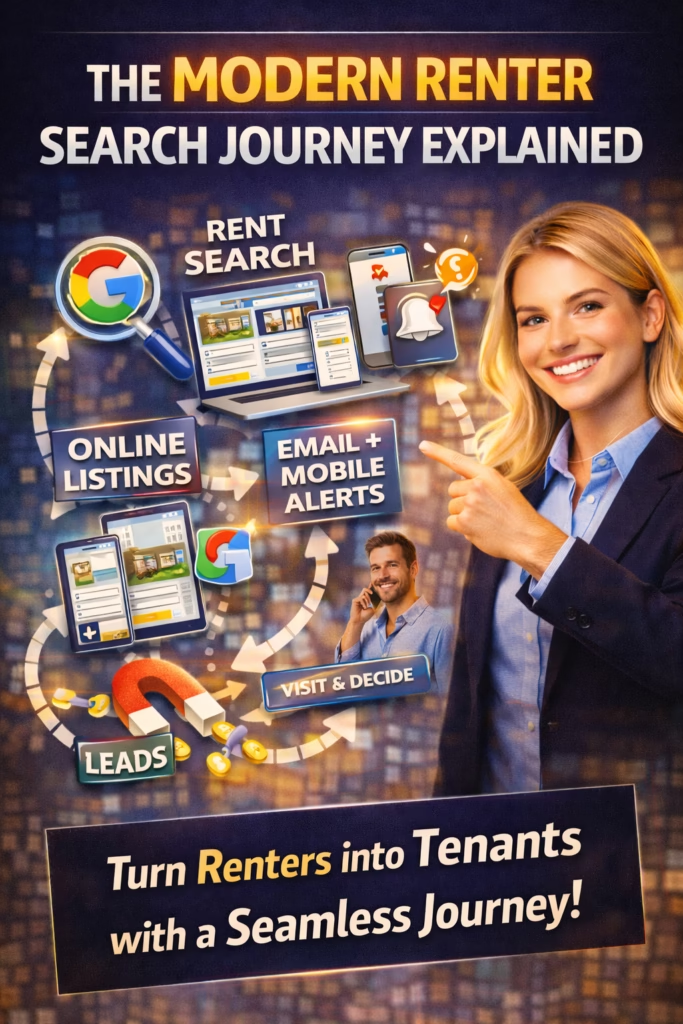
The Modern Renter Search Journey Explained

ChatGPT Image Feb 11 2026 02 08 25 PM
The Modern Renter Search Journey Explained

The Modern Renter Search Journey Explained

The Modern Renter Search Journey Explained maps how renters actually discover, compare, message, tour, and apply—so property managers can optimize visibility, speed-to-lead, and conversion without relying on ad spend.

Renter Journey Conversion System: Discovery Click Inquiry Showing Application Lease

Note: This is general marketing guidance. Keep listings accurate, follow platform rules, and remain fair-housing compliant in wording and screening.

Introduction

The Modern Renter Search Journey Explained begins with one truth: renters don’t search like they used to. They don’t pick one website, carefully browse for days, and then contact a single property.

They move fast. They search across multiple apps. They compare in minutes. They message multiple listings at once. And they choose the landlord or manager who responds first and makes the next step easiest.

Big idea: You don’t win rentals by “having a listing.” You win by owning the journey—visibility + speed + frictionless next steps.

Expanded Table of Contents

1) The renter journey map (the 6 stages)

The Modern Renter Search Journey Explained can be simplified into six stages. If you optimize each stage, vacancy drops and lead quality rises.

StageRenter goalYour job
1) DiscoveryFind options fastBe everywhere with accurate listings
2) ClickPick the best-looking optionEarn the click with photos + clarity
3) InquiryConfirm availability & detailsRespond instantly + qualify quickly
4) ShowingSee it ASAPOffer simple time windows + directions
5) ApplicationApply without confusionRemove friction and set expectations
6) Lease decisionChoose the “safe” optionBuild trust, follow-up, close

Reality: Renters don’t “fall in love” with your listing. They choose the option that feels available, easy, and trustworthy.

2) Discovery: how renters actually find listings

Renters discover rentals through a mix of high-intent and high-velocity channels:

High-intent channels

  • Rental portals (search filters, saved searches)
  • Google searches (“2 bedroom near me”)
  • Local property management websites

High-velocity channels

  • Facebook Marketplace (fast, local)
  • Neighborhood groups
  • Shares and reposts from friends

Why this matters: Your competition isn’t “other managers.” It’s the renter’s attention span. Discovery is fragmented—so distribution wins.

3) Click psychology: what makes renters choose one listing

Renters click based on speed and certainty. They scan, not read—especially on mobile.

The 7 click triggers

  1. Best hero photo: bright, wide, livable
  2. Price clarity: rent visible, not hidden
  3. Availability: “available now” / specific date
  4. Location confidence: neighborhood or cross streets
  5. Key amenity: parking, laundry, pet-friendly
  6. Trust signals: consistent photos, no “scam vibes”
  7. Next step simplicity: “message to schedule showing”

Rule: Make the listing “obviously real” in the first 3 seconds.

4) Inquiry behavior: why renters message multiple properties

Renters message multiple listings because they’re optimizing for:

  • Availability: is it still open?
  • Speed: who can show it first?
  • Fit: requirements, pets, move-in date
  • Risk reduction: avoiding scams and time-wasters

Implication: Your “competition” is often whoever replies first—not whoever has the best property.

5) Speed-to-lead: the hidden conversion lever

The Modern Renter Search Journey Explained always circles back to speed. Inquiries decay fast because renters keep searching until they book a showing.

Response timeTypical resultWhy
< 1 minuteHighest showing rateYou catch them while they’re active
1–5 minutesStrongStill early in their decision cycle
15–60 minutesWeakThey schedule elsewhere
Next dayMostly deadTheir shortlist is already set

Speed wins twice: it increases showings, and it reduces the number of “tire kickers” you deal with.

6) Showings: what renters need to schedule fast

Renters book showings when the next step is simple. The biggest showing killers are: confusion, slow replies, and unclear requirements.

What renters want before they commit to a showing

  • Two or three time windows they can choose from
  • Address or clear location info (at least neighborhood/cross streets)
  • Confirmation of fit (pets, occupancy, move-in date)
  • What to bring (ID, proof of income, etc.)

Best practice: Offer 2 windows (Option A / Option B). People decide faster when choices are limited.

7) Applications: where good leads die (and how to fix it)

Application friction is a silent vacancy tax. Many renters will apply if the process feels fair, clear, and fast.

Top reasons renters don’t apply

  • Unclear requirements (income, credit, occupancy)
  • Surprise fees after the showing
  • Confusing instructions or too many steps
  • No follow-up reminder after the tour

Fix: Provide a short “application checklist” message immediately after the showing and follow up the same day.

8) Trust signals: what reduces skepticism immediately

Renters have scam radar. You need credibility signals in your listing and messages.

Trust signals that work

  • Consistent photo set (not random low-quality images)
  • Clear rent + deposit + availability
  • Normal, professional tone (no “send deposit now” vibes)
  • Simple verification options (call, official application link, office address)
  • Fast responses that answer questions directly

Rule: Trust isn’t a slogan. It’s clarity + consistency + speed.

9) Listing + message templates (copy/paste)

Listing template (short + high converting)

✅ [Beds/Baths] in [Neighborhood]
✅ Rent: $____ • Deposit: $____
✅ Available: [Date]

Highlights:
• [Amenity 1]
• [Amenity 2]
• [Amenity 3]

To schedule a showing:
Message your move-in date + # of occupants + any pets.

Instant reply template

Yes — it’s available ✅
To confirm fit, what’s your move-in date and how many occupants?

Any pets? I’ll send the next showing times.

Showing scheduling template (2 options)

I can schedule you ✅
Option A: [Day/time window]
Option B: [Day/time window]

Which one works? (Move-in date + any pets?)

Post-showing application follow-up

Thanks for touring ✅
If you’d like to apply, here’s what we need:
• ID
• Proof of income
• Basic application

Want me to send the application link now?

10) How automation supports each stage

The Modern Renter Search Journey Explained becomes easier when automation handles the “always on” parts.

StageAutomation helpOutcome
DiscoveryMulti-channel posting + refresh schedulesMore consistent visibility
ClickPhoto/title rotation and A/B testingHigher click-through
InquiryInstant replies + qualification questionsMore showings scheduled
ShowingTime windows + remindersFewer no-shows
ApplicationApplication checklist + follow-upsMore completed apps
LeaseStatus tracking + escalation rulesFaster closes

Outcome: Automation doesn’t just “get leads.” It keeps the renter moving forward.

11) KPIs that predict faster fills

KPIWhat it measuresWhy it matters
Median response timeSpeed-to-leadStrongest predictor of showings
Inquiry → showing rateConversion efficiencyShows if scripts work
Showing → application rateFit + follow-up qualityIdentifies friction points
Days vacantOperational performanceBottom-line metric
Channel shareWhere leads come fromTells you where to scale

Quick win: If you only improve one KPI, improve response time.

12) 30–60–90 day rollout plan

Days 1–30 (Map your journey + fix speed)

  1. Standardize listing template (rent, deposit, availability, requirements)
  2. Build photo sets with strong hero photos
  3. Implement instant reply + qualification script
  4. Offer two showing windows in every conversation
  5. Track response time and showing scheduled rate weekly

Days 31–60 (Increase visibility + reduce friction)

  1. Add multi-channel distribution and refresh cycles
  2. Rotate titles weekly (amenity, neighborhood, availability)
  3. Create application checklist and post-showing follow-up
  4. Measure inquiry → showing conversion by channel

Days 61–90 (Scale across portfolio)

  1. Standardize templates for every unit type
  2. Build a pipeline: New → Qualified → Showing → Applied → Approved
  3. Automate reminders and follow-up sequences
  4. Optimize based on KPIs and vacancy days per unit

13) 25 Frequently Asked Questions

1) What is the modern renter search journey?

It’s the path from discovery to click, inquiry, showing, application, and lease—often across multiple platforms and within a short timeframe.

2) How do renters find rentals today?

They use a mix of portals, Google, social platforms, Marketplace, and local groups.

3) Why do renters message multiple properties?

To compare availability, schedule speed, requirements, and trust quickly.

4) What makes renters click one listing over another?

Better hero photo, price clarity, availability, location confidence, and key amenities.

5) What is speed-to-lead?

How quickly you respond to an inquiry. It’s often the biggest conversion lever.

6) What response time should property managers aim for?

Under 5 minutes is strong; under 1 minute is best.

7) Do renters read full descriptions?

Often no—they scan. Put critical info in the first lines.

8) What info should always be included?

Rent, deposit, availability date, neighborhood/location, and key requirements.

9) What’s the best first reply to a renter inquiry?

Confirm availability, ask move-in date, occupancy, pets, then offer showing times.

10) How do I reduce time-wasting inquiries?

Use qualification questions and list requirements clearly.

11) What causes renters to stop responding?

Slow replies, unclear next steps, or they booked a showing elsewhere.

12) How do I increase showing bookings?

Offer two time windows and confirm fit quickly.

13) What’s the best way to handle “Is this available?”

Say yes, ask move-in date/occupants/pets, then propose showing times.

14) Why do renters hesitate to apply?

Unclear requirements, hidden fees, or confusing instructions.

15) How do I improve application completion?

Send an application checklist immediately after the showing and follow up the same day.

16) What’s the #1 trust signal for renters?

Clarity and professionalism—accurate details, consistent photos, and fast responses.

17) How do I avoid scam perceptions?

Use professional language, avoid pressure tactics, and provide verification options.

18) Can automation help reduce vacancy?

Yes—by improving speed-to-lead, follow-up, and consistent visibility.

19) Does posting on more platforms help?

Usually yes, as long as you can keep listings accurate and consistent.

20) What KPIs should I track?

Response time, inquiry-to-showing rate, showing-to-application rate, and days vacant.

21) What’s the biggest marketing mistake landlords make?

Letting listings go stale and responding slowly.

22) What’s the best listing structure for mobile?

Short first lines with rent/availability, bullet highlights, then next steps.

23) Should I include pet policy?

Yes—pet policy is a major filter and reduces wasted conversations.

24) How many follow-ups should I send?

Three touches is a strong baseline: within an hour, same day, next day.

25) What’s the fastest improvement I can make today?

Implement instant replies with qualification questions and offer showing windows immediately.

14) 25 Extra Keywords

  1. The Modern Renter Search Journey Explained
  2. modern renter behavior
  3. renter search funnel
  4. how renters find apartments
  5. how renters choose rentals
  6. rental marketing funnel
  7. property manager lead generation
  8. rental inquiry conversion
  9. speed to lead rentals
  10. rental showing scheduling
  11. reduce vacancy with automation
  12. Facebook Marketplace rental leads
  13. rental portals vs Marketplace
  14. renter click psychology
  15. best rental listing template
  16. rental description copywriting
  17. renter qualification script
  18. rental lead follow up sequence
  19. application completion rate
  20. rental marketing KPIs
  21. how to get more renter inquiries
  22. how to increase rental showings
  23. rental listing trust signals
  24. 30 60 90 day rental marketing plan
  25. rental lead automation system

© 2026 Your Brand. All Rights Reserved.
General information only—confirm compliance with platform policies, fair-housing requirements, and applicable privacy rules before messaging prospects.

The Modern Renter Search Journey Explained Read More »

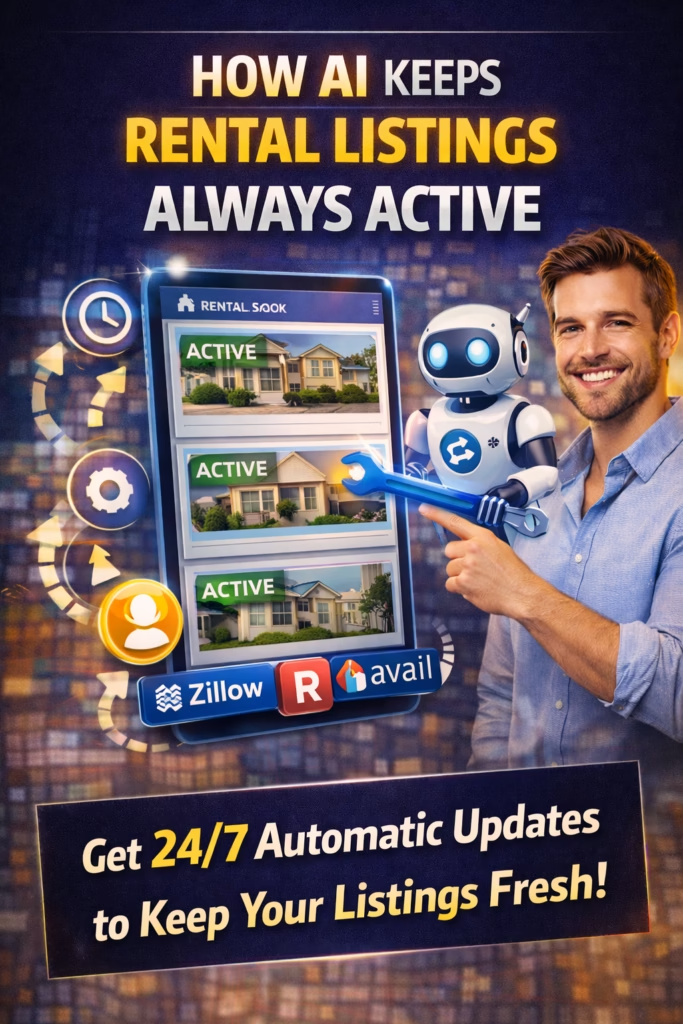
How AI Keeps Rental Listings Always Active

ChatGPT Image Feb 11 2026 02 08 23 PM
How AI Keeps Rental Listings Always Active

How AI Keeps Rental Listings Always Active

How AI Keeps Rental Listings Always Active is a repeatable system to keep units visible, generate more renter inquiries, and reduce vacancy—using listing refresh, multi-channel distribution, and fast follow-up.

Always-Active Rental System: Listing Refresh Multi-Channel Photo Rotation Instant Replies Follow-Up Tracking

Note: This is general marketing guidance. Follow each platform’s rules and avoid spammy duplicate posting. Keep details accurate and fair-housing compliant.

Introduction

How AI Keeps Rental Listings Always Active comes down to one reality: listings go stale fast. A rental post that looked “fresh” on Monday can be buried by Thursday—especially in competitive markets where dozens of new listings appear daily.

Most vacancy pain isn’t caused by lack of demand. It’s caused by lost visibility and slow response. Renters message multiple properties at once. Whoever responds first—and makes the next step easiest—wins.

Big idea: AI doesn’t replace good rentals. It removes the two biggest sources of vacancy: stale listings and slow follow-up.

Expanded Table of Contents

1) Why rental listings go stale (and what “always active” means)

How AI Keeps Rental Listings Always Active starts with understanding why listings die:

  • Freshness bias: many platforms surface newer listings more often
  • Competitive density: new listings push older ones down fast
  • Click decay: renters scroll past posts they’ve already seen
  • Slow response: leads expire within minutes to hours

Always active doesn’t mean “spam repost the same thing.” It means consistent visibility through smart refresh cycles, variation, and fast response that keeps inquiries flowing until the unit is filled.

2) What AI actually does in rental marketing (no hype)

AI supports an always-active rental system by automating the repeatable parts:

1) Refresh + rotation

Schedules listing updates, rotates titles, and swaps photo order to prevent staleness.

2) Multi-channel posting

Formats and publishes listings across multiple platforms consistently.

3) Instant responses

Replies in seconds, collects basic renter info, and moves them to the next step.

4) Follow-up automation

Re-engages renters who ghost and recovers leads that would otherwise be lost.

5) Lead tagging

Labels inquiries by unit, move-in date, and qualification status.

Key point: AI keeps your listings active by keeping your workflow active—especially when your team is busy.

3) Multi-channel distribution: where “always active” really happens

One platform going quiet shouldn’t pause your lead flow. The strongest rental systems distribute across multiple channels:

ChannelBest forHow AI helps
Facebook MarketplaceLocal, fast inquiriesListing velocity + formatting + quick replies
Facebook groupsNeighborhood-specific demandPost scheduling + variations
Google Business Profile (if applicable)High-intent local searchFast responses, posts, Q&A, tracking
Rental portalsSerious rentersConsistency, accuracy, faster follow-up
SMS/email follow-upClosing + schedulingFollow-up sequences and reminders

System rule: Your unit stays “active” until it’s rented—not until one listing gets old.

4) Listing refresh strategy: timing, variation, and safety

How AI Keeps Rental Listings Always Active depends on refresh cycles that maintain visibility without duplicating content.

Refresh levers (use responsibly)

  • Photo order rotation: swap hero photo and rotate gallery order
  • Title variation: same unit, different angle (price, bed/bath, neighborhood, availability)
  • Description variation: reorder sections; add/remove one proof detail
  • Offer emphasis: “available now,” “showings today,” “move-in special” (only if true)

Simple refresh cadence

Daily: refresh/rotate 1–3 elements for active units
Weekly: swap hero photo + rewrite title
Bi-weekly: refresh the description template
Always: update availability, price, and showing times accurately

Important: Avoid copy-paste duplicate posting patterns. Keep each refresh meaningfully different and accurate.

5) Photo rotation system that increases clicks

Renters click when photos answer questions quickly: layout, condition, light, and livability.

The 10-photo rental set

  1. Best “wide” hero shot (living room or exterior)
  2. Kitchen (wide)
  3. Main bedroom
  4. Bathroom
  5. Second bedroom/office (if applicable)
  6. Living room alternate angle
  7. Closet/storage
  8. Laundry (or hookups)
  9. Parking/entry
  10. Neighborhood amenity (pool, gym, nearby landmark)

Rotation tip: Create 3 hero-photo options. Rotate weekly. It changes click behavior without changing the unit.

6) Search-first titles that renters actually click

Titles should match renter search behavior: bedrooms, price, neighborhood, and availability.

Title formula

[Beds/Baths] + [Neighborhood/Area] + [Price/Hook] + [Availability]
Examples:
• 2BR/1BA Near Downtown – $1,450 – Available Now
• 3BR House w/ Garage – Pet Friendly – Showings This Week
• 1BR Apartment – Walkable Area – Move-In Ready

Click hooks to rotate (only if true)

Available now Showings today Pet friendly Washer/dryer Parking included Near transit Updated kitchen Move-in special

Avoid: ALL CAPS, keyword stuffing, or vague titles like “Nice apartment.” Be specific.

7) Description templates (copy/paste)

Template A: Clean + fast qualification

✅ [Beds/Baths] • [Neighborhood/Area]
✅ Rent: $____ • Deposit: $____
✅ Available: [Date] • Lease: [12 mo / flexible]

Highlights:
• [Top 3 features: parking, laundry, updated kitchen, etc.]
• [Pet policy]
• [Utilities policy]

Next step:
Message your move-in date + # of occupants + your city/zip.
I’ll send showing options.

Template B: “Showings + urgency” version

Now scheduling showings ✅
[Address area / cross streets / neighborhood]

Rent: $____ • Available: [Date]
Features: [3–6 bullets]

To book a showing:
Send move-in date + # of occupants + any pets.
I’ll confirm the next available times.

Template C: “Amenities + lifestyle” version

Live near [landmark/area] ✅
[Beds/Baths] • $____/mo • Available [Date]

You’ll love:
• [Amenity 1]
• [Amenity 2]
• [Amenity 3]

Message your move-in timeline and I’ll send details + showing times.

8) Speed-to-lead: why response time beats paid ads

Renter leads expire quickly. If you respond in an hour, you’re competing with whoever responded in two minutes.

Speed-to-lead targets

Response timeOutcome
< 1 minuteBest chance to schedule a showing
< 5 minutesStill strong
30–60 minutesLead often chooses another option
Next dayMostly dead leads

AI advantage: Instant reply + qualification can protect leads even when your team is unavailable.

9) Qualification scripts that filter renters fast

Always-active listings generate volume. Qualification protects your time and improves scheduling efficiency.

Instant reply (universal)

Yes — it’s available ✅
To confirm fit, what’s your move-in date and how many occupants?

Any pets? I’ll send the next showing times.

“Price only” inquiry

Yep ✅ Rent is $____.
To schedule a showing, what’s your move-in date and how many occupants?

I’ll confirm the next available times.

Pre-qual checklist

[ ] Move-in date
[ ] # of occupants
[ ] Pets (Y/N)
[ ] Preferred showing time
[ ] Contact method (text/email)

10) Follow-up SOP to recover ghost inquiries

Even interested renters ghost. Follow-up recovers leads and fills units faster.

3-touch follow-up sequence

TimingMessageGoal
30–60 minConfirm interest + next stepSchedule
Same dayOffer 2 showing windowsCreate decision
Next dayAlternate option / waitlistSave lead

Follow-up #1

Quick check-in ✅
Did you want to schedule a showing?

What day/time works best and what’s your move-in date?

Follow-up #2

I have two showing windows ✅
Option A: [Day/time]
Option B: [Day/time]

Which one works for you? (Move-in date?)

Follow-up #3

Still looking? ✅
If this unit isn’t a fit, tell me your budget + beds/baths and I’ll send another option.

11) Tracking + KPIs that predict faster fills

You can’t improve what you don’t measure. Always-active systems track inputs and outcomes.

KPIWhat it meansTarget
Listing freshnessHow often listings are refreshedWeekly updates minimum
Inquiries per listingDemand + click qualityUp over time
Median response timeConversion leverage< 5 minutes
Showing scheduled rateInquiry → appointmentImprove with scripts
Days vacantOperational bottom lineDown month over month

Pro move: Tag inquiries by platform (Marketplace, portal, groups). Double down on the channel that schedules the most showings.

12) 30–60–90 day rollout plan

Days 1–30 (Stabilize visibility + speed)

  1. Create 3 title variations + 3 description variations per unit
  2. Build a 10-photo set per unit + 3 hero options
  3. Implement instant reply + qualification script
  4. Set a refresh cadence (weekly minimum)
  5. Track response time and showing scheduled rate

Days 31–60 (Increase inquiries + conversions)

  1. Expand distribution to multiple channels
  2. Rotate hero photos weekly and rewrite titles
  3. Add 3-touch follow-up SOP
  4. Test hooks (pet-friendly, parking, laundry, availability)

Days 61–90 (Scale “always active” across portfolio)

  1. Standardize listing templates and refresh workflows
  2. Build a lead pipeline (New → Qualified → Showing → Applied → Approved)
  3. Track vacancy days per unit and improve weak channels
  4. Automate reporting: inquiries, response time, showings, approvals

13) 25 Frequently Asked Questions

1) What does it mean to keep rental listings always active?

It means maintaining consistent visibility through refresh cycles, variation, and fast response—so inquiries keep coming until the unit is filled.

2) Can AI keep rental listings active automatically?

Yes, by scheduling refresh actions, rotating titles/photos, responding instantly, and following up consistently.

3) Will reposting the same listing get me flagged?

It can. Avoid duplicates and use meaningful variation while following platform rules.

4) What’s the safest way to refresh listings?

Rotate hero photos, update titles, reorder description sections, and keep details accurate.

5) How often should I refresh a rental listing?

Weekly is a good baseline, with smaller daily tweaks when competition is high.

6) Which platform produces the fastest renter inquiries?

Marketplace can be very fast locally, while portals can deliver more “ready” renters.

7) Why do my rental listings stop getting messages?

Listings go stale, competition increases, and renters stop clicking familiar posts.

8) What matters more: price or photos?

Both, but photos often determine clicks and initial trust.

9) What’s the best hero photo?

A bright, wide shot that instantly shows livability (living room or exterior).

10) How many photos should I use?

8–15 is common. A consistent 10-photo set works well.

11) Does response time really matter for rentals?

Yes. Renters contact multiple properties; fast response often wins.

12) What’s a good response time target?

Under 5 minutes is strong; under 1 minute is best.

13) What should my first reply say?

Confirm availability, ask move-in date, number of occupants, and pets—then offer showing times.

14) How do I reduce unqualified inquiries?

Use qualification questions and clear listing details (rent, deposit, lease terms).

15) Should I include deposit and fees in the listing?

Usually yes—clarity reduces wasted conversations.

16) Can automation help schedule showings?

Yes, by offering pre-set time windows and collecting required info quickly.

17) How do I recover ghosted leads?

Use a 3-touch follow-up sequence with option-based scheduling.

18) How many follow-ups should I send?

Three is a strong baseline: 30–60 minutes, same day, next day.

19) What KPIs should property managers track?

Inquiries per listing, response time, showing scheduled rate, and days vacant.

20) Does AI replace leasing staff?

No—AI handles first contact and organization. Staff still handle showings, approvals, and relationships.

21) What’s the biggest mistake landlords make with rental marketing?

Letting listings go stale and responding slowly.

22) What’s the biggest mistake with automation?

Creating repetitive duplicate posts instead of varied, accurate refresh cycles.

23) How do I keep my listings compliant?

Follow platform rules, avoid duplicate spam patterns, keep facts accurate, and stay fair-housing compliant.

24) Can “always active” reduce vacancy?

Yes—consistent visibility and fast response typically reduce days vacant.

25) What’s the fastest improvement I can make today?

Turn on instant replies with qualification questions and rotate your hero photo and title.

14) 25 Extra Keywords

  1. How AI Keeps Rental Listings Always Active
  2. rental listing automation
  3. keep rental listings fresh
  4. rental marketing automation
  5. property management lead generation
  6. reduce rental vacancy
  7. automated listing refresh
  8. Facebook Marketplace rental listings
  9. Marketplace rental lead system
  10. rental inquiry automation
  11. instant reply for rental leads
  12. speed to lead rentals
  13. rental listing title formula
  14. rental description template
  15. renter qualification script
  16. rental lead follow up sequence
  17. how to schedule showings faster
  18. multi channel rental distribution
  19. photo rotation for rental listings
  20. how to get more renter inquiries
  21. rental listing visibility strategy
  22. property manager automation system
  23. AI leasing assistant
  24. rental marketing KPIs
  25. 30 60 90 day rental marketing plan

© 2026 Your Brand. All Rights Reserved.
General information only—confirm compliance with platform policies, fair-housing requirements, and applicable privacy rules before messaging prospects.

How AI Keeps Rental Listings Always Active Read More »

The Rise of Marketplace-Driven Local Marketing

ChatGPT Image Feb 10 2026 01 56 05 PM
The Rise of Marketplace-Driven Local Marketing

The Rise of Marketplace-Driven Local Marketing

The Rise of Marketplace-Driven Local Marketing is changing how local businesses grow: instead of buying attention, they earn it by showing up consistently where customers already shop—then converting with proof, clear offers, and speed.

Marketplace-First Growth System: Listings Proof Photos Offer Cadence Speed-to-Lead Follow-Up

Note: This is general marketing guidance. Keep your activity compliant with platform rules and avoid spammy duplication.

Introduction

The Rise of Marketplace-Driven Local Marketing is happening for the same reason Marketplace itself exploded: people don’t want to browse endless ads. They want to search for what they need, see real photos, message a real person, and solve the problem quickly.

For local businesses, that behavior is pure leverage. Marketplace shoppers are often urgent and intent-driven—moving this week, furnishing a home, replacing a broken appliance, booking a service, or hunting for a deal that still feels trustworthy.

But this strategy only works when you treat Marketplace like a real marketing channel—not an occasional posting app. The businesses winning right now operate Marketplace like a system: consistent listing cadence, clean proof photos, clear offers, fast replies, and follow-up.

Big idea: Marketplace-driven marketing turns your listings into a 24/7 local demand capture engine—without paying per click.

Expanded Table of Contents

1) What Marketplace-driven local marketing means in 2025–2026

The Rise of Marketplace-Driven Local Marketing refers to a shift in how local businesses acquire customers. Instead of relying primarily on paid ads, businesses increasingly build a “Marketplace-first” presence that captures demand organically through consistent listings and fast conversion workflows.

Marketplace-driven marketing in one sentence

You consistently publish compliant listings that match buyer searches, prove legitimacy with real photos, and convert leads fast through messaging scripts and follow-up.

What this strategy is not

  • Not spam-posting the same listing repeatedly
  • Not relying on stock photos and vague pricing
  • Not posting randomly “when you remember”
  • Not hoping one listing goes viral

Reality: The winners are not “luckier.” They are more consistent and more operational.

2) Why Marketplace is becoming the new local “search engine”

Marketplace platforms increasingly function like local search: users type what they want, filter by distance, and message immediately. This is similar to Google “near me” behavior—but the communication happens inside the platform.

Why customers like Marketplace

  • Speed: message a seller instantly
  • Local proximity: see what’s available nearby
  • Proof: real photos and social profiles reduce fear
  • Deals: pricing feels competitive and transparent
  • Control: buyers feel like they’re “shopping,” not being sold

Strategic advantage: Marketplace traffic is often bottom-of-funnel. People aren’t discovering a brand—they’re solving a problem.

3) Intent economics: why Marketplace traffic converts fast

The Rise of Marketplace-Driven Local Marketing is powered by urgency. Marketplace shoppers usually want the outcome soon: pickup today, delivery this week, service booked now.

How intent shows up in messages

MessageWhat it really meansBest response move
“Is this available?”I’m interested but unsureConfirm + ask pickup/delivery + location
“What’s your lowest?”I’m price-shoppingOffer options + clarify priorities
“Can you deliver?”I will buy if it’s easyAsk zip + confirm schedule + upsell bundle
“Where are you located?”I’m ready to actSend address area + time windows

Conversion lever: Speed-to-lead + clear next steps can double conversion without changing traffic.

4) The Marketplace Growth System: the 6 levers that control outcomes

If you want predictable results, treat Marketplace like a system with controllable levers. These six levers determine lead flow and sales velocity:

1) Listing volume

More quality listings = more surfaces to appear in search.

2) Proof photos

Real photos + context reduce skepticism and increase replies.

3) Offer clarity

Clear price, terms, and availability trigger messages.

4) Cadence

Consistent posting keeps you fresh and visible without spamming.

5) Speed-to-lead

Fast responses beat better offers in many markets.

6) Follow-up

Simple follow-ups recover leads that would otherwise disappear.

Rule: If leads are low, improve listings + cadence. If leads exist but sales are low, improve speed + follow-up.

5) Listings that rank: Marketplace SEO fundamentals

Marketplace search is simpler than people think: match what users type. The strongest listings include the core keyword plus a differentiator and locality.

Title formula

[Main keyword] + [Specific item/service] + [Hook] + [Condition] + [City/Area]
Examples:
• Couch – Sectional – Like New – Delivery Available – Rochester
• Interior Painting – Fast Quote – Licensed – Fort Worth
• King Mattress – Cooling – New – Pickup Today – Local

Keyword rotation ideas (avoid stuffing)

delivery available pickup today same day new like new bundle local near me financing limited stock

Avoid: ALL CAPS, keyword dumps, or repetitive titles that look automated.

6) Proof photos: how to look legitimate instantly

Marketplace is full of scams and low-trust listings. Proof photos are your edge. Your goal is to look “obviously real” within the first two images.

The 8-photo proof framework (works across niches)

  1. Hero shot (clean, bright, straight)
  2. Full product/service context
  3. Close-up detail (quality/texture)
  4. Brand tag/label or proof of item legitimacy
  5. Alternate angle showing dimensions/thickness
  6. Bundle/accessories if included
  7. Proof shot (store corner, van, sign, tools—subtle)
  8. Offer card image (simple text: price, delivery, pickup)

Fast win: Create one consistent photo corner with bright lighting and a clean background. Repeat forever.

7) Offer + pricing strategy that triggers messages

Most Marketplace listings fail because the offer is unclear. You don’t need the lowest price—you need the easiest decision.

Offer clarity checklist

  • Price: one clear number (or a truthful range)
  • Availability: pickup today / delivery this week
  • Proof: real photos, condition stated clearly
  • Next step: “Message your city/zip” or “Reply YES”

Copy/paste offer block

✅ [Item/Service] — [Condition]
✅ Price: $___
✅ Pickup: Available today
✅ Delivery: Available (send your zip/city)

Reply “YES” + your city for the fastest options.

Pro move: Put “Pickup today / Delivery available” in the first 2 lines. It removes friction instantly.

8) Cadence without spam: daily rhythm that stays compliant

The goal is consistency without duplication. Marketplace rewards freshness, but platforms punish spam-like behavior. Rotate listings with real differences.

Recommended cadence (safe and effective)

  • Daily: 3–10 listings posted or refreshed (varied)
  • Weekly: refresh top performers (new first photo + slight title change)
  • Monthly: retire stale listings and publish new angles/offers

Variation rules to reduce flags

  • Rotate different products/services, not clones
  • Swap the first photo often
  • Use different hooks (delivery, bundle, clearance, timing)
  • Keep claims and pricing honest and consistent

Avoid: identical duplicate listings at the same time with identical photos and titles.

9) Messaging scripts: convert “Is this available?” into bookings

Marketplace rewards speed. Your first response should confirm, ask one question, and provide the next step.

Instant reply (universal)

Yes — it’s available ✅
Are you looking for pickup today or delivery this week?

What city/zip are you in? I’ll confirm the fastest options.

Handle “lowest price?” without losing the lead

I can help ✅
Is your priority the lowest price, or the best value/quality?

Tell me what you’re looking for + your city and I’ll send the best options today.

Rule: End every message with a simple question (city/zip + timing).

10) Follow-up SOP: recovering ghost leads

Ghosting is normal. Most businesses lose money because they don’t follow up. Keep follow-up short, helpful, and option-based.

3-touch follow-up sequence

TimingMessageGoal
20–40 minQuick check-in + next stepRe-engage
Same dayConfirm availability + timing optionsCreate action
Next dayAlternate optionSave the lead

Follow-up #1

Quick check-in ✅
Did you still want this?

Tell me your city and I’ll confirm pickup/delivery options.

Follow-up #2

Heads up ✅ We’ve had a couple people ask about it today.
If you want it, I can confirm the fastest pickup/delivery window.

What city are you in?

Follow-up #3 (alternate)

Still shopping? ✅
If this isn’t perfect, tell me what you need + your budget and I’ll send a better match.

11) The Local Signal Layer: how Marketplace supports Maps + SEO

The Rise of Marketplace-Driven Local Marketing doesn’t replace Google—it reinforces it. Marketplace creates local activity, branded searches, and proof signals that often spill into Maps and web conversions.

How Marketplace can support local visibility

  • More branded search: people see you on Marketplace then Google you
  • More calls: increased demand leads to more reviews and activity
  • More proof content: photos and videos can be repurposed for GBP
  • More velocity: consistent demand improves operational consistency

Pro move: Repurpose proof photos and short clips to your Google Business Profile every week. It signals freshness and legitimacy.

12) KPIs + tracking: what to measure weekly

You can’t scale what you don’t measure. Track Marketplace like an operator—weekly numbers that predict sales.

KPIWhat it meansTarget
Active listingsVisibility surface area30–120+ (market dependent)
Messages per weekLead volume25+ for strong flow
Median response timeConversion leverage< 5 minutes (good), < 1 minute (best)
Qualified rateHow many provide city + timingImprove with scripts
Booked rateAppointments/pickups scheduledImproves with options + follow-up

Truth: Many businesses don’t need more traffic. They need faster replies and better proof.

13) 30–60–90 day rollout plan

Days 1–30 (Start daily messages)

  1. Create your proof photo system and staging corner
  2. Build 30–50 unique listings across categories/offers
  3. Implement instant reply scripts + follow-up SOP
  4. Post/refresh daily with variety (3–10)
  5. Track response time and messages weekly

Days 31–60 (Convert more of the same leads)

  1. Identify top winners and replicate variations
  2. Improve titles with clearer keyword intent
  3. Test offers: delivery, bundles, clearance angles
  4. Standardize pipeline stages for staff
  5. Repurpose photos/clips to Google Business Profile weekly

Days 61–90 (Scale into a predictable engine)

  1. Expand to 60–120+ listings (market dependent)
  2. Double down on top categories and hooks
  3. Systemize follow-up + booking scripts
  4. Measure attributed sales and refine offers
  5. Build a repeatable weekly operating cadence

90-day goal: A system that generates consistent leads without paying per click.

14) 25 Frequently Asked Questions

1) What is Marketplace-driven local marketing?

It’s a strategy where local businesses generate leads by consistently publishing compliant Marketplace listings that match buyer searches, use proof photos, and convert with fast messaging and follow-up.

2) Why is Marketplace-driven marketing rising now?

Because shoppers increasingly prefer search-and-message buying behavior, and many local businesses want growth without paying for every click.

3) Is Marketplace traffic really “free”?

You don’t pay per click, but it requires consistent effort: listings, photos, and follow-up. Over time it becomes a compounding system.

4) What kinds of businesses benefit most?

Businesses with urgent local demand: furniture/mattresses, home services, appliances, vehicles, rentals, and local retail offers.

5) How many listings should I have active?

Many businesses start with 30–50 and scale to 60–120+ depending on market size and inventory.

6) How often should I post or refresh?

Daily or several times per week, with variety. Refresh winners weekly with a new first photo and minor title edits.

7) How do I avoid getting flagged?

Avoid spam patterns: don’t post identical duplicates, rotate photos/titles, keep inventory accurate, and stay compliant with platform rules.

8) Do stock photos work?

Real photos convert best. Proof photos reduce skepticism and increase replies.

9) What’s the most important conversion lever?

Response speed. Fast replies can double conversions without changing traffic volume.

10) What should my title include?

Main keyword + specific item/service + hook + condition + city/area.

11) What makes a listing “rank” better?

Keyword match, freshness, engagement, clarity, and credible photos that earn messages and saves.

12) Should I include delivery?

If you offer it, yes. It reduces friction and increases message rate.

13) What offer triggers the most messages?

Clear pricing plus “pickup today” or “delivery available,” and bundles that feel like a complete solution.

14) What do I say to “Is this available?”

Confirm availability, ask pickup vs delivery, and ask for city/zip to provide options.

15) How do I handle “lowest price?”

Ask whether they want lowest price or best value, then offer options that match their budget.

16) How do I reduce ghosting?

Use a short 3-touch follow-up sequence and always provide the next step.

17) Is Marketplace a replacement for Google?

No, but it can become a major lead source and reinforce your Google presence through branded search and activity.

18) How does Marketplace support Google Maps?

It can increase brand awareness, calls, and review velocity—signals that often improve local conversion and visibility.

19) What’s the best way to track performance?

Track active listings, messages per week, response time, booked rate, and sales attributed to Marketplace.

20) Should I use automation?

Automation can help with consistency, but it must be compliant and still feel human in photos, titles, and responses.

21) What’s the biggest mistake businesses make?

Posting inconsistently, using weak photos, and responding slowly.

22) What’s the fastest improvement I can make today?

Install instant replies and make every message end with a simple question (city/zip + pickup/delivery).

23) Do I need a website for this to work?

No, but a website can increase trust and improve conversion when people Google you after seeing listings.

24) What’s a compliant way to scale?

Scale with variety: unique listings, rotated photos, accurate details, and consistent quality—avoid spam patterns.

25) What’s the core reason this strategy works?

Marketplace captures high-intent local demand, and speed-to-lead converts that demand into booked outcomes.

15) 25 Extra Keywords

  1. The Rise of Marketplace-Driven Local Marketing
  2. marketplace-driven local marketing strategy
  3. Facebook Marketplace local business marketing
  4. Marketplace lead generation for local businesses
  5. organic Marketplace traffic system
  6. Marketplace SEO title strategy
  7. Marketplace posting cadence best practices
  8. Marketplace proof photo framework
  9. how to get more Marketplace messages
  10. Marketplace conversion messaging scripts
  11. speed to lead Marketplace strategy
  12. Marketplace follow up SOP
  13. how to avoid Marketplace listing flags
  14. compliance friendly Marketplace scaling
  15. Marketplace listings for local growth
  16. Marketplace-first marketing system
  17. local marketing without paid ads
  18. free traffic local lead generation
  19. Marketplace visibility for small business
  20. Marketplace offer and pricing strategy
  21. local signals Marketplace and Google Maps
  22. repurpose Marketplace content to GBP
  23. tracking Marketplace leads weekly
  24. 30 60 90 day Marketplace rollout plan
  25. predictable Marketplace lead engine

© 2026 Your Brand. All Rights Reserved.
General information only—confirm compliance with platform policies and applicable privacy rules before sending marketing messages.

The Rise of Marketplace-Driven Local Marketing Read More »

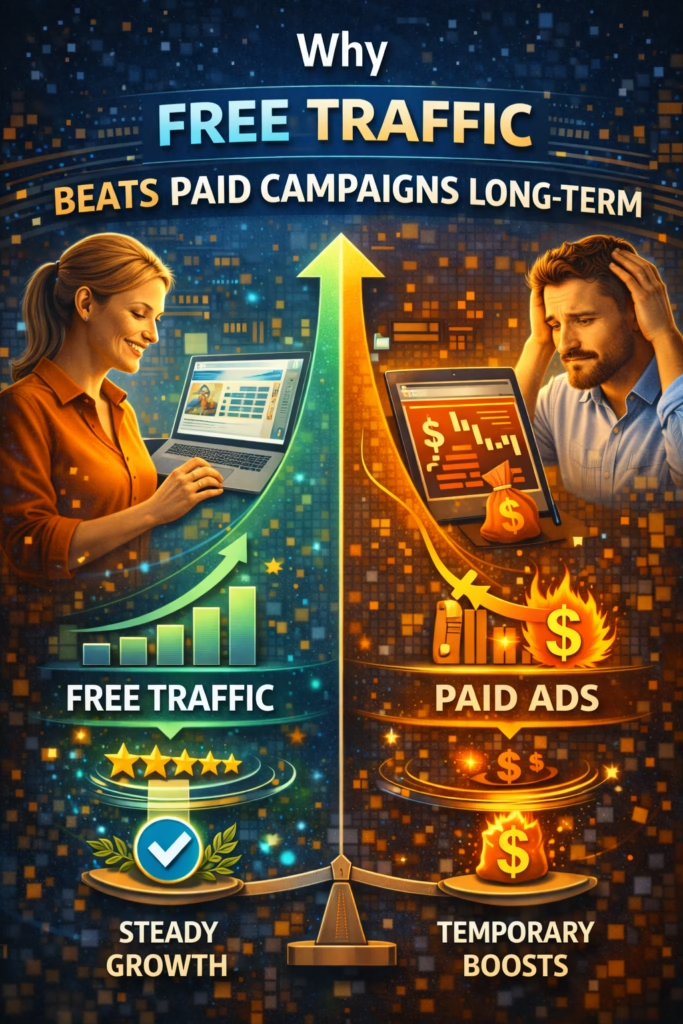
Why Free Traffic Beats Paid Campaigns Long-Term

ChatGPT Image Feb 10 2026 01 56 12 PM
Why Free Traffic Beats Paid Campaigns Long-Term

Why Free Traffic Beats Paid Campaigns Long-Term

Why Free Traffic Beats Paid Campaigns Long-Term comes down to one reality: paid campaigns rent attention, while organic systems build an asset that keeps producing leads even when spend pauses.

Compounding Organic Demand Stack: SEO Google Maps Content Marketplace Reviews Retention

Note: This is general marketing guidance. Always comply with platform rules, ad policies, and privacy laws when messaging leads.

Introduction

Why Free Traffic Beats Paid Campaigns Long-Term is not a slogan—it’s unit economics. Paid campaigns can be great for speed, but they come with a hard truth: when the budget stops, the traffic stops. Organic traffic doesn’t work that way.

Free traffic systems (SEO, Google Business Profile visibility, content, Marketplace visibility where appropriate, and retention) behave like an asset. Each week of effort can stack on the last week, raising baseline demand and lowering your dependence on ads.

Big idea: Paid traffic is a lever. Free traffic is a foundation. The long game is building a foundation strong enough that you can choose when to use the lever.

Expanded Table of Contents

1) Renting vs owning attention: the core difference

To understand Why Free Traffic Beats Paid Campaigns Long-Term, start with a simple metaphor: paid traffic is renting a billboard. Organic traffic is buying the property where the billboard lives.

Paid campaigns (rent)

  • Immediate visibility
  • Predictable spend → clicks
  • Stops instantly when spend stops
  • Performance fluctuates with auctions

Free traffic systems (own)

  • Slower ramp
  • Visibility improves with consistency
  • Leads continue after work is done
  • Trust and authority compound over time

Operator takeaway: You don’t “choose” organic instead of paid. You build organic so paid becomes optional and strategic—not required for survival.

2) The compounding effect: why organic grows while ads reset

Paid campaigns have a reset button. Organic does not. Every ranking page, every review, every helpful post, every saved Marketplace listing, and every branded search adds a little more baseline demand.

What “compounding” looks like in real life

AssetWhat you do onceWhat it can produce repeatedly
SEO pageWrite a focused page targeting a keywordMonthly clicks and leads for months/years
Google Business ProfileOptimize categories, photos, services, Q&ACalls and direction requests daily
ReviewsSystemize requests post-saleHigher conversion rate + Maps visibility lift
Short-form contentPublish weekly videos answering real questionsDiscovery traffic + branded searches
Marketplace listingsConsistent compliant posting + fast repliesHigh-intent messages without boosting

Reality: Paid traffic can scale fast. But it does not compound unless you turn it into assets (emails, reviews, content, brand searches, retargeting audiences).

3) Trust economics: why “free” clicks convert differently

Organic clicks often convert better because the buyer feels like they “found you,” not like you chased them. When someone discovers you through Maps, an SEO article, a helpful video, or a Marketplace search, they usually have higher intent and less skepticism.

Trust signals that organic traffic naturally carries

  • Context: the person searched for a problem you solve
  • Proof: reviews, photos, and consistency reinforce legitimacy
  • Relevance: content answers the exact question they have
  • Proximity: local visibility builds “they’re near me” confidence

Simple truth: Organic works best when your content mirrors buyer intent—what they’re searching, not what you wish they searched.

4) CAC and margin: why paid often gets more expensive over time

Most businesses don’t quit paid ads because they hate ads. They quit because unit economics collapse: cost-per-lead rises, lead quality drops, and margin gets squeezed—especially in competitive markets.

Why paid can degrade over time

  • Auction pressure: more advertisers enter and bid up costs
  • Creative fatigue: performance decays unless you constantly refresh
  • Targeting shrink: platform privacy changes can reduce precision
  • Low-intent exposure: interruption-based traffic needs more nurturing

Paid is a treadmill: it can drive growth, but you must keep running to stay in place. Organic is a flywheel: it turns easier as it gains momentum.

5) The Free Traffic Stack: channels that build durable demand

If you want the full picture of Why Free Traffic Beats Paid Campaigns Long-Term, think in layers. One channel is good. A stack is unstoppable.

1) SEO pages

Service pages, city pages, comparison pages, and “how-to” posts that match search intent.

2) Google Business Profile

Maps visibility, photos, services, posts, and consistent NAP citations.

3) Reviews engine

Systematic requests, fast responses, and review velocity.

4) Short-form content

Reels/Shorts/TikTok that answer buyer questions and create branded search.

5) Marketplace intent capture

Listings that show up when people search on-platform—without boosting.

6) Retention/referrals

Email/SMS follow-up, reactivation, and referral offers that recycle customers.

Rule: Build at least 3 organic layers. Any single layer can wobble. A stack keeps producing even when one channel dips.

6) Content that ranks and sells: the operating model

Content fails when it’s written for algorithms instead of humans. The easiest way to win is to publish what customers actually ask—then structure it so it ranks.

High-performing content formats

  • Buyer guides: “Best option for X budget / X problem”
  • Comparisons: “Option A vs Option B”
  • Local pages: “Service in [City]” with real proof and photos
  • FAQ hubs: “Everything you need to know before buying”
  • Process pages: “What to expect / timeline / pricing range”

The content cadence that compounds

Weekly:
• 1 long-form SEO article OR 1 major service/city page improvement
• 2–5 short-form videos clipped from the article (15–30 seconds)
• 5–15 Google Business Profile photos/posts (real activity)
• Review requests after every completed sale/service

Most important: Consistency beats intensity. Ten weeks of “good” beats one week of “perfect.”

7) Local dominance: Maps + reviews + proximity signals

For local businesses, “free traffic” is often Maps traffic. People searching “near me” are not browsing—they’re ready.

Local signals that drive Maps visibility

Primary category Service keywords Review velocity Photo freshness Q&A completeness Citations/NAP Click-to-call rate Driving directions On-site relevance

Local flywheel: More visibility → more calls → more customers → more reviews → more visibility.

8) Marketplace visibility as organic intent capture

Another reason Why Free Traffic Beats Paid Campaigns Long-Term is that platforms like Marketplace (when used compliantly) let you intercept demand where people are already shopping.

Marketplace “free traffic” rules that keep it clean

  • Rotate unique listings (don’t spam duplicates)
  • Use real photos and proof of legitimacy
  • Keep offers honest and inventory accurate
  • Respond fast (speed-to-lead is your multiplier)
  • Refresh winners with new first photo + minor title edits

Compliance note: Avoid misleading claims, prohibited items, or repetitive posting behavior that violates platform rules.

9) Offers that pull leads without “boosting” everything

Organic traffic converts when the offer is clear. Many businesses lose the organic game because their offer requires too much thinking.

Offer clarity checklist

ElementWhat “clear” looks likeWhy it matters
PriceVisible starting price or rangeReduces friction
Next stepCall/text/book/messageIncreases conversion
TimeframeSame-day / this week availabilityCreates urgency
ProofReviews/photos/resultsBuilds trust fast
Risk reversalWarranty / guarantees where appropriateReduces hesitation

Pro move: Build one “hero offer” you repeat everywhere—website, Maps, content, Marketplace, and follow-ups. Repetition builds recognition.

10) How to measure organic like an operator

Free traffic isn’t “free” if you don’t measure it. The goal is to see your baseline demand rise month after month.

Weekly scorecard

[ ] Organic website clicks (SEO pages)
[ ] Google Business Profile calls + direction requests
[ ] New reviews (count + rating)
[ ] Marketplace messages (if relevant)
[ ] Lead-to-booked rate
[ ] Response time (median)

North Star metric: Baseline leads when ad spend is $0. That number should grow every month.

11) The hybrid plan: when paid makes sense inside an organic engine

Paid campaigns are most powerful when they are not your only source of oxygen. Use paid to amplify what already works organically.

Smart uses of paid

  • Testing: validate new offers fast
  • Retargeting: warm audiences from organic traffic
  • Launch boosts: accelerate initial traction for proven assets
  • Seasonal spikes: when demand is naturally higher

Bad use of paid: spending to cover weak fundamentals (slow replies, unclear offers, no proof, no reviews).

12) 30–60–90 day rollout plan

Days 1–30 (Build the foundation)

  1. Fix your offer clarity (price, proof, next step)
  2. Optimize Google Business Profile (services, photos, Q&A, posts)
  3. Create 4–8 high-intent SEO pages (service + city + buyer guide)
  4. Set a weekly content cadence (2–5 short videos)
  5. Install tracking and a weekly scorecard

Days 31–60 (Create compounding assets)

  1. Publish 4 more long-form pages and refresh top performers
  2. Systemize review requests (every sale/service)
  3. Improve photos and proof across web + Maps + listings
  4. Build a simple follow-up and reactivation sequence

Days 61–90 (Scale baseline demand)

  1. Double down on the top 20% of topics/offers producing leads
  2. Expand into adjacent keywords and nearby cities
  3. Increase content output without sacrificing quality
  4. Use paid only to amplify proven winners (retargeting + testing)

90-day goal: A measurable baseline lead flow that continues even if you pause ads.

13) 25 Frequently Asked Questions

1) Why free traffic beats paid campaigns long-term?

Because organic traffic compounds into assets (rankings, reviews, brand demand) while paid campaigns stop producing the moment you stop spending.

2) Is paid traffic a waste of money?

No. Paid traffic is useful for speed, testing, and retargeting. It becomes risky when it’s your only source of leads.

3) What counts as “free traffic”?

Organic website traffic from SEO, Google Maps/Business Profile visibility, referrals, social discovery, Marketplace visibility (where appropriate), and repeat customers.

4) Does free traffic really work for local businesses?

Yes—especially through Google Maps, reviews, and local SEO pages targeting “near me” intent.

5) How long does SEO take to work?

Many sites see early traction in 30–90 days, with stronger compounding gains over 3–12 months depending on competition and consistency.

6) Why do paid campaigns get more expensive over time?

More competition enters auctions, creatives fatigue, and targeting changes can reduce efficiency—raising CPA and squeezing margins.

7) What’s the biggest advantage of organic traffic?

Durability. A ranking or Maps position can generate leads repeatedly without additional spend per click.

8) Can organic traffic outperform paid traffic in volume?

Yes, in many markets. It’s common for strong Maps + SEO to become a primary lead driver once the system is built.

9) What’s the best “free traffic” channel for local intent?

Google Business Profile/Maps, supported by reviews, photos, and a relevant website.

10) What role do reviews play in free traffic?

They improve trust and can influence visibility and conversion across Maps, website, and listings.

11) How do I start building free traffic with limited time?

Start with Google Business Profile optimization, review requests, and one high-intent service/city page.

12) Is social media “free traffic”?

It can be—especially short-form discovery content—but it’s strongest when it drives branded searches and repeat exposure.

13) What is the “Free Traffic Stack”?

A layered strategy combining SEO, Maps, reviews, content, listings/marketplaces, and retention so no single channel controls your pipeline.

14) Why does organic traffic convert better sometimes?

Because it’s intent-driven—people searched for the problem and found you, which feels more trustworthy than interruption ads.

15) What kind of content ranks best?

Pages that directly answer buyer questions: guides, comparisons, local pages, pricing/process explainers, and FAQs.

16) Do I need to blog to get free traffic?

No, but publishing helpful pages consistently accelerates rankings and expands your keyword footprint.

17) Can Marketplace generate “free traffic”?

In many niches, yes—if you post consistently, use real proof photos, rotate listings, and respond quickly while staying compliant.

18) What’s the fastest organic lever?

Often Google Business Profile improvements + photo freshness + review velocity.

19) What’s the most overlooked organic lever?

Response speed and follow-up systems. Many leads are lost due to slow replies, not lack of traffic.

20) Should I ever stop running paid campaigns?

Not necessarily. The goal is to build organic so paid becomes optional and strategic rather than required.

21) What’s the best way to use paid in a long-term plan?

Retarget warm audiences, test new offers, and amplify proven organic winners.

22) How do I know organic is working?

Your baseline leads should rise month over month even when ad spend is reduced.

23) What KPIs matter most for organic?

Maps calls/directions, organic clicks, review velocity, lead-to-booked rate, and median response time.

24) What’s the risk of relying only on paid?

Dependency. If costs rise or accounts get restricted, your lead flow can collapse overnight.

25) What’s the simplest long-term marketing principle?

Build assets that produce demand repeatedly, then use paid to accelerate—not to survive.

14) 25 Extra Keywords

  1. Why Free Traffic Beats Paid Campaigns Long-Term
  2. free traffic vs paid traffic
  3. organic traffic strategy 2025 2026
  4. SEO vs paid ads long term
  5. compounding content marketing
  6. local SEO traffic system
  7. Google Maps SEO strategy
  8. Google Business Profile optimization
  9. how to get free leads online
  10. reduce dependence on ads
  11. marketing flywheel vs treadmill
  12. lower CAC with organic traffic
  13. build an organic lead engine
  14. content cadence for organic growth
  15. how to rank locally on Google
  16. review engine for local businesses
  17. organic lead generation for small business
  18. long term marketing strategy for local business
  19. free traffic sources for local businesses
  20. Marketplace organic lead strategy
  21. Maps calls and directions tracking
  22. organic traffic measurement KPIs
  23. retargeting warm organic audiences
  24. 30 60 90 day organic marketing plan
  25. how to build brand demand without ads

© 2026 Your Brand. All Rights Reserved.
General information only—confirm compliance with platform policies and applicable privacy rules before sending marketing messages.

Why Free Traffic Beats Paid Campaigns Long-Term Read More »

Organic Lead Systems for Small Businesses

ChatGPT Image Feb 10 2026 01 55 42 PM
Organic Lead Systems for Small Businesses

Organic Lead Systems for Small Businesses

Organic Lead Systems for Small Businesses is a repeatable way to generate inbound calls and messages—without depending on paid ads—using visibility, trust, listing velocity, and fast follow-up.

Organic Lead Engine: Marketplace Google Maps Content Follow-Up Speed-to-Lead Tracking

Note: This is general marketing guidance. Keep platform activity compliant and avoid spammy duplication.

Introduction

Organic Lead Systems for Small Businesses are the fastest way to build predictable demand without living on a treadmill of paid ads. Ads can work—but the moment you stop paying, the faucet turns off.

Organic lead systems are different. They turn platforms you already have into an inbound engine that compounds: your Google presence strengthens, your listings keep generating messages, and your follow-up system converts leads while you’re busy (or sleeping).

Big idea: Paid ads rent attention. Organic systems own attention.

Expanded Table of Contents

1) What “organic lead systems” actually mean

Organic Lead Systems for Small Businesses are repeatable processes that generate inbound leads from existing demand—without paying for each click.

That includes:

  • Search demand: Google Maps and local search (“near me” traffic)
  • Marketplace demand: Facebook Marketplace browsing + search
  • Social demand: short-form video and community distribution
  • Referral demand: reviews, shares, and word-of-mouth loops

System definition: A lead system is only real when it works even on a busy week—because it’s process-driven, not personality-driven.

2) The 4 pillars: visibility, trust, speed, follow-up

Almost every organic lead engine is built on four controllable levers:

1) Visibility

Prospects can find you easily in the places they already search: Maps, Marketplace, community feeds.

2) Trust

They believe you’re real: proof photos, reviews, clear info, and consistency.

3) Speed-to-lead

Fast replies win. Most buyers contact multiple businesses at once.

4) Follow-up

Most revenue lives in follow-up. Ghosting isn’t rejection—it’s competition.

Reality check: If you have visibility but no speed, you leak money. If you have speed but no trust, you attract low-quality leads.

3) Demand capture vs demand creation (know the difference)

Small businesses waste time when they confuse these two categories:

TypeWhat it meansExamples
Demand capturePeople already want it and are looking nowGoogle Maps, Marketplace search, “near me” keywords
Demand creationYou introduce a problem/solution and build awarenessContent strategy, education posts, community presence

Shortcut: Start with demand capture first (fast wins). Then use content to compound trust and raise lead quality.

4) Facebook Marketplace: the underpriced visibility channel

Marketplace is not just for used items. It’s an attention marketplace where local buyers browse with intent—and where consistent listing velocity can create daily inbound messages.

Why Marketplace works for small businesses

  • It’s local by default
  • It rewards freshness (consistent activity wins)
  • It favors clear keywords + credible photos
  • It converts fast when you respond quickly

Marketplace listing velocity (simple framework)

Goal: 15–60+ active listings (depending on niche + market)
Cadence: post/refresh 3–8 listings per day OR 4–7 days/week
Rule: rotate photos + titles + offers (avoid identical duplication)

Compliance note: Scale with variety, accuracy, and real proof—don’t copy/paste identical posts everywhere.

5) Google Business Profile + Maps: compounding local demand

Google Maps is the highest-intent lead source for most local businesses because people search when they’re ready to buy.

The local Maps compounding loop

  1. Optimize your Google Business Profile (services, categories, photos, hours)
  2. Collect consistent reviews (with real keywords naturally)
  3. Post updates and photos weekly
  4. Answer Q&A and messages fast
  5. Track calls, direction requests, and keyword growth

Maps advantage: Every improvement compounds, because Google rewards consistency and relevance over time.

6) Content flywheel: short-form that feeds search and trust

Content is how you make organic leads higher quality. People don’t just want a provider—they want proof.

3 content types that drive inbound leads

1) Proof content

Before/after, walkthroughs, results, delivered projects, real customers.

2) Decision content

“How to choose,” “what it costs,” “what to avoid,” “what to expect.”

3) Local content

City-specific posts, neighborhood cues, local FAQs, availability updates.

Flywheel: One short-form video can become: Marketplace listing proof, Google post, IG reel, TikTok, and a blog section.

7) Offers that convert (without sounding salesy)

Your offer is the “why message now.” Great organic systems make the next step obvious.

Offer clarity checklist

  • What is it? (service/product)
  • Who is it for? (buyer type)
  • What happens next? (estimate, showing, delivery, consultation)
  • How fast can it happen? (availability)
  • What proof exists? (photos, reviews, credentials)

High-converting hooks (rotate)

Available this week Same-day options Free estimate Fast turnaround Local delivery Clear pricing Limited slots

Rule: Only claim what you can deliver. Organic systems rely on trust.

8) Automation that increases leads without increasing spam

Automation works when it reduces delay, not when it creates duplication.

Best places to automate

  • Instant first reply: qualify leads immediately
  • Follow-up sequence: recover ghost leads
  • Routing: send leads to the right person/team
  • Tracking: tags for city, offer, platform, outcome

Simple rule: Automate response and follow-up first. Then automate posting only if you can maintain variation and accuracy.

9) First-response scripts and qualification flows

Organic lead systems win because they respond faster than competitors—and they ask one easy question that moves the lead forward.

Universal instant reply

Yes — I can help ✅
What city/zip are you in, and are you trying to do this this week or later?

I’ll confirm the fastest options.

Price question (without losing the lead)

Totally ✅ Pricing depends on a couple details.
What city are you in, and what’s the rough timeframe (ASAP / this week / later)?

I’ll send the best option first.

Qualification checklist

[ ] City/zip
[ ] Timeline
[ ] Budget range (optional)
[ ] Key requirement (size, scope, bedrooms, etc.)
[ ] Next step (estimate, showing, pickup, delivery)

10) Follow-up SOP that recovers ghost leads

Most leads don’t say “no.” They get distracted or they go with whoever made it easiest. Follow-up is where organic systems become predictable.

3-touch follow-up sequence

TimingMessageGoal
20–40 minQuick check-in + questionRe-engage
Same dayAvailability + optionsCreate action
Next dayAlternate optionSave lead

Follow-up #1

Quick check-in ✅
Do you still want to move forward?

What city/zip are you in? I’ll confirm the fastest option.

Follow-up #2

Heads up ✅ I have a couple openings.
If you want it, I can lock in the next slot.

What city are you in?

Follow-up #3 (alternate)

Still shopping? ✅
If this isn’t the perfect fit, tell me your city + budget and I’ll send a better option.

11) KPIs that predict 50–200+ leads/month

KPIWhat it meansTarget
Visibility outputs# of listings/posts/photos per weekConsistent, sustainable rhythm
Messages/weekInbound lead volumeUp month over month
Median response timeConversion leverage< 5 min (good), < 1 min (best)
Booked rateAppointments/showings/quotes setImprove with scripts
Close rateSales from bookedTrack weekly

Truth: Most businesses don’t need more traffic. They need less leakage.

12) 30–60–90 day rollout plan

Days 1–30 (Build the foundation)

  1. Set up your offer clarity (what, who, next step, availability)
  2. Build 15–40 Marketplace listings (varied titles and proof photos)
  3. Optimize Google Business Profile basics + photos
  4. Install instant reply + qualification question
  5. Track response time and messages weekly

Days 31–60 (Increase conversion)

  1. Identify top-performing listings/offers and replicate variants
  2. Add the 3-touch follow-up SOP
  3. Publish weekly proof content (short-form)
  4. Collect reviews consistently

Days 61–90 (Scale predictably)

  1. Increase listing velocity while maintaining variation
  2. Expand to nearby cities/areas (if relevant)
  3. Systemize lead routing + tracking
  4. Measure booked rate and optimize offers weekly

13) 25 Frequently Asked Questions

1) What are Organic Lead Systems for Small Businesses?

They’re repeatable processes that generate inbound leads using platforms like Marketplace, Google Maps, and content—without paying for each click.

2) Do organic lead systems work in every niche?

Most local niches can generate organic leads, but the best channels vary by buyer intent and search behavior.

3) Which channel produces the fastest organic leads?

Marketplace often produces faster leads, while Google Maps compounds strongly over time.

4) How fast can I get leads without ads?

You can often get leads within days using Marketplace + fast replies; Maps and content typically compound over 30–90 days.

5) Do I need a website?

No, but a website can increase trust and conversion—especially for higher-ticket services.

6) What matters most for organic conversion?

Trust, clarity, speed-to-lead, and follow-up.

7) How important is response time?

Extremely. Fast replies can double conversions without changing traffic.

8) What’s a good response time target?

Under 5 minutes is good; under 1 minute is best.

9) Why do leads ghost?

They contact multiple businesses and choose the one that responds fastest and makes the next step easiest.

10) What is a follow-up SOP?

A structured sequence of messages that recovers leads who didn’t respond the first time.

11) How many follow-ups should I send?

Three is a strong baseline: 20–40 minutes, same day, next day.

12) What should my first reply say?

Confirm you can help, ask city/zip, and ask timeframe.

13) Do reviews matter for organic leads?

Yes—especially on Google. Reviews boost trust and local ranking signals.

14) How do I get more reviews?

Ask consistently after successful outcomes and make it easy (one link, simple ask).

15) What content works best?

Proof content, decision content, and local content.

16) Do I need to post daily content?

No. Consistency matters more than volume. Start with weekly.

17) What is listing velocity?

A consistent rhythm of new and refreshed listings that keeps you visible.

18) How do I avoid spammy duplication on Marketplace?

Rotate photos, titles, offers, and timing. Keep listings accurate and varied.

19) Can automation help organic lead systems?

Yes—especially for instant replies, routing, follow-up, and tracking.

20) Does automation increase risk on platforms?

It can if it causes repetitive posting patterns. Use automation for speed and consistency, not duplication.

21) What KPIs should I track?

Messages/week, response time, booked rate, close rate, and output consistency.

22) What’s the biggest mistake with organic lead generation?

Inconsistent activity and slow response time.

23) How do I improve lead quality organically?

Increase proof, improve offer clarity, and use content that pre-qualifies prospects.

24) Is paid advertising still useful?

Yes, but it works best when layered on top of a strong organic foundation.

25) What’s the fastest improvement I can make today?

Implement instant replies + a follow-up sequence, and improve your first photo/title clarity.

14) 25 Extra Keywords

  1. Organic Lead Systems for Small Businesses
  2. organic lead generation system
  3. small business marketing without ads
  4. how to get leads organically
  5. inbound lead generation for local businesses
  6. Facebook Marketplace lead generation
  7. Marketplace listing velocity strategy
  8. Facebook Marketplace SEO strategy
  9. Google Business Profile lead system
  10. Google Maps SEO for small business
  11. local SEO lead generation
  12. how to rank in Google Maps
  13. organic customer acquisition
  14. automation for lead follow-up
  15. speed to lead system
  16. follow-up SOP for leads
  17. lead conversion scripts
  18. how to reduce lead ghosting
  19. local business lead funnel
  20. inbound marketing system for small business
  21. how to get more calls without ads
  22. how to get more messages without ads
  23. content flywheel for local business
  24. organic lead tracking KPIs
  25. 30 60 90 day lead generation plan

© 2026 Your Brand. All Rights Reserved.
General information only—confirm compliance with platform policies and applicable privacy rules before sending marketing messages.

Organic Lead Systems for Small Businesses Read More »

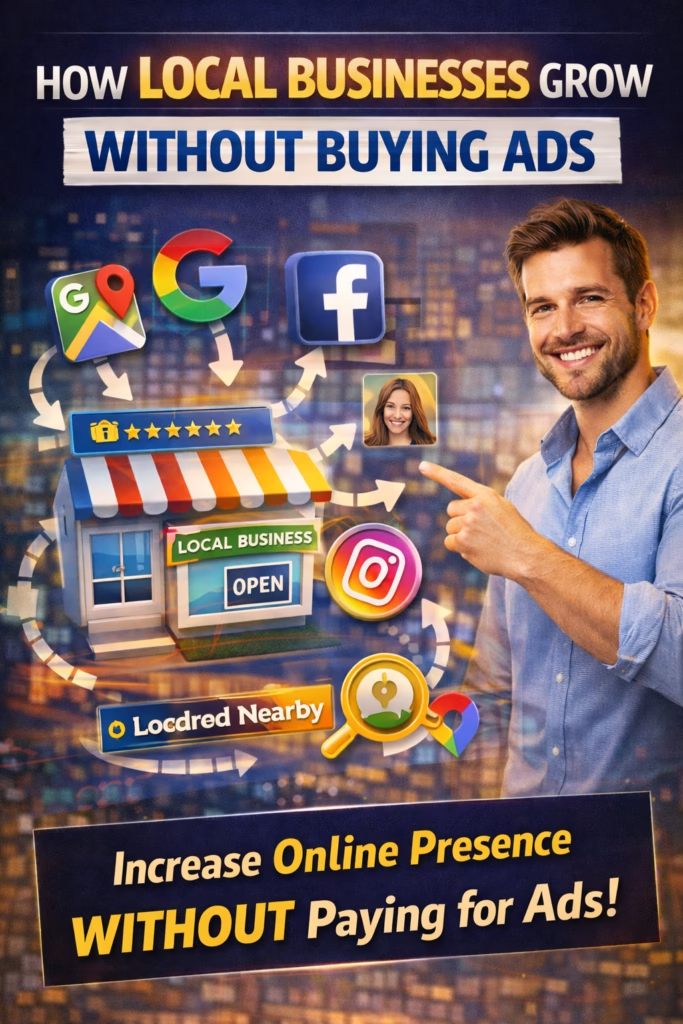
How Local Businesses Grow Without Buying Ads

ChatGPT Image Feb 10 2026 01 55 46 PM
How Local Businesses Grow Without Buying Ads

How Local Businesses Grow Without Buying Ads

How Local Businesses Grow Without Buying Ads is a repeatable visibility system: rank locally, show up everywhere buyers already are, respond fast, follow up automatically, and turn attention into booked jobs.

Organic Growth Engine: Google Maps Marketplace Content Loop Referrals Automation Follow-Up

Note: This is general marketing guidance. Confirm platform rules and avoid spammy duplication or misleading claims.

Introduction

How Local Businesses Grow Without Buying Ads is not about “hoping” people find you. It’s about building a system where your business appears in the places local buyers already look—then converting that attention with speed, trust, and consistent follow-up.

Paid ads can work. But many local businesses get stuck in a cycle: spend → leads → stop spending → leads disappear. Organic growth breaks that cycle by turning visibility into a compounding asset.

Big idea: Organic growth is a system, not a tactic.

Expanded Table of Contents

1) The “no-ads” growth model (visibility + conversion)

To grow without buying ads, you only need two things to improve every month:

1) Visibility (getting found)

You show up where local buyers search and browse: Maps, Marketplace, local groups, and “near me” queries.

2) Conversion (turning attention into bookings)

Fast replies, clear offers, proof, and follow-up turn the same traffic into more revenue.

Rule: If you’re not growing, you’re missing visibility, conversion, or both.

2) What buyers do before they call (and how you show up)

Most local buyers follow a simple path:

  1. Search on Google (“near me” / city + service)
  2. Scan Maps listings and reviews
  3. Browse social proof (photos, posts, before/after)
  4. Message 2–5 businesses
  5. Hire the one that responds fast and feels trustworthy

Pro move: The goal isn’t to “be everywhere.” It’s to be present in the 3–4 places buyers already check.

3) Google Maps: the highest-intent organic channel

For many local businesses, Google Maps is the most valuable organic channel because the buyer is already in “hire mode.” Your job is to be the obvious choice.

Maps visibility basics (the compounding layer)

  • Profile completeness: categories, services, hours, photos, description
  • Consistency: name/address/phone info matches everywhere
  • Review velocity: steady new reviews beat “one big push”
  • Proof: real job photos, team photos, and frequent updates
  • Response habits: reply to reviews and messages

Rule: Map growth compounds when you post weekly and collect reviews consistently.

4) Facebook Marketplace & local groups: organic demand capture

Marketplace and local groups work because buyers already browse there daily. You can capture demand without paying for reach—if you post consistently and respond fast.

What performs best organically

  • Clear offer headline (what it is + starting price/range)
  • Real photos (not stock-only)
  • Local location cues (city/area served)
  • Simple CTA question (“What city/zip are you in?”)

Title formula (works across niches)

[Service/Item] + [Primary benefit] + [Offer hook] + [City]
Examples:
• Interior Painting – Fast Quote – This Week – Keene
• Mattress Sale – Queen/King Deals – Delivery Available – Rochester
• Property Cleanup – Same Week Scheduling – Oswego

Avoid: copy/paste duplicate posts with identical photos and titles at the same time.

5) The content loop: turning one job into 30 posts

One of the best “no-ads” strategies is to create content from work you’re already doing.

One job → multiple assets

AssetWhat to captureWhere it goes
Before/After2–4 photos, same angleGoogle Maps, Facebook, Instagram
Short video10–20 seconds walkthroughReels/Shorts/TikTok
FAQ post“How long does it take?”Blog + social
Proof postReview screenshot + job photoAll channels

Rule: Consistency beats creativity. A weekly rhythm builds compounding visibility.

6) Referrals and reputation: the compounding trust engine

Referrals are “organic ads” you don’t pay for. The system is simple: do great work, ask at the right time, make it easy to refer, and follow up professionally.

Referral ask template

Quick favor — if you were happy with everything, could you leave a short review?
And if you know anyone else who needs [service], feel free to send them my way.
I’ll take great care of them.

Pro move: Create a “review + referral” message that goes out automatically after every completed job.

7) Speed-to-lead: the cheapest conversion lever

Most local businesses don’t lose leads because they lack traffic. They lose leads because they respond too slowly.

Why speed beats ads

  • Fast response increases booking rate without increasing traffic
  • Speed builds trust (“they’re professional and on it”)
  • Speed reduces lead leakage to competitors

Goal: Under 5 minutes is good. Under 1 minute is best.

8) Follow-up SOP: recovering leads competitors lose

Ghosting is normal. The businesses that win are the ones that follow up consistently and politely.

3-touch follow-up sequence

TimingMessageGoal
20–40 minutesQuick check-in + questionRe-engage
Same dayOffer next stepBook
Next dayProvide optionsSave the lead

Follow-up #1

Quick check-in ✅
Did you still want help with this?

What city/zip are you in and what timeframe are you trying to schedule?

Follow-up #2

Heads up ✅ I have a couple openings this week.
If you tell me your city/zip, I’ll confirm the fastest option.

Follow-up #3

Still shopping? ✅
If you tell me your budget range + city, I’ll send the best options and next steps.

9) Offers that convert without discounting

You don’t need to race to the bottom. Most buyers want clarity and confidence, not just a cheap price.

High-conversion offer elements

  • Clear starting point: “Starting at $___” or “Free estimate”
  • Specific availability: “This week” / “Next-day delivery”
  • Proof: photos, reviews, simple guarantees if applicable
  • Friction removal: easy scheduling, simple checkout, clear next step

Pro move: Turn your offer into a 3-line “scan block” in every post.

10) The simple operations stack to run it weekly

Organic growth fails when it’s “random.” You need a weekly routine.

Weekly checklist (simple)

[ ] 3–7 Marketplace posts (rotating offers/cities)
[ ] 1–3 Google Business Profile posts
[ ] 5–15 review requests sent
[ ] Follow-up SOP run daily
[ ] Track response time + booked appointments

Rule: The businesses that grow without ads treat visibility like a weekly appointment.

11) KPIs that prove you’re growing without ads

KPIWhat it meansTarget
Inbound leads/weekDemand captureUp month over month
Median response timeConversion leverage< 5 min
Booked rateLead quality + follow-upImprove with SOP
Review velocityTrust growthSteady weekly
Maps actionsHigh-intent visibilityUp over time

Important: Track weekly. Organic growth is a compounding curve, not a daily spike.

12) 30–60–90 day rollout plan

Days 1–30 (Build visibility foundation)

  1. Optimize Google Business Profile basics + photos
  2. Pick 3–7 core services/offers and 3–7 target areas
  3. Start a consistent Marketplace / group posting cadence
  4. Implement instant replies + speed-to-lead process
  5. Send review requests after every job

Days 31–60 (Increase conversion)

  1. Standardize your offer block (3 lines) in every post
  2. Run the 3-touch follow-up SOP on every lead
  3. Improve proof content (before/after, reviews)
  4. Track response time and booked rate weekly

Days 61–90 (Scale without spending)

  1. Double down on the best areas and best offers
  2. Add more listing/post volume (without duplication)
  3. Automate follow-ups and review requests
  4. Expand content loop output from each job

13) 25 Frequently Asked Questions

1) Can local businesses really grow without buying ads?

Yes. Many grow by improving organic visibility in Maps and social platforms, then converting leads with speed and follow-up.

2) What is the fastest no-ads growth lever?

Speed-to-lead and consistent follow-up.

3) Is Google Maps better than social?

Often for high-intent leads, yes. Social can amplify awareness and proof.

4) How long does organic growth take?

Typically weeks to months, with compounding results when consistent.

5) Do I need a website to grow organically?

Not always, but it can improve trust and conversion.

6) What should I post weekly if I’m busy?

Before/after proof, one helpful tip, and one clear offer post.

7) How many Marketplace posts should I do?

Start with 3–7 per week, then scale if replies are strong.

8) What’s the biggest mistake with organic growth?

Posting inconsistently and responding slowly.

9) How do reviews help growth without ads?

Reviews increase trust and improve Maps conversion.

10) How do I ask for reviews without being awkward?

Ask right after delivering value and make it easy with a simple message.

11) Does content have to be “viral”?

No. Consistent, local proof content beats viral attempts for most businesses.

12) What content converts best?

Before/after proof, testimonials, and clear availability offers.

13) How do I avoid spam flags?

Use unique posts, vary photos/titles, and avoid aggressive duplication.

14) Should I include pricing in posts?

Often yes—at least a starting range—to reduce friction.

15) What should my first reply to a lead say?

Confirm availability, ask city/zip, and ask timeframe.

16) How many follow-ups is too many?

Three touches is a clean standard for most local businesses.

17) Why do leads ghost?

They message multiple businesses and choose the fastest, clearest responder.

18) Can automation help without ads?

Yes—automation improves response time, follow-up, and review requests.

19) What’s the best weekly routine?

Post consistently, request reviews, respond fast, and track KPIs.

20) What should I track to prove progress?

Leads, response time, booked rate, review velocity, and Maps actions.

21) How do I pick the right offer?

Choose a clear, easy next step: “free estimate,” “available this week,” or “delivery available.”

22) Can referrals replace ads?

In many cases, yes—especially when you ask consistently.

23) How do I turn one job into more leads?

Capture proof content and request reviews right after completion.

24) Do I need multiple social platforms?

No. Pick 1–2 and be consistent, then expand later.

25) What’s the fastest improvement I can make today?

Set instant replies and run a simple follow-up sequence.

14) 25 Extra Keywords

  1. How Local Businesses Grow Without Buying Ads
  2. grow a local business without ads
  3. organic local lead generation
  4. local business marketing without paid ads
  5. how to get customers without advertising
  6. Google Maps SEO for local businesses
  7. Google Business Profile growth strategy
  8. organic marketing for small businesses
  9. Facebook Marketplace lead generation
  10. local visibility strategy
  11. speed to lead for local businesses
  12. follow-up SOP for leads
  13. how to increase booked appointments
  14. referral system for local businesses
  15. review request strategy
  16. reputation marketing without ads
  17. content loop for local businesses
  18. before and after marketing strategy
  19. local SEO vs paid ads
  20. organic sales pipeline for local services
  21. how to rank in Google Maps
  22. local business growth blueprint
  23. customer acquisition without ad spend
  24. automated follow-up for local leads
  25. organic lead system for small business

© 2026 Your Brand. All Rights Reserved.
General information only—confirm compliance with platform policies and applicable privacy rules before sending marketing messages.

How Local Businesses Grow Without Buying Ads Read More »

Marketplace Optimization for Local Search Dominance

ChatGPT Image Feb 9 2026 05 17 34 PM
Marketplace Optimization for Local Search Dominance

Marketplace Optimization for Local Search Dominance

Marketplace Optimization for Local Search Dominance explains how businesses win local demand by aligning listings with proximity, trust, and behavioral search signals.

Dominance Signals: Proximity • Relevance • Proof • Velocity • Consistency

Important: Optimization is about clarity and accuracy, not manipulation.

Introduction

Marketplace Optimization for Local Search Dominance is not about gaming algorithms. It’s about matching how real buyers search, decide, and act in local environments.

Modern buyers don’t start with Google. They start where inventory is visible, local, and immediately actionable.

Core idea: Marketplaces are the new local search engines.

Table of Contents

  • Why Marketplaces dominate local intent
  • How local Marketplace search actually works
  • Proximity as the primary ranking signal
  • Listing SEO fundamentals
  • Photos as trust accelerators
  • Behavioral signals that boost visibility
  • Response speed and conversion lift
  • Cadence and freshness
  • Common optimization mistakes
  • 25 FAQs
  • 25 Extra Keywords

Why Marketplaces Dominate Local Intent

Marketplaces compress the buyer journey.

  • No research phase
  • No comparison fatigue
  • Immediate contact

How Local Marketplace Search Actually Works

Marketplace algorithms prioritize:

  • Distance from the buyer
  • Keyword relevance
  • Engagement history
  • Seller responsiveness

Proximity as the Primary Ranking Signal

Local distance reduces risk perception.

  • Faster fulfillment
  • Easier resolution
  • Higher trust

Listing SEO Fundamentals

Optimized listings use natural, buyer-language keywords.

  • Product or service name
  • Condition or scope
  • Location reference

Photos as Trust Accelerators

Authenticity beats polish.

  • Real environment
  • Clear context
  • Consistent framing

Behavioral Signals That Boost Visibility

Marketplaces reward interaction.

  • Replies
  • Saves
  • Shares

Response Speed and Conversion Lift

Speed equals trust.

  • Fast replies increase ranking
  • Fast replies increase closes

Cadence and Freshness

Consistency keeps listings visible.

  • Regular updates
  • Rotated inventory
  • Fresh photos

Common Optimization Mistakes

  • Duplicate listings
  • Misleading descriptions
  • Slow response times
  • Ignoring proximity cues

25 Frequently Asked Questions

1. What is Marketplace Optimization for Local Search Dominance?

It’s the strategic alignment of listings with local buyer behavior and Marketplace ranking signals.

2–25.

FAQs cover proximity, trust signals, response time, SEO, photos, cadence, and scaling visibility.

25 Extra Keywords

  1. Marketplace Optimization for Local Search Dominance
  2. local marketplace SEO
  3. Marketplace local ranking
  4. Facebook Marketplace optimization
  5. local search dominance strategy
  6. Marketplace visibility tactics
  7. local buyer intent
  8. Marketplace proximity signals
  9. local listing optimization
  10. Marketplace trust signals
  11. local commerce optimization
  12. Marketplace search behavior
  13. local demand capture
  14. Marketplace ranking factors
  15. local marketplace marketing
  16. Marketplace conversion optimization
  17. buyer proximity psychology
  18. local visibility systems
  19. Marketplace SEO strategy
  20. local listing dominance
  21. Marketplace behavioral signals
  22. local digital marketplaces
  23. nearby buyer targeting
  24. Marketplace trust optimization
  25. local search replacement platforms

© 2026 Your Brand. All rights reserved.

Marketplace Optimization for Local Search Dominance Read More »

Why Consistent Posting Beats Boosted Listings

ChatGPT Image Feb 9 2026 05 17 37 PM
Why Consistent Posting Beats Boosted Listings

Why Consistent Posting Beats Boosted Listings

Why Consistent Posting Beats Boosted Listings comes down to simple economics: organic activity compounds favorably while paid promotion creates dependency. Algorithms reward consistency with higher organic reach, trust builds through visible presence, and sustainable businesses own their traffic rather than renting it.

Organic vs Paid Comparison: Algorithm Favor Cost Efficiency Compound Effects Trust Signals Sustainability Ownership

Note: This analysis focuses on marketplace platforms (Facebook Marketplace, Craigslist, OfferUp). Platform features and costs may change—verify current rates and policies.

Introduction

Why Consistent Posting Beats Boosted Listings is a question every business faces when deciding how to invest marketing resources. Should you pay to boost listings for instant visibility, or commit to consistent organic posting that builds over time? The data overwhelmingly favors organic consistency.

Boosted listings promise immediate reach: pay $5-20 per listing, get thousands of impressions, reach more buyers faster. It sounds compelling—until you run the numbers over 6-12 months and realize you're spending thousands for temporary visibility that vanishes the moment you stop paying. Meanwhile, consistent organic posters build algorithmic favor, accumulate trust signals, and create owned assets that generate leads indefinitely without ongoing costs.

This isn't about never using paid promotion—it's about understanding that consistent posting is the foundation, and boosting is the occasional accelerant. Businesses that reverse this equation (paying to boost everything while posting sporadically) waste money fighting platform algorithms instead of working with them.

The marketplace algorithms—Facebook Marketplace, Craigslist, OfferUp—all reward activity, recency, and engagement. Consistent posters get higher organic reach, better placement, and more favorable treatment than sporadic boosters. This algorithmic advantage compounds over time, creating a widening gap between organic-first and paid-dependent strategies.

Big idea: Paid promotion is renting attention. Consistent posting is building equity. Rent creates dependency. Equity creates freedom.

Expanded Table of Contents

1) The economics: organic vs boosted cost comparison

Boosted listing costs (Facebook Marketplace example)

Facebook Marketplace boosting costs vary by market, competition, and duration, but typical costs are:

  • $5-10 per listing for 7-day boost (low-cost items, small markets)
  • $10-20 per listing for 7-day boost (mid-ticket items, competitive markets)
  • $20-50 per listing for 7-day boost (high-value items, major metros)

Annual cost comparison: 50 active listings

StrategyWeekly CostMonthly CostAnnual Cost
Boost all listings ($10 avg)$500$2,000-2,500$24,000-30,000
Boost 50% of listings$250$1,000-1,250$12,000-15,000
Boost 20% of listings$100$400-500$4,800-6,000
Organic only (no boosting)$0$0$0

True cost of organic: time investment

Organic isn't "free"—it requires time. But time investment decreases with automation:

Manual organic posting (Month 1-2):
- Create/photograph listings: 2 hours/week
- Post to platform: 1 hour/week  
- Respond to messages: 3-5 hours/week
- Total: 6-8 hours/week

Automated organic posting (Month 3+):
- Batch content creation: 1 hour/week
- Automated cross-posting: 0 hours (automated)
- AI handles initial responses: 0 hours (automated)
- Agent handles qualified leads: 2-3 hours/week
- Total: 3-4 hours/week

Value of time saved: 3-4 hours/week × $50-100/hour = $150-400/week = $7,800-20,800/year

3-year total cost comparison

ApproachYear 1Year 2Year 33-Year Total
Boosted (all listings)$24,000$28,000 (inflation)$32,000 (inflation)$84,000
Organic + automation tools$3,600 (tools + setup)$1,800 (tools only)$1,800 (tools only)$7,200
Savings with organic$20,400$26,200$30,200$76,800

Cost per lead comparison

Scenario: 100 leads generated per month

Boosted approach:
- Ad spend: $2,000/month
- Cost per lead: $20
- Lead quality: Mixed (some low-intent clickers)
- Dependency: High (stop paying = leads stop)

Organic approach:
- Ad spend: $0/month
- Tool costs: $150/month (automation)
- Cost per lead: $1.50
- Lead quality: Higher (organic searchers/browsers)
- Dependency: Zero (owned visibility)

Difference: $18.50 saved per lead
Annual savings: 1,200 leads × $18.50 = $22,200

Rule: Boosting converts dollars to temporary visibility. Organic converts time to permanent assets. Time is the better investment.

2) How marketplace algorithms reward consistency

Algorithm factors that favor consistent posters

Marketplace algorithms (Facebook, OfferUp, etc.) use recency, activity, and engagement signals to determine organic reach:

1. Recency signals

  • Last posting date: Listings from active accounts rank higher
  • Account freshness: Recently active sellers get visibility boost
  • Response time: Fast responders get "typically replies within" badge

2. Activity patterns

  • Posting frequency: Daily/weekly posters favored over monthly/sporadic
  • Listing volume: More active listings = more visibility opportunities
  • Account age with activity: Long-term consistent posters build authority

3. Engagement metrics

  • Message rate: Listings that generate messages rank higher
  • Response rate: Sellers who respond quickly get algorithmic favor
  • Transaction completion: Completed deals boost account reputation

Organic reach: consistent vs sporadic posting

Posting PatternImpressions per ListingMessage RateAlgorithm Status
Daily posting (consistent)500-2,0003-8%Favored (high activity signals)
3x/week (moderate)300-1,2002-6%Neutral (acceptable activity)
Weekly (light)200-8001.5-4%Lower priority (inactive periods)
Monthly (sporadic)100-4001-3%Penalized (algorithm assumes inactive)

Boosted listings and algorithm confusion

Here's the problem with relying on boosting: paid reach bypasses organic algorithm signals. When you stop boosting, the algorithm doesn't have organic engagement data to reward you with natural reach.

Boost-dependent account:
- Boosts listings → Gets paid reach → Some engagement
- Stops boosting → Algorithm sees: low organic activity, sporadic posting
- Result: Near-zero organic reach when ads stop

Organic-first account:
- Posts consistently → Gets organic reach → Strong engagement  
- Algorithm sees: high activity, good engagement, reliable poster
- Result: High organic reach without paying

The boost-dependent account is invisible without ad spend.
The organic-first account has built algorithmic equity.

The "fresh content" bias

Marketplace algorithms prioritize new listings over older ones—even if older listings are boosted. This creates an advantage for consistent posters:

  • Daily poster: Always has fresh listings in "recently posted" feeds
  • Sporadic poster + boosting: Old listings get paid reach but lower engagement
  • Algorithm conclusion: Daily poster = better content → reward with more organic reach

Pro move: Refresh top-performing listings weekly with new first photo and slightly modified title. Algorithm treats it as "fresh" and rewards with visibility boost.

3) The compound effect of consistent posting

How organic reach compounds over time

Boosted listings deliver linear returns: spend $X, get Y impressions. Organic posting delivers compounding returns: each post builds on previous algorithmic favor.

Month-by-month compound trajectory

Month 1 (Building foundation):
- 30 listings posted
- 15,000 total impressions (500/listing avg)
- 150 messages (1% message rate)
- Algorithm learns: new active account

Month 3 (Algorithm recognition):
- 90 total listings posted (cumulative)
- 60,000 total impressions (667/listing avg—algorithm boost)
- 480 messages (0.8% message rate but 3x volume)
- Algorithm learns: consistent reliable poster

Month 6 (Compounding effects):
- 180 total listings posted
- 150,000 total impressions (833/listing avg—higher placement)
- 1,350 messages (0.9% message rate, 9x Month 1 volume)
- Algorithm learns: high-value established seller

Month 12 (Full compound):
- 360 total listings posted
- 400,000 total impressions (1,111/listing avg—top-tier placement)
- 3,600 messages (0.9% rate, 24x Month 1 volume)
- Algorithm status: preferred seller with maximum organic reach

Contrast with boosted approach (same timeframe):
Month 1: 30 listings × $10 boost = $300 → 45,000 paid impressions
Month 12: Still 30 listings × $10 boost = $300 → 45,000 paid impressions
Result: No compounding. Linear spend for linear results.

The network effect of listing volume

More listings create exponential visibility opportunities:

Active ListingsSearch Keywords CapturedDaily ImpressionsWeekly Messages
10 listings10-20 keywords500-1,0003-8
30 listings30-70 keywords2,000-5,00015-35
50 listings50-150 keywords4,000-10,00030-70
100 listings100-300 keywords10,000-25,00075-180

Trust accumulation (buyers remember active sellers)

Consistent organic presence builds brand recognition:

  • Buyer A searches "Queen mattress" → sees your listing → doesn't message
  • 3 days later: Buyer A searches "King mattress" → sees your listing again → "I've seen this seller before"
  • 5 days later: Buyer A searches "bed frame" → sees your listing third time → "This seller has everything" → messages

Boosted listings don't create this repeated exposure effect—buyers see one promoted listing, never see you again if it doesn't convert immediately.

Content library builds over time

Every listing you create becomes a permanent asset:

Year 1: Create 200 unique listings
Year 2: Reuse/refresh 200 existing + create 150 new = 350 total library  
Year 3: Reuse/refresh 350 existing + create 100 new = 450 total library

Result after 3 years:
- 450 listing templates ready to deploy
- Zero creation time for existing listings (copy/paste)
- Organic reach maximized (algorithm rewards this library)

vs Boosted approach after 3 years:
- Same 50 listings boosted repeatedly
- Still paying $2,000/month for temporary visibility
- No accumulated library or algorithmic equity

Truth: Compounding is the most powerful force in marketing. Organic posting compounds. Boosting doesn't.

4) Trust signals: organic presence vs paid promotion

Why organic presence builds more trust

Buyers subconsciously distinguish between organic listings and promoted ones. Organic listings signal "real seller with real inventory." Promoted listings signal "paying for attention" which can raise skepticism.

Trust hierarchy (buyer perspective):

  1. Highest trust: Organic listing from seller with many active listings
  2. High trust: Organic listing from responsive seller with reviews
  3. Neutral trust: New organic listing with limited history
  4. Lower trust: Boosted listing with "Sponsored" label
  5. Lowest trust: Boosted listing from account with few listings

Organic trust signals

SignalHow It's BuiltTrust Impact
Active listing volumeConsistent posting over monthsHigh (shows real business)
Response time badgeFast replies = "Typically replies within minutes"High (shows responsiveness)
Account longevityYears of consistent activityMedium (shows reliability)
Engagement historyCompleted transactions visible in some platformsHigh (social proof)
Profile completenessPhoto, bio, verificationMedium (shows legitimacy)

Paid promotion skepticism factors

  • "Sponsored" label: Immediate signal that seller paid for visibility
  • Limited listing history: If only boosted listing is visible, raises "why?" questions
  • Overpromotion: Boosting low-quality listings doesn't hide poor quality
  • Scammer association: Some scammers boost fake listings—creates buyer caution

Review and rating implications

Organic-first seller profile:
- 50+ active listings (visible commitment)
- 45+ completed transactions (some platforms show this)
- "Typically replies within 10 minutes" badge
- Profile: Active for 2+ years with consistent posting
- Buyer perception: "This is a real professional seller"

Boost-dependent seller profile:
- 5-10 total listings (limited inventory)
- "Sponsored" labels on listings
- Response time: Variable (no badge earned)
- Profile: Sporadic activity with boosting
- Buyer perception: "Is this a legitimate business?"

Invisible vs visible sellers

The ultimate trust signal is visibility without paying for it:

  • Buyer searches → finds your listing organically → "They're doing well enough to rank naturally"
  • Buyer searches → finds only your boosted listing → "Why do they need to pay for visibility?"

Pro move: Build organic presence first. Then occasional strategic boosting amplifies already-trusted listings rather than creating all visibility through paid promotion.

5) Platform dependency risk of boosted listings

The boost dependency cycle

Month 1: Start boosting listings → get leads → make sales
Month 3: Boosting works → increase budget → more leads
Month 6: Revenue depends on boosting → must maintain budget
Month 12: Try to reduce boost budget → leads drop 70-80% immediately
Result: Trapped in ongoing ad spend to maintain business

Organic alternative:
Month 1: Start consistent posting → slow lead ramp-up
Month 3: Algorithm recognizes activity → organic reach increases
Month 6: Strong organic lead flow → boosting unnecessary
Month 12: Reduce posting to 3x/week → leads only drop 20-30%
Result: Sustainable lead generation independent of ad spend

What happens when you stop boosting

TimeframeBoost-Dependent BusinessOrganic-First Business
Week 1 after stopping adsLeads drop 60-80%Leads drop 0-10%
Week 2-4Leads drop 80-95%Leads stable (organic unaffected)
Month 2-3Near-zero leads (no organic reach built)Leads continue (organic reach maintained)
Recovery time6-12 months to build organic from scratchN/A (no recovery needed)

Platform risks amplified by dependency

  • Ad cost increases: Platforms raise prices 10-30% annually—trapped businesses must pay
  • Policy changes: Algorithm updates favor different content—paid reach fluctuates
  • Account issues: Ad account restrictions = instant business halt
  • Budget cuts: Economic downturn forces ad cuts = revenue collapse
  • Competitor bidding: More competitors boosting = higher costs for same reach

Real-world dependency examples

Example 1: Real estate agent
- Spent $3,000/month boosting listings for 2 years ($72K total)
- Economic downturn → must cut budget → stops boosting
- Lead flow drops from 80/month to 8/month in 30 days
- Takes 9 months to rebuild organic presence
- Lesson: $72K spent building nothing permanent

Example 2: Furniture store
- Built organic presence through daily posting (no boosting)
- $0 ad spend over 2 years
- Generates 100+ leads/month consistently
- Could pause posting for a month with minimal impact
- Lesson: Time investment built owned asset

Business valuation implications

When selling a business, organic traffic is worth more than paid:

Lead SourceValuation MultipleWhy
Organic marketplace3-5x annual profitSustainable, owned asset
Paid advertising1-2x annual profitRequires ongoing spend to maintain
Referral/word-of-mouth4-6x annual profitSelf-sustaining, zero cost

Rule: Build assets, not dependencies. Organic presence is an asset. Paid promotion is an expense that creates dependency.

6) ROI analysis: 3-year comparison

Full ROI calculation: 50 active listings

Scenario A: Boosted approach

Investment:
Year 1: $24,000 (boost all listings)
Year 2: $28,000 (10-15% cost increase)
Year 3: $32,000 (continued increases)
Total investment: $84,000

Returns:
- Leads generated: 3,600 over 3 years (100/month avg)
- Cost per lead: $23.33
- Lead quality: Mixed (includes low-intent paid clicks)
- Sustainability: Zero (stops when spending stops)
- Owned assets: None
- Business value added: Minimal (ad-dependent revenue)

ROI: Revenue generated - $84,000 spent
If average deal = $5,000 commission and 5% conversion:
- 3,600 leads × 5% = 180 deals
- 180 × $5,000 = $900,000 revenue
- ROI: $816,000 profit after ad spend
- But: business remains ad-dependent

Scenario B: Organic approach

Investment:
Year 1: $3,600 (automation tools + setup)
Year 2: $1,800 (automation tools only)
Year 3: $1,800 (automation tools only)
Total investment: $7,200

Returns:
- Leads generated: 4,320 over 3 years (starts 60/month, grows to 150/month)
- Cost per lead: $1.67
- Lead quality: Higher (organic searchers)
- Sustainability: High (owned algorithmic equity)
- Owned assets: 200+ listing templates, algorithmic favor, brand recognition
- Business value added: Significant (sustainable organic channel)

ROI: Revenue generated - $7,200 spent
If average deal = $5,000 commission and 6% conversion (higher quality):
- 4,320 leads × 6% = 259 deals
- 259 × $5,000 = $1,295,000 revenue
- ROI: $1,287,800 profit after tool costs
- Plus: business operates independently of ad spend

ROI comparison summary

MetricBoosted ApproachOrganic ApproachAdvantage
3-year investment$84,000$7,200Organic saves $76,800
Total leads3,6004,320Organic +20%
Cost per lead$23.33$1.67Organic 93% cheaper
Total revenue$900,000$1,295,000Organic +$395,000
Net profit$816,000$1,287,800Organic +$471,800
SustainabilityAd-dependentIndependentOrganic wins

Time-adjusted ROI

Factor in time investment value:

Organic time investment:
- Year 1: 8 hours/week × 50 weeks = 400 hours
- Year 2-3: 4 hours/week × 100 weeks = 400 hours (automation reduces time)
- Total: 800 hours over 3 years
- Value at $75/hour: $60,000

Adjusted organic ROI:
- Investment: $7,200 + $60,000 (time) = $67,200
- Returns: $1,287,800
- Net ROI: $1,220,600
- Still beats boosted approach by $404,600

Pro move: Even when accounting for time value, organic approach delivers 50%+ higher ROI than paid boosting over 3 years.

7) Lead quality: organic vs boosted

Why organic leads convert better

Organic marketplace leads show 20-40% higher conversion rates than boosted listings. Why?

Intent signals in organic vs paid

FactorOrganic LeadBoosted Lead
Search behaviorActively searched specific termSaw promoted content in feed
Intent levelHigh (looking to buy)Mixed (some just browsing)
Decision stageLate stage (researching options)Early stage (awareness)
Action likelihoodHigh (messaged organically)Medium (clicked ad out of curiosity)

Conversion rate comparison

Organic marketplace lead funnel:
- 100 organic inquiries
- 65 respond to first message (65% engagement)
- 40 qualify as serious buyers (61% of responders)
- 12 book appointment/showing (30% of qualified)
- 7 make purchase (58% close rate)
- Overall: 7% inquiry-to-purchase

Boosted listing lead funnel:
- 100 boosted inquiries
- 45 respond to first message (45% engagement)
- 20 qualify as serious buyers (44% of responders)
- 8 book appointment/showing (40% of qualified—desperation)
- 3 make purchase (38% close rate)
- Overall: 3% inquiry-to-purchase

Organic leads convert 2.3x better than boosted leads

Lead qualification indicators

  • Organic leads more likely to:
    • Ask specific product questions (shows real interest)
    • Have budget clarity (researched before contacting)
    • Respond quickly to follow-up (higher engagement)
    • Complete transactions (serious buyer intent)
  • Boosted leads more likely to:
    • Ask only "is this available?" (low effort)
    • Ghost after initial response (browsing, not buying)
    • Negotiate aggressively (price shopping)
    • Never follow through (low commitment)

Cost per acquisition (not just cost per lead)

True profitability comparison:

Boosted approach:
- $24,000 annual ad spend
- 1,200 leads generated
- 3% conversion = 36 customers
- Cost per acquisition: $666.67

Organic approach:
- $3,600 annual investment (tools)
- 1,440 leads generated (ramps over year)
- 7% conversion = 101 customers  
- Cost per acquisition: $35.64

Organic CPA is 95% lower while delivering higher quality leads

Truth: Lead quantity matters. Lead quality matters more. Organic delivers both higher quantity (after ramp) and higher quality.

8) Sustainable growth models

The unsustainable growth trap

Boosted listing businesses often follow this pattern:

Quarter 1: Boost $5,000 → generate $25,000 revenue → profit $20,000
Quarter 2: Boost $7,500 → generate $30,000 revenue → profit $22,500
Quarter 3: Boost $10,000 → generate $35,000 revenue → profit $25,000
Quarter 4: Economic downturn → cut boost to $3,000 → revenue drops to $12,000

Problem: Revenue growth was ad-driven, not business-driven
Result: When ads pause, business collapses

The sustainable organic model

Quarter 1: Post consistently + tools $900 → generate $15,000 revenue → profit $14,100
Quarter 2: Post consistently + tools $450 → generate $22,000 revenue → profit $21,550
Quarter 3: Post consistently + tools $450 → generate $32,000 revenue → profit $31,550
Quarter 4: Reduce posting 50% → revenue drops only to $28,000 → profit $27,550

Advantage: Revenue growth is organic-driven, compounds independently
Result: Business maintains strong revenue even with reduced effort

Sustainable growth characteristics

FactorUnsustainable (Boost-Dependent)Sustainable (Organic-First)
Lead source90%+ paid advertising70-90% organic, 10-30% strategic paid
Cash flowRevenue tied to ad spendRevenue independent of ad spend
ScalabilityLinear (spend more = get more)Exponential (compounding organic reach)
ResilienceFragile (any budget cut = crisis)Resilient (survives budget cuts)
TransferabilityNot transferable (stops with owner)Transferable (owned algorithmic equity)
ValuationLow (ad-dependent earnings)High (sustainable organic channel)

The 70/30 rule

Sustainable businesses follow the 70/30 principle:

  • 70% of leads: Organic sources (marketplace, SEO, referrals, content)
  • 30% of leads: Paid sources (strategic boosting, ads, promotions)

This balance provides:

  • Stable baseline from organic (survives budget cuts)
  • Growth acceleration from paid (scales when needed)
  • Risk diversification (not dependent on any single channel)

Long-term business model implications

5-year outlook:

Boost-dependent business:
- Year 1-3: Grow by increasing ad spend
- Year 4-5: Ad costs rise, margins shrink
- Exit strategy: Limited (buyer inherits ad dependency)
- Business value: 1-2x annual profit

Organic-first business:
- Year 1-3: Build organic, strategic paid acceleration
- Year 4-5: Organic dominates, minimal paid needed
- Exit strategy: Strong (buyer inherits owned channel)
- Business value: 3-5x annual profit

Pro move: Build the business you'd want to buy. Buyers pay premiums for sustainable organic channels, not ad-dependent revenue streams.

9) When boosting makes sense (the 20% use case)

Strategic boosting scenarios

Boosting isn't always wrong—it's a tactical tool for specific situations:

1. Launch acceleration

  • Situation: New business with zero organic presence
  • Strategy: Boost 3-5 best listings for 30 days while building organic
  • Budget: $300-500 one-time
  • Goal: Generate initial transactions and reviews
  • Exit plan: Phase out boosting as organic ramps

2. Seasonal peaks

  • Situation: Holiday season, back-to-school, peak buying periods
  • Strategy: Boost top performers during 2-4 week peak window
  • Budget: $500-1,500 seasonally
  • Goal: Capture temporary demand surge
  • Exit plan: Return to organic-only post-season

3. New market entry

  • Situation: Expanding to new geographic market
  • Strategy: Boost listings in new market while organic builds
  • Budget: $400-800 for 60 days
  • Goal: Establish presence faster than organic alone
  • Exit plan: Transition to organic as local algorithm recognizes you

4. Inventory liquidation

  • Situation: Need to clear slow-moving inventory quickly
  • Strategy: Boost specific clearance items only
  • Budget: $200-500 until inventory clears
  • Goal: Move product faster than organic timeline
  • Exit plan: Stop boosting when inventory sold

When boosting makes sense: decision framework

QuestionIf YES → Consider BoostingIf NO → Stay Organic
Is this temporary (under 90 days)?✅ Short-term tactical boost❌ Build organic instead
Do you have strong organic already?✅ Amplify what works❌ Boosting won't fix weak organic
Is there a specific time-sensitive goal?✅ Boost for urgency❌ Organic fine for ongoing
Can you afford to lose this money?✅ Discretionary budget OK❌ Don't risk essential cash
Will boosting create dependency?❌ No → boost carefully✅ Yes → avoid

The 80/20 boost budget rule

If you must boost listings, follow the 80/20 rule:

  • 80% of budget: Organic system (tools, time, content creation)
  • 20% of budget: Strategic boosting (seasonal, launch, tests)

This ensures boosting stays supplemental, not foundational.

Red flags: when NOT to boost

  • ❌ Boosting because organic "takes too long" (builds dependency)
  • ❌ Boosting all listings every week (unsustainable cost)
  • ❌ Boosting to compensate for poor quality listings (fix content first)
  • ❌ Boosting as your only marketing strategy (no owned assets)
  • ❌ Boosting when cash flow is tight (creates financial stress)

Rule: Use boosting like salt—a little enhances flavor, too much ruins the dish. Organic is the meal; boosting is the seasoning.

10) The optimal hybrid approach

The 90/10 organic-first model

The most successful businesses use a hybrid approach that prioritizes organic but includes strategic paid:

Organic foundation (90% of effort):

  • Daily posting 5-7 days/week
  • 30-100 active listings maintained
  • Automation for posting and response
  • Continuous optimization based on data
  • Goal: Maximum organic reach

Strategic boosting (10% of effort):

  • Boost top 5 performers 1-2x/quarter
  • Seasonal boost campaigns 2-4 weeks/year
  • New product launch boosts (first 2 weeks)
  • Test new markets with 30-day boost trial
  • Goal: Amplify what organic already proves works

Hybrid implementation workflow

Month 1-3: Pure organic (build foundation)
- Post consistently, no boosting
- Establish baseline organic performance
- Build algorithmic favor and activity history
- Measure: impressions, messages, conversions

Month 4: First strategic boost test
- Identify top 3 organic performers
- Boost each for 7 days ($30 total test budget)
- Compare boosted performance vs organic baseline
- Decision: Did boost provide 3x ROI? If yes, repeat quarterly. If no, stay organic-only.

Month 5-6: Optimize organic based on data
- Double down on top categories
- Refresh winning listing formats
- Improve titles and photos based on engagement
- Continue consistent posting

Quarter 2: Seasonal boost (optional)
- If seasonal peak applies (holidays, summer, etc.)
- Boost top 10 performers for 2-week peak window
- Budget: $200-400 (tactical, time-limited)
- Goal: Capture temporary demand surge

Ongoing: 95% organic, 5% strategic boost
- Organic generates 150-200 leads/month (sustainable)
- Strategic boost adds 20-40 leads during campaigns
- Total: 180-240 leads/month with minimal paid spend

Budget allocation: hybrid model

CategoryMonthly BudgetAnnual BudgetPurpose
Automation tools$150$1,800Organic efficiency
Content creation$50 (photos/graphics)$600Organic quality
Strategic boosting$100 avg (varies)$1,200Seasonal acceleration
Total investment$300$3,600Organic-first hybrid

Compare to boost-only approach: $24,000-30,000/year

Savings: $20,400-26,400/year (85-90% reduction)

Performance tracking: organic vs boosted

Track both channels separately to understand true ROI:

Dashboard metrics (monthly):

Organic performance:
- Active listings: 60
- Impressions: 48,000
- Messages: 180 (0.38% rate)
- Conversions: 13 sales (7.2% conversion)
- Cost: $150 (tools)
- Cost per sale: $11.54

Boosted performance (when active):
- Boosted listings: 5
- Impressions: 12,000 (paid)
- Messages: 35 (0.29% rate—lower than organic!)
- Conversions: 1 sale (2.9% conversion—lower!)
- Cost: $100
- Cost per sale: $100

Insight: Organic outperforms paid on every metric except raw impression volume

Pro move: Use paid to test new concepts fast (new market, new product). Once proven, transition to organic-only. Paid validates, organic scales.

11) Common mistakes with boosted listings

Mistake 1: Boosting before building organic

Problem: New accounts boost immediately, never establish organic presence. Algorithm doesn't develop organic reach signals.

Solution: Post organically for 30-60 days first. Then boost if needed. This builds algorithmic equity while paying.

Mistake 2: Boosting low-quality listings

Problem: Paying to promote poorly optimized listings with bad photos, unclear offers, or high prices just wastes money.

Solution: Fix listing quality first. Only boost your proven best performers—listings that already convert organically.

Mistake 3: Boosting everything

Problem: "Boost all listings" approach burns through budget on mediocre inventory instead of focusing on winners.

Solution: Boost only top 10-20% of listings—those with highest organic message rates and conversions.

Mistake 4: No organic baseline for comparison

Problem: Can't tell if boosting is working without knowing organic performance. Might be paying for traffic you'd get free.

Solution: Track organic performance first. Then boost and compare. Calculate true incremental value of paid promotion.

Mistake 5: Continuous boosting without breaks

Problem: Never stopping boost campaigns means never understanding if organic reach is improving. Creates permanent dependency.

Solution: Boost in campaigns (7-14 days), then pause 30-60 days. Measure organic during off periods. Build organic strength over time.

Mistake 6: Ignoring boost performance data

Problem: Boosting "because everyone does" without analyzing if it actually generates ROI.

Solution: Track cost per message and cost per sale for boosted listings. If boost CPA > organic CPA, stop boosting and fix organic.

Mistake 7: Boosting to compensate for sporadic posting

Problem: Post once/month, boost to get visibility. Fighting algorithm instead of working with it.

Solution: Post consistently to build organic favor. Then boost becomes optional enhancement, not necessity.

Mistake 8: Using boost as only marketing strategy

Problem: No organic posting, no content, no reviews—just boosted listings. Business completely dependent on ad spend.

Solution: Treat boost as 10-20% of marketing mix. Build organic foundation that survives without ads.

Truth: The biggest mistake isn't boosting—it's depending on boosting instead of building sustainable organic presence first.

12) Transitioning from boosted to organic-first

The weaning process (90-day transition)

Month 1: Build organic alongside paid

  • Continue current boost budget (maintain revenue)
  • Start daily organic posting (5-10 new listings/week)
  • Set up automation tools (ManyChat, Calendly, etc.)
  • Track organic metrics separately from boosted
  • Goal: Establish posting consistency without disrupting revenue

Month 2: Reduce boost budget 50%

  • Cut boost budget in half (e.g., $2,000 → $1,000)
  • Boost only top 10 performers (vs all listings)
  • Increase organic posting to 15-20 listings/week
  • Monitor lead volume carefully—expect 20-30% dip
  • Goal: Shift dependency from paid to organic gradually

Month 3: Eliminate recurring boosts

  • Stop all recurring boost campaigns
  • Organic should now generate 60-80% of previous lead volume
  • Keep $200-500 budget for strategic tests only
  • Optimize organic posting based on 60 days of data
  • Goal: Prove organic sustainability and achieve budget independence

Expected performance during transition

PeriodBoosted LeadsOrganic LeadsTotal LeadsBudget
Pre-transition80/month10/month90/month$2,000/month
Month 180/month25/month105/month$2,000/month
Month 240/month55/month95/month$1,000/month
Month 310/month90/month100/month$200/month
Month 65/month140/month145/month$100/month

Managing the revenue dip

Expect temporary revenue decline during transition:

Months 2-3: Revenue may drop 15-25%
Months 4-6: Revenue returns to baseline
Months 7-12: Revenue exceeds pre-transition levels

Why the dip?
- Organic reach takes time to compound
- Algorithm needs 30-60 days to recognize consistent posting
- Trust signals (reviews, engagement) build gradually

Why it recovers?
- Organic reach surpasses previous paid reach by month 4-5
- Higher quality organic leads convert better
- No ongoing ad spend = higher profit margins

Result: Short-term pain, long-term gain

Safety nets during transition

  • Keep boost budget available: Don't cancel accounts, just pause campaigns
  • Monitor daily: Track lead flow closely during first 60 days
  • Have 90-day cash buffer: Revenue dip shouldn't create cash crisis
  • Can reverse if needed: If organic doesn't ramp as expected by month 3, resume strategic boosting

Pro move: Time your transition to align with seasonal slow periods. Don't transition during peak season when revenue stability matters most.

13) 30–60–90 day organic posting system

Days 1–30: Foundation and consistency

  1. Week 1: Setup and baseline
    • Audit current listings and performance
    • Set up automation tools (ManyChat, Zapier/Make)
    • Create content library (50+ listing templates)
    • Establish daily posting schedule (5-10 listings/day)
    • Track baseline metrics (impressions, messages, conversions)
  2. Week 2-3: Posting cadence
    • Post consistently every day (no gaps)
    • Vary listings (rotate categories, sizes, price points)
    • Optimize photos and titles based on engagement
    • Set up instant response automation (under 10 sec)
    • Monitor algorithm response (are impressions increasing?)
  3. Week 4: First optimization
    • Analyze top performers (which listings get most messages?)
    • Create more variants of winners
    • Refresh underperformers with new photos
    • Compare week 4 metrics vs week 1 baseline
    • Target: 30-50% increase in organic impressions vs baseline

Days 31–60: Algorithm recognition and scaling

  1. Week 5-6: Expand listing volume
    • Increase active listings from 30 to 50-80
    • Maintain daily posting consistency
    • Implement weekly refresh of top 20 performers
    • Track response time badge achievement
    • Target: Algorithm recognizes as "active seller"
  2. Week 7-8: Conversion optimization
    • Analyze message-to-conversion funnel
    • Improve qualification questions in chatbot
    • A/B test titles and primary photos
    • Implement follow-up sequences for ghost leads
    • Target: 40-60% improvement in message rates vs month 1

Days 61–90: Compound effects and systematization

  1. Week 9-10: Full compound phase
    • Organic reach should be 2-3x month 1 baseline
    • Document all SOPs for team consistency
    • Reduce posting to 3-5x/week (test if reach maintains)
    • Identify opportunities for strategic boost tests
    • Target: Self-sustaining organic lead flow
  2. Week 11-12: Strategic enhancement
    • Calculate full 90-day ROI vs previous approach
    • Plan next quarter optimization priorities
    • Consider strategic boost test on top 5 performers
    • Expand to additional platforms (Craigslist, OfferUp)
    • Target: 100-150 organic leads/month consistently

90-day success criteria

  • ✅ Consistent daily posting established (90% consistency rate)
  • ✅ 60-100 active listings maintained
  • ✅ Organic impressions 2-3x month 1 baseline
  • ✅ 100-150 organic leads per month
  • ✅ Under 5-minute median response time
  • ✅ 5-10% inquiry-to-sale conversion rate
  • ✅ $0 required ad spend for baseline lead flow
  • ✅ All automation workflows functioning
  • ✅ Time investment: 5-10 hours/week (vs 20+ manual)

Rule: The first 90 days are an investment in algorithmic equity. Results compound after month 3—don't quit at day 60.

14) 25 Frequently Asked Questions

1) Why does consistent posting beat boosted listings?

Algorithms reward activity with higher organic reach, costs compound favorably (free vs paid), trust builds through presence, and organic systems don't depend on ongoing ad spend.

2) How much cheaper is organic vs boosted?

Organic costs $1-2 per lead (tools only). Boosted costs $20-30 per lead (ad spend). That's 90-95% cost reduction with organic.

3) Do marketplace algorithms really favor consistent posters?

Yes. Platforms prioritize sellers with recent activity, high engagement, and consistent patterns—rewarding them with 2-3x higher organic reach than sporadic posters.

4) How long does it take for organic to work?

30 days to establish baseline, 60 days for algorithm recognition, 90 days for full compound effects and sustainable lead flow.

5) Can I mix organic and boosted strategies?

Yes. Optimal is 90% organic effort + 10% strategic boosting for specific campaigns, seasonal peaks, or tests.

6) What happens if I stop boosting cold turkey?

If you have no organic foundation, leads drop 70-90% immediately. If you built organic alongside, leads drop only 10-20%.

7) Should new businesses start with boosting or organic?

Start with organic for 60-90 days to build algorithmic equity. Then add strategic boosting only if needed for acceleration.

8) How do I know if my boosted listings are worth the cost?

Calculate cost per acquisition (CPA). If boosted CPA > organic CPA and boosted CPA > average order value margin, stop boosting.

9) Do boosted listings convert better than organic?

No. Organic leads convert 2-3x better because they show higher intent (actively searched vs saw promoted content).

10) Can I transition from boosted to organic without losing revenue?

Yes, but expect 15-25% revenue dip for months 2-3 during transition. Recovers by month 4-5 and exceeds previous levels by month 6-9.

11) How much time does organic posting require?

Manual: 6-8 hours/week initially. Automated: 3-4 hours/week ongoing. Time decreases as systems mature.

12) What if my competitors boost all their listings?

Good—they're wasting money. Your consistent organic presence builds algorithmic favor while they burn cash. You win long-term.

13) Is boosting ever the right choice?

Yes for: launch acceleration, seasonal peaks, new market entry, inventory liquidation—always time-limited and strategic, never foundational.

14) Can small businesses compete organically against big spenders?

Yes. Algorithms favor activity and engagement, not budget. Consistent small business often outranks sporadic big spender.

15) What's the #1 mistake businesses make with boosted listings?

Using boosting as foundation instead of supplement. Creates dependency rather than building owned assets.

16) How do I measure organic vs boosted performance?

Track separately: organic impressions/messages/conversions vs boosted impressions/messages/conversions. Calculate CPA for each.

17) Will Facebook penalize me if I stop boosting?

No. Platforms don't penalize—they just won't give you free organic reach if you never built it through consistent posting.

18) Should I boost my best performers or worst performers?

Only boost proven best performers. Never boost low performers—fix quality first or don't waste money promoting garbage.

19) Can automation help organic posting?

Absolutely. Automation is essential for scaling organic posting without proportional time investment. Tools cost $100-300/month but save 10-15 hours/week.

20) How many listings do I need for organic to work?

Minimum 20-30 active listings. Optimal 50-100. More listings = more keyword coverage = higher organic reach.

21) Does organic work in competitive markets?

Yes. Consistency beats competition. Most competitors are sporadic—daily posting gives you algorithmic advantage.

22) Should I tell my team to stop all boosting?

Not immediately. Transition gradually over 90 days. Build organic first, then phase out boost dependency.

23) What if organic doesn't generate enough leads?

First optimize quality (photos, titles, offers). Then increase volume (more listings). Only boost if organic truly maxed out and ROI justified.

24) Can I sell my business if it's boost-dependent?

Yes, but at lower valuation (1-2x profit vs 3-5x for organic-first). Buyers discount ad-dependent revenue streams.

25) What's the ultimate argument for organic over boosted?

Boosting rents attention temporarily. Organic builds owned equity permanently. Equity appreciates. Rent evaporates.

15) 25 Extra Keywords

  1. Why Consistent Posting Beats Boosted Listings
  2. organic vs boosted listings
  3. Facebook Marketplace organic strategy
  4. consistent posting strategy
  5. marketplace algorithm favor
  6. organic reach vs paid
  7. boosted listing ROI
  8. consistent posting benefits
  9. organic marketplace leads
  10. boosted listing costs
  11. marketplace posting consistency
  12. organic vs paid promotion
  13. sustainable marketplace strategy
  14. boost-dependent business risk
  15. organic listing advantages
  16. marketplace algorithm rewards
  17. cost per lead organic vs boosted
  18. compound effect organic posting
  19. trust signals organic presence
  20. platform dependency risk
  21. organic first hybrid approach
  22. transitioning from boosted to organic
  23. when to boost listings
  24. organic marketplace ROI
  25. consistent posting vs sporadic boosting

© 2026 Your Brand. All Rights Reserved.
General analysis and marketing guidance—platform features, costs, and policies subject to change. Verify current marketplace rules and pricing.

Why Consistent Posting Beats Boosted Listings Read More »

How Local Signals Affect Marketplace Visibility

ChatGPT Image Feb 9 2026 05 19 07 PM
How Local Signals Affect Marketplace Visibility

How Local Signals Affect Marketplace Visibility

How Local Signals Affect Marketplace Visibility explains why nearby relevance is the #1 distribution force on Facebook Marketplace—then shows the exact system to win more local impressions, clicks, and messages.

Local Visibility Stack: Proximity City Intent Engagement Cadence Trust Response Time

Note: This is general marketing guidance. Keep your Marketplace activity compliant with platform rules and avoid spammy duplication or misleading location settings.

Introduction

How Local Signals Affect Marketplace Visibility comes down to one reality: Marketplace is built to help people buy nearby. That’s why two sellers can post the exact same item and get wildly different results—one is close to buyers and “looks local” to the system, and the other doesn’t.

Local signals aren’t just distance. They’re a bundle of cues that tell Marketplace your listing is relevant for a specific area: proximity, location consistency, city intent keywords, local engagement, posting cadence, trust signals, and your speed-to-lead.

Big idea: You don’t “get lucky” on Marketplace. You earn distribution by stacking local signals.

Expanded Table of Contents

1) The simple model of local Marketplace distribution

Marketplace tries to answer one question: “Is this listing relevant and safe for this buyer right now, in this area?”

Step 1: Local eligibility

Your listing has to qualify for the buyer’s radius, filters, and category match. If you’re too far away or your category is off, you may barely show.

Step 2: Relevance match

Keywords, attributes (size/condition/type), and title clarity determine whether you match what people search and browse.

Step 3: Performance expansion

If local buyers click, save, and message, Marketplace expands your reach to more nearby people.

Step 4: Trust protection

Listings that look spammy or misleading can get throttled—even if they’re “relevant.”

Rule: Local signals decide whether you get “shown.” Engagement decides whether you get “expanded.”

2) The 7 local signal buckets that affect visibility

How Local Signals Affect Marketplace Visibility becomes easy when you bucket it. These are the levers you can actually control.

Local Signal BucketWhat it includesWhat you control
ProximityDistance to buyerLegit local posting strategy and coverage plan
Location accuracyPin/city consistencyCorrect city selection and consistent settings
City intent SEOLocal keywordsCity/area terms used naturally in titles
Category + attributesFilters and fitCorrect category, condition, size/type attributes
Local engagementNearby clicks/messagesPhotos, offers, first lines, CTA
CadenceFreshness + activityDaily/weekly rhythm + rotation
TrustAccount behavior patternsNo spammy duplication, accurate listings, clean patterns

Avoid: thinking “local signals” only means “city in title.” That’s only one small piece.

3) Proximity: why distance is the default ranking force

Marketplace is designed for local transactions. That means proximity is often the strongest default signal—especially in categories where pickup is common.

What proximity changes

  • How often you appear in “Nearby” browse feeds
  • Whether you show when users set a distance filter
  • How competitive your listing is against similar items closer to the buyer

Practical proximity rule

Rule: In competitive categories, being closer can outperform better photos and better pricing.

Pro move: Build a coverage plan: choose the core cities you can truly service (pickup/delivery) and tailor your titles and offers to those areas.

4) Location accuracy: pin placement, consistency, and trust

Local visibility improves when your listing’s location signals are consistent and believable.

Location mistakes that can reduce reach

  • Constantly changing cities day-to-day
  • Using an area far from where you actually transact
  • Inconsistent wording (title says one city, listing location shows another)
  • Using overly broad locations when buyers search by city

Important: Don’t misrepresent location. Trust signals are part of the local ranking layer.

5) City intent SEO: titles that match local searches

People search locally. They don’t just type “apartment.” They type “apartment in [city]” or they browse and filter by area. City intent helps match that behavior and boosts buyer confidence.

Local title formula

[Primary keyword] + [Key attribute] + [Offer hook] + [City/Area]
Examples:
• 2 Bedroom Apartment – Renovated – Available Now – Rochester
• Queen Mattress – Cooling Hybrid – Delivery Available – Oswego
• Landscaping Service – Weekly Plans – Free Quote – Syracuse

Where to place the city

  • Best: end of the title (keeps readability high)
  • Also good: first line of description: “Serving [City] and nearby areas.”

Rule: City keywords work best when they are natural and consistent with the listing location.

6) Category fit + attribute signals (the hidden filter)

Marketplace distribution often starts with filters buyers apply without thinking: category, condition, price range, and sometimes item attributes. If you’re miscategorized, you may not show—even if your title is perfect.

Attribute checklist

  • Correct category (don’t “hack” into another category)
  • Accurate condition (new/used/like new)
  • Price set realistically (or clearly explained if unusual)
  • Filled-out attributes where applicable (size, brand, model, etc.)

Pro move: Create listing templates by category so attributes never get skipped.

7) Local engagement: why nearby clicks matter more

Engagement is not equal everywhere. If buyers near you engage, it reinforces local relevance and can expand your distribution in that same area.

Engagement signals that help local reach

  • Local clicks on your hero photo
  • Saves/favorites from nearby users
  • Messages initiated (especially if you reply quickly)
  • Repeat engagement over multiple days

Fast engagement boosters

Hero photo clarity

Clean, bright, centered. The first photo is your “local billboard.”

Local offer hook

“Pickup today” / “Delivery available in [city]” reduces friction.

First 2 lines matter

People scan. Put the offer and availability immediately.

CTA question

End with: “What city/zip are you in?” to convert views into messages.

Rule: Local engagement is a feedback loop—more engagement can create more local visibility.

8) Cadence and “local activity”: staying visible without spam

Marketplace rewards freshness and consistent activity. Your goal is a realistic posting rhythm that keeps you “present” locally.

Clean cadence model

  • Daily or 3–6x/week: post new listings or refresh winners
  • Weekly: update the first photo + slight title tweak on top performers
  • Monthly: retire stale listings and replace with new offers

Local rotation map (example)

DayCity/Area FocusWhat changes
MonCity ATitle ends with City A + local offer hook
TueCity BDifferent hero photo angle + City B
WedCity CBundle variant + City C
ThuCity ARefresh winners (new first photo)
FriCity B“Available today” push + City B
SatCity CBest sellers refresh + City C
SunAll localGeneral “serving nearby areas” language

Avoid: identical duplicate listings across multiple cities at the same time.

9) Trust and behavior patterns that protect your reach

Trust signals are part of local visibility. Marketplace is sensitive to suspicious patterns, misleading details, and spam-like repetition.

Trust protectors

  • Accurate location and honest descriptions
  • Unique listings (not copy/paste duplicates)
  • Consistent posting rhythm (not weird spikes)
  • Fast, professional messaging
  • Real photos that match the listing

Rule: Local visibility rises when the platform trusts you won’t create a bad buyer experience.

10) The local visibility playbook (templates + examples)

Local-first description template

✅ [Primary item/service] — Available Now
Serving: [City] + nearby areas

• Details: [Top 3 features]
• Condition: [New/Used/Like new]
• Pickup/Delivery: [Options]

Reply with your city/zip and your timeframe (today/this week) and I’ll confirm the fastest option.

Local hook lines (copy/paste)

Available today in [City] Delivery available in [City] + nearby Pickup in [City] — quick checkout Fast scheduling for [City] residents Serving [City] & surrounding areas

Title examples that stack local signals

• [Keyword] – [Attribute] – Delivery Available – [City]
• [Keyword] – Available Today – [City]
• [Keyword] – Bundle Deal – [City]

Pro move: Keep the city at the end of the title for readability, and reinforce the service area in the first lines of the description.

11) Operational speed-to-lead: the local conversion loop

Local visibility is only valuable if it converts. Speed-to-lead improves conversion and strengthens engagement outcomes that can help distribution.

Instant reply script (local)

Yes — it’s available ✅
Are you in [City] or nearby?

Pickup today is possible, and delivery depends on your zip.
What city/zip are you in?

Follow-up #1 (30–60 minutes)

Quick check-in ✅
Still interested? If you send your city/zip I’ll confirm the fastest pickup/delivery option.

Rule: Every message ends with one easy question: city/zip + timeframe.

12) KPIs that prove local visibility is improving

KPIWhat it indicatesGoal
Views by city/area focusLocal relevance strengthUp over time
Messages per 1,000 viewsOffer + CTA effectivenessImprove weekly
Save rateOffer appealImprove with proof photos
Median response timeConversion leverage< 5 min (good), < 1 min (best)
Bookings/appointmentsRevenue outcomesTrack consistently

Important: Don’t judge one day. Local signals compound across consistent cadence.

13) 30–60–90 day rollout plan

Days 1–30 (Build local foundation)

  1. Pick 3–7 core cities/areas you truly serve
  2. Create title formulas with city at the end
  3. Standardize photos and first two description lines
  4. Post consistently (daily or several times weekly)
  5. Implement instant replies + city/zip qualification

Days 31–60 (Increase local engagement)

  1. Refresh winners weekly with new first photos
  2. Test local hooks (“Available today in [City]”)
  3. Improve offer clarity (pickup/delivery/availability)
  4. Run the 3-touch follow-up SOP

Days 61–90 (Scale local coverage)

  1. Add more listing velocity with unique variants
  2. Expand city rotation slowly (avoid erratic jumps)
  3. Double down on top-performing city + offer combinations
  4. Track KPIs weekly and optimize what’s working

14) 25 Frequently Asked Questions

1) How do local signals affect Marketplace visibility?

Marketplace prioritizes nearby relevance. Proximity, location accuracy, city intent keywords, local engagement, cadence, and trust signals can influence what local buyers see.

2) Is distance the biggest factor?

Often yes. Proximity is frequently the strongest default local signal.

3) Should I add my city to the title?

Yes in many cases—especially for services and competitive markets—if it matches your listing location.

4) What if I serve multiple cities?

Use a rotation strategy: tailor titles and first description lines to one area at a time instead of duplicating the same listing everywhere.

5) Can inconsistent locations hurt reach?

Yes. Erratic location behavior can reduce trust and distribution.

6) Does the listing pin matter?

Accurate, consistent location settings help local relevance and buyer confidence.

7) Do city keywords help if I’m far away?

They can help match intent, but distance often still limits distribution.

8) What local engagement signals matter most?

Clicks, saves, and messages from nearby buyers are usually strong indicators.

9) How do I get more local clicks?

Improve hero photos, clarify offers, and keep titles readable with strong keywords.

10) How often should I post to stay visible locally?

Daily or several times weekly with clean rotation and refreshed winners.

11) What is “listing velocity”?

How consistently and frequently you publish and refresh listings over time.

12) Can duplicates reduce visibility?

Yes—spammy duplication can hurt trust and distribution.

13) Should I use “near me” in titles?

Usually it’s better to use the actual city/area instead of “near me.”

14) Does response time affect local distribution?

Fast replies improve conversion and engagement outcomes that can support distribution.

15) What’s the best first reply to a local buyer?

Confirm availability and ask their city/zip plus pickup vs delivery timeframe.

16) Do services behave differently than items?

Often yes. Services may rely more on city intent, clarity, and trust presentation.

17) Does category selection matter for local visibility?

Yes. Wrong categories can remove you from common buyer filters.

18) Do attributes (size/brand) matter?

They can. Attributes help buyers filter and help relevance matching.

19) Does pricing influence local reach?

Pricing influences clicks and messages, which influence distribution.

20) How do I refresh listings safely?

Change the first photo, tweak the title slightly, keep details accurate, and avoid mass duplication.

21) What’s the biggest mistake with local signals?

Trying to look “everywhere at once” instead of building consistent local relevance.

22) How long does local visibility improvement take?

Often days to weeks—local signals compound with consistent cadence.

23) Should I mention neighborhoods?

Yes if commonly searched and accurate—neighborhood terms can help local intent.

24) How do I measure local performance?

Track views and messages by city focus, response times, and bookings.

25) What’s the fastest win for better local visibility?

Improve the hero photo, add a local offer hook, and respond fast with a city/zip question.

15) 25 Extra Keywords

  1. How Local Signals Affect Marketplace Visibility
  2. Facebook Marketplace local signals
  3. Marketplace visibility local
  4. Marketplace proximity ranking
  5. local SEO for Marketplace
  6. city keywords Marketplace titles
  7. Marketplace distribution local reach
  8. Marketplace local engagement signals
  9. Marketplace location accuracy
  10. how to rank locally on Marketplace
  11. Marketplace city rotation strategy
  12. Marketplace listing velocity local
  13. Marketplace cadence strategy
  14. Marketplace trust signals
  15. Marketplace response time conversion
  16. speed to lead Marketplace
  17. Marketplace local buyer intent
  18. Marketplace neighborhood keywords
  19. Marketplace local impressions
  20. Marketplace local buyer messages
  21. Marketplace title formula city
  22. Marketplace description template local
  23. Marketplace local offer hooks
  24. how to get more Marketplace views locally
  25. Marketplace local visibility checklist

© 2026 Your Brand. All Rights Reserved.
General information only—confirm compliance with platform policies and applicable privacy rules before automating communications or changing location settings.

How Local Signals Affect Marketplace Visibility Read More »

The SEO Layer Behind Facebook Marketplace

ChatGPT Image Feb 9 2026 05 17 41 PM
The SEO Layer Behind Facebook Marketplace

The SEO Layer Behind Facebook Marketplace

The SEO Layer Behind Facebook Marketplace is the invisible discovery system that determines whether your listings get shown locally—based on keywords, engagement, freshness, proximity, trust, and speed-to-lead.

Marketplace SEO Signals: Keywords Engagement Freshness Proximity Trust Response Time

Note: This is general marketing guidance. Keep your Marketplace activity compliant with platform rules and avoid spammy duplication or misleading listings.

Introduction

The SEO Layer Behind Facebook Marketplace is real—even if Facebook never calls it “SEO.” Marketplace is a discovery engine. It decides what to show people based on what they search, what they click, how they engage, and what the platform believes is most relevant and trustworthy locally.

Most sellers think visibility is random. It’s not. Marketplace visibility is the result of a handful of controllable levers: title keywords, category fit, photo quality, price clarity, posting cadence, engagement, and the single most underrated factor—how fast you respond.

Big idea: If you treat Marketplace like a search engine (with local distribution rules), your reach becomes predictable.

Expanded Table of Contents

1) How Marketplace discovery works (simple model)

Marketplace discovery is basically three funnels happening at the same time:

1) Search intent

People type keywords (e.g., “queen mattress,” “2 bedroom apartment,” “iPhone 13”). Marketplace tries to match titles, categories, and description language.

2) Browse intent

People scroll what the platform suggests. Marketplace uses location, past behavior, and engagement patterns to decide what appears.

3) Local relevance

Marketplace heavily favors nearby items. Even “perfect” listings struggle if distance and relevance signals are weak.

4) Engagement feedback loop

If people click, save, message, and stay on your listing, Marketplace learns it’s relevant and expands distribution.

Rule: Visibility expands when your listing performs well with the first batch of viewers.

2) The 6 signal buckets that shape Marketplace visibility

To understand The SEO Layer Behind Facebook Marketplace, use these six buckets. Almost every “ranking mystery” is inside one of them.

Signal BucketWhat it includesYour levers
Keyword relevanceTitle/description matchClear titles, natural keywords, correct categories
Local relevanceProximity + city intentAccurate location, city keywords, consistent local activity
EngagementClicks, saves, messagesBetter photos, better offers, clearer CTAs
FreshnessRecency + cadencePosting rhythm, refreshing winners, rotating inventory
TrustAccount health + behaviorCompliance, realistic patterns, accurate listings
Response timeSpeed-to-leadInstant reply, scripts, automation, staffing

Avoid: “One perfect listing” thinking. Marketplace rewards systems and consistency.

3) Keyword SEO: titles and descriptions that actually rank

Marketplace keyword SEO is simple: match how humans search. The best listings sound natural while still containing the words buyers use.

Title formula

[Primary keyword] + [Key attribute] + [Condition/Offer] + [City]
Examples:
• Queen Mattress – Cooling Hybrid – New – Rochester
• 2 Bedroom Apartment – Updated – Available Now – Syracuse
• Used iPhone 13 – Unlocked – Great Condition – Oswego

Description SEO (do this, not stuffing)

  • Repeat the primary keyword 1–2 times naturally
  • Add synonyms buyers use (e.g., “delivery,” “pickup,” “available now”)
  • Answer common questions early (condition, size, included items)
  • End with a clear CTA (city/zip question)

Rule: Write like you’re texting a buyer, not writing a brochure.

4) Local SEO: proximity, city keywords, and local relevance

Marketplace is heavily local. Even when keywords match, local relevance often decides who wins distribution.

Local signals that matter

  • Distance: how close you are to the searcher
  • Location accuracy: consistent and realistic location settings
  • City keywords: including city/area in titles (when appropriate)
  • Local engagement: repeat engagement from local users helps

Pro move: Build a “city rotation” in titles instead of trying to force the same listing everywhere.

5) Engagement SEO: clicks, saves, messages, and dwell time

Engagement is Marketplace’s version of “user satisfaction.” If people interact with your listing, the platform has proof it’s relevant.

Engagement behaviors that usually help distribution

  • Click-through from browse feed
  • Longer time on listing (reading photos/details)
  • Saves/favorites
  • Messages initiated
  • Repeat engagement over days (not just one spike)

How to increase engagement fast

Better hero photo

Clean, bright, centered. Your first image is your “SEO meta title.”

Clear offer language

“Pickup today” or “Delivery available” near the top reduces friction.

Answer questions early

Condition, dimensions, price clarity, what’s included.

CTA that qualifies

Ask for city/zip + timeframe to turn clicks into messages.

Rule: Engagement isn’t a vanity metric. It’s a distribution trigger.

6) Freshness SEO: cadence, rotation, and “listing velocity”

Marketplace rewards consistent activity. Not “spam.” Consistent, varied, realistic posting that keeps your account active and your listings fresh.

Freshness levers

  • Cadence: daily or several times weekly posting
  • Rotation: new angles, new photos, new titles—not duplicates
  • Refreshing winners: update first photo + slight title tweak
  • Retiring stale listings: replace low performers with new offers

Simple weekly cadence model

DayWhat to postWhy it helps SEO
MonTop category listingsHigh demand keywords
TueBundle/offer variantsBoost engagement
WedBudget entriesHigh volume messaging
ThuPremium/high ticketHigher value leads
Fri“Available today” pushWeekend traffic spike
SatRefresh winnersFreshness signal
SunClearance/limited stockUrgency + engagement

Avoid: mass posting identical listings with identical photos and near-identical titles at once.

7) Trust SEO: account health, behavior patterns, and compliance

Trust is an invisible layer. Marketplace is sensitive to suspicious patterns: too many repeats, unrealistic activity spikes, misleading listings, inconsistent locations, or user reports.

Trust signals you control

  • Accurate condition and description (no bait-and-switch)
  • Consistent, human posting rhythm
  • Unique listings instead of duplicates
  • Professional communication (fast, respectful replies)
  • Clear photos that match the actual item/service

Rule: Trust is SEO. If trust drops, visibility drops—no matter how good your keywords are.

8) Visual SEO: why photos act like ranking signals

Photos are not just conversion assets—they’re discovery assets. Better photos create higher clicks, longer dwell time, and more messages, which act like “SEO proof.”

The 6-photo structure that performs in most categories

  1. Clean hero shot
  2. Different angle or close-up detail
  3. Proof shot (tag/label/store context if relevant)
  4. Feature or benefit shot (size/thickness/material, etc.)
  5. Included items / bundle components
  6. CTA image (optional): delivery, availability, easy steps

Pro move: Standardize a “photo corner” and shoot everything the same way to build trust and consistency.

9) Price + offer SEO: how pricing changes distribution

Pricing affects who clicks. Who clicks affects your engagement. Engagement affects distribution. That’s the SEO chain.

Pricing levers that increase clicks

  • Clear, simple price (avoid confusing ranges)
  • Bundle pricing (feels like a deal)
  • Offer clarity (delivery available, pickup today)
  • Anchors only if truthful (“was $X” should be accurate)

Rule: Better offers increase engagement, and engagement is Marketplace SEO fuel.

10) Operational SEO: speed-to-lead and follow-up SOP

The easiest Marketplace “ranking hack” is response time. Fast replies increase message completion and conversion, which improves the performance loop.

Instant reply script (universal)

Yes — it’s available ✅
Are you looking for pickup today or delivery this week?

What city/zip are you in? I’ll confirm the fastest options.

Follow-up SOP (3 touches)

TimingMessageGoal
30–60 minQuick check-in + one questionRe-engage
Same dayConfirm availability + next stepCreate action
Next dayOffer alternate optionSave the lead

Avoid: long paragraphs. Short replies win on Marketplace.

11) KPIs to prove your Marketplace SEO is improving

KPIWhy it mattersTarget
Active listingsVisibility surface areaIncrease steadily
Clicks per listingPhoto/title strengthUp and to the right
Messages per weekLead volumeMarket dependent
Save rateOffer appealImprove with better proof
Median response timeConversion + trust< 5 min (good), < 1 min (best)

Truth: Most visibility problems are really “click and message” problems.

12) 30–60–90 day rollout plan

Days 1–30 (Build the SEO foundation)

  1. Define your keyword list (primary + synonyms)
  2. Standardize photos (lighting, angles, proof shots)
  3. Write 3 description templates + instant reply scripts
  4. Start consistent cadence (daily or several times weekly)
  5. Track response time + messages weekly

Days 31–60 (Increase engagement signals)

  1. Improve hero photos and first 2 lines of description
  2. Test offer variants (bundles, delivery positioning)
  3. Refresh top listings weekly
  4. Implement 3-touch follow-up SOP

Days 61–90 (Scale visibility predictably)

  1. Expand listing velocity with unique angles (not duplicates)
  2. Rotate keywords and city terms
  3. Double down on what produces the most messages
  4. Measure leads and optimize based on KPI trends

13) 25 Frequently Asked Questions

1) Is there really SEO on Facebook Marketplace?

Yes—Marketplace has a discovery system influenced by keywords, engagement, freshness, local relevance, trust, and response time.

2) What’s the biggest Marketplace SEO lever?

Usually titles + photos + response time, because they drive engagement.

3) Do descriptions matter for ranking?

They help relevance and conversion, but titles and photos often carry the biggest weight.

4) Does location affect visibility?

Yes. Marketplace is highly local and proximity often matters.

5) Should I put the city in the title?

If it’s relevant to buyers, yes—especially for services and local items.

6) What is “freshness” on Marketplace?

How recent your listing is and how consistently you post/refresh content.

7) How often should I post?

Many sellers perform best daily or several times weekly with rotation.

8) Can too many duplicates hurt me?

Yes—spammy duplication can reduce trust and visibility.

9) Do photos affect ranking?

Indirectly through engagement. Better photos increase clicks and messages.

10) What’s a good number of photos?

Usually 6–10 quality images per listing.

11) What’s the best title format?

Primary keyword + key attribute + condition/offer + city.

12) Should I keyword stuff titles?

No. Keep titles readable and natural.

13) Do saves/favorites matter?

They can be a positive engagement signal.

14) Does response time affect visibility?

It can influence conversion outcomes, which feed the performance loop.

15) What’s a strong first reply?

Confirm availability + ask one question + offer next step.

16) What’s the best CTA?

Ask for city/zip or timeframe to qualify and move forward.

17) Does pricing affect SEO?

Pricing affects clicks and messages, which affect distribution.

18) Should I use “pickup today”?

Yes if true—urgency can increase engagement.

19) Is “delivery available” worth stating?

Yes if you offer it—it reduces friction and increases replies.

20) How do I refresh a listing safely?

Update the first photo, adjust the title slightly, and keep details accurate.

21) What’s the biggest mistake sellers make?

Inconsistent posting and slow response time.

22) How long does it take to see results?

Often within days to weeks if cadence and response are consistent.

23) Can I “rank” for multiple keywords?

Yes—by rotating listings and using natural keyword coverage.

24) Should I include brand names in titles?

Yes when it’s a common search term and accurate.

25) What’s the fastest improvement I can make today?

Upgrade your hero photo and implement instant replies with one qualifying question.

14) 25 Extra Keywords

  1. The SEO Layer Behind Facebook Marketplace
  2. Facebook Marketplace SEO
  3. how Marketplace search works
  4. Marketplace ranking factors
  5. Marketplace listing optimization
  6. Marketplace title SEO formula
  7. Marketplace visibility strategy
  8. local signals Marketplace
  9. Marketplace engagement signals
  10. Marketplace freshness algorithm
  11. Marketplace posting cadence
  12. Marketplace listing velocity
  13. Marketplace trust signals
  14. how to get more Marketplace views
  15. how to get more Marketplace messages
  16. Marketplace photo optimization
  17. Marketplace description template
  18. Marketplace keyword research
  19. Marketplace local reach
  20. Marketplace response time conversion
  21. speed to lead Marketplace
  22. Marketplace follow up SOP
  23. how to refresh Marketplace listings
  24. Marketplace offer strategy
  25. Marketplace SEO checklist

© 2026 Your Brand. All Rights Reserved.
General information only—confirm compliance with platform policies and applicable privacy rules before automating communications.

The SEO Layer Behind Facebook Marketplace Read More »

Scroll to Top