
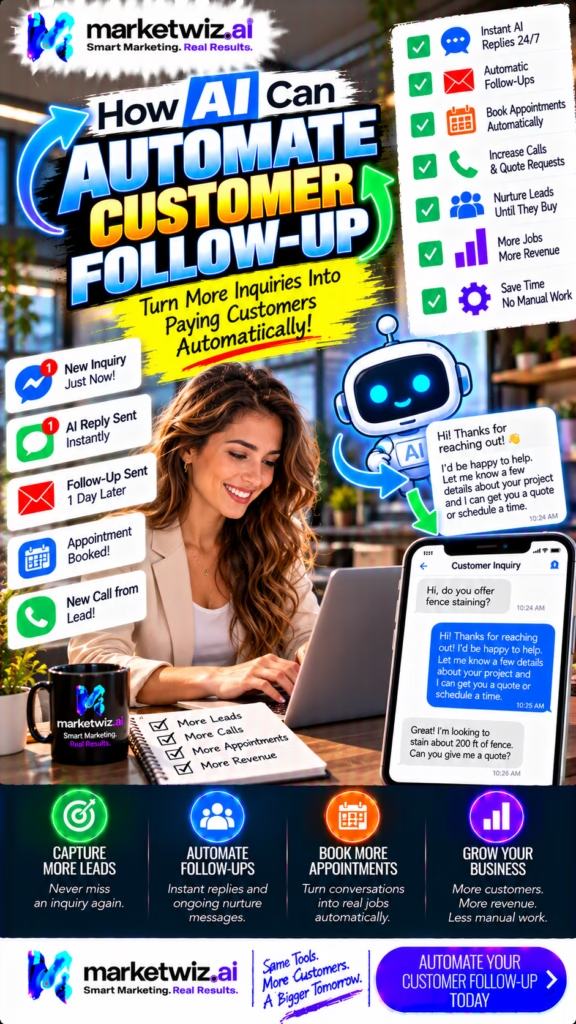
How AI Can Automate Customer Follow-Up
Discover how artificial intelligence can help businesses respond to inquiries, organize leads, automate appropriate reminders, follow up on estimates, support customer relationships, and build a more consistent communication process without losing the human touch.
1. Why Customer Follow-Up Matters More Than Ever
Generating customer inquiries is only one part of building a successful business. Once someone contacts a company, the next steps can determine whether that inquiry becomes a productive conversation, an appointment, a completed purchase, or a missed opportunity.
Many businesses invest significant time and resources in search engine optimization, social media, advertising, Google Maps visibility, website development, and local marketing. These efforts may attract interested customers, but the value of that attention depends partly on what happens after the first message arrives.
A potential customer might request a painting estimate, ask about an HVAC installation, inquire about a landscaping project, or seek information about a product. If the business does not respond clearly, the customer may continue researching alternatives.
Customer follow-up is the process of maintaining useful communication after an initial interaction. It may involve acknowledging an inquiry, requesting missing information, confirming an appointment, answering questions about an estimate, or checking in after a completed service.
Artificial intelligence can support these activities by helping businesses organize information, prepare relevant messages, identify outstanding tasks, and coordinate approved communication workflows.
The central opportunity: AI customer follow-up automation can help businesses maintain more consistent communication while allowing employees to focus on conversations that require experience, judgment, and personal attention.
The objective is not to contact customers as frequently as possible. It is to communicate when the information is useful, expected, and appropriate.
A strong follow-up strategy respects customer preferences, avoids unnecessary messages, and provides a clear path to human assistance.
2. What Is AI Customer Follow-Up Automation?
AI customer follow-up automation combines artificial intelligence with configured business processes to assist with customer communication after an inquiry, appointment, estimate, or transaction.
Traditional automation typically follows predefined rules. For example, a system may send an appointment reminder at a scheduled time or notify an employee when a new contact form is submitted.
AI adds capabilities such as understanding message context, organizing inquiries, drafting relevant responses, summarizing conversations, and suggesting the next appropriate action.
Core components of AI follow-up
Inquiry Recognition
Identify incoming customer messages and organize them by topic or service request.
Contextual Responses
Draft useful replies using verified information and approved communication guidelines.
Workflow Coordination
Trigger appropriate tasks, reminders, and notifications through authorized systems.
Human Escalation
Direct complex, sensitive, or uncertain situations to employees who can assist.
AI follow-up systems may operate through customer relationship management platforms, email tools, messaging integrations, website chat, scheduling software, and other supported systems.
The exact capabilities depend on the tools used, the permissions available, and the quality of the business information connected to the system.
3. Traditional Follow-Up vs. AI-Powered Customer Follow-Up
Manual follow-up often depends on employees remembering to call, email, or message customers at the right time.
This approach can work well when inquiry volume is manageable and responsibilities are clear. However, growing businesses may need additional organization to keep communication consistent.
AI-assisted follow-up can support employees by identifying unresolved inquiries, preparing responses, and coordinating tasks across authorized systems.
| Follow-Up Activity | Manual Process | AI-Assisted Process |
|---|---|---|
| New Inquiry Review | Employee reads and categorizes messages | AI suggests categories for staff review |
| Initial Response | Employee writes each reply | AI drafts or sends approved responses |
| Follow-Up Tracking | Notes and manual reminders | CRM tasks and automated status tracking |
| Appointment Reminders | Manual calls or messages | Verified scheduling-based reminders |
| Conversation Summaries | Employee prepares notes | AI creates reviewable summaries |
| Complex Questions | Employee handles directly | AI routes to an appropriate employee |
| Performance Review | Manual reporting | AI-assisted analysis of verified records |
The best system does not remove employees from customer relationships. Instead, it helps them identify where their attention is most valuable.
4. How AI Automates the Customer Follow-Up Process
An effective AI follow-up workflow begins with a real customer interaction and proceeds through a sequence of controlled steps.
Each step should have a defined purpose, appropriate permissions, and a reliable method for checking whether the next action is necessary.
Capture the Customer Inquiry
Receive a message through an authorized website form, email account, phone system, or supported messaging channel.
Identify the Customer's Request
Use AI to classify the inquiry based on relevant details such as service category, product interest, or appointment request.
Check the Business Context
Reference approved information about available services, operating hours, contact procedures, and existing customer records.
Prepare the Appropriate Response
Draft a relevant message or select an approved response that addresses the customer's actual question.
Trigger an Authorized Follow-Up
Send the message or create a staff task only when the channel, consent status, and workflow rules permit it.
Update the Customer Record
Record the communication outcome and any relevant next steps in the authorized business system.
Stop or Escalate When Appropriate
End unnecessary follow-up after a response, opt-out, completed action, or staff intervention.
The system should not repeatedly contact a customer simply because a scheduled message exists. Good automation checks whether the original reason for follow-up still applies.
5. Automate Follow-Up for New Customer Leads
New lead follow-up begins when a potential customer contacts a business for the first time or submits a new inquiry.
The immediate priority is usually to acknowledge the request, understand what the customer needs, and establish a clear next step.
What an effective initial response should accomplish
- Confirm that the inquiry was received.
- Recognize the requested service or product.
- Provide accurate, relevant information.
- Ask a necessary clarifying question if details are missing.
- Explain when a team member can respond.
- Provide an appropriate contact or scheduling option.
An AI system can help prepare these responses, but the business must verify that automated claims match actual operating conditions.
For example, an HVAC company should not promise immediate technician availability if its schedule has not been checked.
Practical principle: A helpful first response is specific to the customer's inquiry and clear about the next step. It does not need to be long, overly promotional, or artificially urgent.
6. Improve Customer Response Time With AI
Response time measures how long a business takes to provide an appropriate reply after a customer contacts it.
Customers often appreciate prompt acknowledgment, especially when they are comparing multiple providers or trying to schedule a project.
AI can assist by recognizing new inquiries, notifying employees, preparing responses, and collecting preliminary details outside normal business hours.
Ways to improve response workflows
- Centralize incoming inquiries where practical.
- Create clear responsibility for each channel.
- Use automated notifications for new requests.
- Prepare verified answers to common questions.
- Distinguish acknowledgments from actual service commitments.
- Escalate urgent or complex situations appropriately.
- Monitor unresolved messages.
A fast but inaccurate response can damage customer confidence. Speed should therefore be balanced with clarity, correctness, and realistic expectations.
7. Personalize Customer Follow-Up With AI
Personalization means making a message relevant to the customer's actual situation.
AI can use authorized context such as the service requested, the stage of an estimate, or the customer's preferred contact method to draft a more useful reply.
Effective personalization does not require intrusive tracking or excessive collection of personal information.
Appropriate personalization examples
Service-Specific Replies
Reference the actual service requested rather than sending a generic promotion.
Estimate Status
Follow up about an existing estimate using verified project information.
Appointment Context
Send reminders tied to a confirmed appointment rather than an assumed booking.
Customer Preferences
Use the communication method and frequency the customer has permitted.
Messages should avoid pretending that an employee personally reviewed a situation when only an automated system has processed it.
Transparency and relevance are more valuable than manufactured familiarity.
8. AI Email Follow-Up Automation for Businesses
Email remains useful for estimates, project information, appointment confirmations, and other business communication.
AI can help draft email responses, organize threads, identify outstanding questions, and prepare reminders for staff approval.
Common email follow-up workflows
- Confirming receipt of an estimate request
- Providing verified next-step information
- Following up on an unanswered customer question
- Sending appointment details
- Checking whether an estimate needs clarification
- Sharing appropriate post-service information
Businesses should distinguish transactional communication from marketing messages and comply with applicable email requirements.
Automated email sequences should also stop when a customer responds, declines, unsubscribes where applicable, or completes the intended action.
9. AI SMS Follow-Up and Text Message Automation
Text messaging can be convenient for brief, relevant business communication, including appointment reminders and customer-requested updates.
However, SMS automation requires careful attention to consent, message purpose, timing, and applicable laws.
AI can help prepare concise messages and organize responses, but it should operate only through properly authorized messaging systems.
Appropriate SMS use cases
- Confirmed appointment reminders
- Customer-requested scheduling updates
- Relevant replies to existing inquiries
- Authorized estimate status updates
- Service completion notifications
Compliance consideration: Automated marketing texts and calls can trigger legal requirements that differ from ordinary customer service communications. Businesses should obtain appropriate consent and follow applicable rules before activating campaigns.
AI systems should honor opt-outs and maintain suppression rules so customers are not contacted after requesting that communication stop.
11. Automate Follow-Up After Sending an Estimate or Quote
Estimates and proposals often require customer consideration. The customer may need time to compare options, discuss the project, or ask additional questions.
A useful follow-up process makes it easy for the customer to continue the conversation without feeling pressured.
Recommended estimate follow-up approach
Confirm the Estimate Was Delivered
Use verified delivery status and provide the customer with a clear way to ask questions.
Allow Appropriate Review Time
Choose timing that fits the project, customer expectations, and communication permissions.
Offer Helpful Clarification
Ask whether the customer needs an explanation of the proposal rather than applying unnecessary pressure.
Update the Opportunity Status
Record acceptance, rejection, pending decisions, or requests for revision accurately.
Stop Follow-Up When Appropriate
End the sequence when the customer declines, opts out, or no longer needs the communication.
AI should never invent discounts, deadlines, or availability to create artificial urgency.
12. AI Appointment Reminders and Scheduling Follow-Up
Appointment reminders help customers and employees prepare for scheduled interactions.
AI can assist with reminders when connected to an authorized scheduling system that contains verified appointment information.
Useful reminder details
- Confirmed appointment date
- Confirmed appointment time and time zone
- Relevant appointment purpose
- Appropriate preparation instructions
- Verified rescheduling procedure
- Business contact information
The system should account for appointment changes and cancellations. A reminder based on outdated calendar data can create confusion.
Businesses should also avoid exposing sensitive appointment information in channels that are not appropriate for it.
13. Recover Unanswered Inquiries and Missed Follow-Up Opportunities
Some inquiries remain unresolved because they arrive during busy periods, are routed incorrectly, or lack sufficient information.
AI can assist by identifying records without a documented response or next step.
This does not mean every old contact should receive an automated message. Businesses must first determine whether follow-up is relevant, permitted, and still useful.
Missed inquiry review checklist
- Was the customer already contacted elsewhere?
- Is the original request still active?
- Has the customer opted out?
- Is the contact information current?
- Does the business still offer the requested service?
- Would a human review be more appropriate?
A reliable workflow checks these conditions before creating a new communication task.
14. Connect AI Follow-Up Automation With Your CRM
Customer relationship management software provides a structured place to track leads, conversations, estimates, appointments, and customer outcomes.
AI integrations can help organize this information and reduce repetitive administrative work.
Important CRM follow-up fields
| CRM Field | Purpose | Automation Opportunity |
|---|---|---|
| Lead Source | Identify where the inquiry originated | Organize channel reporting |
| Inquiry Type | Understand customer needs | Suggest appropriate routing |
| Contact Permission | Track allowed communication | Control message eligibility |
| Assigned Owner | Identify responsible employee | Create staff notifications |
| Last Contact | Record communication history | Identify unresolved requests |
| Next Action | Define the appropriate follow-up | Create authorized tasks |
| Opportunity Status | Track customer progress | Stop or adjust workflows |
| Outcome | Measure business results | Support performance analysis |
CRM records should be accurate, protected, and accessible only to authorized personnel and integrations.
Poorly maintained records can lead to duplicate messages, incorrect personalization, and missed customer preferences.
15. Use AI for Lead Nurturing Without Over-Messaging
Lead nurturing involves providing relevant information to interested prospects as they consider a purchase or service.
Some customers are ready to schedule immediately. Others may be researching options, comparing providers, or planning a future project.
AI can assist with categorizing these stages and preparing appropriate educational content.
Helpful nurturing content
- Answers to common service questions
- Explanations of project preparation
- Verified product or service information
- Relevant maintenance guidance
- Clear estimate or consultation procedures
- Accurate answers to customer-requested questions
A nurturing sequence should not continue indefinitely. Businesses need clear limits, suppression rules, and a method for respecting customer preferences.
The purpose is to support informed decisions, not to manufacture urgency.
16. AI Customer Segmentation for More Relevant Follow-Up
Customer segmentation organizes contacts into meaningful groups so communication can reflect genuine needs.
For example, a company might distinguish new inquiries from existing customers, or estimate requests from appointment confirmations.
AI can assist with classifying records, but segmentation should rely on appropriate business information rather than sensitive or speculative personal characteristics.
Useful operational segments
New Inquiries
People who recently requested information and need an appropriate initial response.
Pending Estimates
Customers with an outstanding proposal who may need clarification.
Scheduled Customers
People with verified appointments who may benefit from reminders.
Completed Projects
Customers who may need legitimate post-service information or support.
Segmentation should simplify communication rather than create unnecessary categories that are difficult to maintain.
17. AI Chatbots as Part of Customer Follow-Up Automation
AI chatbots can help answer routine questions and collect information through supported websites and messaging platforms.
When integrated with an authorized business workflow, a chatbot may also help continue a conversation after the initial inquiry.
Chatbot follow-up functions
- Clarify missing service details.
- Explain published business procedures.
- Provide verified next steps.
- Record an authorized callback request.
- Route complex questions to staff.
- Identify whether the inquiry is resolved.
Chatbots should not invent customer history or imply that a human has reviewed a request when that has not happened.
Businesses should provide a practical way to reach human support when necessary.
18. AI Phone Assistants and Follow-Up Call Workflows
Phone-based AI systems may assist with incoming call handling, callback organization, and routine information collection.
Outbound automated calling requires additional care because applicable laws and consent requirements may restrict how businesses contact people.
Potential phone-related workflows
- Identify unanswered inbound call requests.
- Collect authorized callback preferences.
- Route customer questions to staff.
- Provide verified business information.
- Organize call summaries.
- Create employee follow-up tasks.
Businesses should evaluate call recording disclosures, automated calling rules, and customer consent before activating AI calling features.
Complex or safety-sensitive situations should be escalated appropriately.
19. Automate Post-Service Customer Follow-Up
Customer communication should not always end immediately after a service is completed.
Appropriate post-service follow-up can help customers understand what was done, obtain relevant care information, and communicate any remaining questions.
Post-service communication examples
- Confirming completion of a project
- Sharing relevant care instructions
- Providing verified warranty information when applicable
- Asking whether the customer has unresolved questions
- Requesting honest feedback without incentives tied to positive sentiment
- Providing a clear support contact method
Follow-up should be relevant to the completed work and consistent with the customer's communication preferences.
Businesses should avoid sending repetitive promotional messages under the appearance of customer support.
20. Use AI Follow-Up to Support Customer Retention
Customer retention involves maintaining relationships with people who have previously purchased products or services.
For businesses with recurring service needs, relevant follow-up can help customers stay informed about available maintenance or support options.
AI may assist with organizing service histories, identifying appropriate reminders, and preparing useful communications.
Retention-oriented follow-up
- Customer-requested maintenance reminders
- Relevant product care information
- Subscription or service renewal notices where applicable
- Support for unresolved customer concerns
- Accurate updates about existing service arrangements
Retention should be based on continued value and customer trust, not excessive contact.
21. AI Customer Follow-Up Examples Across Service Industries
Different service businesses need different follow-up workflows. A single generic message sequence is rarely appropriate for every industry.
| Industry | Common Follow-Up Need | AI-Assisted Application |
|---|---|---|
| HVAC | Installation estimates and maintenance inquiries | Organize requests and approved reminders |
| Plumbing | Service requests and scheduling | Collect details and notify staff |
| Electrical | Project estimates | Track unanswered proposals |
| Painting | Residential and commercial quotes | Support estimate clarification |
| Landscaping | Seasonal and recurring work | Coordinate appropriate service reminders |
| Roofing | Inspection and replacement inquiries | Organize consultation follow-up |
| Cleaning | Recurring service requests | Support scheduling communication |
| Remodeling | Longer project consideration | Track proposal questions and next steps |
| Retail | Product availability questions | Provide verified information and follow-up |
Every workflow should reflect the company's real services, actual availability, and communication obligations.
22. AI Follow-Up Throughout the Sales Pipeline
A sales pipeline describes the stages through which an opportunity moves, from initial inquiry to a final outcome.
AI can assist by organizing records and suggesting appropriate tasks at each stage.
Example pipeline stages
New Inquiry
A customer requests information. The system records the request and identifies the appropriate initial response.
Qualified Opportunity
The business determines whether the inquiry matches its offerings and service requirements.
Consultation or Estimate
Staff review the project and provide accurate information or a proposal.
Customer Consideration
Appropriate follow-up offers clarification without unnecessary pressure.
Decision
The system records acceptance, decline, or another verified outcome.
Post-Sale Support
Relevant customer service information and follow-up tasks are managed appropriately.
Each stage should have clear entry and exit conditions so automation does not continue after the customer has moved to a different stage.
23. Choose the Right Timing and Frequency for AI Follow-Up
There is no universal follow-up schedule that fits every business, customer, and communication channel.
An appointment reminder may be appropriate near a confirmed meeting. An estimate follow-up may require more time because the customer is evaluating a significant purchase.
The correct timing depends on the customer's expectations, the purpose of the message, applicable rules, and the nature of the service.
Timing considerations
- Was the message requested or expected?
- Is the information still relevant?
- Has the customer already responded?
- Does the channel have timing restrictions?
- Has the customer opted out?
- Would a staff member provide a better response?
- Is another message actually necessary?
Good automation should make it easy to pause, cancel, or modify a sequence.
Follow-up rule: More messages do not automatically create better customer relationships. Relevance, permission, and usefulness should determine whether another message is sent.
24. Measure AI Customer Follow-Up Performance
Businesses should evaluate automated follow-up using customer outcomes and communication quality.
A large number of automated messages does not necessarily indicate a successful system.
Important follow-up metrics
| Metric | What It Measures | Why It Matters |
|---|---|---|
| First Response Time | Time to an appropriate initial response | Evaluates responsiveness |
| Qualified Conversations | Relevant customer interactions | Measures inquiry quality |
| Appointment Completion | Scheduled interactions that occur | Tracks operational outcomes |
| Estimate Outcomes | Accepted, declined, or pending proposals | Supports pipeline analysis |
| Duplicate Messages | Unnecessary repeated communication | Identifies workflow errors |
| Opt-Out Rate | Customers declining further communication | Highlights relevance and consent concerns |
| Customer Feedback | Experience with the follow-up process | Supports quality improvements |
| Completed Sales or Jobs | Verified business outcomes | Connects follow-up to results |
Reports should distinguish correlation from causation. An improvement in appointments may have several contributing factors beyond automation.
Businesses should review both positive results and customer complaints to understand the full impact of their workflows.
25. Common AI Customer Follow-Up Mistakes to Avoid
Automated communication can create problems when systems are launched without sufficient testing, oversight, or customer protections.
Frequent mistakes
- Sending messages without appropriate permission.
- Failing to honor opt-out requests.
- Continuing follow-up after a customer responds.
- Using outdated appointment information.
- Inventing prices, discounts, or deadlines.
- Sending the same message through multiple channels unnecessarily.
- Using incorrect customer names or project details.
- Failing to route complex questions to staff.
- Collecting excessive personal information.
- Ignoring platform-specific automation restrictions.
- Allowing automated systems to make unsupported commitments.
- Failing to monitor system errors.
- Measuring only the number of messages sent.
- Using overly aggressive follow-up schedules.
- Failing to protect customer records.
The most effective prevention strategy is to establish clear workflow rules, test representative scenarios, and review actual conversations regularly.
26. Privacy, Consent, and Compliance in AI Follow-Up Automation
Customer follow-up systems may process personal information and initiate communication through channels subject to legal or platform requirements.
Businesses should review applicable laws, consent obligations, privacy notices, data security practices, and vendor agreements before activating automated messaging.
Responsible automation checklist
- Use customer information for legitimate purposes.
- Collect only necessary data.
- Document applicable communication permissions.
- Distinguish marketing from transactional messages.
- Honor opt-outs and suppression lists.
- Apply reasonable message limits.
- Secure customer records.
- Restrict integration access.
- Provide human escalation.
- Review automated outputs for accuracy.
- Follow the rules of each messaging platform.
- Seek qualified legal advice where appropriate.
The legal treatment of automated calls, text messages, email marketing, and customer service communications can differ.
A business should not assume that permission to contact a customer through one channel automatically authorizes every type of automated outreach.
27. A 90-Day AI Customer Follow-Up Implementation Roadmap
A phased implementation allows businesses to improve existing processes before adding complex automation.
This roadmap provides a practical planning framework. It does not promise a specific increase in leads, appointments, or revenue.
Days 1–15: Audit Customer Communication
Identify inquiry channels, current response procedures, missed messages, follow-up responsibilities, and common customer questions.
Days 16–30: Organize Contact Records
Review CRM information, communication permissions, lead stages, employee ownership, and record accuracy.
Days 31–45: Build Basic Follow-Up Rules
Configure inquiry acknowledgments, staff notifications, and clear stopping conditions for approved workflows.
Days 46–60: Add Supervised AI Assistance
Test message classification, response drafting, conversation summaries, and human escalation procedures.
Days 61–75: Connect Scheduling and Estimates
Introduce verified appointment reminders and appropriate estimate follow-up where supported and permitted.
Days 76–90: Review Performance and Refine
Measure customer outcomes, communication quality, opt-outs, duplicate messages, and employee feedback before expanding automation.
The sequence can be adjusted according to the business's size, industry, technical resources, and existing systems.
28. Advanced AI Follow-Up Strategies for Growing Businesses
Once a business has reliable basic workflows, it may benefit from more advanced automation.
Conversation-aware task creation
AI can identify an unresolved customer question and suggest a follow-up task for the appropriate employee.
Estimate-stage communication
Different proposal stages can trigger different approved tasks, such as clarification requests or staff review, rather than sending identical messages to every prospect.
Multi-channel coordination
A centralized system can help prevent unnecessary duplicate messages when customers interact through email, website chat, and other supported channels.
Customer support escalation
Messages involving complaints, technical uncertainty, or sensitive concerns can be routed to trained staff.
Follow-up quality auditing
AI can assist with identifying messages that contain inaccurate information, excessive repetition, or missing context.
Workflow performance analysis
Businesses can compare verified outcomes across different approved communication processes and adjust their approach based on meaningful results.
Advanced systems should remain understandable and controllable. Complexity without oversight can create more operational problems than it solves.
29. The Future of AI-Powered Customer Communication
AI tools are becoming more capable of organizing business information, understanding conversation context, and supporting workflows across software platforms.
As integrations improve, businesses may find it easier to connect customer inquiries, scheduling, estimates, CRM records, and post-service communication.
However, more capable automation does not remove the need for reliable information, appropriate consent, and professional judgment.
Long-term priorities
- Keep business information accurate.
- Maintain clear customer communication permissions.
- Use AI to reduce repetitive administrative work.
- Provide practical human support.
- Protect customer information.
- Monitor automated decisions and responses.
- Measure actual customer outcomes.
- Improve workflows based on verified feedback.
The most sustainable approach is to use AI as a support system for better customer relationships rather than treating automation as an end in itself.
30. How Market Wiz AI Supports Smarter Customer Follow-Up
Market Wiz AI focuses on helping businesses coordinate digital marketing activities and AI-supported customer communication.
Customer follow-up becomes especially important when businesses receive inquiries from multiple sources, including organic search, Google Maps, websites, social media, and other permitted marketing channels.
A coordinated approach can help businesses organize inquiries, respond with relevant information, and maintain a clearer process for handling potential customers.
Important areas of focus
- Organic marketing visibility
- Google Maps and local SEO strategies
- Website and social media inquiry workflows
- AI-assisted customer response preparation
- Lead organization and qualification
- Follow-up process consistency
- Human escalation when needed
- Performance monitoring and improvement
A successful system should connect marketing activity with real customer service processes rather than simply increasing the number of automated messages.
Market Wiz AI's broader marketing approach can complement responsible follow-up automation by helping businesses improve how they attract, organize, and communicate with interested customers.
Actual results depend on the business, market conditions, software configuration, communication permissions, and implementation quality.
30 Frequently Asked Questions About AI Customer Follow-Up Automation
1. What is AI customer follow-up automation?
AI customer follow-up automation uses artificial intelligence and configured workflows to assist with responding to inquiries, sending appropriate reminders, organizing conversations, and identifying when human attention is needed.
2. How does AI automate customer follow-up?
AI can classify incoming messages, draft context-aware responses, identify next steps, update authorized CRM records, and trigger approved follow-up workflows.
3. Can AI follow up with leads automatically?
Yes. Properly configured AI systems can assist with automatic lead follow-up through supported channels when customer permissions and applicable rules allow it.
4. Can AI send personalized follow-up messages?
AI can draft messages using verified inquiry details and approved templates, but personalization should be accurate, relevant, and respectful of privacy.
5. Does AI customer follow-up work for small businesses?
Yes. Small businesses can use AI-assisted follow-up for inquiry acknowledgments, reminders, lead organization, and routine customer communication.
6. Can AI replace customer service employees?
AI can assist with repetitive tasks, but employees remain important for complex questions, sensitive situations, estimates, complaints, and decisions requiring judgment.
7. What types of customer follow-up can AI automate?
AI can support new inquiry acknowledgments, estimate follow-up, appointment reminders, post-service check-ins, and other authorized customer communication workflows.
8. Can AI follow up through email?
Yes. AI can draft or help send email follow-ups through authorized systems, subject to applicable marketing rules, consent requirements, and customer preferences.
9. Can AI automate SMS follow-up?
AI can assist with SMS follow-up when integrated with a compliant messaging system and used according to applicable consent and communication requirements.
10. Can AI follow up through social media messages?
AI may support messaging on platforms that permit the specific integration and automation, subject to platform rules and customer permissions.
11. How quickly should businesses follow up with leads?
Businesses should respond promptly when appropriate, using accurate expectations and respecting operating hours, consent, and customer preferences.
12. Can AI follow up outside business hours?
AI can acknowledge inquiries and collect appropriate information outside business hours while clearly stating when human assistance is available.
13. What is AI lead nurturing?
AI lead nurturing uses software-assisted communication and organization to help interested prospects receive relevant information as they consider a purchase or service.
14. Can AI follow up after an estimate?
Yes. With appropriate permission and accurate records, AI-assisted workflows can remind customers about an outstanding estimate and offer a convenient way to ask questions.
15. Can AI send appointment reminders?
AI-supported systems can send reminders when connected to verified scheduling information and authorized communication channels.
16. Can AI follow up after a completed service?
Yes. AI can help businesses send appropriate post-service check-ins, share care information, and request honest feedback without pressuring customers.
17. How does AI integrate with a CRM?
AI can connect with supported CRM systems to organize inquiries, summarize authorized conversations, assign tasks, and track follow-up status.
18. What is an AI follow-up sequence?
An AI follow-up sequence is a defined series of approved communications or tasks triggered by events such as an inquiry, appointment, estimate, or completed job.
19. How do businesses prevent automated follow-up spam?
Businesses should use appropriate consent, reasonable message limits, relevant content, suppression rules, opt-out handling, and human oversight.
20. Can AI improve lead conversion rates?
AI may support conversion by improving communication consistency and organization, but results vary and no conversion increase is guaranteed.
21. Can AI help recover missed leads?
AI-assisted systems can identify unresolved inquiries and help staff respond when follow-up is appropriate and permitted.
22. What information does AI need for follow-up?
Useful information may include inquiry type, relevant service details, contact preferences, follow-up status, and verified appointment information, while avoiding unnecessary personal data.
23. Is AI follow-up expensive?
Costs depend on the software, integrations, message volume, setup complexity, monitoring, and business requirements.
24. How do I measure automated follow-up performance?
Track response times, qualified conversations, appointments, completed sales, opt-outs, customer feedback, and communication errors.
25. Can AI automate follow-up for HVAC companies?
Yes. HVAC companies can use AI-assisted workflows for service inquiries, estimate follow-up, appointment reminders, and appropriate maintenance communication.
26. Can AI follow up for real estate and home service businesses?
Yes. AI can support inquiry organization, scheduling, and authorized follow-up for real estate and home service businesses, with human review for regulated or complex matters.
27. What are the risks of AI follow-up automation?
Risks include inaccurate messages, unwanted contact, privacy issues, duplicate communication, incorrect scheduling, and failures to escalate important customer concerns.
28. How can AI make follow-up feel more personal?
AI can use accurate, relevant context to draft helpful messages while avoiding fabricated familiarity or intrusive personalization.
29. What should a business automate first?
Start with reliable inquiry acknowledgment, staff notifications, and basic follow-up tracking before introducing complex automated sequences.
30. What is the best AI customer follow-up strategy?
Use clear customer permissions, verified information, useful timing, simple workflows, CRM organization, human escalation, and measurement of real customer outcomes.
30 Additional SEO Keywords for AI Customer Follow-Up Automation
These keyword ideas can support related articles, service pages, and marketing research. Use them naturally when they match the page's subject and actual business capabilities.
Final Thoughts: Use AI to Build Better Customer Follow-Up Systems
Customer follow-up is an essential part of turning business inquiries into productive conversations and long-term relationships.
Artificial intelligence can assist with many repetitive parts of that process, including inquiry organization, response drafting, reminder coordination, CRM updates, and follow-up task management.
The strongest implementations begin with accurate business information and a clear understanding of the customer's needs.
Automation should provide helpful responses, support staff, respect communication permissions, and stop when further contact is no longer appropriate.
Businesses should also measure meaningful outcomes rather than relying only on the number of messages sent.
When integrated responsibly, AI can help companies build more organized communication processes while preserving the human judgment and service quality customers expect.
The goal of AI customer follow-up is not to automate every conversation. It is to make every appropriate customer interaction more organized, relevant, and useful.
Build Smarter Customer Communication With Market Wiz AI
Discover how organic marketing, local visibility strategies, AI-supported responses, and organized lead workflows can help your business connect marketing activity with more consistent customer communication.
Explore MarketWiz.ai© 2026 Market Wiz AI. This article provides general educational information about AI customer follow-up, marketing automation, and business communication. Applicable laws, platform policies, and software capabilities may change. Specific marketing results, conversions, and revenue are not guaranteed.











10. AI Follow-Up for Facebook, Instagram, and Other Social Channels
Businesses often receive customer questions through social media comments, direct messages, and business messaging features.
AI can assist with response preparation and inquiry organization where the platform permits the integration and automation.
The goal should be to help people who have legitimately contacted the business, not to generate unsolicited mass messages.
Social media follow-up priorities
Businesses should review platform-specific restrictions before connecting automation tools.
A workflow that is permitted on one messaging channel may not be permitted on another.