
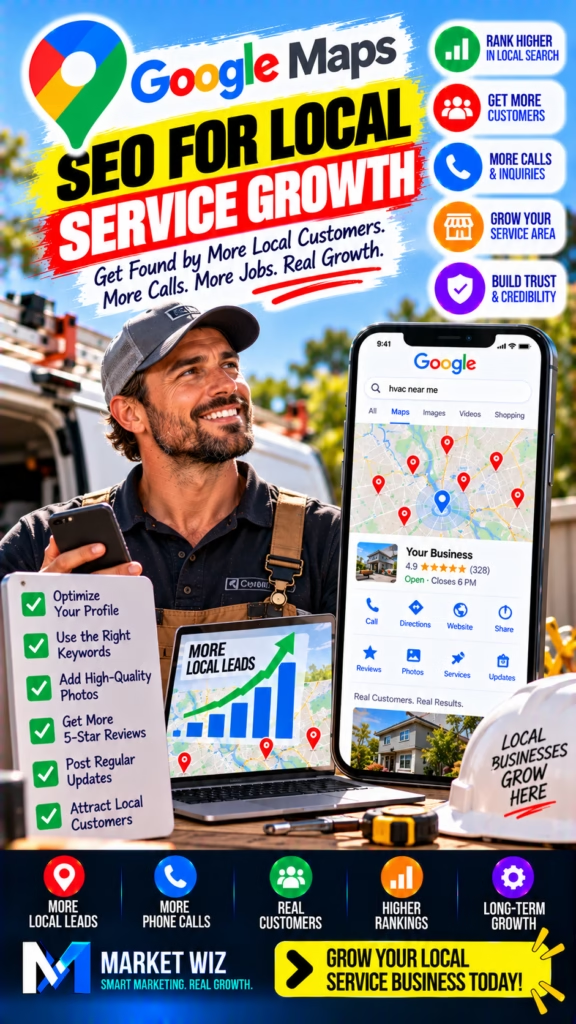
Google Maps SEO for Local Service Growth
Local service businesses depend on customers who need reliable help in their immediate communities. Google Maps SEO can make it easier for those customers to discover relevant providers, compare options, review business information, and make contact. This comprehensive guide explains how contractors, home service companies, and other local providers can build stronger Google Maps visibility, attract more qualified inquiries, and create a sustainable foundation for business growth without relying entirely on paid advertising.
1. Why Google Maps SEO Matters for Local Service Growth
For many local service businesses, the customer journey begins with a practical problem. A homeowner needs an air conditioning repair. A property manager needs an electrician. A family wants a painting contractor. A business owner needs a commercial cleaning company.
These customers often search Google because they want to identify a provider that serves their area, appears credible, and offers a straightforward way to make contact. Google Maps and local search results can help them compare nearby options.
A well-maintained Google Business Profile gives eligible businesses an opportunity to present accurate information where local customers are already searching. It can display the business name, category, hours, contact information, customer reviews, photographs, and other supported details.
However, simply creating a profile does not guarantee visibility. Google uses multiple signals to determine which businesses appear for particular searches and locations.
The most effective strategy connects local search visibility with a useful customer experience. Businesses need to be discoverable, but they also need to answer questions, respond to inquiries, and provide the services customers expect.
Core principle: Google Maps SEO should support actual local business growth. Higher visibility is valuable when it helps the right customers discover a legitimate business and take meaningful action.
2. How Google Maps Connects Customers With Local Services
Google Maps helps customers find businesses related to their searches and geographic context. A search may be specific, such as a particular contractor's name, or broader, such as a service category.
Google may display local business results in Search, Maps, or other supported interfaces. The precise presentation can vary by device, query, and location.
For service businesses, these results may become an early point of contact with customers who are comparing providers.
What customers commonly evaluate
- Whether the company provides the requested service.
- Whether it serves the customer's location.
- Whether the business appears legitimate and established.
- What previous customers say about their experiences.
- Whether contact information and hours are clear.
- Whether the business website provides useful details.
A Google Maps listing should therefore be treated as part of the customer journey, not merely as a place to insert search keywords.
3. Understand Google's Three Main Local Ranking Factors
Google identifies relevance, distance, and prominence as the primary considerations behind local search rankings. Understanding these factors helps businesses prioritize realistic improvements.
Relevance
How closely the business matches what someone is searching for. Accurate categories and business information help establish relevance.
Distance
How far the business is from the location associated with the search. A provider may serve a wide region but rank differently across it.
Prominence
How well-known the business is, based on information Google can evaluate from its profile and other sources across the web.
Search Context
The exact query and search location affect how relevant local results are selected and ordered for a particular customer.
No single tactic guarantees a particular ranking position. A business with many reviews may still rank below a closer competitor that better matches the customer's query.
Businesses should evaluate all three primary factors rather than assume that publishing more posts or adding more keywords will solve every ranking problem.
4. Establish an Eligible and Verified Google Business Profile
Google Business Profiles are intended for eligible businesses that satisfy Google's representation requirements. For local service companies, eligibility depends on how the business actually operates and interacts with customers.
A business that visits customers at their locations may qualify as a service-area business. Other companies may operate from locations where customers can visit during stated hours.
The correct profile configuration should reflect real operations. A business should not invent a storefront, office, or staffed location simply to gain exposure in a particular city.
Initial setup checklist
- Confirm the business meets Google's eligibility requirements.
- Use the genuine business name.
- Choose accurate categories.
- Configure the address or service-area settings correctly.
- Complete the verification steps Google requires.
- Review profile access and ownership permissions.
Verification helps establish the ability to manage the profile, but verification by itself does not guarantee prominent local rankings.
5. Choose the Most Accurate Primary Business Category
The primary business category helps describe what the company principally does. For service providers, this can be especially important because customers often search by trade or service type.
A plumbing company should accurately identify its plumbing operations. A painting company should choose a category reflecting its actual work. A company offering several distinct trades should select the category that best represents its main business activity.
Secondary categories can represent other genuine activities when those categories are available and appropriate.
Businesses should avoid adding unrelated categories solely to capture more searches.
Best practice: Review categories against the business's actual offerings. Accuracy is more useful than attempting to target every possible service keyword through category selection.
6. Configure Service Areas Without Misrepresenting Locations
Service-area settings help eligible businesses explain where they travel or deliver to customers. They are particularly relevant for contractors and other mobile providers.
A business may serve several cities, neighborhoods, or counties. However, adding those places to a profile does not guarantee that the business will rank prominently in each one.
Google's distance factor still matters. A company may be visible near its operating location and less visible farther away.
Businesses should list only genuine service areas and follow Google's current rules about service-area configuration.
When a business operates multiple locations, each location should independently meet eligibility requirements before a separate profile is created.
7. Complete Every Relevant Business Profile Detail Accurately
Incomplete or outdated information can make it harder for customers to understand and contact a service provider.
A useful profile should reflect the business's current operations, including the services it actually provides and the ways customers can reach it.
Important information to maintain
- Business name and primary category.
- Relevant secondary categories.
- Address or service-area settings.
- Current business telephone number.
- Official website link.
- Regular and special business hours.
- Accurate business description.
- Genuine offerings and supported profile attributes.
- Authentic business photographs.
Accuracy also supports customer trust. A profile that lists the wrong telephone number or outdated hours can lose opportunities even when it appears in search results.
8. Write a Business Description That Explains Real Services
A business description should communicate what the company does, who it serves, and what makes its offerings relevant.
Descriptions work best when they are specific without becoming repetitive. Customers should be able to understand the company without reading a long sequence of keywords.
For example, an HVAC company might explain its actual heating and cooling offerings, while a landscaping provider might describe the types of outdoor work it performs.
Avoid unsupported promises, misleading claims, and unnecessary repetition of city names.
The description should be written for real customers. It is not a substitute for choosing accurate categories or maintaining a credible online presence.
9. Present Service Offerings Clearly and Specifically
Local service businesses often provide multiple related offerings. A contractor might perform installation, maintenance, repair, or replacement work.
When Google Business Profile supports service details, businesses should describe their actual offerings accurately.
A website can provide additional explanations, including what each service involves, which customer problems it addresses, and how customers can request assistance.
This helps distinguish a company that offers a particular service from one that merely uses the service name in promotional content.
Customer-focused approach: Describe services using language customers understand, but ensure every claim matches the business's real capabilities.
10. Research Local Keywords Based on Customer Intent
Keyword research helps businesses understand how potential customers describe their needs.
Some searches are broad, while others identify a particular problem, service type, or location.
For example, a homeowner may search for a general contractor category or for a more specific project-related service.
Businesses can use relevant search phrases to plan useful website pages and educational content.
Keyword research should reflect genuine offerings, not encourage businesses to claim services they do not perform.
Useful keyword categories
- Primary trade or service category.
- Specific service or project type.
- Customer problem or repair need.
- Genuine geographic coverage.
- Commercial or residential customer needs.
- Questions customers ask before booking.
Search phrases should be incorporated naturally where they help explain relevant information.
11. Connect Google Maps SEO With a Strong Local Website
A Google Business Profile provides an important discovery point, but a website can explain the business in greater detail.
Customers may visit a company's website to evaluate service information, review project examples, understand operating coverage, or find contact options.
Useful website content can also support a business's broader online presence.
A strong website should be mobile-friendly, accessible, easy to navigate, and accurate about what the business offers.
Pages should load reliably and provide clear information without unnecessary barriers.
A website does not guarantee higher Google Maps rankings, but it can strengthen the overall customer journey.
12. Create Dedicated Pages for Important Service Categories
A service business may offer several distinct types of work. Dedicated website pages can help customers understand those offerings in greater detail.
A painting contractor might explain interior painting, exterior painting, and cabinet refinishing separately when those are genuine services.
An electrical company may provide useful information about different types of electrical work it performs.
Each page should offer meaningful details, not merely repeat the same promotional paragraph with a different heading.
What useful service pages may include
- A clear explanation of the service.
- Typical customer needs or project situations.
- What the business actually provides.
- Relevant project photographs when available.
- Common customer questions.
- Genuine service coverage.
- Clear contact information.
13. Develop Helpful Location Pages for Genuine Service Markets
Businesses serving multiple communities may benefit from website pages explaining their actual coverage in those locations.
These pages should be useful to local customers, not mass-produced solely to target city names.
A genuine location page might discuss the services offered in that area, relevant customer considerations, and verified project experience.
Avoid creating pages that falsely suggest the business maintains offices in locations where it has no eligible physical operation.
Distinctive, accurate information is more valuable than a large collection of nearly identical pages.
14. Build an Authentic Google Review Strategy
Customer reviews can influence how people evaluate a local service business.
Google also states that review count and positive ratings can contribute to local prominence.
Businesses should invite real customers to share honest experiences through compliant review requests.
The goal is not to manufacture a perfect-looking rating. It is to build an authentic record of customer experiences.
Fake reviews, purchased reviews, and prohibited incentives should be avoided.
Practical review process: After completing a legitimate customer interaction, provide a simple, neutral opportunity for the customer to leave honest feedback.
15. Respond Professionally to Customer Feedback
Customer reviews are an opportunity to understand service quality and demonstrate professionalism.
Positive feedback can be acknowledged with a brief, genuine response.
Critical feedback should be handled calmly, without disclosing private customer information or escalating disagreements publicly.
A business should investigate legitimate concerns and offer appropriate next steps when possible.
Review responses do not guarantee a particular Google Maps ranking, but they can help customers evaluate how a company communicates.
16. Use Authentic Photographs to Build Customer Confidence
Service businesses often benefit from showing the real work they perform.
Photographs can help customers understand the business's experience, equipment, work environment, and completed projects.
A painting company might display genuine completed painting projects. A landscaping business might show actual outdoor transformations.
Images should accurately represent the business and comply with Google's content policies.
Businesses should obtain appropriate permissions before publishing customer property or identifiable personal information.
There is no guaranteed ranking benefit from uploading a particular number of photographs.
17. Publish Useful Google Business Profile Updates
Where supported, Google Business Profile posts can help businesses communicate relevant information.
A company may share genuine updates about offerings, business developments, or other useful customer information.
However, posting frequency should not be mistaken for a guaranteed ranking factor.
Google does not promise that publishing a fixed number of posts each week will produce a specific local ranking.
Businesses should prioritize accuracy, relevance, and usefulness over unnecessary content volume.
18. Strengthen Local Prominence Beyond Google Maps
Google identifies prominence as a primary factor in local search results.
Prominence reflects how well-known a business is based on information Google can evaluate.
Businesses may strengthen their broader presence through genuine customer relationships, useful resources, relevant industry involvement, and authentic online references.
A local company should focus on becoming recognizable and trustworthy to the people it actually serves.
Manipulative tactics such as artificial link networks or misleading directory listings are not sustainable substitutes for legitimate business prominence.
19. Maintain Accurate Business Information Across Relevant Directories
Customers may discover service businesses through several legitimate online platforms.
A company should ensure that important contact details are accurate wherever it maintains a business presence.
Incorrect telephone numbers, old addresses, and outdated website links can create unnecessary customer confusion.
Relevant directory listings may also provide useful ways for customers to find the business.
However, submitting a business to large numbers of unrelated directories does not guarantee higher Google Maps rankings.
Quality, accuracy, and relevance should guide directory management.
20. Improve the Mobile Experience for Local Customers
Many customers search for local services using mobile devices.
A useful mobile experience should make it easy to understand the business and find reliable contact information.
Websites should be readable without excessive zooming, support straightforward navigation, and avoid unnecessary obstacles.
Contact forms should request only information that is reasonably necessary.
Businesses should also ensure that telephone numbers and contact options work as intended.
Better usability can reduce friction between customer discovery and an actual inquiry.
21. Turn Google Maps Visibility Into Qualified Service Leads
Google Maps visibility becomes more valuable when interested customers can take the next step easily.
A qualified lead is not simply any profile interaction. It is an inquiry that reasonably matches the business's offerings, geographic coverage, and customer requirements.
Businesses should provide clear contact information, accurate service descriptions, and practical next steps.
They should also establish a process for evaluating incoming inquiries.
Useful qualification questions
- What service does the customer need?
- Where is the project or service location?
- What is the general scope of the work?
- When does the customer need assistance?
- Is the request within the company's capabilities?
A simple qualification process helps businesses prioritize relevant opportunities without making customer contact unnecessarily difficult.
22. Reduce Missed Opportunities With Better Lead Response
A business may attract valuable inquiries but lose opportunities when nobody responds.
Customer communication is therefore an important part of local service growth.
Businesses should establish clear responsibilities for handling calls, contact forms, and other supported communication channels.
Automated acknowledgments can be useful when they are accurate and transparent.
However, automated messages should not imply that a human has reviewed or confirmed a request when that has not happened.
Important distinction: Fast lead response is a customer experience strategy. It should not be presented as a guaranteed Google Maps ranking tactic.
23. Use AI to Support Local SEO and Customer Engagement
AI tools can assist local service businesses with repetitive marketing and administrative tasks.
For example, AI may help prepare content drafts, organize profile audit findings, summarize customer inquiries, and support communication workflows.
AI can also help identify missing information or inconsistent business details for human review.
However, AI cannot directly control Google's organic local rankings.
Generated content should be checked for accuracy, and businesses should protect customer information when using third-party systems.
The strongest approach combines automation with verified business information and accountable human oversight.
24. Google Maps SEO Strategies Across Local Service Industries
Different service industries may need different types of customer information.
An HVAC company may need clear descriptions of actual heating and cooling offerings.
A painting contractor may benefit from genuine project photographs and detailed service pages.
A plumbing company may need accurate hours and straightforward contact information.
A landscaping company may want to explain the types of properties and outdoor work it handles.
| Industry | Useful Local SEO Focus | Customer Conversion Consideration |
|---|---|---|
| HVAC | Accurate heating and cooling offerings | Clear availability and service coverage |
| Plumbing | Relevant plumbing categories and details | Reliable contact information |
| Electrical | Clear descriptions of actual electrical work | Project qualification and communication |
| Painting | Service pages and authentic project photos | Clear estimate request process |
| Landscaping | Accurate offerings and seasonal information | Project scope and property details |
| Cleaning | Residential or commercial service clarity | Coverage, scheduling, and scope |
| Roofing | Specific roofing offerings and project information | Customer needs and site location |
The best approach reflects the business's actual services and the questions customers ask before choosing a provider.
25. Analyze Local Competitors Without Copying Bad Practices
Competitor research can reveal how customers encounter businesses within a particular local market.
A business can review publicly available categories, website information, customer questions, and general search result patterns.
However, a competitor's ranking does not prove that every tactic the competitor uses is responsible or effective.
Businesses should not copy misleading business names, fictional locations, or questionable review practices.
The purpose of competitor analysis is to identify legitimate opportunities to improve relevance, customer information, and overall business quality.
26. Measure Google Maps SEO Performance With Meaningful Metrics
Local SEO measurement should go beyond checking whether a business appears in one particular position.
Google Maps results vary by search location and query.
Businesses should evaluate available Google Business Profile performance information alongside website analytics, customer inquiry records, and completed sales.
| Metric | What It Measures | How to Use It |
|---|---|---|
| Local visibility | Appearance for relevant searches and locations | Evaluate trends across a representative market |
| Profile interactions | Available engagement with the business profile | Identify customer interest patterns |
| Website visits | Traffic reaching the business website | Review useful content and customer paths |
| Qualified leads | Inquiries matching business requirements | Measure actual opportunity quality |
| Booked jobs | Confirmed customer work | Connect marketing to operational outcomes |
| Revenue | Completed business value | Evaluate overall commercial performance |
Performance data should be interpreted carefully. Not every profile interaction becomes a customer, and not every completed job can be attributed to one marketing channel.
27. Google Maps SEO vs. Paid Local Advertising
Organic Google Maps SEO and paid advertising serve different purposes.
Organic local search focuses on helping an eligible business appear in relevant unpaid local results.
Paid advertising provides sponsored placements under the applicable advertising systems.
Google states that businesses cannot request or pay for a better organic local ranking.
Some companies may use both approaches, while others prioritize organic visibility to reduce dependence on ongoing advertising spending.
The right marketing mix depends on budget, competition, customer demand, and the business's operational capacity.
28. Common Google Maps SEO Mistakes That Limit Service Growth
Local service businesses can avoid many preventable problems by reviewing the accuracy and usefulness of their online presence.
- Using an inaccurate primary business category.
- Claiming services the business does not provide.
- Publishing misleading business names.
- Creating duplicate or ineligible locations.
- Using fictitious addresses to target cities.
- Ignoring verification requirements.
- Maintaining outdated telephone numbers.
- Displaying inaccurate operating hours.
- Assuming service areas guarantee rankings.
- Buying fake customer reviews.
- Using misleading project photographs.
- Producing repetitive, low-value website pages.
- Relying entirely on profile posting frequency.
- Ignoring relevant customer questions.
- Failing to respond to qualified inquiries.
- Measuring rankings from only one search location.
- Confusing profile interactions with completed jobs.
- Expecting guaranteed first-place rankings.
Not every issue affects every company. A useful audit identifies the problems supported by actual evidence and prioritizes corrections accordingly.
29. A Practical 90-Day Google Maps SEO Growth Plan
A structured plan can help local service businesses build a stronger foundation without chasing disconnected marketing tactics.
Days 1–30: Establish the Foundation
Audit Profile Eligibility and Accuracy
Review verification, business categories, address or service-area configuration, contact information, hours, and policy compliance.
Review Local Search Relevance
Identify relevant service queries, evaluate genuine offerings, and review how the business appears from appropriate search locations.
Establish Baseline Metrics
Record available profile performance data, website inquiries, qualified leads, and completed jobs using consistent definitions.
Days 31–60: Improve Customer Information
Strengthen Website Service Pages
Improve useful explanations of actual services, customer questions, and genuine geographic coverage.
Develop Authentic Reputation Signals
Encourage honest customer feedback, maintain accurate photographs, and respond professionally to customer reviews.
Improve Contact and Follow-Up Processes
Ensure inquiries reach the right team, establish clear response responsibilities, and organize relevant customer information.
Days 61–90: Measure and Refine
Evaluate Search Visibility Patterns
Review relevant searches across representative neighborhoods and distinguish distance limitations from correctable relevance problems.
Assess Qualified Lead Performance
Compare inquiry quality, customer contact outcomes, and booked work rather than relying only on profile interaction totals.
Prioritize the Next Improvements
Address verified information gaps, customer experience issues, and genuine local marketing opportunities based on the evidence collected.
90-day objective: Create a more accurate, useful, measurable, and customer-focused local search presence. Ranking improvements are possible, but specific positions and timelines cannot be guaranteed.
30. Build Sustainable Local Service Growth Through Google Maps SEO
Sustainable local service growth requires more than an optimized listing.
Businesses need a combination of accurate information, relevant services, genuine customer trust, helpful online content, and reliable communication.
Google Maps SEO can support discovery, but the business must deliver on the expectations created by its online presence.
A company that attracts qualified inquiries but fails to respond may lose valuable opportunities.
A business that earns strong visibility but publishes misleading information may damage customer confidence.
The strongest strategy connects marketing, operations, and customer experience.
This approach also makes it easier to evaluate whether local search activity is contributing to appointments, completed projects, and lasting customer relationships.
30 Frequently Asked Questions About Google Maps SEO for Local Service Growth
1. What is Google Maps SEO for local service businesses?
Google Maps SEO is the process of improving a local service business's eligible Google Business Profile and supporting online presence so customers can more easily discover accurate, relevant business information in local search results.
2. How does Google Maps SEO help local service businesses grow?
Google Maps SEO can support growth by helping potential customers discover a business, understand its services, evaluate its reputation, and contact it. Business growth depends on competition, customer demand, and the ability to convert inquiries into sales.
3. What determines Google Maps rankings?
Google identifies relevance, distance, and prominence as the main factors influencing local results. Rankings depend on the search and location, and no single optimization guarantees a particular position.
4. Is Google Business Profile optimization free?
Creating and managing an eligible Google Business Profile is free. Businesses may separately choose to pay for professional optimization, website work, marketing support, or other services.
5. Can service-area businesses appear on Google Maps?
Yes. Eligible service-area businesses that visit or deliver to customers can maintain Google Business Profiles when they follow Google's eligibility and address visibility requirements.
6. Does adding more service areas increase Google Maps rankings?
Adding service areas does not guarantee higher rankings. Businesses should list genuine areas they serve, while understanding that distance remains an important local ranking factor.
7. How do I choose the best Google Business Profile category?
Choose the most accurate available primary category for the business's main activity and use relevant secondary categories only when they describe genuine additional offerings.
8. Do Google reviews help local service business rankings?
Google states that review count and positive ratings can contribute to prominence. Reviews can also help customers evaluate a business, but no review total guarantees a ranking.
9. How can local service businesses get more Google reviews?
Businesses can invite real customers to share honest feedback through compliant review requests. They should not buy fake reviews, selectively solicit only positive reviews, or offer prohibited incentives.
10. Do Google Business Profile posts improve rankings?
Google does not guarantee ranking improvements from a specific posting schedule. Posts can help share useful business updates, but they should not be treated as a direct ranking formula.
11. How important is distance for Google Maps SEO?
Distance is one of Google's main local ranking factors. A service business may serve a wide region but still appear differently depending on where a customer searches.
12. Can a contractor rank on Google Maps without a storefront?
An eligible contractor that serves customers at their locations may qualify as a service-area business. It should follow Google's rules for addresses, customer contact, and business eligibility.
13. Should service businesses create a Google Business Profile for every city?
No. Separate profiles should exist only for genuinely eligible business locations or operations. Creating fictitious offices or duplicate profiles to target additional cities is not an appropriate strategy.
14. Does a website improve Google Maps SEO?
A useful website can support local relevance, customer confidence, and a business's broader online presence. It does not guarantee a particular Google Maps ranking.
15. What should a local service landing page include?
A useful local service landing page should explain the actual service, who it helps, genuine geographic coverage, relevant project details, customer questions, and clear contact information.
16. Do business photos matter for Google Maps marketing?
Authentic business photos can help customers understand a company's work and make informed decisions. Uploading a particular number of photos does not guarantee higher rankings.
17. How do local backlinks support Google Maps SEO?
Google indicates that links can contribute to local prominence. Relevant, naturally earned references may support a business's online presence, while manipulative link schemes should be avoided.
18. Why does my Google Maps ranking change across neighborhoods?
Local results vary with search location, query relevance, and competing businesses. Distance can make the same business appear in different positions across neighborhoods.
19. How long does Google Maps SEO take to work?
Timelines vary by competition, business location, profile quality, online presence, and the work completed. No legitimate provider can guarantee a fixed timeline for reaching a particular ranking.
20. Can Google Maps SEO generate leads without paid ads?
Yes. Organic local search can generate customer inquiries without paying for ad clicks, although optimization, website maintenance, and customer service may still require time or professional expense.
21. How can I track leads from Google Maps?
Use available Google Business Profile performance information, website analytics, appropriate tracking links, call records, and a CRM to understand which inquiries become qualified opportunities.
22. What is the difference between Google Maps SEO and Google Ads?
Google Maps SEO focuses on organic local visibility, while Google Ads provides paid advertising placements. Paying for advertising does not buy a better organic local ranking.
23. Can AI help manage Google Maps SEO?
AI can assist with profile audits, content drafts, performance organization, and customer communication workflows. It cannot directly control or guarantee Google's organic rankings.
24. What local service industries benefit from Google Maps SEO?
Eligible local businesses such as HVAC companies, plumbers, electricians, painters, landscapers, roofers, cleaners, and other service providers may benefit when customers search for their offerings locally.
25. Should I add keywords to my Google Business Profile name?
Use the business's genuine real-world name. Adding keywords or city names that are not part of the actual business name can violate Google's business representation guidelines.
26. Does responding quickly to leads improve Google Maps rankings?
Google does not establish a guaranteed ranking benefit from a specific response time. Fast, helpful responses can improve customer experience and reduce missed business opportunities.
27. How can I improve Google Maps conversion rates?
Provide accurate business information, clear offerings, authentic reviews, useful photos, reliable contact methods, and prompt customer follow-up. Track qualified inquiries rather than focusing only on profile views.
28. Can Google Maps SEO support multiple service locations?
Yes. Businesses with multiple genuinely eligible locations can manage accurate profiles for those locations. Each profile must follow Google's rules and reflect actual operations.
29. What are common Google Maps SEO mistakes for service businesses?
Common mistakes include inaccurate categories, misleading addresses, duplicate profiles, outdated contact details, fake reviews, thin website content, and measuring rankings without considering search location.
30. What is the best long-term Google Maps SEO strategy for local service growth?
Maintain an eligible, accurate profile; explain genuine services clearly; build a useful website and authentic reputation; monitor local performance; and improve how customer inquiries become completed jobs.
30 Additional SEO Keywords for Local Service Growth
These keyword themes can support future research, educational articles, service pages, and local marketing planning. Use relevant phrases naturally and avoid repetitive keyword stuffing.
Conclusion: Build Local Service Growth Around Visibility, Trust, and Customer Experience
Google Maps SEO can be an important part of a local service business's marketing strategy. It helps eligible companies present relevant information to customers who are actively searching for nearby providers.
However, strong local visibility is not achieved through shortcuts alone.
Businesses should begin with accurate Google Business Profile information, genuine service categories, proper location settings, and verified business details.
They should then support that profile with useful website content, authentic customer reviews, relevant online references, and dependable communication.
Most importantly, businesses should connect local SEO to measurable customer outcomes.
A qualified inquiry, a completed estimate, or a booked service appointment can be more meaningful than an isolated ranking screenshot.
Market Wiz AI helps local businesses coordinate Google Maps optimization, organic marketing strategies, AI-assisted content workflows, and customer engagement processes within a more organized growth strategy.
The long-term objective is to make it easier for the right local customers to discover a legitimate business, understand its offerings, and confidently take the next step.
Grow Your Local Service Business With Market Wiz AI
Discover how Market Wiz AI can help your business improve Google Maps visibility, strengthen local SEO foundations, organize organic marketing, support customer engagement, and create a more measurable strategy for attracting qualified local service inquiries.
Build Your Local Growth Strategy →