
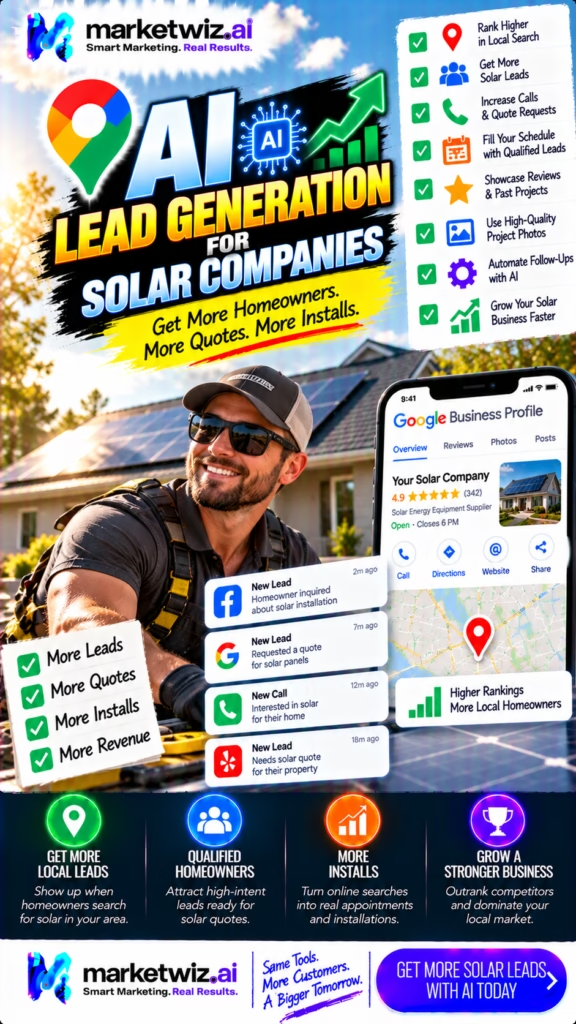
AI Lead Generation for Solar Companies
Solar companies face a unique marketing challenge: homeowners and business owners often need substantial information before making an installation decision. Artificial intelligence can help solar businesses organize inquiries, improve response workflows, support organic marketing, qualify prospective customers, and create a more consistent sales pipeline. This complete guide explains how AI-powered lead generation works for solar installers, how to combine automation with local SEO and content marketing, and how to build a responsible strategy that turns genuine solar interest into qualified consultation opportunities.
1. Understanding AI Lead Generation for Solar Companies
AI lead generation for solar companies involves using artificial intelligence and automated workflows to support the process of attracting, identifying, communicating with, and qualifying potential solar customers.
The technology can assist with activities that traditionally require substantial manual effort, such as organizing inquiries, answering common questions, routing prospects to appropriate team members, and preparing customer communication.
However, AI lead generation should not be confused with fully automated solar selling.
Residential and commercial solar projects involve property conditions, energy consumption, electrical requirements, financing decisions, permitting, and other considerations that require professional evaluation.
AI is most useful when it improves the efficiency of the early customer journey without replacing the technical expertise needed for a successful solar installation.
Core components of AI solar lead generation
- Organic prospect discovery
- AI-assisted marketing content
- Website inquiry management
- Automated initial responses
- Preliminary lead qualification
- Customer question handling
- Appointment coordination
- CRM lead organization
- Permitted follow-up workflows
- Sales pipeline reporting
- Human escalation for complex questions
- Marketing performance analysis
The purpose of AI solar lead generation is not to replace a knowledgeable solar consultant. It is to help the company spend less time on repetitive administrative work and more time speaking with prospects who are ready for meaningful project discussions.
2. Why Solar Companies Need Smarter Lead Generation
Solar installation is a considered purchase.
Prospective customers may research multiple installers, compare equipment options, ask about warranties, review financing arrangements, and evaluate whether solar makes sense for their property.
The sales process can involve several interactions before a customer decides to request a detailed proposal.
A solar company therefore needs more than a collection of contact names.
It needs a reliable process for identifying genuine interest, responding to inquiries, organizing information, and helping customers understand their options.
Common solar lead generation challenges
Inconsistent Inquiry Flow
Lead volume may fluctuate across seasons, geographic markets, and marketing channels.
Slow Response Processes
Manual inquiry handling can create delays when sales teams are busy with consultations and installations.
Unqualified Prospects
Some inquiries fall outside the service area or do not match the company's project capabilities.
Complex Sales Journeys
Customers may need education and multiple conversations before moving forward.
AI-supported systems can help address some of these operational challenges.
The strongest improvements usually come from combining automation with clear qualification standards, accurate marketing, and human accountability.
3. How the AI-Powered Solar Lead Generation Process Works
A useful solar lead generation system should follow a clear customer journey.
Every stage should have a defined purpose, from the first discovery interaction to the eventual sales consultation.
Attract Relevant Solar Prospects
Use local SEO, educational content, organic social media, referrals, and other relevant marketing channels to reach people interested in solar energy.
Capture Customer Inquiries
Provide clear website forms, legitimate contact methods, and supported messaging channels that make it easy for prospects to ask questions.
Respond With Approved Information
Use properly configured AI to acknowledge inquiries, answer common questions, and explain the next steps without inventing technical or financial claims.
Collect Preliminary Qualification Details
Ask relevant questions about project location, property type, ownership, and installation interests while minimizing unnecessary personal information.
Route Qualified Inquiries
Send appropriate prospects to authorized sales representatives or consultation scheduling workflows.
Track Outcomes and Improve
Review appointments, consultations, proposals, contracts, and completed projects to identify which marketing activities produce meaningful results.
The process should be designed around the company's actual operations rather than forcing every prospect through the same automated conversation.
4. Generate Solar Leads Without Depending Entirely on Paid Ads
Paid advertising is one way to reach prospective solar customers, but it is not the only option.
Solar companies can also build visibility through organic search, local business listings, educational content, referrals, and consistent social media activity.
Organic channels may require time and ongoing effort, but they can help a business develop its own audience and marketing assets.
Organic solar lead generation channels
- Google Business Profile
- Local search engine optimization
- Solar installation website content
- Educational blog articles
- Relevant social media posts
- Authentic project photography
- Customer referrals
- Local partnerships
- Community education
- Useful video explanations
- Relevant business directories
- Consistent customer engagement
AI can assist with planning and organizing content across these channels.
However, businesses should review AI-generated materials before publishing, particularly when content discusses solar savings, financing, incentives, or equipment performance.
Organic marketing advantage: Building accurate, useful content on business-owned channels can support long-term discoverability without requiring every customer interaction to begin with a paid advertisement.
5. Local SEO for Solar Installation Companies
Local search optimization helps solar installers become discoverable when potential customers look for relevant businesses in their area.
Searches may include phrases such as solar panel installation, residential solar installers, commercial solar companies, or solar installation in a specific city.
A solar company should optimize around the services and locations it genuinely supports.
Local solar SEO essentials
- Accurate business name and contact information
- Clear installation service descriptions
- Relevant geographic service information
- Useful location-specific website content
- Mobile-friendly website navigation
- Appropriate page titles and headings
- Authentic project information
- Consistent local business citations
- Genuine customer reviews
- Helpful educational resources
Companies should avoid publishing large numbers of repetitive location pages that provide little value beyond changing city names.
A useful local page should describe actual availability, services, project considerations, and relevant information for that market.
6. Google Maps Optimization for Solar Companies
Eligible solar businesses can use Google Business Profile to manage information displayed across Google Search and Maps.
Google identifies relevance, distance, and prominence as its main local ranking factors.
Solar companies should maintain accurate information and follow Google's eligibility requirements, especially when operating as service-area businesses.
Google Business Profile checklist
- Claim and verify an eligible profile
- Use the real-world business name
- Select accurate business categories
- Provide correct contact information
- Set an appropriate service area
- Follow address display requirements
- Maintain accurate business hours
- Link to the official website
- Add authentic project photos
- Respond professionally to reviews
- Update important operational information
A solar installer should not create fake office locations to appear in additional cities.
Likewise, the business name should not be stuffed with keywords that are not part of its actual name.
Google Maps visibility depends on multiple factors and cannot be guaranteed by a single profile optimization.
7. Solar Lead Generation Keyword Research
Solar keyword research helps companies understand what prospective customers are trying to accomplish.
Some searchers want basic information about solar energy.
Others are actively comparing installation companies or looking for a consultation.
A strong content strategy should distinguish between these stages of customer intent.
| Search Intent | Example Keyword | Recommended Content |
|---|---|---|
| Educational | How residential solar panels work | Clear educational guide |
| Cost Research | Solar installation cost in [state] | Transparent explanation of cost factors |
| Local Installer | Solar installers in [city] | Accurate local service page |
| Comparison | Solar panels versus grid electricity | Balanced explanation of considerations |
| Commercial | Commercial solar installation company | Commercial project capability page |
| Consultation | Residential solar installation estimate | Clear consultation process |
Keyword research should guide useful content, not encourage repetitive or misleading claims.
The company's website should answer real customer questions at each stage of the buying journey.
8. AI Content Marketing for Solar Installers
Educational content can help solar companies explain unfamiliar technical concepts to prospective customers.
AI writing tools can assist with outlines, first drafts, content organization, and topic research.
However, solar marketing requires careful review because incorrect information may affect significant financial decisions.
Useful solar content topics
Solar Basics
Explain how photovoltaic systems work and what customers should understand before installation.
Installation Process
Describe site assessment, system design, permitting, installation, inspection, and utility coordination.
Equipment Education
Explain panels, inverters, monitoring systems, and battery storage without unsupported performance claims.
Financial Considerations
Discuss the factors affecting project cost and financing while verifying current incentives and assumptions.
The goal is to make solar information more understandable.
Content should not promise specific savings, tax benefits, or payback periods without sufficient supporting information.
Qualified staff should review technical and financial statements before publication.
10. Build a Solar Website That Converts Relevant Visitors
A solar company's website should make it easy for visitors to understand what the business offers and how to request more information.
The website should communicate the installation process clearly without overwhelming visitors with technical jargon.
Essential solar website elements
- Clear residential or commercial service descriptions
- Accurate service area information
- Accessible contact options
- Mobile-friendly inquiry forms
- Explanation of the consultation process
- Authentic project examples
- Relevant qualifications and credentials
- Warranty information where applicable
- Transparent financial disclosures
- Useful educational content
- Fast-loading core pages
- Privacy and consent information
A website should not require visitors to submit extensive personal information before they can learn basic details about the company.
Clear navigation and understandable next steps can reduce friction during the inquiry process.
11. AI Chatbots for Solar Lead Capture
An AI chatbot can help solar website visitors find information and submit inquiries.
For example, a chatbot may explain the company's service area, describe the consultation process, or direct a prospect to a human representative.
The system should use approved business information and avoid inventing technical specifications, pricing, incentives, or installation promises.
Appropriate chatbot tasks
- Answering general company questions
- Explaining consultation steps
- Collecting basic inquiry information
- Identifying the requested project type
- Providing approved service area information
- Routing questions to the correct team
- Supporting authorized scheduling workflows
- Communicating expected response times
A chatbot should clearly identify itself as an automated system when appropriate and provide a reasonable path to human assistance.
AI chatbots should not provide definitive solar savings estimates, credit decisions, or technical installation approvals without qualified human review.
12. AI Lead Qualification for Residential Solar Projects
Lead qualification helps a solar company determine whether an inquiry is appropriate for its installation capabilities.
AI can support preliminary screening by collecting relevant information from interested prospects.
However, early qualification should not be mistaken for a final technical feasibility assessment.
Potential preliminary questions
- What city or service area is the property in?
- Is the project residential or commercial?
- Does the prospect own the property?
- Is the customer interested in panels, batteries, or both?
- Is the project for an existing building or new construction?
- When would the prospect like to discuss the project?
- What contact method does the prospect prefer?
Additional details should be collected only when necessary and handled with appropriate privacy protections.
Roof condition, structural suitability, electrical capacity, and system design require professional assessment.
13. Use AI Lead Scoring Without Losing Human Judgment
Lead scoring is the process of organizing prospects based on defined business criteria.
For solar companies, useful criteria may include service location, project type, requested timeline, and whether the inquiry matches available services.
AI can assist with classification and routing, but automated scores should not become unquestioned decisions.
| Qualification Signal | Possible Interpretation | Recommended Action |
|---|---|---|
| Within Service Area | Potentially eligible for consultation | Continue qualification |
| Outside Service Area | May not match company coverage | Provide accurate coverage information |
| Residential Inquiry | Home installation interest | Route to residential team |
| Commercial Inquiry | Business or facility project | Route to commercial team |
| Requests Technical Estimate | Needs professional evaluation | Arrange qualified consultation |
| General Educational Question | May be early in research | Provide accurate information |
Lead scoring should not rely on unnecessary sensitive personal characteristics.
Teams should periodically review automated decisions for errors, unfair treatment, and missed opportunities.
14. Improve Solar Lead Response Workflows With AI
When someone requests information about solar installation, a clear response can help maintain momentum in the customer journey.
AI can acknowledge an inquiry promptly and communicate the next steps.
The system may also route the request to a team member who handles the relevant project type.
Useful response workflow elements
- Immediate inquiry acknowledgment where supported
- Confirmation that the request was received
- Accurate explanation of the next step
- Appropriate human routing
- Clear business contact information
- Respect for customer communication preferences
- Tracking of unresolved inquiries
- Escalation of complex questions
Response speed should not come at the expense of accuracy.
An immediate but misleading answer may cause more problems than a careful human follow-up.
15. Automate Solar Lead Follow-Up Responsibly
Solar customers may need time to compare options and consider their project.
A well-organized follow-up process can help the company maintain appropriate contact without overwhelming prospects.
AI can support reminders, approved message preparation, and internal workflow management.
Automated calls and messages must follow applicable laws, platform rules, and consent requirements.
Responsible follow-up principles
- Obtain appropriate consent before automated outreach
- Honor opt-out requests promptly
- Respect communication preferences
- Use accurate customer information
- Avoid excessive contact frequency
- Provide useful information rather than repetitive pressure
- Maintain records required for compliance
- Escalate financial and technical questions
Consent requirements can vary by communication method and jurisdiction.
Companies should review their specific obligations before deploying automated calling or messaging.
16. AI Appointment Scheduling for Solar Consultations
Appointment scheduling can become a bottleneck when sales teams handle many inquiries manually.
AI-assisted scheduling can reduce administrative work when connected to an authorized booking system.
The system should only offer genuinely available appointments.
Solar appointment workflow
Confirm Basic Project Fit
Verify relevant service area and project type before offering an appointment.
Check Actual Availability
Use the connected calendar or booking system rather than inventing time slots.
Confirm Appointment Details
Provide the correct date, time, location or meeting format, and preparation instructions.
Support Appropriate Reminders
Send permitted reminders through approved channels and allow customers to reschedule when supported.
The goal is a convenient and reliable consultation experience.
Complex commercial projects may require a different scheduling process from residential consultations.
17. Integrate AI Lead Generation With a Solar CRM
A customer relationship management system helps solar companies organize prospect information and sales activities.
When properly integrated, AI workflows can reduce repetitive data entry and support consistent lead handling.
The CRM should serve as a reliable record of customer interactions and project progress.
Useful solar CRM stages
- New inquiry
- Contact attempted
- Initial response completed
- Preliminary qualification
- Consultation scheduled
- Consultation completed
- Site assessment
- Proposal prepared
- Proposal under review
- Contract signed
- Project in progress
- Installation completed
- Closed or not proceeding
The exact stages should reflect the company's real sales and installation process.
Access controls, data retention, and privacy requirements should be considered when connecting systems.
18. AI Lead Generation for Commercial Solar Companies
Commercial solar projects can differ substantially from residential installations.
Business customers may evaluate larger facilities, multiple properties, different energy usage patterns, and more complex procurement processes.
AI can support inquiry classification, research organization, and administrative communication.
However, commercial project feasibility requires professional engineering, financial, and operational analysis.
Commercial solar lead considerations
- Business location
- Facility type
- Property ownership or authorization
- Project scope
- Available roof or land area
- Electrical infrastructure
- Energy usage considerations
- Decision-making process
- Project timeline
- Professional assessment requirements
Automated systems should not make binding commitments about engineering feasibility, project savings, or financing eligibility.
19. Build Trust With Solar Prospects Through Accurate Marketing
Trust is essential when customers are considering a substantial home or business investment.
Solar marketing should accurately describe the company's services, experience, and consultation process.
AI-generated content should be reviewed carefully before publication.
Trust-building solar marketing elements
- Real company identity and contact details
- Accurate licensing and credential information
- Authentic installation examples
- Clear equipment and warranty explanations
- Transparent project consultation procedures
- Verifiable customer feedback
- Accurate service area information
- Responsible financing discussions
- Honest descriptions of installation timelines
- Accessible human support
Businesses should not invent certifications, customer results, or project histories.
A smaller collection of genuine project examples is more trustworthy than a large portfolio of fabricated work.
20. Handle Solar Savings, Incentives, and Financing Claims Carefully
Solar marketing often discusses electricity savings, tax incentives, financing, and long-term financial benefits.
These subjects require particular care because outcomes vary widely between customers.
Savings may depend on electricity consumption, utility rates, system production, installation costs, financing terms, and other factors.
Incentive eligibility depends on current laws, program rules, customer circumstances, and project details.
Claims requiring verification
- Guaranteed monthly savings
- Specific payback periods
- Claims of free solar panels
- Tax credit eligibility
- Rebate availability
- Financing approval
- System production estimates
- Property value increases
- Installation completion timelines
- Utility bill elimination
Important: AI should not invent solar savings figures or present conditional financial incentives as universally available. Every material claim should be supported by current, verifiable information.
Solar companies should use qualified professionals to review project-specific financial and technical representations.
21. Use Genuine Reviews and Project Examples in Solar Marketing
Customer reviews and completed project examples can help prospective buyers understand a solar company's work.
Authentic feedback may address communication, installation experience, professionalism, and customer support.
Companies should follow applicable review platform policies and avoid manufactured testimonials.
Review and project content best practices
- Request honest reviews without incentives
- Do not purchase fake reviews
- Respond professionally to customer concerns
- Obtain appropriate permission for customer photos
- Use real project imagery
- Describe project details accurately
- Avoid presenting exceptional outcomes as typical
- Protect customer privacy
AI can help organize review response drafts, but human review is important when handling complaints or sensitive project issues.
22. Build a Practical AI Automation Stack for Solar Marketing
An effective solar marketing system does not require every possible AI tool.
The technology should be selected based on the company's actual operational needs.
A smaller, well-integrated system may be more useful than a complicated collection of disconnected tools.
| System Component | Primary Purpose | Important Safeguard |
|---|---|---|
| Website and Forms | Capture relevant inquiries | Privacy notices and appropriate data collection |
| AI Chat Assistant | Answer approved questions and route leads | Human escalation and accuracy monitoring |
| CRM | Organize prospects and sales stages | Access controls and data quality |
| Scheduling System | Coordinate consultations | Real availability and confirmation |
| Content Workflow | Prepare and distribute marketing content | Human editorial review |
| Analytics | Evaluate customer acquisition outcomes | Reliable tracking and interpretation |
Before adding new software, solar companies should identify the exact problem they want to solve.
For example, a business struggling with missed inquiries may benefit more from improved response routing than from generating additional content volume.
23. Privacy, Consent, and Compliance in AI Solar Lead Generation
Solar lead generation often involves personal contact information and details about a customer's property.
Businesses should collect only information needed for legitimate business purposes and protect it appropriately.
Automated outreach also creates legal and platform compliance considerations.
Important compliance priorities
- Appropriate consent for automated communications
- Respect for applicable calling and messaging laws
- Clear opt-out procedures
- Accurate privacy disclosures
- Secure handling of customer information
- Limited access to sensitive records
- Retention and deletion practices
- Truthful advertising claims
- Review of financing and incentive statements
- Human oversight of automated decisions
The exact requirements depend on jurisdiction, communication method, technology, and business practices.
Companies should obtain appropriate professional guidance when implementing regulated outreach or financial marketing workflows.
24. Measure AI Solar Lead Generation Performance
Generating inquiries is only one part of solar customer acquisition.
A business should also evaluate how many prospects are relevant, how many consultations occur, and how many projects progress through the sales pipeline.
AI systems should be evaluated based on meaningful operational results rather than automation activity alone.
| Metric | What It Measures | Why It Matters |
|---|---|---|
| Total Inquiries | Number of incoming prospects | Shows overall inquiry activity |
| Qualified Leads | Prospects meeting relevant criteria | Indicates lead relevance |
| Response Time | Time before an initial response | Helps assess communication efficiency |
| Booked Consultations | Appointments scheduled | Shows progress toward sales discussions |
| Consultation Attendance | Appointments actually completed | Identifies scheduling and engagement quality |
| Proposals Issued | Formal project proposals prepared | Tracks progression toward purchase decisions |
| Signed Contracts | Projects accepted by customers | Measures sales conversion |
| Completed Installations | Projects delivered | Connects marketing with operational outcomes |
Tracking should also distinguish between lead sources.
A large number of inexpensive inquiries may not be valuable if very few match the company's installation capabilities.
Qualified consultations and completed projects provide more meaningful context.
25. Common AI Solar Lead Generation Mistakes to Avoid
Automation can improve efficiency, but poorly designed systems may create confusion or damage customer trust.
Solar companies should address the underlying sales process before automating it extensively.
Common mistakes
- Prioritizing lead volume over lead quality
- Using misleading solar savings claims
- Publishing unverified incentive information
- Allowing AI to invent equipment specifications
- Sending unauthorized automated messages
- Ignoring customer opt-out requests
- Failing to provide human escalation
- Using inaccurate service area information
- Creating duplicate or fabricated business listings
- Publishing fake project photos
- Using overly complicated lead forms
- Failing to integrate lead records with the CRM
- Booking appointments without checking availability
- Ignoring data privacy and security
- Measuring only clicks instead of sales outcomes
A responsible AI implementation should improve clarity, accuracy, and customer experience.
If automation creates more confusion than it resolves, the workflow should be revised.
26. A 90-Day AI Lead Generation Roadmap for Solar Companies
Solar businesses can introduce AI-supported lead generation in manageable stages.
The following 90-day plan is an implementation framework, not a guarantee of leads, sales, or revenue.
Days 1–15: Audit Existing Marketing and Sales Processes
Review current lead sources, website forms, Google Business Profile information, response procedures, CRM records, and consultation workflows.
Days 16–30: Improve Organic Visibility
Update relevant local SEO information, clarify service pages, and identify useful solar education topics for the website and social media.
Days 31–45: Introduce AI Inquiry Handling
Configure approved AI responses, define human escalation rules, and test customer inquiry routing before broader deployment.
Days 46–60: Add Qualification and CRM Organization
Create relevant lead qualification questions, connect authorized systems, and establish clear sales pipeline stages.
Days 61–75: Improve Scheduling and Follow-Up
Review real appointment availability, customer consent, follow-up procedures, and communication preferences.
Days 76–90: Measure and Refine
Compare qualified inquiries, consultations, proposals, contracts, and operational outcomes. Correct inaccurate automation behavior and refine marketing priorities.
Companies should expand automation only after testing its accuracy, reliability, and compliance.
27. Advanced AI Lead Generation Strategies for Solar Businesses
Once a solar company has reliable foundational workflows, it can consider more advanced automation and marketing improvements.
Use intent-based content planning
Separate educational topics from high-intent installation searches.
This helps the company serve prospects at different stages of the buying journey.
Improve lead source attribution
Where technically and legally appropriate, record which marketing channels contribute to customer inquiries.
Avoid assuming that every inquiry came from the last website page visited.
Introduce human-reviewed AI summaries
AI can summarize customer conversations for authorized team members, helping reduce repetitive administrative work.
Summaries should be checked for accuracy before being used in technical or financial decisions.
Segment residential and commercial workflows
Different project types may require different qualification questions, sales representatives, and scheduling processes.
Improve appointment preparation
Provide customers with accurate information about what to expect during a solar consultation.
Do not request sensitive documents until they are necessary and can be handled securely.
Review automation quality regularly
Audit AI responses for accuracy, privacy issues, unintended promises, and missed human escalations.
Advanced solar automation should make the customer experience more reliable, not merely more automated. The best workflows combine useful technology with knowledgeable human support.
28. AI Solar Marketing and Organic Lead Generation With Market Wiz AI
Solar companies need consistent visibility and reliable customer communication to support their growth.
Market Wiz AI focuses on coordinated digital marketing, organic content distribution, and AI-supported customer engagement for businesses.
For solar installers, a coordinated approach can connect local search visibility, useful educational content, social media activity, and organized lead follow-up.
The objective is to help businesses build a more consistent online presence and manage genuine customer interest more effectively.
Solar marketing priorities
- Local search visibility
- Accurate business information
- Consistent organic content
- Educational solar marketing
- Clear customer communication
- AI-supported inquiry organization
- Appropriate lead qualification
- Reliable human follow-up
- Transparent performance measurement
Solar companies should choose marketing systems that fit their actual service capabilities, team resources, and customer acquisition goals.
30 Frequently Asked Questions About AI Lead Generation for Solar Companies
1. What is AI lead generation for solar companies?
AI lead generation for solar companies uses artificial intelligence and automation to support prospect discovery, customer communication, lead qualification, appointment coordination, and sales pipeline management.
2. How can AI help solar companies generate leads?
AI can help solar companies organize inquiries, answer common questions, route prospects, support content creation, and automate permitted follow-up activities while human teams handle complex technical and financial decisions.
3. Can solar companies generate leads without paid advertising?
Yes. Solar companies can attract prospects through organic search, Google Business Profile optimization, useful educational content, referrals, social media, and relevant local marketing.
4. What is solar lead qualification?
Solar lead qualification is the process of determining whether an interested prospect fits a solar company's service area, installation capabilities, project requirements, and appointment criteria.
5. Can AI qualify residential solar leads?
AI can collect preliminary information such as location, property ownership, roof type, and project interests, but technical eligibility and financial suitability should be reviewed by qualified professionals.
6. How does AI improve solar lead response time?
Properly configured AI systems can acknowledge inquiries promptly, provide approved information, and notify the appropriate team member without waiting for manual review of every message.
7. Can AI book solar consultation appointments?
AI can support appointment scheduling when integrated with an authorized calendar or booking system, subject to availability, customer consent, and the company's scheduling rules.
8. What is the difference between solar leads and qualified solar leads?
A solar lead is an interested prospect. A qualified solar lead meets defined criteria that make the inquiry appropriate for further consultation or evaluation.
9. Does Google Maps help solar companies get leads?
Google Maps can help eligible solar businesses become discoverable in relevant local searches when their business profiles contain accurate information and follow Google's guidelines.
10. What SEO keywords should solar companies target?
Solar companies can research relevant phrases such as solar panel installation, residential solar installers, commercial solar installation, and location-specific searches that accurately match their offerings.
11. Can AI write marketing content for solar installers?
AI can assist with drafting educational articles, social posts, and website content, but companies should verify technical claims, local incentives, pricing, and savings statements before publication.
12. How can solar companies use social media for lead generation?
Solar companies can share educational information, authentic project examples, customer questions, installation explanations, and useful local content to build awareness and encourage inquiries.
13. Can AI follow up with solar leads automatically?
AI can support follow-up workflows through permitted communication channels when the business has appropriate consent, follows applicable laws, and provides required opt-out options.
14. Is AI solar lead generation better than buying leads?
Neither approach is universally better. AI-supported owned-channel marketing may improve control over prospect relationships, while purchased leads vary in quality, exclusivity, cost, and compliance.
15. How much does AI solar lead generation cost?
Costs depend on the software, integrations, content production, communication volume, management requirements, and whether a company uses an agency or an internal team.
16. Can AI help solar companies manage customer inquiries after hours?
Yes. An appropriately configured system can provide approved answers, collect inquiries, and communicate expected next steps outside regular business hours.
17. What information should a solar lead form collect?
A solar lead form may collect contact information, service location, project type, property ownership status, and preferred contact method, while minimizing unnecessary personal data.
18. Can AI estimate solar panel savings?
AI may assist with preliminary explanations, but reliable savings estimates require verified assumptions about electricity rates, system design, production, costs, incentives, financing, and usage.
19. Should solar companies use AI chatbots?
AI chatbots can be useful for handling common questions and routing inquiries when they are transparent, accurate, monitored, and able to escalate complex issues to humans.
20. How does CRM integration improve solar lead generation?
CRM integration can centralize inquiries, reduce duplicate data entry, track sales stages, and help teams follow up consistently with appropriate access controls.
21. What are the biggest mistakes in AI solar lead generation?
Common mistakes include misleading savings claims, poor lead qualification, unauthorized automated outreach, inaccurate AI answers, weak human oversight, and failure to measure actual sales outcomes.
22. Can AI help commercial solar companies find prospects?
AI can help organize research, classify inbound inquiries, and support business development workflows, but commercial project feasibility requires detailed professional evaluation.
23. How can solar installers improve website conversion rates?
Solar installers can improve website usability with clear service areas, trustworthy project information, transparent consultation steps, mobile-friendly forms, and accessible contact options.
24. Can AI identify the best solar leads?
AI can help prioritize leads using relevant, lawfully collected business criteria, but scoring should be monitored for accuracy, bias, and inappropriate assumptions.
25. How long does organic solar lead generation take?
Organic results vary by market competition, website condition, content quality, local reputation, and marketing consistency. There is no guaranteed timeframe.
26. What metrics should solar companies track?
Useful metrics include qualified inquiries, response times, booked consultations, attended appointments, proposals, signed contracts, acquisition costs, and completed installations.
27. How can solar companies avoid low-quality leads?
Solar companies can use clear service descriptions, accurate marketing claims, relevant qualification questions, and transparent consultation requirements to reduce unsuitable inquiries.
28. Does AI replace solar sales representatives?
AI is best used to support repetitive tasks and customer communication. Human professionals remain important for technical assessments, financial explanations, project proposals, and relationship building.
29. How can solar companies use AI responsibly?
Responsible AI use includes transparency, consent-based communications, privacy safeguards, accurate information, human escalation, compliance reviews, and ongoing monitoring.
30. What is the best AI lead generation strategy for solar companies?
A strong strategy combines relevant organic marketing, accurate local SEO, educational content, prompt inquiry handling, practical lead qualification, CRM organization, compliant follow-up, and human-led solar consultations.
30 Additional SEO Keywords for AI Solar Lead Generation
These search phrases can support solar marketing research, educational content planning, website optimization, and relevant organic lead generation strategies.
Final Thoughts: Build a Smarter Solar Lead Generation System
AI lead generation offers solar companies an opportunity to improve the organization, consistency, and efficiency of customer acquisition.
The strongest systems combine accurate local marketing, educational content, accessible inquiry channels, and reliable customer communication.
AI can help manage repetitive tasks, support preliminary qualification, and organize sales pipeline information.
However, professional solar consultants remain essential for technical assessments, project proposals, financial explanations, and customer decision-making.
Organic search, Google Maps, website content, and social media can help solar businesses build visibility beyond paid advertising.
Automation should support those marketing channels without introducing misleading claims, privacy problems, or unwanted communications.
Companies should measure qualified inquiries, consultations, proposals, contracts, and completed installations rather than judging success only by lead volume.
The most effective AI solar lead generation strategy connects useful marketing, responsible automation, and knowledgeable human sales teams to create a better customer journey.
Turn Smarter Marketing Into More Solar Opportunities
Strengthen your online visibility with coordinated organic marketing, consistent content, and AI-supported customer engagement. Discover how Market Wiz AI helps businesses build a stronger digital presence and organize customer acquisition.
Explore MarketWiz.ai© 2026 Market Wiz AI. This article is for educational purposes and does not provide legal, financial, tax, engineering, or installation advice. Solar incentives, financing requirements, advertising rules, and communication regulations vary. Lead volume, rankings, appointments, savings, and revenue results are not guaranteed.












9. Organic Social Media Marketing for Solar Companies
Social media can help solar installers share useful information and establish familiarity with potential customers.
Consistent content may support awareness among homeowners and business owners who are exploring renewable energy options.
Solar social content ideas
AI can help organize a content calendar and prepare drafts for human review.
Solar companies should avoid posting fabricated customer testimonials or images that falsely represent completed installations.
Authentic, accurate content builds a more reliable brand presence.