

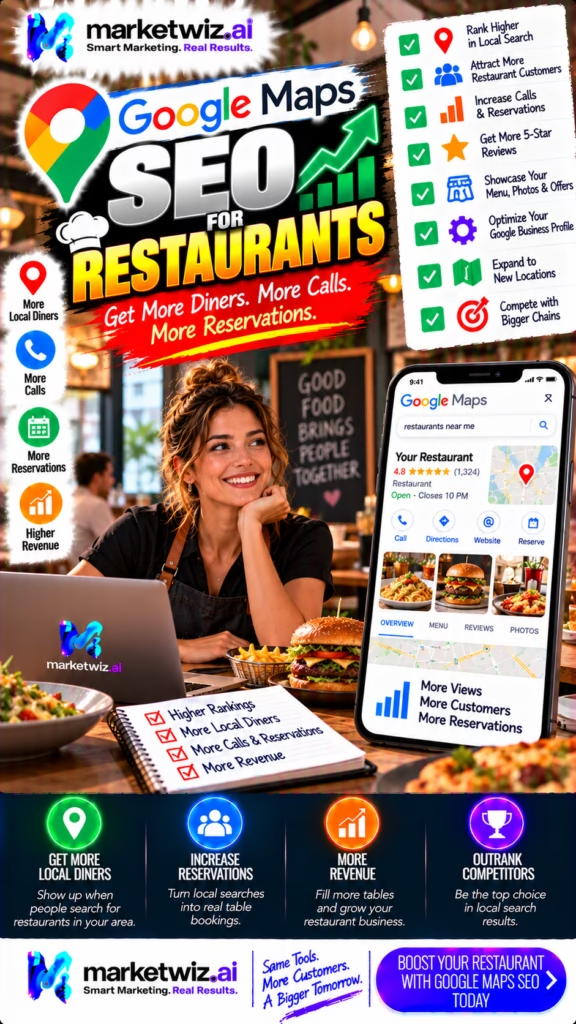
Google Maps SEO for Restaurants
When customers search for somewhere to eat, Google Maps can influence which restaurants they discover, compare, and visit. From cuisine searches and menu browsing to directions, phone calls, reservations, and takeout decisions, a well-maintained local presence helps restaurants connect with diners at important decision-making moments. This comprehensive guide explains how restaurant owners can build stronger Google Maps visibility, improve their Google Business Profile, earn customer trust, and turn local discovery into meaningful dining opportunities.
1. Understanding Google Maps SEO for Restaurants
Google Maps SEO for restaurants is the practice of improving how accurately and prominently a restaurant appears in relevant local Google searches. It involves maintaining a useful Google Business Profile, strengthening the restaurant's website, and helping potential diners find trustworthy information about the dining experience.
Restaurant discovery is especially location-sensitive. A customer searching for Italian food, breakfast, sushi, a family restaurant, or a place to eat nearby may be interested in visiting within a short period of time.
Unlike broader informational searches, many restaurant-related searches combine immediate needs with practical considerations such as distance, opening hours, price range, menu availability, dietary options, and customer reviews.
For restaurant owners, this creates an important opportunity. A relevant and complete business listing can help potential customers understand what the restaurant offers before they ever visit its website.
What restaurant Google Maps SEO includes
- Google Business Profile setup and verification
- Accurate restaurant name, address, and contact details
- Appropriate primary and secondary categories
- Current opening and special holiday hours
- Relevant cuisine and menu information
- Authentic food and restaurant photography
- Genuine customer reviews and thoughtful responses
- Clear reservation and ordering information
- Mobile-friendly restaurant website optimization
- Consistent local business information
- Monitoring customer discovery and engagement
The central goal of restaurant Google Maps SEO is not simply to appear for more searches. It is to appear for searches that accurately match the restaurant's location, cuisine, atmosphere, and customer experience.
A restaurant serving authentic Thai cuisine should prioritize accurate Thai food information rather than attempting to rank for every cuisine category in its city.
Relevance and accuracy create a better foundation for both search visibility and customer satisfaction.
2. Why Google Maps Matters for Restaurant Marketing
Restaurant customers frequently make decisions using several pieces of information at once.
They may compare restaurants based on distance, customer feedback, food photos, opening hours, menu choices, and whether reservations are available.
Google Maps places much of this information within a familiar discovery interface.
A restaurant that maintains accurate and useful information can make it easier for customers to decide whether the business matches their preferences.
Important customer actions
Discover Restaurants
Find relevant dining options based on cuisine, location, and search intent.
Explore Menus
Review available dishes, restaurant offerings, and relevant dining details.
Read Reviews
Understand experiences shared by customers who have visited the restaurant.
Take Action
Request directions, call, visit a website, or use supported ordering and booking options.
These actions can happen before the customer visits a restaurant's own website.
That makes the accuracy of the business listing particularly important.
If a diner sees outdated hours or an incorrect menu, the restaurant may create unnecessary friction before the customer even arrives.
Strong restaurant marketing should therefore connect local discovery with the real dining experience.
3. Google's Three Core Local Ranking Factors for Restaurants
Google identifies three main factors that influence local search rankings: relevance, distance, and prominence.
Understanding these factors helps restaurant owners focus on legitimate improvements rather than misleading ranking shortcuts.
Relevance
Relevance describes how closely a restaurant matches what someone is searching for.
For example, a restaurant with accurate information identifying it as a Japanese restaurant may be more relevant to a search for Japanese food than a business with unrelated categories.
Relevant categories, accurate business descriptions, menu details, and useful website content can help communicate what a restaurant actually offers.
Distance
Distance concerns how far the restaurant is from the location associated with the search.
A diner searching from downtown may see different local results than someone searching from a suburban neighborhood.
Restaurants cannot simply optimize their way around physical distance. Their actual location remains important.
Prominence
Prominence reflects how well-known a business is, including information Google can find about it online.
Google indicates that factors such as reviews and links can contribute to local prominence.
Building a genuine reputation, maintaining a helpful website, and earning relevant recognition can support this dimension.
| Ranking Factor | Meaning | Restaurant SEO Focus |
|---|---|---|
| Relevance | How well the business matches the search | Accurate categories, menus, cuisine details, and business information |
| Distance | Proximity to the searched location | Correct address and map pin |
| Prominence | How established and recognized the business is | Authentic reviews, useful website content, and genuine reputation |
Important: Google does not offer businesses the ability to purchase better organic local rankings. Advertising and organic Google Maps visibility are different marketing activities.
4. Optimize Your Restaurant Google Business Profile
A Google Business Profile is one of the most important sources of restaurant information displayed across Google Search and Maps.
Eligible restaurant owners should claim and verify their business profile, then review each available field for accuracy.
The profile should describe the real business, not an idealized or exaggerated version of it.
Essential profile information
- Real-world restaurant name
- Accurate physical address
- Correct map pin placement
- Primary business category
- Relevant secondary categories
- Business phone number
- Official website URL
- Regular opening hours
- Holiday and special hours
- Appropriate restaurant attributes
- Menu information
- Available reservation or ordering options
- Authentic restaurant photos
Restaurant owners should revisit their profile whenever operational details change.
Seasonal hours, temporary closures, updated menus, and changes to ordering arrangements should be reflected where relevant.
A complete profile is valuable because it reduces uncertainty for diners who are comparing restaurants.
5. Choose the Right Restaurant Categories
Google Business Profile categories communicate the primary nature of a business.
Restaurants should select the most specific available category that accurately represents their main business activity.
For example, a business specializing in Mexican cuisine may have a more appropriate cuisine-specific category than a broad restaurant category, depending on the options available.
Examples of restaurant category considerations
- Italian restaurants
- Mexican restaurants
- Chinese restaurants
- Japanese restaurants
- Thai restaurants
- Indian restaurants
- Seafood restaurants
- Breakfast restaurants
- Pizza restaurants
- Vegetarian restaurants
- Barbecue restaurants
- Fast food restaurants
These are illustrative business types, not a guarantee that every label is currently available as an exact Google Business Profile category.
Restaurant owners should choose from the actual categories presented in Google's interface.
Secondary categories should describe genuine additional business activities.
A restaurant should not add unrelated categories simply to target more keywords.
6. Restaurant Keyword Research for Google Maps SEO
Restaurant keyword research helps owners understand how potential customers describe the food and dining experiences they want.
Search intent may involve cuisine, a specific dish, a neighborhood, a dining occasion, or a practical feature such as takeout availability.
Common restaurant search patterns
| Search Intent | Example Query | Relevant Information |
|---|---|---|
| Cuisine | Italian restaurant in [city] | Accurate cuisine category and menu |
| Dish | Wood-fired pizza near [area] | Actual menu offerings |
| Meal | Breakfast restaurant in [neighborhood] | Breakfast menu and opening hours |
| Dining Occasion | Anniversary dinner in [city] | Authentic atmosphere and reservation details |
| Convenience | Takeout food near [location] | Accurate takeout availability |
| Dietary Preference | Vegetarian restaurant in [city] | Real menu options and accurate dietary information |
Keywords should be incorporated naturally into relevant website content and appropriate profile fields.
Restaurant owners should not modify their business name to include unrelated keywords or geographic phrases unless those words are part of the real-world name.
Restaurant SEO works best when keywords reflect the actual dining experience. A customer searching for gluten-free dishes, outdoor seating, or late-night food should receive accurate information rather than unsupported promotional claims.
7. Optimize Restaurant Menus for Local Search
Menus are among the most important pieces of information customers use when evaluating restaurants.
They help diners understand the cuisine, available dishes, pricing information where provided, and whether the restaurant offers options that match their preferences.
A menu should be accessible, accurate, and easy to navigate on a mobile device.
Restaurant menu SEO best practices
- Use clear names for actual dishes
- Organize items into understandable categories
- Provide useful descriptions where appropriate
- Keep availability and pricing current
- Make menu information accessible on mobile devices
- Include relevant dietary information accurately
- Use readable text rather than relying only on images
- Link to the current menu from the restaurant website
- Maintain consistency across supported ordering platforms
- Remove discontinued offerings when appropriate
A menu published only as a difficult-to-read image may create usability problems for customers.
An accessible HTML menu can make dish information easier to navigate and understand.
Restaurants should also verify that any menu information appearing in their Google Business Profile reflects what customers can actually order.
8. Use Authentic Food Photography to Strengthen Restaurant Discovery
Restaurant photography helps customers evaluate food presentation, atmosphere, seating arrangements, and the overall dining environment.
Images can communicate details that are difficult to convey through text alone.
For example, a customer planning a family dinner may want to understand the seating environment, while someone looking for a quick lunch may be interested in menu presentation and ordering options.
Useful restaurant photo categories
Signature Dishes
Show real menu items prepared and presented by the restaurant.
Restaurant Interior
Help diners understand seating, atmosphere, and the dining environment.
Exterior and Entrance
Make the restaurant easier to recognize when customers arrive.
Dining Experience
Show authentic details such as table settings, dining spaces, and restaurant features.
Restaurants should use images that accurately represent the business.
Misleading stock photos or heavily altered images may create unrealistic expectations.
Image quality matters, but the objective is trustworthy representation rather than artificial perfection.
Adding photos alone does not guarantee improved local rankings.
9. Build Restaurant Reputation Through Genuine Google Reviews
Customer reviews can influence how diners evaluate restaurants.
They may provide information about food, atmosphere, customer experience, and other details that matter during restaurant selection.
Google also identifies review information as relevant to local prominence.
Restaurants should focus on earning authentic feedback through real customer experiences.
Ethical restaurant review strategies
- Make it easy for customers to find the legitimate review link
- Use permitted review QR codes where appropriate
- Invite honest feedback without demanding positive ratings
- Avoid offering discounts or gifts in exchange for reviews
- Do not selectively request reviews only from happy customers
- Never purchase or fabricate customer reviews
- Respond respectfully to relevant feedback
- Use recurring concerns to improve restaurant operations
A restaurant should not pressure customers to leave a review while employees watch.
Review requests should be neutral and consistent with Google's policies.
Reputation principle: Genuine customer feedback is more valuable than manufactured review activity because it helps both future diners and the restaurant itself.
10. Respond to Restaurant Reviews Professionally
Review responses are a public part of restaurant customer communication.
Potential diners may read both the original feedback and the restaurant's response when evaluating a business.
A thoughtful response can demonstrate professionalism and attentiveness.
Responding to positive reviews
Thank the customer for sharing their experience and acknowledge relevant details when appropriate.
Responses should sound natural rather than relying on the same repetitive promotional script.
Responding to negative reviews
Remain respectful, avoid arguments, and acknowledge concerns without revealing private customer information.
When an issue requires additional investigation, offer an appropriate way to continue the conversation.
Do not invent explanations or make promises that the restaurant cannot fulfill.
Customer feedback may also reveal operational issues that deserve internal attention.
11. Keep Restaurant Hours and Special Hours Accurate
Restaurant hours are particularly important because many diners search shortly before visiting.
A customer may be deciding where to eat during lunch, planning a late dinner, or checking whether a restaurant is open during a holiday.
Incorrect hours can lead to unnecessary travel and customer frustration.
Hours that may require review
- Regular opening and closing times
- Different weekday and weekend hours
- Holiday hours
- Temporary closures
- Seasonal schedules
- Special event closures
- Relevant kitchen or ordering hours
- Changes to dine-in availability
Restaurants should use the appropriate Google Business Profile features to communicate supported hours and operational changes.
Website and third-party information should also be reviewed for consistency.
12. Optimize Restaurant Reservations and Booking Information
Reservations can be an important part of the dining journey for restaurants that accept advance bookings.
Customers may want to confirm availability before choosing a restaurant for a date night, business dinner, celebration, or group gathering.
A clear booking process reduces uncertainty and unnecessary steps.
Reservation optimization checklist
- Use accurate reservation information
- Link to an appropriate booking provider where supported
- Explain whether walk-ins are accepted
- Communicate relevant party-size requirements
- Keep booking policies current
- Make the reservation process mobile-friendly
- Clarify cancellation policies where applicable
- Avoid advertising unsupported booking availability
Reservation features and integrations vary by restaurant, provider, region, and eligibility.
Restaurants should verify their available options rather than assuming a booking feature is supported universally.
Reservation functionality may improve convenience, but it does not guarantee a higher Google Maps ranking.
13. Improve Takeout, Pickup, and Delivery Visibility
Not every customer searching for a restaurant intends to dine in.
Some customers are looking for takeout, pickup, or delivery.
These searches often include practical questions about menu availability, ordering methods, hours, and service coverage.
Restaurants should clearly communicate the options they actually provide.
Useful ordering information
- Whether takeout is available
- Whether pickup is supported
- Whether delivery is available
- Current ordering methods
- Supported third-party ordering providers
- Relevant ordering hours
- Menu availability
- Accurate customer instructions
Where Google supports relevant ordering integrations, restaurants can review the information displayed in their listing.
Ordering options should not be advertised unless they are actually available.
14. Build a Restaurant Website That Supports Google Maps SEO
A restaurant website provides additional space to communicate details that may not fit comfortably within a business profile.
It can help customers explore menus, restaurant history, dining options, location information, and reservation or ordering procedures.
A useful website should work well on mobile devices, where many local searches take place.
Important restaurant website elements
- Clear restaurant name and cuisine
- Accurate location and contact information
- Current opening hours
- Accessible menu pages
- Useful food and restaurant photography
- Mobile-friendly navigation
- Fast-loading core pages
- Reservation information where applicable
- Ordering information where applicable
- Accessible contact details
- Relevant local page titles and descriptions
- Appropriate structured data
The website should reflect the restaurant's real offerings and atmosphere.
Avoid publishing large numbers of repetitive pages that merely swap neighborhood names.
Useful local content should provide genuine information for the intended audience.
15. Mobile SEO for Restaurant Searches
Restaurant discovery frequently happens on smartphones.
A diner may be walking through a neighborhood, traveling through an unfamiliar city, or deciding where to eat while already away from home.
Mobile usability is therefore a practical part of restaurant customer experience.
Mobile restaurant website priorities
- Readable menus without excessive zooming
- Easy access to address and directions
- Clearly displayed phone number
- Simple reservation navigation
- Accessible ordering information
- Legible text and buttons
- Fast-loading images
- Minimal disruptive pop-ups
- Consistent mobile and desktop information
A visually impressive website may still frustrate customers if essential information is difficult to find.
Restaurants should test their mobile experience using real devices and realistic customer tasks.
16. Create Restaurant Content That Matches Local Search Intent
Restaurant content should answer questions that potential diners genuinely care about.
Useful content may describe the cuisine, menu specialties, restaurant atmosphere, dining options, or relevant local information.
The objective is not to publish articles solely to repeat restaurant keywords.
Content should help customers understand whether the restaurant matches their needs.
Examples of useful restaurant content
- Descriptions of signature dishes
- Current seasonal menu information
- Restaurant history and culinary approach
- Dining room and seating information
- Information about real dietary options
- Special event or group dining policies
- Ordering and pickup instructions
- Location and parking information
- Frequently asked customer questions
- Accurate updates about menu changes
A restaurant known for wood-fired pizza might explain its preparation process and current pizza offerings.
A breakfast restaurant might provide useful details about morning hours and available breakfast items.
Specific, authentic information is more helpful than generic claims about being the best restaurant in the city.
17. Build Consistent Local Citations for Restaurants
Local citations are online references to a restaurant's business information.
These references may appear on directories, restaurant discovery websites, social platforms, and other relevant business listings.
Consistent information helps reduce confusion when customers encounter the restaurant across different websites.
Information to keep consistent
- Real-world restaurant name
- Physical address
- Phone number
- Official website
- Relevant business category
- Opening hours where listed
Restaurants should prioritize accurate and relevant listings over submitting their information to large numbers of low-quality directories.
If the restaurant moves, changes its phone number, or updates its website, important listings should be reviewed.
Citation consistency is one component of a trustworthy local business presence.
18. Optimize Restaurant Visibility for Neighborhood Searches
Restaurant searches frequently include neighborhood names, districts, landmarks, or specific parts of a city.
A customer may search for lunch near a downtown office district or dinner in a particular neighborhood.
Restaurants should describe their actual location accurately on their website.
Useful neighborhood information
- Correct street address
- Actual neighborhood or district
- Relevant parking information
- Public transportation access
- Entrance instructions when needed
- Nearby landmarks when genuinely helpful
- Accessibility information
A restaurant should not claim to operate in neighborhoods where it has no physical location.
Creating dozens of nearly identical city pages is not a substitute for genuine local relevance.
Neighborhood SEO should help customers find the restaurant. It should not misrepresent where the restaurant is physically located.
19. Google Maps SEO Strategies for Different Restaurant Types
Restaurant SEO priorities can vary depending on the business model.
A fine-dining restaurant may place greater emphasis on reservations and atmosphere, while a quick-service restaurant may prioritize accurate ordering and pickup information.
| Restaurant Type | Customer Priority | SEO and Profile Focus |
|---|---|---|
| Fine Dining | Atmosphere, menu, reservations | Authentic interior photos, menu details, booking information |
| Fast Casual | Convenience, menu, location | Accurate hours, ordering information, easy directions |
| Breakfast Restaurant | Morning availability and menu | Opening hours, breakfast dishes, relevant categories |
| Pizza Restaurant | Pizza offerings, takeout, delivery | Menu accuracy, ordering methods, authentic food photos |
| Seafood Restaurant | Menu, freshness-related information, atmosphere | Current offerings, restaurant details, genuine reviews |
| Family Restaurant | Menu variety, seating, convenience | Accurate dining information and helpful atmosphere photos |
| Vegetarian Restaurant | Relevant dietary offerings | Accurate menu descriptions and appropriate categories |
| Food Truck | Current operating location and schedule | Eligibility-compliant profile information and reliable location updates |
Each restaurant should optimize around what it actually provides.
A strategy based on accurate differentiation is more useful than copying every feature from competing businesses.
20. Google Maps SEO for Multi-Location Restaurants
Restaurant groups operating multiple physical locations need consistent brand information while preserving the unique details of each location.
Each eligible restaurant location should have its own accurate business profile.
The website should also help customers identify the correct restaurant location.
Multi-location SEO checklist
- Maintain eligible profiles for individual locations
- Use accurate location-specific addresses
- Display correct hours for each restaurant
- Link to the appropriate location page
- Identify location-specific menu differences
- Use genuine photos of each location
- Keep local contact details current
- Monitor reviews for individual locations
- Prevent duplicate or conflicting listings
- Maintain consistent brand standards
A multi-location website can provide a clear location directory with useful individual restaurant pages.
These pages should contain real location information rather than automatically generated duplicate content.
21. Use Restaurant Schema Markup Correctly
Structured data helps search engines interpret information published on a website.
Schema.org includes a Restaurant type that can describe restaurant information.
Depending on the website and applicable search engine support, relevant structured data may include business identity, address, opening hours, cuisine, menu URL, and other factual details.
Restaurant schema implementation principles
- Use accurate restaurant information
- Match structured data to visible page content
- Use the correct business type
- Include legitimate location information
- Keep hours and menu references current
- Follow applicable Google structured data policies
- Validate markup before publication
- Avoid inventing ratings or review counts
Structured data should describe the actual restaurant and its publicly available information.
It does not guarantee special search features or higher Google Maps rankings.
23. Track Restaurant Google Maps SEO Performance
Restaurant owners should evaluate whether their local visibility efforts are helping customers discover and engage with the business.
Google Business Profile offers performance information for eligible businesses, although available metrics and interfaces can change over time.
Website analytics, reservation systems, and ordering tools may provide additional insight into customer behavior.
| Metric | What It Indicates | How to Use It |
|---|---|---|
| Profile Interactions | Available customer engagement activity | Monitor changes in listing engagement |
| Website Visits | Traffic reaching restaurant pages | Evaluate website discovery and navigation |
| Phone Inquiries | Customer calls where measurable | Assess communication demand |
| Direction Requests | Interest in navigating to the location | Observe location-related engagement |
| Reservations | Bookings through tracked systems | Review dining conversion activity |
| Online Orders | Transactions through supported platforms | Evaluate ordering performance |
| Customer Reviews | Public feedback and reputation trends | Identify strengths and recurring concerns |
No single metric provides a complete picture of restaurant marketing performance.
A restaurant may receive more website visits without a corresponding increase in reservations.
Owners should connect visibility metrics with meaningful business outcomes where reliable measurement is possible.
24. Common Google Maps SEO Mistakes Restaurants Should Avoid
Many restaurant visibility problems begin with inaccurate or neglected business information.
Other issues result from attempting to manipulate rankings rather than improving the customer experience.
Restaurant SEO mistakes
- Leaving outdated opening hours online
- Publishing menus that no longer reflect available dishes
- Choosing unrelated business categories
- Adding keywords to the business name improperly
- Using an incorrect address or map pin
- Buying or fabricating Google reviews
- Offering incentives in exchange for reviews
- Using misleading food photography
- Ignoring mobile website usability
- Creating duplicate restaurant profiles
- Publishing thin, repetitive location pages
- Displaying unsupported reservation options
- Ignoring negative customer feedback
- Failing to update important directory listings
- Expecting guaranteed ranking results from one optimization
A restaurant should review its listing from the perspective of someone who has never visited before.
Can that person understand the cuisine, find the location, inspect the menu, confirm the hours, and take the next step?
If not, those customer experience problems deserve attention.
25. A Practical 90-Day Google Maps SEO Roadmap for Restaurants
Restaurant owners can organize local SEO improvements through a staged plan.
This 90-day framework provides an operational sequence rather than a guarantee of ranking or revenue results.
Days 1–15: Audit the Restaurant Listing
Review profile ownership, verification, business name, address, map pin, phone number, website, categories, and current opening hours.
Days 16–30: Improve Menu and Dining Information
Update menu details, review ordering and reservation options, and confirm that restaurant attributes accurately reflect the business.
Days 31–45: Strengthen Photography and Reputation
Add authentic restaurant images, review existing customer feedback, and establish a policy-compliant process for requesting honest reviews.
Days 46–60: Improve the Restaurant Website
Review mobile navigation, menu accessibility, location information, page titles, internal links, and relevant structured data.
Days 61–75: Review Local Listings and Content
Correct important directory information, publish genuinely useful restaurant content, and ensure consistency across relevant platforms.
Days 76–90: Measure and Refine
Review available profile performance metrics, website engagement, reservations, ordering activity, and customer feedback to identify the next priorities.
Some improvements, such as correcting hours, may immediately improve information accuracy for customers.
Ranking changes depend on many factors and may take longer or may not occur as expected.
26. Advanced Restaurant Google Maps SEO Strategies
Once the foundational information is accurate, restaurants can focus on deeper improvements that strengthen relevance and customer usefulness.
Improve menu discoverability
Review whether important menu items are represented clearly on the website and through supported business profile features.
Strengthen local website content
Publish information that helps customers understand the restaurant's actual location, cuisine, dining experience, and practical options.
Maintain operational consistency
Coordinate updates between restaurant management, the website, the business profile, and relevant ordering platforms.
Review customer feedback themes
Look for recurring questions or concerns that can be addressed through better information or operational improvements.
Improve conversion paths
Make it easier for customers to find the current menu, request directions, call the restaurant, or use legitimate booking and ordering options.
Monitor location-specific performance
For restaurant groups, review each location individually rather than assuming that one optimization strategy will perform identically everywhere.
Advanced restaurant SEO is not about finding a secret ranking trick. It is about improving the accuracy, depth, usefulness, and consistency of the restaurant's online presence.
27. Restaurant Marketing and Local Visibility With Market Wiz AI
Google Maps SEO is an important part of restaurant discovery, but it works best as part of a coordinated marketing strategy.
A restaurant may also benefit from useful website content, consistent social media activity, accurate online listings, and organized customer communication.
Market Wiz AI focuses on helping businesses strengthen their online presence through coordinated digital marketing, content distribution, and AI-supported customer engagement.
For restaurant marketing, the underlying objective is to help customers discover accurate information and understand what makes the business relevant to their dining needs.
Core restaurant marketing priorities
- Accurate restaurant information
- Strong local search relevance
- Consistent digital visibility
- Authentic food and dining content
- Useful customer communication
- Clear reservation and ordering information
- Mobile-friendly customer experiences
- Ongoing performance measurement
The strongest approach connects customer discovery with a reliable and welcoming restaurant experience.
30 Frequently Asked Questions About Google Maps SEO for Restaurants
1. What is Google Maps SEO for restaurants?
Google Maps SEO for restaurants is the process of improving a restaurant's local search presence through an accurate Google Business Profile, relevant business information, menu details, authentic reviews, useful photos, and a strong restaurant website.
2. How do restaurants rank higher on Google Maps?
Restaurants can improve their local visibility by maintaining accurate Google Business Profile information, selecting appropriate categories, publishing useful website content, earning genuine customer reviews, and strengthening local relevance and prominence. Rankings are not guaranteed.
3. What factors influence restaurant rankings on Google Maps?
Google identifies relevance, distance, and prominence as the main factors affecting local search rankings. Accurate restaurant information, genuine reviews, and a useful online presence can support those factors.
4. Is Google Business Profile free for restaurants?
Yes. Eligible restaurants can create and manage a Google Business Profile without paying Google for the listing.
5. What Google Business Profile category should a restaurant choose?
Restaurants should choose the most accurate available primary category for their actual business, such as an appropriate restaurant or cuisine-specific category, and add relevant secondary categories when justified.
6. Do Google reviews help restaurant SEO?
Genuine customer reviews can support a restaurant's reputation and local prominence. Google indicates that more reviews and positive ratings can help local rankings, but no particular ranking position is guaranteed.
7. How can restaurants get more Google reviews?
Restaurants can invite customers to share honest experiences through permitted review links or QR codes, without offering incentives or selectively requesting only positive reviews.
8. Should restaurants respond to Google reviews?
Yes. Thoughtful responses can demonstrate attentiveness, clarify concerns, and help future diners understand how the restaurant communicates with customers.
9. Do restaurant photos improve Google Maps rankings?
Authentic food, interior, exterior, and atmosphere photos help diners evaluate a restaurant. Photos improve listing usefulness, although uploading photos alone does not guarantee a ranking increase.
10. How often should restaurants update their Google Business Profile?
Restaurants should update their profile whenever hours, menus, contact details, ordering options, or other important information changes, and review the listing regularly for accuracy.
11. Does adding a menu help restaurant local SEO?
Accurate menu information helps Google and customers understand what a restaurant offers and supports searches for relevant dishes and cuisine types.
12. Can restaurants rank for specific dishes on Google Maps?
Restaurants may appear for relevant dish searches when their actual offerings, menu information, website content, and business profile align with the searcher's needs and location.
13. Does a restaurant need a website for Google Maps SEO?
A restaurant can have a Google Business Profile without a website, but an accurate, mobile-friendly website can provide additional menu, location, reservation, and customer information.
14. How important is mobile SEO for restaurants?
Mobile SEO is important because many diners use phones to find restaurants, inspect menus, check hours, request directions, call, and make reservations.
15. Do online reservations help restaurant SEO?
Accurate reservation options can make a restaurant listing more useful and reduce booking friction, but enabling reservations does not guarantee improved Google Maps rankings.
16. Can restaurant delivery and takeout options appear on Google?
Depending on eligibility, location, and supported integrations, restaurants can display relevant ordering, pickup, delivery, or related options through Google.
17. What are local citations for restaurant SEO?
Local citations are online references to a restaurant's business details, such as its name, address, phone number, and website, on relevant directories and platforms.
18. Does consistent NAP information matter for restaurants?
Yes. Consistent and accurate name, address, and phone information reduces customer confusion and helps maintain trustworthy business information across online sources.
19. Can restaurants improve Google Maps rankings with keywords?
Restaurants can use relevant cuisine, menu, and location language naturally in their website content and appropriate profile fields, but should not add keywords to their business name unless they are part of the real-world name.
20. How does restaurant location affect Google Maps rankings?
Distance is one of Google's main local ranking factors, so a restaurant's proximity to the searcher or searched location can influence where it appears.
21. Can restaurants pay Google for better organic Maps rankings?
No. Google states that businesses cannot request or pay for better local organic rankings. Paid advertising is separate from organic local search results.
22. How long does Google Maps SEO take for restaurants?
Results vary based on competition, location, listing accuracy, website quality, reputation, and other factors. There is no guaranteed timeframe for ranking improvements.
23. How can new restaurants improve Google Maps visibility?
New restaurants should establish an eligible Google Business Profile, complete accurate business details, publish menus and authentic photos, maintain correct hours, and build genuine customer awareness and reviews.
24. How can restaurants optimize for near me searches?
Restaurants should maintain accurate location details, relevant categories, useful menu information, a mobile-friendly website, and a trustworthy local reputation. Repeating near me phrases is not a substitute for relevance and proximity.
25. Does restaurant schema markup help Google Maps rankings?
Accurate Restaurant structured data can help search engines interpret website information, but schema markup does not guarantee rich results or higher Google Maps rankings.
26. How should restaurants manage multiple locations on Google Maps?
Each eligible restaurant location should maintain its own accurate business profile, location-specific details, hours, and customer information while following Google's guidelines.
27. Can restaurants use Google Business Profile posts for promotions?
Eligible restaurants can use supported Google Business Profile updates to communicate relevant news, events, and offers, subject to current feature availability and content policies.
28. What restaurant SEO mistakes should be avoided?
Avoid inaccurate hours, outdated menus, keyword-stuffed business names, fake reviews, duplicate listings, misleading categories, low-quality location pages, and inconsistent contact information.
29. How can restaurants measure Google Maps SEO performance?
Restaurants can review available Business Profile performance metrics, website analytics, reservation data, phone inquiries, direction requests, and other relevant customer actions.
30. What is the best Google Maps SEO strategy for restaurants?
A strong restaurant Google Maps SEO strategy combines an accurate Google Business Profile, relevant categories, current menus and hours, authentic photos, genuine reviews, useful local website content, and consistent performance monitoring.
30 Additional Restaurant Google Maps SEO Keywords
These related search phrases can support restaurant keyword research, content planning, website optimization, and customer-focused local marketing.
Final Thoughts: Build Stronger Restaurant Visibility on Google Maps
Google Maps SEO helps restaurants make their information more accessible, accurate, and useful to potential diners.
A well-maintained Google Business Profile can communicate essential details such as cuisine, location, opening hours, menus, and customer feedback.
A strong restaurant website adds further context and provides customers with a reliable place to explore dining options, reservation details, and ordering information.
Genuine reviews, authentic photography, accurate local listings, and consistent updates can strengthen the overall customer discovery experience.
Restaurant owners should focus on Google's core local ranking principles: relevance, distance, and prominence.
No individual optimization can guarantee a top Google Maps position.
However, a sustained commitment to accurate business information, useful content, and customer trust creates a stronger foundation for local visibility.
The most effective restaurant SEO strategy helps the right customers discover the right restaurant with the right information at the right moment.
Help More Local Customers Discover Your Restaurant
Build a stronger digital presence with coordinated local marketing, consistent content, and smarter customer engagement. Explore how Market Wiz AI approaches business visibility and organic customer acquisition.
Explore MarketWiz.ai© 2026 Market Wiz AI. This article is for educational purposes. Google features, eligibility, ranking factors, and platform policies may change. Search rankings, reservations, customer traffic, and revenue results are not guaranteed.











22. Connect Restaurant Social Media With Local Discovery
Social media provides another opportunity for restaurants to communicate their identity and offerings.
Food photos, menu updates, behind-the-scenes content, and accurate restaurant announcements can help people become familiar with the business.
While social engagement should not be treated as a guaranteed Google Maps ranking factor, a consistent digital presence can support broader restaurant awareness.
Useful restaurant social content
Restaurants should prioritize accurate content and genuine customer interaction.
Promotional information should remain consistent with the actual menu, hours, and availability.