
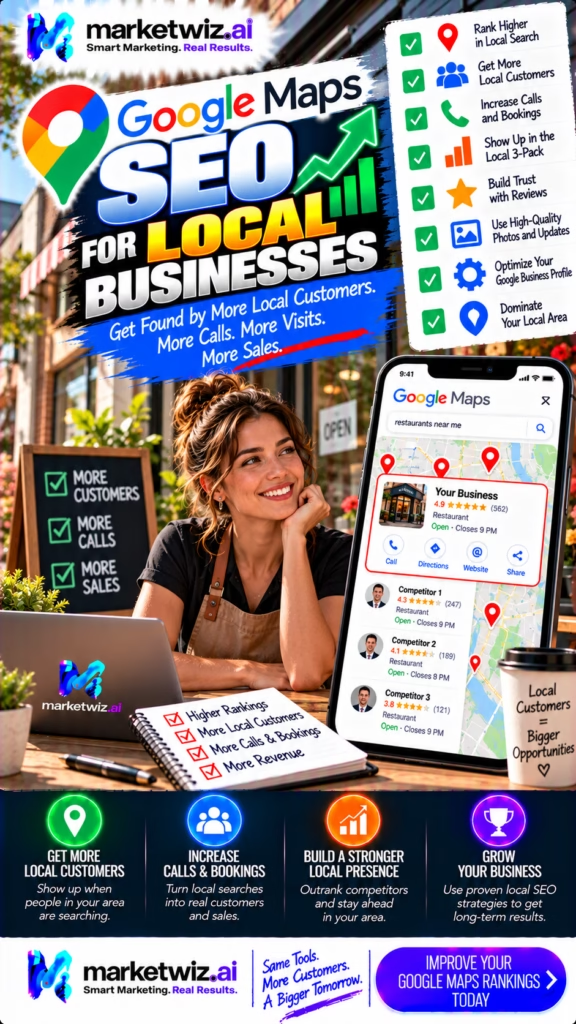
Google Maps SEO for Local Businesses
Google Maps SEO helps local businesses connect with customers searching for nearby products, professional services, stores, contractors, restaurants, and other local solutions. By combining Google Business Profile optimization, accurate business information, relevant website content, authentic customer reviews, local keyword research, and effective lead management, businesses can build a stronger presence in local search and create more opportunities for qualified calls, website visits, appointments, and sales.
Why Google Maps SEO Matters for Local Businesses
Local customers increasingly rely on digital search to decide which businesses deserve their attention. Whether someone needs an emergency plumber, a nearby restaurant, a roofing contractor, a dental office, a flooring specialist, or a local retail store, Google Search and Google Maps often play an important role in the discovery process.
Customers want useful answers quickly. They want to know whether a business is nearby, whether it provides the right product or service, whether it appears trustworthy, and how to contact it.
A well-maintained Google Business Profile can help answer those questions before a potential customer even reaches the company's website.
The profile may display business hours, contact information, customer reviews, photos, services, directions, and other details that influence the next decision.
This makes Google Maps SEO more than a technical marketing exercise. It is part of the customer's purchasing journey.
Google Maps SEO connects local search visibility with real customer intent. The objective is not simply to appear for more searches. It is to help the right customers discover a relevant business, understand its value, and take an appropriate next step.
For small businesses competing against larger companies, local search provides an important opportunity to communicate relevance and credibility without relying exclusively on traditional paid advertising.
What Is Google Maps SEO for Local Businesses?
Google Maps SEO is the process of improving a business's local search presence so potential customers can discover it through relevant Google Maps and Google Search results.
It involves maintaining an accurate Google Business Profile, selecting appropriate business categories, explaining products and services, strengthening website relevance, developing a trustworthy reputation, and monitoring customer interactions.
Unlike traditional website SEO, which can target searches from many geographic locations, Google Maps SEO places particular emphasis on local relevance.
A business may be highly relevant to a customer in one neighborhood while appearing less prominently to someone much farther away.
This geographic dimension makes local SEO different from ordinary keyword optimization.
Google Maps SEO typically includes:
- Google Business Profile management
- Business category optimization
- Accurate name, address, and phone information
- Relevant product and service descriptions
- Local keyword research
- Authentic customer reviews
- Professional business photos
- Website SEO and location relevance
- Local citations and business information consistency
- Performance measurement and lead tracking
These elements work together to improve the quality and usefulness of a business's local digital presence.
How Google Maps Rankings Work
Understanding Google's local ranking system is essential before developing an optimization strategy.
Google identifies three primary factors in local rankings: relevance, distance, and prominence.
Relevance
How closely a business profile matches what a customer is searching for.
Distance
How far the business is from the location used for the local search.
Prominence
How well-known or established the business appears, including relevant signals from across the web.
Customer Relevance
A practical optimization objective: provide clear, useful information that helps customers evaluate the business.
Relevance
Relevance reflects how closely a business matches the customer's search.
A company that installs hardwood flooring should clearly communicate its actual flooring offerings. A plumbing company should identify the plumbing work it performs. A restaurant should maintain accurate information about its category and customer experience.
Accurate categories, service details, and website content help establish that connection.
Distance
Distance reflects the relationship between the business location and the location associated with the search.
Businesses cannot simply optimize their way into being geographically closer to every customer.
This is why local rankings may differ significantly between neighborhoods, even within the same city.
Prominence
Prominence relates to how well-known a business is. Google explains that information such as links, articles, directories, review count, and review ratings can contribute to local prominence.
A strong local SEO strategy therefore extends beyond editing a business profile.
It includes the broader reputation and web presence supporting the business.
Optimize Your Google Business Profile
Google Business Profile is a central component of Google Maps SEO.
It provides eligible businesses with a way to manage important information displayed across Google Search and Google Maps.
A complete, accurate profile can make it easier for customers to understand what the business does and whether it meets their needs.
Important profile information includes:
- Real-world business name
- Primary business category
- Relevant additional categories
- Accurate business address or service area
- Business phone number
- Website URL
- Regular and special business hours
- Business description
- Products and services where available
- Authentic business photos
- Relevant business attributes
Accuracy matters because customers use this information to make real decisions.
Incorrect hours may cause a wasted trip. An outdated phone number can prevent an inquiry. Misleading service information may attract customers the business cannot help.
Profile optimization should prioritize usefulness and factual accuracy rather than aggressive keyword insertion.
Important: Google Business Profile names should reflect the business's actual name. Adding artificial keywords, extra cities, or unrelated marketing phrases to the business name can violate Google's guidelines.
Choose the Right Google Business Profile Categories
Business categories help Google understand the nature of a company.
Choosing an accurate primary category is one of the most important foundational decisions when configuring a Google Business Profile.
The primary category should describe the business's central activity as specifically as the available options reasonably allow.
Additional categories can describe other genuine activities when appropriate.
A company should not select unrelated categories simply because those categories receive search traffic.
Examples of category relevance
| Business Type | Category Strategy | Customer Intent |
|---|---|---|
| HVAC Contractor | Choose an accurate HVAC-related category | Heating, cooling, repair, installation |
| Flooring Company | Use categories matching actual flooring work | Floor installation and replacement |
| Cleaning Company | Identify the actual cleaning business type | Residential or commercial cleaning |
| Restaurant | Select the most accurate restaurant category | Food, dining, location, hours |
| Auto Repair Shop | Match the shop's real automotive work | Vehicle diagnostics and repairs |
Category selection should reflect the real business model and should be reviewed when the company meaningfully changes its offerings.
Research Local Keywords That Attract Real Customers
Local keyword research helps businesses understand how nearby customers describe their needs.
Some searches explicitly mention a city or neighborhood. Others use phrases such as "near me" or rely on Google's understanding of the searcher's location.
Businesses should research the language customers actually use rather than assuming every search includes the official name of a service.
Common local keyword patterns
- Product or service + city
- Business category + near me
- Product or service + neighborhood
- Emergency service + location
- Commercial service + city
- Residential service + local area
- Specialized product + nearby location
- Business category + open now
For example, a flooring contractor might research searches related to tile installation, hardwood flooring, luxury vinyl plank, flooring replacement, and local flooring contractors.
A cleaning company might focus on office cleaning, janitorial work, commercial cleaning, recurring cleaning, and building maintenance.
The goal is to identify relevant demand and create useful content around it.
Keywords should appear naturally in website content and appropriate profile fields, not as repetitive lists designed to manipulate rankings.
Write a Strong Google Business Profile Description
A business description should explain what the company does, whom it serves, and what makes its offerings relevant to potential customers.
The strongest descriptions are clear and specific. They avoid exaggerated claims, unrelated keywords, and information that does not help customers.
A local roofing contractor might describe residential roof replacement, roof repairs, roofing materials, and the geographic area it serves.
A commercial cleaning company might explain its office cleaning, facility cleaning, recurring maintenance, and scheduling options.
The description should remain consistent with the company's real services and current capabilities.
Elements of an effective description
- A clear explanation of the business
- Its primary products or services
- Relevant customer types
- Useful specialties or differentiators
- Accurate geographic context
- Natural and professional language
The description is an opportunity to build customer understanding, not a place to insert every possible search phrase.
Use High-Quality Photos to Strengthen Local Trust
Visual content can help customers evaluate a business before making contact.
A customer searching for a restaurant may want to see the dining environment. Someone researching a painting contractor may want to inspect completed projects. A customer choosing a retail store may want to understand the available products.
Useful photos communicate information that a written description cannot always convey.
Photo opportunities for local businesses
Completed Work
Show genuine projects and outcomes relevant to the business's actual offerings.
Business Location
Help customers recognize an eligible storefront or physical business location.
Products
Present real products, inventory, equipment, or merchandise accurately.
Team and Operations
Provide authentic insight into the people, facilities, and work behind the company.
Businesses should avoid misleading imagery that suggests work, facilities, or products they do not actually provide.
Photos should support trust through accuracy, clarity, and relevance.
Build a Strong Google Reviews Strategy
Customer reviews are an important component of local business reputation.
Reviews can help prospective customers understand what others experienced and whether a company appears suitable for their needs.
Google also identifies review count and positive ratings as factors that can help local rankings.
Businesses should therefore create a consistent, ethical process for requesting genuine customer feedback.
Best practices for requesting reviews
- Ask customers for honest feedback
- Use Google's permitted review link or QR code
- Make the process easy to understand
- Request feedback consistently
- Do not offer incentives in exchange for reviews
- Do not request only positive reviews
- Never purchase or fabricate customer reviews
- Respond professionally when appropriate
A business with a thoughtful review process can gather useful feedback while building a more informative public reputation.
Review quality matters. The objective should be to represent genuine customer experiences, not to manufacture a perfect-looking rating. Authentic feedback supports better customer decisions and a more credible business presence.
Respond to Reviews and Strengthen Customer Confidence
A review response provides another opportunity to communicate professionalism.
Positive reviews can be acknowledged with a genuine thank-you. Critical reviews can be addressed with empathy, factual accuracy, and an appropriate path toward resolution.
Businesses should avoid arguing publicly with customers or disclosing private information.
The response should reflect the actual circumstances and avoid scripted language that feels disconnected from the customer's experience.
For local businesses, reputation management is not only about search visibility.
It is also about how potential customers interpret the company's communication and accountability.
Maintain Accurate Business Information and Local Citations
Local citations are references to a business across websites, directories, business listings, and other relevant online resources.
These references may contain the company's name, address, phone number, website, or business category.
Maintaining accurate information helps customers recognize the business and avoid confusion.
In local SEO, this is often described as NAP consistency: name, address, and phone number.
Common citation locations
- Relevant business directories
- Local chamber of commerce listings
- Industry-specific directories
- Business association websites
- Local organization directories
- Established review platforms
- Relevant community business resources
Businesses should prioritize legitimate, relevant citations rather than creating large volumes of low-quality listings.
Outdated information should be corrected when practical, particularly after a company changes its location, phone number, website, or name.
Connect Google Maps SEO With Your Website
A Google Business Profile can introduce customers to a company, but a website can provide the deeper information needed to make a purchasing decision.
A useful local business website should explain what the company offers, where it operates, and how customers can contact it.
It should also provide helpful information about services, products, project requirements, pricing considerations, and common customer questions.
Important website SEO elements
- Clear page titles and headings
- Useful product and service pages
- Accurate location and contact information
- Mobile-friendly design
- Fast and reliable page loading
- Logical website navigation
- Relevant internal links
- Accessible contact options
- Appropriate structured data
- Original and helpful content
Website SEO and Google Maps SEO should complement each other rather than operate as unrelated marketing activities.
When a customer clicks from a business profile to a website, the experience should remain consistent and relevant.
Create Service Pages That Support Local Search Intent
Businesses with several distinct offerings may benefit from dedicated service pages.
These pages can provide more specific information than a general homepage.
For example, an HVAC company may have separate pages for air conditioning repair, heating repair, system installation, and maintenance.
A painting company may develop pages for interior painting, exterior painting, cabinet painting, and commercial painting.
Each page should explain the actual service and help the customer understand its relevance.
Useful service-page information
- What the service includes
- Who the service is intended for
- Common customer problems
- Available options or configurations
- Typical project considerations
- Relevant service locations
- Examples of completed work
- Frequently asked questions
- How to request additional information
The objective is to make each page useful enough to stand on its own.
Build Helpful City and Location Landing Pages
Businesses serving multiple communities may need to explain their geographic coverage.
Location pages can help customers understand whether the company operates in a particular city or neighborhood.
However, creating dozens of nearly identical pages with only the city name changed is not a sustainable SEO strategy.
Each location page should contain meaningful information that genuinely relates to the location being discussed.
Useful location-specific content
- Services actually available in the area
- Relevant operating or travel considerations
- Real local project examples
- Accurate location or service-area details
- Customer questions relevant to that market
- Local business information where applicable
A business should never imply that it operates a physical office in a city when it does not.
Honest geographic information helps customers understand coverage and supports a more trustworthy website.
Google Maps SEO for Service-Area Businesses
Many local companies visit customers instead of receiving them at a storefront.
Examples include plumbers, electricians, HVAC contractors, roofers, cleaning companies, landscapers, and mobile repair providers.
Eligible service-area businesses can use Google Business Profiles while following Google's specific guidelines.
Businesses that do not serve customers at their address should follow the appropriate address visibility requirements.
Service areas should reflect the locations the business actually serves.
Adding a city to a service-area list does not guarantee that the company will rank prominently throughout that city.
Important distinction: Serving a city does not automatically justify creating a separate Google Business Profile for that city. Additional profiles must meet Google's eligibility and location requirements.
Service-area companies should combine accurate profile configuration with useful website pages, genuine customer reviews, and clear information about their actual geographic coverage.
Use Local Content Marketing to Build Relevance
Local content marketing helps businesses answer questions customers ask before purchasing.
A contractor might publish guidance about choosing materials, evaluating project estimates, or understanding maintenance requirements.
A restaurant might explain menu options, dietary accommodations, or reservation procedures.
A retail business might publish product comparisons and buying guides relevant to its inventory.
Content should be created to help customers rather than simply to increase page count.
Examples of useful local content
- Product buying guides
- Service preparation checklists
- Frequently asked customer questions
- Project planning resources
- Maintenance and care guides
- Local considerations affecting customers
- Comparisons between relevant options
- Explanations of the customer process
Helpful content can strengthen the overall website and give customers more reasons to engage with the business.
Analyze Local Competitors Without Copying Them
Local SEO competition is influenced by geography, business category, and search intent.
A competitor that appears prominently for one search may not appear in the same position for another search or location.
Businesses can learn from the local search environment by examining publicly visible competitor information.
Useful competitive research areas
- Business categories
- Types of services offered
- Customer review themes
- Quality of profile photos
- Website service coverage
- Local content depth
- Customer contact experience
- Geographic relevance
The objective is not to imitate every competing profile or manipulate business information.
Instead, research should reveal where the business can improve its own accuracy, usefulness, reputation, and customer experience.
Turn Google Maps Visibility Into More Customer Inquiries
Better visibility does not automatically mean better business performance.
A company can appear in local search results and still lose potential customers because its information is unclear, its phone is unanswered, or its website is difficult to use.
This is why conversion optimization should be part of a Google Maps SEO strategy.
Customer conversion considerations
Clear Contact Information
Make it easy for customers to find accurate phone numbers and appropriate contact options.
Relevant Offerings
Explain exactly which products or services the business provides.
Trustworthy Reputation
Present authentic reviews, useful photos, and accurate business details.
Responsive Follow-Up
Establish a process for handling inquiries and advancing qualified opportunities.
Customers should not have to work unnecessarily hard to determine whether a business can help them.
Clear information and reliable communication can improve the experience after discovery.
Respond Quickly to Leads Generated Through Google Maps
A local search inquiry often begins while the customer is actively comparing options.
The person may contact multiple businesses, request several estimates, or evaluate different locations before making a decision.
Businesses should have a practical process for responding to incoming calls, contact forms, appointment requests, and other available inquiry channels.
A missed inquiry can represent a missed opportunity, especially when the customer has an urgent need.
Effective lead handling includes:
- Monitoring incoming inquiries
- Responding as quickly as practical
- Confirming the customer's needs
- Checking service-area eligibility
- Answering relevant questions
- Providing accurate next steps
- Scheduling appointments when appropriate
- Recording the lead source
- Following up on legitimate opportunities
Google Maps SEO should be connected to the company's actual sales and customer support process.
Use AI Automation to Support Local Lead Management
As local search visibility increases, businesses may need additional systems to organize customer inquiries and follow-up.
AI-supported workflows can help with repetitive administrative activities such as lead routing, notifications, customer information organization, and reporting.
The appropriate implementation depends on the business, its communication channels, and the permissions available through its software.
Potential AI-supported workflows
- Incoming lead notifications
- Contact information organization
- CRM record updates
- Lead qualification assistance
- Appointment workflow support
- Sales team routing
- Follow-up reminders
- Performance reporting
- Customer question categorization
- Source attribution support
Businesses should use appropriate human oversight for important customer decisions, sensitive information, pricing, and complex conversations.
Automation should support customer experience, not replace accuracy or accountability.
Google Maps SEO for Multi-Location Businesses
Businesses with multiple eligible locations face additional local SEO challenges.
Each location may serve a different customer base, face different competitors, and require unique operating information.
A centralized marketing strategy can establish consistent standards while allowing each location to communicate accurate local details.
Multi-location management priorities
- Verify each location's eligibility
- Maintain accurate location information
- Use consistent branding
- Select appropriate categories
- Manage location-specific hours
- Maintain relevant location website pages
- Monitor reviews for each location
- Track performance separately
- Correct outdated location information
Businesses should not create duplicate or fictitious profiles to simulate a larger physical presence.
Sustainable multi-location SEO depends on accurately representing the company's real operations.
Google Maps SEO vs. Traditional Paid Advertising
Google Maps SEO and traditional paid advertising are different customer acquisition approaches.
Organic local SEO focuses on improving business relevance, accuracy, prominence, and discoverability within Google's local results.
Paid advertising purchases additional exposure through advertising systems and associated media budgets.
Both approaches can support customer acquisition, but they have different cost structures and management requirements.
| Factor | Google Maps SEO | Traditional Paid Ads |
|---|---|---|
| Primary Approach | Improve organic local discoverability | Purchase advertising exposure |
| Ongoing Costs | Optimization, content, management, and operations | Media spend plus management and creative costs |
| Geographic Relevance | Influenced by relevance, distance, and prominence | Controlled through available targeting settings |
| Primary Assets | Business profile, website, reputation, local presence | Campaigns, advertisements, landing pages |
| Results | Variable; rankings are not guaranteed | Variable; exposure and conversions are not guaranteed |
| Measurement | Calls, website activity, directions, leads, sales | Impressions, clicks, conversions, leads, sales |
For businesses seeking a diversified acquisition strategy, Google Maps SEO can complement paid advertising rather than necessarily replacing it.
The appropriate mix depends on profitability, customer demand, competition, operating capacity, and the company's marketing objectives.
Measure Google Maps SEO Performance
A local SEO strategy should be evaluated through meaningful business outcomes.
Rankings can provide useful diagnostic information, but they do not fully explain whether marketing activity is creating valuable customer opportunities.
Businesses should combine available Google Business Profile performance information with website analytics and sales tracking.
| Metric | What It Measures | Why It Matters |
|---|---|---|
| Profile Views | Available profile visibility data | Indicates customer discovery activity |
| Calls | Calls attributed through available reporting | Shows direct customer interest |
| Website Clicks | Visits initiated through profile links | Shows interest in deeper information |
| Directions Requests | Requests for directions | Useful for eligible physical locations |
| Qualified Leads | Inquiries matching business criteria | Measures opportunity quality |
| Appointments | Scheduled customer conversations or visits | Tracks sales progression |
| Closed Sales | Completed customer transactions | Connects marketing with revenue |
Some customer actions may occur outside directly measurable website sessions, so attribution should be interpreted carefully.
A business can improve its reporting by recording lead sources, reviewing customer inquiries, and connecting marketing activity to its sales process.
Common Google Maps SEO Mistakes to Avoid
Local SEO mistakes can reduce customer confidence, create inaccurate business information, or introduce unnecessary account risks.
Common mistakes include:
- Using a business name filled with extra keywords
- Selecting unrelated business categories
- Publishing incorrect hours or phone numbers
- Creating duplicate or ineligible profiles
- Using addresses that do not meet Google's guidelines
- Buying or fabricating customer reviews
- Offering prohibited review incentives
- Publishing misleading business photos
- Creating thin, duplicated location pages
- Ignoring website usability
- Failing to respond to customer inquiries
- Measuring rankings without measuring business outcomes
Businesses should prioritize a credible and maintainable presence rather than shortcuts designed to produce temporary visibility.
Accurate information and consistent management create a stronger foundation for long-term customer acquisition.
Google Maps SEO Strategies for Different Local Industries
Local search optimization should reflect the business's actual industry and customer journey.
Different customers require different information before they are ready to contact a company.
Home Improvement Contractors
Roofing, flooring, painting, remodeling, and other home improvement companies can emphasize accurate service descriptions, completed projects, geographic coverage, and genuine customer reviews.
HVAC, Plumbing, and Electrical Companies
These businesses may benefit from clear service categories, accurate operating information, relevant repair and installation pages, and dependable inquiry handling.
Restaurants and Food Businesses
Restaurants can focus on accurate hours, location details, menu information, dining photos, customer reviews, and helpful information about the experience.
Retail Stores
Retail businesses can highlight their location, relevant product categories, business hours, real inventory information where supported, and customer contact options.
Professional Offices
Professional offices can communicate accurate specialties, appointment information, office locations, credentials where relevant, and clear explanations of their offerings.
Commercial Cleaning Companies
Commercial cleaning businesses can describe the types of facilities they serve, available cleaning programs, scheduling considerations, and the process for requesting an estimate.
Across all industries, the strongest strategy is built around relevance and customer needs rather than generic optimization checklists.
A Practical 90-Day Google Maps SEO Action Plan
Local businesses can approach Google Maps SEO through a structured improvement process.
The following plan provides an organizational framework rather than a promise of specific rankings or results within 90 days.
Days 1–15: Audit the Local Presence
Review Google Business Profile eligibility, business information, categories, website relevance, reviews, existing citations, and available performance data.
Days 16–30: Correct Foundational Issues
Update inaccurate profile details, verify contact information, improve service descriptions, and resolve important website usability problems.
Days 31–45: Improve Local Content
Strengthen relevant service pages, clarify geographic coverage, improve internal linking, and publish genuinely useful information for local customers.
Days 46–60: Develop Reputation Processes
Establish a compliant review request process, improve review response workflows, and add authentic business photos where appropriate.
Days 61–75: Improve Lead Handling
Review incoming call procedures, contact forms, appointment workflows, CRM tracking, and customer follow-up practices.
Days 76–90: Evaluate and Refine
Compare available performance indicators, identify weaknesses, evaluate lead quality, and prioritize the next round of improvements.
Google Maps SEO should continue beyond the initial optimization period.
Business information changes, competitors evolve, customer needs shift, and new opportunities emerge.
Regular review helps keep the business's local presence accurate and useful.
Build a Sustainable Google Maps SEO Strategy
Sustainable Google Maps SEO requires more than completing a profile once.
A business's online presence should evolve alongside its actual operations.
New services may need updated descriptions. Changed business hours should be corrected. New locations may require appropriate profile and website management.
Customer feedback can reveal information gaps, recurring concerns, and opportunities to improve the buying experience.
Businesses should also review whether the leads generated through local search are commercially valuable.
More inquiries are not necessarily better if those inquiries consistently fall outside the company's service area, capabilities, or ideal customer profile.
The long-term objective is profitable local customer acquisition. Google Maps visibility should support relevant discovery, trustworthy business information, responsive communication, qualified leads, and measurable customer outcomes.
This approach creates a more complete connection between local SEO and business growth.
Frequently Asked Questions About Google Maps SEO for Local Businesses
1. What is Google Maps SEO for local businesses?
Google Maps SEO is the process of improving a local business's relevance, accuracy, visibility, and online presence so it can be discovered by customers using Google Maps and local Google Search results.
2. Why is Google Maps SEO important for local businesses?
Google Maps SEO helps local businesses become discoverable when nearby customers search for relevant products, services, and business categories.
3. How does Google rank businesses on Maps?
Google identifies relevance, distance, and prominence as the main factors used to determine local search rankings.
4. What is a Google Business Profile?
A Google Business Profile is a business listing that eligible companies can manage to present their information on Google Search and Google Maps.
5. Is Google Business Profile free?
Creating and managing an eligible Google Business Profile is free, although businesses may choose to invest in professional optimization and marketing support.
6. How long does Google Maps SEO take?
Results vary depending on competition, location, existing visibility, business relevance, and the quality of ongoing optimization. There is no guaranteed ranking timeline.
7. Can a small business compete on Google Maps?
Yes. Small businesses can improve their local presence by maintaining accurate profiles, choosing appropriate categories, earning genuine reviews, strengthening website relevance, and serving customers well.
8. Do Google reviews affect local rankings?
Google indicates that more reviews and positive ratings can help local rankings. Reviews also help customers evaluate businesses.
9. How can businesses get more Google reviews?
Businesses can ask genuine customers for honest reviews through permitted methods such as a review link or QR code, without offering prohibited incentives or attempting to manipulate ratings.
10. Should businesses respond to Google reviews?
Responding professionally to reviews can demonstrate attentiveness and help prospective customers understand how the business communicates.
11. What are Google Business Profile categories?
Categories describe the business's primary activities and help Google understand which types of searches may be relevant to the listing.
12. Do Google Business Profile photos matter?
Accurate and useful photos can help customers evaluate the business, understand its offerings, and feel more confident about contacting it.
13. What is NAP consistency in local SEO?
NAP consistency refers to maintaining accurate and consistent business name, address, and phone information across relevant online listings.
14. Do local citations help Google Maps SEO?
Accurate local citations can support a trustworthy business presence and help customers find consistent business information across the web.
15. Can a business rank on Google Maps without a website?
An eligible business can have a Google Business Profile without a website, but a useful website can provide additional information and strengthen the overall customer journey.
16. Does website SEO affect Google Maps visibility?
Website content, business information, links, and overall web presence can contribute to local prominence and help Google understand a business's relevance.
17. What are local SEO keywords?
Local SEO keywords combine products, services, business categories, or customer needs with geographic intent, such as a city, neighborhood, or nearby search.
18. Should local businesses create city landing pages?
Useful city landing pages can help customers understand where a business operates, provided the pages contain substantial, accurate, location-specific information rather than duplicated doorway content.
19. Can service-area businesses use Google Maps SEO?
Yes. Eligible service-area businesses can use Google Business Profiles while following Google's address display, eligibility, and service-area guidelines.
20. Can businesses create profiles for every city they serve?
No. Serving multiple cities does not automatically qualify a business for separate profiles in each city. Additional profiles must meet Google's location and eligibility requirements.
21. Does adding keywords to a business name improve Google Maps SEO?
A Google Business Profile name should reflect the business's real-world name. Adding unrelated keywords or location terms that are not part of the actual business name violates Google's guidelines.
22. Can Google Maps SEO generate phone calls?
Yes. Relevant local visibility can help customers discover a business and call through the contact information shown on its profile.
23. Can Google Maps SEO increase store visits?
Google Maps can help customers find eligible storefront businesses, view their hours, request directions, and decide whether to visit.
24. How can businesses measure Google Maps performance?
Businesses can review available Google Business Profile performance data, website analytics, calls, directions requests, leads, appointments, and attributable sales.
25. What is the Google local pack?
The local pack is a group of local business results that Google may display in Search for queries with local intent.
26. Does posting updates improve Google Maps rankings?
Google Business Profile updates can communicate useful business information, but posting frequently does not guarantee improved rankings.
27. How can local businesses improve lead quality from Google Maps?
Businesses can improve lead relevance by presenting accurate categories, services, locations, hours, photos, descriptions, and website information that match what customers actually need.
28. Can Google Maps SEO work with social media marketing?
Yes. Social media can increase customer awareness and provide supporting content while Google Maps helps customers discover and evaluate local businesses.
29. Is Google Maps SEO better than paid advertising?
Google Maps SEO and paid advertising serve different purposes. Local SEO builds organic discovery while paid advertising can purchase additional exposure. The right combination depends on business goals and economics.
30. What is the best long-term Google Maps SEO strategy?
The strongest long-term approach combines accurate Google Business Profile management, useful website content, genuine reviews, local relevance, consistent business information, customer experience, and measurable improvement.
30 Additional Google Maps SEO Keywords
These related search phrases represent additional topics businesses can research when developing helpful local SEO content, improving service pages, and planning relevant marketing resources.
Final Thoughts: Make Google Maps SEO Part of Your Local Growth Strategy
Google Maps SEO provides local businesses with an opportunity to connect with customers who are already searching for relevant products, services, and nearby companies.
The strongest approach combines accurate Google Business Profile information, appropriate categories, genuine customer reviews, useful website content, local relevance, and consistent business information.
Businesses should also recognize that discovery is only the beginning of the customer journey.
Responsive communication, helpful information, effective lead qualification, and reliable follow-up can determine whether a local search interaction becomes a meaningful opportunity.
Rather than relying on isolated optimization tactics, local companies can build a repeatable process that connects visibility, customer trust, sales activity, and measurable business results.
Google Maps SEO works best as part of a complete local customer acquisition strategy built around accuracy, relevance, and long-term customer value.
Turn Local Visibility Into More Business Opportunities
Market Wiz AI helps businesses strengthen their digital presence through coordinated marketing, local visibility, consistent content, and AI-supported customer engagement. Build a more connected approach to reaching local customers and turning interest into real conversations.
Explore MarketWiz.ai© 2026 Market Wiz AI. This guide is provided for educational purposes. Google Maps visibility and business results vary by location, competition, relevance, and other factors. No specific rankings or customer outcomes are guaranteed.