
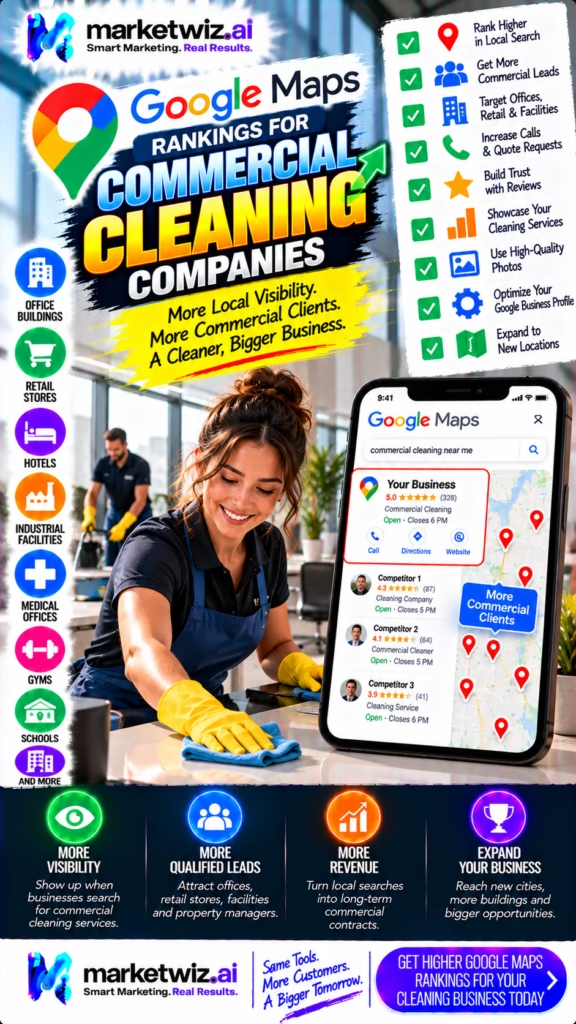
Google Maps Rankings for Commercial Cleaning Companies
Discover how commercial cleaning businesses, janitorial contractors, office cleaning providers, and facility maintenance companies can improve Google Maps visibility, attract qualified business inquiries, compete for recurring cleaning contracts, and develop sustainable local marketing strategies.
For commercial cleaning companies, a consistent pipeline of qualified business customers is essential to long-term growth. Whether a company specializes in office cleaning, recurring janitorial maintenance, warehouse cleaning, commercial floor care, or specialized facility cleaning, being discoverable when local businesses need these services can create valuable sales opportunities.
Property managers, office administrators, facility directors, building owners, and business operators often begin their search for cleaning providers through Google Search and Google Maps. They may search for "commercial cleaning company near me," "office cleaning contractor," "janitorial company in my area," or "commercial building cleaning services."
These searches represent opportunities for cleaning companies whose capabilities and service territories align with the customer's needs.
However, having a Google Business Profile does not automatically result in strong rankings or profitable commercial contracts. Effective local visibility requires accurate business information, relevant service categories, authentic customer feedback, a useful website, and an organized sales process.
The objective of Google Maps rankings for commercial cleaning companies should not be limited to generating additional calls. A stronger strategy focuses on reaching businesses that require the company's actual cleaning capabilities and may become long-term customers.
A recurring office cleaning contract may provide a different financial opportunity from a one-time cleaning request. A warehouse cleaning project may involve different staffing, equipment, scheduling, and pricing requirements from a small professional office.
Understanding these distinctions helps cleaning companies align their Google Maps SEO strategies with operational priorities.
Core principle: Effective Google Maps SEO for commercial cleaning companies combines local search visibility with business relevance. The most valuable inquiries come from organizations whose facilities, cleaning schedules, locations, and requirements match the provider's capabilities.
1. Understanding Google Maps Rankings for Commercial Cleaning Companies
Google Maps rankings describe how eligible local businesses appear within Google's map-based search results.
For commercial cleaning companies, these results may appear when potential customers search for office cleaning, janitorial maintenance, commercial floor care, warehouse cleaning, or other relevant services.
How Commercial Customers Search
Commercial cleaning customers often have defined operational requirements. An office manager may need daily cleaning after business hours, while a property manager may require recurring cleaning across multiple commercial buildings.
A warehouse operator may need specialized floor cleaning, and a business opening a new facility may be researching cleaning providers before establishing an ongoing contract.
These customers may use different search terms depending on their facility type, geographic location, and cleaning requirements.
Why Ranking Relevance Matters
A cleaning company specializing in large commercial facilities may prefer inquiries from property managers and facility directors rather than small residential cleaning requests.
A provider focused on professional offices may not want industrial cleaning inquiries that require equipment or qualifications it does not possess.
Effective local SEO should reflect the company's actual capabilities.
Visibility Does Not Guarantee Contracts
A strong Google Maps position can create opportunities for discovery.
However, securing commercial cleaning contracts also depends on responsiveness, professionalism, pricing, service capabilities, and the customer's procurement process.
2. Why Google Maps Matters for Commercial Cleaning Businesses
Commercial cleaning is often a geographically dependent business. Cleaning teams must travel to customer facilities and complete work according to agreed schedules.
This makes local visibility important when businesses search for providers.
Business Customers Often Need Local Providers
Facility managers and office administrators typically need companies that can reliably serve their properties.
Google Maps helps customers discover providers associated with relevant geographic areas.
Recurring Contracts Create Long-Term Opportunities
Unlike certain one-time consumer purchases, commercial cleaning can involve recurring service agreements.
Depending on the customer's requirements, these arrangements may include daily, weekly, or other scheduled cleaning.
Google Maps Supports Provider Comparison
Prospective customers can review business information, ratings, photographs, and available contact options before requesting a proposal.
Local Visibility Can Support Multiple Customer Types
Relevant commercial customers may include:
- Office buildings.
- Retail stores.
- Property management companies.
- Warehouses and distribution facilities.
- Professional offices.
- Educational facilities.
- Medical office facilities, when appropriately qualified.
- Multi-tenant commercial properties.
- Commercial real estate operators.
- General business facilities.
Companies should target only the facility types they are equipped and authorized to clean.
The value of local SEO is often better measured by qualified contract opportunities and retained commercial customers than by search visibility alone.
3. Google's Three Core Local Ranking Factors
Google identifies relevance, distance, and prominence as the primary factors influencing local rankings.
Relevance
Relevance concerns how closely a business matches the customer's search query.
A commercial cleaning company should accurately describe its business operations, services, and relevant categories.
Distance
Distance concerns how far a business is from the location associated with a search.
Commercial cleaning companies may appear for searches in nearby areas, but results can vary based on geography.
Prominence
Prominence concerns how well-known or established a business appears to be.
Google considers information available about businesses, including certain links, references, and review signals.
What Cleaning Companies Can Improve
Cleaning providers cannot control Google's algorithms or the searcher's physical location.
They can improve the accuracy, completeness, usefulness, and credibility of their business information.
No legitimate SEO provider can guarantee a particular organic Google Maps ranking. Paid advertising and organic local search rankings operate through different systems.
4. Optimizing Google Business Profile for Commercial Cleaning Companies
A Google Business Profile is an important customer-facing resource for eligible local cleaning companies.
It can communicate business identity, contact information, service coverage, operating hours, and relevant offerings.
Verify Business Eligibility
Before optimization, confirm that the business qualifies for a Google Business Profile and follows Google's current representation guidelines.
Use the Real Business Name
The profile name should accurately represent the company's real-world business identity.
Avoid adding unnecessary keywords, cities, or promotional phrases to the name.
Maintain Accurate Contact Information
Review the business phone number, website, operating hours, and other public details.
Incorrect information can create confusion for prospective commercial customers.
Write a Clear Commercial Cleaning Description
A useful business description should explain the company's actual specialties.
For example, a provider might describe recurring office cleaning, commercial janitorial maintenance, and facility floor care if those services are genuinely offered.
Clarify Service Coverage
Eligible service-area businesses should configure geographic coverage according to Google's guidelines.
Keep Business Information Updated
Review important profile details whenever operations, hours, services, or contact information change.
5. Choosing Accurate Commercial Cleaning Categories and Services
Business categories help communicate the nature of a cleaning company to Google and potential customers.
Select the Most Accurate Primary Category
The primary category should reflect the company's main business activity.
Because category availability and wording may change, companies should review Google's current category options.
Use Secondary Categories Carefully
Additional categories should represent real services rather than unrelated business activities.
Describe Actual Commercial Cleaning Services
Depending on capabilities, relevant offerings may include:
- Recurring office cleaning.
- Commercial janitorial maintenance.
- Commercial restroom cleaning.
- Retail facility cleaning.
- Warehouse cleaning.
- Commercial floor care.
- Building common-area cleaning.
- Post-construction cleaning.
- Commercial carpet cleaning.
- Specialized facility cleaning where qualified.
Avoid Overstating Capabilities
A company should not claim specialized medical, hazardous, or industrial cleaning capabilities without the necessary training, equipment, and authorization.
Clear Specialization Improves Customer Fit
Accurate service descriptions help prospective customers determine whether a provider can meet their facility requirements.
6. High-Intent Keywords for Commercial Cleaning Google Maps SEO
Keyword research helps cleaning companies understand how commercial customers search for providers.
General Commercial Cleaning Keywords
- Commercial cleaning company near me.
- Local commercial cleaning contractor.
- Commercial cleaning business.
- Professional janitorial company.
- Commercial building cleaning.
Office Cleaning Keywords
- Office cleaning company.
- Office janitorial contractor.
- Recurring office cleaning.
- Business office cleaning.
- After-hours office cleaning.
Facility Cleaning Keywords
- Warehouse cleaning company.
- Retail store cleaning.
- Commercial property cleaning.
- Facility janitorial maintenance.
- Commercial floor cleaning.
Contract-Oriented Keywords
- Commercial cleaning contract.
- Janitorial cleaning proposal.
- Office cleaning quote.
- Commercial cleaning estimate.
- Recurring janitorial services.
Understanding Search Intent
| Keyword Type | Example | Potential Intent |
|---|---|---|
| Informational | How much does commercial cleaning cost? | Researching budgets |
| General local | Commercial cleaners near me | Finding nearby providers |
| Specialized | Warehouse cleaning company | Finding relevant expertise |
| Recurring contract | Weekly office cleaning company | Seeking ongoing arrangements |
| Transactional | Request janitorial cleaning proposal | Preparing to contact providers |
Prioritize Commercial Customer Intent
A company focused on recurring business contracts may benefit from emphasizing commercial keywords rather than broad house-cleaning terms.
The strongest keyword strategy connects actual service capabilities with the customers the business wants to serve.
7. Building Commercial Cleaning Trust With Authentic Photography
Commercial cleaning customers often want confidence that a provider can work professionally within business facilities.
Authentic photographs can help communicate the company's operations and capabilities.
Show Real Cleaning Operations
Appropriate photographs may show cleaning equipment, staff performing authorized work, and relevant facility environments.
Highlight Different Facility Types
A company serving multiple commercial markets may display authentic examples from offices, retail properties, warehouses, and other permitted locations.
Respect Customer Privacy
Obtain appropriate permission before photographing or publishing images from customer facilities.
Avoid exposing confidential documents, employee information, security systems, or restricted areas.
Use Before-and-After Photos Honestly
Before-and-after images can demonstrate results when they accurately represent work completed by the company.
Avoid misleading editing or fabricated project examples.
Keep Website Galleries Organized
Organized galleries can help potential customers find examples related to their facility type and cleaning requirements.
Authentic photographs can help commercial customers understand a cleaning company's operations, equipment, and experience without relying on exaggerated marketing claims.
8. Commercial Cleaning Reviews and Reputation Management
Business customers often evaluate reliability, communication, professionalism, and consistency when choosing cleaning contractors.
Authentic customer reviews can provide helpful information during that process.
Request Genuine Feedback
Cleaning companies can invite customers to share honest feedback about their experiences.
Requests should follow Google's review policies and avoid prohibited incentives or review manipulation.
Why Commercial Reviews Matter
Feedback describing ongoing office cleaning, dependable scheduling, or professional communication may help prospective customers understand the provider's experience.
Respond Professionally
Thoughtful responses demonstrate attention to customer relationships.
Avoid disclosing private contract details or confidential facility information.
Do Not Purchase Reviews
Fake or manipulated reviews can damage credibility and violate platform policies.
Use Feedback to Improve Operations
Customer feedback may reveal opportunities to improve scheduling, quality assurance, staff communication, or issue resolution.
9. Geographic Targeting for Commercial Cleaning and Janitorial Companies
Commercial cleaning companies typically operate within defined service territories.
Travel distance, staff availability, facility size, and contract value can influence which areas are economically practical.
Define Actual Service Coverage
Identify the cities and communities where the business can consistently provide cleaning services.
Understand Service-Area Limitations
Adding locations to a Google Business Profile does not guarantee rankings in those areas.
Visibility still depends on relevance, distance, prominence, and other aspects of the search.
Evaluate Travel Economics
A large recurring facility contract may justify longer travel distances than a small one-time cleaning assignment.
Research Nearby Commercial Markets
Consider local office concentrations, industrial properties, retail districts, and commercial building demand.
Use Meaningful Location Content
Website pages can explain real geographic coverage and relevant local experience.
Avoid publishing dozens of nearly identical pages that simply replace one city name with another.
10. Commercial Cleaning Website Optimization for Local SEO
A website helps commercial customers evaluate whether a cleaning company can meet their facility requirements.
Clearly Identify Commercial Services
The homepage should explain whether the company focuses on office cleaning, janitorial maintenance, floor care, warehouse cleaning, or other services.
Explain Facility Types Served
Customers should understand whether the company serves offices, retail locations, warehouses, or other commercial environments.
Communicate Scheduling Options
Where applicable, describe available cleaning schedules such as recurring, after-hours, or other agreed service arrangements.
Describe the Proposal Process
Business customers may need site visits, scope assessments, formal estimates, or procurement documentation.
Explain the company's actual process clearly.
Improve Mobile Usability
Facility managers and business owners may research providers from mobile devices.
A responsive website should offer readable content, clear navigation, and accessible contact information.
Use Authentic Trust Signals
Appropriate examples may include genuine customer testimonials, accurate business qualifications, and relevant project experience.
Do not invent certifications, insurance coverage, customer relationships, or contract results.
Answer Commercial Buyer Questions
Helpful website content can explain cleaning frequency, facility assessments, service customization, and factors that influence contract pricing.
11. Creating Service-Specific Landing Pages for Commercial Cleaning
Commercial cleaning includes several distinct services and facility types.
Useful service pages help customers understand what a company offers and whether it can meet their requirements.
Office Cleaning Pages
Explain recurring office cleaning capabilities, scheduling options, and the types of office spaces served.
Janitorial Maintenance Pages
Describe ongoing facility maintenance, routine cleaning tasks, and service coordination.
Commercial Floor Cleaning Pages
Explain the specific floor care methods and surface types the company supports.
Warehouse Cleaning Pages
Discuss relevant warehouse cleaning capabilities, operational considerations, and available service arrangements.
Retail Cleaning Pages
Describe cleaning options appropriate for retail environments, where offered.
Post-Construction Cleaning Pages
Explain the company's actual post-construction cleaning scope and project requirements.
Specialized Facility Pages
Medical, industrial, and other specialized environments may involve additional requirements.
Only publish claims that accurately reflect the company's training, qualifications, and capabilities.
Avoid Thin Duplicate Pages
Each landing page should provide meaningful information specific to its service.
12. Local Citations and Consistent Commercial Cleaning Business Information
Local citations are references to a business on directories, industry platforms, and other relevant websites.
These references may include the company's name, address, phone number, and website.
Keep Contact Information Accurate
Incorrect phone numbers or outdated websites can create problems for customers trying to request proposals.
Review Relevant Directories
Local business directories, appropriate industry resources, and professional associations may provide additional opportunities for discovery.
Prioritize Relevance and Accuracy
Mass submissions to low-quality or unrelated directories may provide limited practical value.
Update Important Listings
When a company changes contact details or operating information, review major public listings.
Avoid Artificial Business Locations
Do not create fake offices or misleading addresses to pursue additional Google Maps rankings.
13. Generating Qualified Commercial Cleaning Leads and Contracts
Strong Google Maps visibility is most valuable when it produces inquiries from organizations that match the company's business model.
Define an Ideal Commercial Customer
Consider which facility types, contract sizes, cleaning schedules, and geographic areas best match the company's operations.
Prioritize Relevant Contract Opportunities
A cleaning company focused on recurring office contracts may want to emphasize ongoing janitorial maintenance rather than one-time residential cleaning.
Ask Useful Qualification Questions
An initial inquiry process may collect:
- Business or facility location.
- Type of commercial property.
- Approximate facility size.
- Required cleaning frequency.
- Preferred service hours.
- Specialized cleaning requirements.
- Expected contract start date.
- Whether a site assessment is needed.
Communicate Scope Clearly
Commercial cleaning agreements often depend on detailed service expectations.
Clearly defining the requested scope can improve proposal accuracy and customer understanding.
Respond to Inquiries Consistently
Facility managers may contact multiple providers.
An organized follow-up process helps ensure qualified inquiries receive timely attention.
Measure Contract Outcomes
The most useful marketing metrics connect inquiries to site visits, proposals, accepted contracts, retention, and revenue.
A smaller number of well-qualified commercial inquiries may provide more long-term value than a large volume of unrelated cleaning requests.
14. Tracking Google Maps SEO Performance for Commercial Cleaning Companies
Performance measurement helps cleaning companies understand whether their marketing activities are generating meaningful contract opportunities.
Review Business Profile Performance
Available Google Business Profile metrics can provide insight into customer interactions and discovery activity.
Track Website Visits
Appropriate analytics and tagged links can help identify website traffic associated with local search.
Record Inquiry Sources
A CRM or organized tracking system can record where prospective commercial customers found the company.
Classify Lead Quality
Separate inquiries that match the company's facility types, locations, and cleaning capabilities from requests outside its service scope.
| Metric | What It Measures | Business Value |
|---|---|---|
| Profile interactions | Customer engagement | Initial interest |
| Website visits | Tracked site traffic | Research activity |
| Qualified inquiries | Relevant facility requests | Lead quality |
| Site assessments | Scheduled facility evaluations | Sales progression |
| Proposals delivered | Formal contract offers | Pipeline activity |
| Contracts won | Accepted commercial agreements | Conversion performance |
| Retained contracts | Ongoing customer relationships | Recurring revenue potential |
| Attributed revenue | Revenue connected to marketing | Financial contribution |
Useful Marketing Performance Formulas
Qualified lead rate: Qualified inquiries divided by total inquiries, multiplied by 100.
Proposal conversion rate: Accepted proposals divided by proposals delivered, multiplied by 100.
Customer acquisition cost: Relevant marketing and sales acquisition costs divided by new customers acquired.
Average contract value: Total value of relevant contracts divided by the number of contracts.
Evaluate Profitability, Not Just Revenue
Cleaning contracts can vary substantially in labor requirements, travel costs, supplies, equipment needs, and scheduling complexity.
A larger contract is not necessarily more profitable than a smaller one.
Marketing performance should be evaluated alongside operational costs and customer retention.
15. Common Google Maps SEO Mistakes Commercial Cleaning Companies Should Avoid
Using Inaccurate Business Categories
Incorrect categories can create poor search relevance and customer confusion.
Keyword-Stuffing the Business Name
Adding promotional phrases or unrelated city names to the profile name can violate Google's guidelines.
Creating Fake Office Locations
Artificial addresses or ineligible virtual offices should not be used to pursue additional rankings.
Claiming Services the Company Cannot Provide
Misrepresenting specialized cleaning capabilities can create serious customer and operational problems.
Using Fake Reviews
Purchased or manipulated reviews can undermine customer trust and violate platform policies.
Ignoring Commercial Search Intent
A janitorial company focused on recurring office contracts may waste resources attracting unrelated residential cleaning inquiries.
Publishing Thin Location Pages
Nearly identical city pages with minimal useful information may offer little value to visitors.
Failing to Track Contract Outcomes
Search visibility and call volume do not automatically indicate profitable business growth.
Expecting Guaranteed Rankings
Organic Google Maps rankings can change according to location, query, competition, and other factors.
16. Google Maps SEO Strategies for Commercial Cleaning Specialties
Commercial cleaning includes multiple service categories with distinct customer needs.
Local SEO should reflect the company's actual specialties.
Office Cleaning Companies
Office cleaning providers can highlight recurring maintenance, available scheduling, and relevant facility types.
Content may explain cleaning frequency options, proposal processes, and service coordination.
Janitorial Maintenance Providers
Janitorial companies can emphasize ongoing facility cleaning, routine maintenance, and consistent service delivery.
Warehouse Cleaning Companies
Warehouse-focused providers can describe their actual capabilities for large commercial spaces, floor areas, and operational environments.
Retail Cleaning Companies
Retail customers may prioritize cleaning schedules that accommodate store operations and customer traffic.
Commercial Floor Care
Floor care providers can explain the specific surfaces, equipment, and methods they support.
Post-Construction Cleaning
Companies offering post-construction cleaning can describe relevant project stages, scope expectations, and coordination requirements.
Medical Office Cleaning
Medical environments may require specialized procedures, training, and compliance considerations.
Only appropriately qualified providers should advertise capabilities they can genuinely deliver.
Multi-Property Commercial Cleaning
Companies serving property managers may explain their ability to coordinate cleaning across multiple eligible facilities.
Operational capacity and geographic coverage should be represented accurately.
Commercial Carpet Cleaning
Providers offering commercial carpet care can describe supported cleaning methods and appropriate facility types.
Specialized Facility Cleaning
Specialized facilities may have unique safety, operational, or regulatory requirements.
Marketing claims should accurately reflect the company's training, equipment, and qualifications.
17. A Practical 90-Day Google Maps SEO Roadmap for Commercial Cleaning Companies
A structured optimization roadmap helps commercial cleaning businesses prioritize local visibility, customer trust, and lead generation improvements.
Days 1–15: Audit and Research
- Review Google Business Profile eligibility and ownership.
- Verify business contact information.
- Evaluate primary and secondary categories.
- Identify core commercial cleaning services.
- Research relevant local competitors.
- Document existing lead and contract metrics.
Days 16–30: Improve Profile Accuracy
- Correct incomplete business details.
- Review geographic service coverage.
- Update operating hours.
- Clarify actual cleaning capabilities.
- Add authentic permitted photographs.
- Review important business directory listings.
Days 31–45: Strengthen Website Content
- Improve the main commercial cleaning page.
- Create useful specialty service pages.
- Clarify facility types served.
- Explain the proposal process.
- Improve mobile usability.
- Review contact form accessibility.
Days 46–60: Build Customer Trust
- Implement compliant review requests.
- Respond professionally to feedback.
- Publish authentic operational examples.
- Verify testimonials and qualifications.
- Improve commercial customer FAQs.
- Review relevant industry listings.
Days 61–75: Improve Lead Management
- Configure appropriate lead attribution.
- Organize inquiry records.
- Define qualified commercial leads.
- Track site assessments.
- Record proposals and accepted contracts.
- Evaluate follow-up procedures.
Days 76–90: Evaluate and Refine
- Compare results with the original baseline.
- Review relevant local search visibility.
- Identify high-value facility types.
- Evaluate geographic contract profitability.
- Improve weak website experiences.
- Plan the next optimization cycle.
Develop a more accurate, credible, and measurable local search presence. Rankings and contract revenue are not guaranteed within a specific period, but a structured process supports better marketing decisions.
18. Advanced Google Maps SEO Strategies for Commercial Cleaning Growth
Once foundational local SEO practices are established, commercial cleaning companies can refine marketing using customer, facility, contract, and geographic performance data.
Segment Leads by Facility Type
Track whether inquiries originate from offices, retail properties, warehouses, property managers, or other commercial customers.
This helps identify the facility types most aligned with company capabilities.
Evaluate Recurring Contract Opportunities
Recurring agreements may create long-term customer relationships, but contract profitability depends on service requirements and operating costs.
Research Geographic Demand
Review which communities generate relevant inquiries and accepted contracts.
Consider travel requirements, staff availability, and customer concentrations.
Develop Content Around Procurement Questions
Commercial buyers may research service scopes, cleaning frequencies, site assessments, insurance documentation, and proposal requirements.
Useful content can explain the company's actual procedures.
Improve Proposal Qualification
A structured intake process can help identify facility requirements before preparing a detailed proposal.
Coordinate Marketing With Staffing Capacity
Marketing priorities should reflect available employees, supervisory capacity, equipment, and scheduling limitations.
Build Legitimate Business Relationships
Professional relationships with property managers, commercial real estate professionals, facility operators, and local business organizations may create additional opportunities.
Monitor Local Ranking Variation
Google Maps rankings can vary by searcher location and query wording.
Evaluate representative searches across actual service territories instead of relying on a single ranking position.
Measure Customer Retention
For recurring cleaning businesses, customer retention can be a significant part of financial performance.
Tracking renewal patterns and contract duration can provide useful insight into marketing quality and service delivery.
Connect SEO With Financial Results
Review contract revenue, gross margins, customer acquisition costs, retention, and operational capacity.
These measurements provide a more complete picture than ranking visibility alone.
Maintain Long-Term Accuracy
Commercial cleaning markets, customer needs, and company capabilities change over time.
Regularly review business information, website content, service offerings, customer feedback, and marketing performance.
Google Maps rankings for commercial cleaning companies become most valuable when they help attract qualified business customers. Accurate business information, relevant commercial service content, authentic reviews, clear geographic coverage, and meaningful contract tracking can support sustainable local growth.
30 Frequently Asked Questions About Google Maps Rankings for Commercial Cleaning Companies
1. What are Google Maps rankings for commercial cleaning companies?
Google Maps rankings refer to where eligible commercial cleaning businesses appear in local Google search results for relevant cleaning and janitorial queries.
2. How can commercial cleaning companies improve Google Maps rankings?
Commercial cleaning companies can improve their local presence by maintaining accurate Google Business Profiles, choosing relevant categories, earning authentic reviews, and providing helpful website content.
3. What factors influence Google Maps rankings?
Google identifies relevance, distance, and prominence as the primary factors influencing local rankings.
4. Can Google Maps generate commercial cleaning contracts?
Google Maps can help businesses discover and contact local commercial cleaning providers, potentially creating opportunities for janitorial and facility cleaning contracts.
5. Is Google Business Profile free for commercial cleaning businesses?
Creating and managing an eligible Google Business Profile is free, although professional marketing assistance may involve additional costs.
6. What Google Business Profile category should a commercial cleaning company use?
A commercial cleaning company should choose the most accurate available category representing its primary business and add only relevant secondary categories.
7. How long does commercial cleaning Google Maps SEO take?
Results depend on local competition, geographic factors, business history, and optimization quality. No ranking timeline is guaranteed.
8. Do reviews help commercial cleaning companies rank?
Google states that review count and positive ratings can contribute to local rankings, while authentic feedback can also help customers evaluate a cleaning provider.
9. Can janitorial companies use Google Maps without a storefront?
Eligible service-area cleaning companies can use Google Business Profiles while following Google's business address and service-area requirements.
10. Should commercial cleaners target office cleaning keywords?
Yes, if office cleaning is a genuine offering. Relevant searches can help connect providers with businesses seeking recurring or specialized office cleaning.
11. Can Google Maps SEO attract recurring cleaning contracts?
Clear service information and local visibility can help commercial cleaning companies reach customers seeking ongoing janitorial arrangements.
12. Do service-area cities guarantee higher rankings?
No. Adding cities to a Google Business Profile service area does not guarantee rankings in those locations.
13. What keywords should commercial cleaning companies target?
Relevant keywords may include commercial cleaning company near me, office cleaning contractor, janitorial company, warehouse cleaning, medical office cleaning, and commercial floor cleaning.
14. Are separate commercial cleaning service pages useful?
Yes. Helpful pages explaining office cleaning, janitorial maintenance, commercial floor care, and other actual offerings can improve customer understanding and support organic discovery.
15. Can commercial cleaning companies rank in nearby cities?
Eligible businesses may appear for nearby-city searches, but visibility depends on relevance, distance, prominence, and competition.
16. How can janitorial companies attract larger contracts?
They can clearly describe commercial capabilities, facility types served, scheduling options, and experience relevant to larger or recurring contracts.
17. Does website quality matter for commercial cleaning SEO?
A useful, accessible, mobile-friendly website helps customers understand services and can support organic search visibility and lead conversion.
18. What are local citations for janitorial businesses?
Local citations are references to a business on directories and other websites, often including its name, address, phone number, and website.
19. Should cleaning companies target residential and commercial keywords?
They should target only the customer types and services they genuinely offer, rather than attracting unrelated inquiries.
20. How can cleaning companies track Google Maps leads?
They can combine Google Business Profile performance data, tagged website links, CRM records, and appropriate call tracking to evaluate inquiries and contract opportunities.
21. Can new commercial cleaning companies benefit from Google Maps SEO?
Yes. Accurate business information, relevant content, authentic reviews, and customer-focused websites can help eligible new businesses build local visibility.
22. What is commercial cleaning search intent?
Commercial cleaning search intent describes what a business customer wants when searching for office cleaning, janitorial maintenance, or specialized facility cleaning.
23. Do Google Business Profile posts guarantee ranking improvements?
No. Posts can communicate useful updates, but they do not guarantee improvements in organic Google Maps rankings.
24. Should commercial cleaning companies upload photos?
Authentic photographs of equipment, team operations, and permitted completed projects can help customers understand the company's capabilities.
25. Are city-specific cleaning landing pages worthwhile?
Useful location pages can explain real service coverage and local experience, but thin duplicate pages should be avoided.
26. Can Google Maps SEO reduce unqualified cleaning inquiries?
Clear commercial service descriptions, facility types, geographic coverage, and contract requirements can help attract customers whose needs match the provider's offerings.
27. What mistakes hurt commercial cleaning local SEO?
Common mistakes include inaccurate business information, keyword-stuffed names, fake locations, misleading service claims, manipulated reviews, and poor lead tracking.
28. How often should a cleaning company update its Google Business Profile?
Businesses should update important information whenever it changes and periodically review services, hours, photos, reviews, and contact details.
29. Can Google Maps SEO work alongside commercial cleaning advertising?
Yes. Organic local SEO and paid advertising can complement one another when reaching businesses seeking relevant cleaning services.
30. How can MarketWiz.ai help commercial cleaning companies?
MarketWiz.ai can help commercial cleaning companies explore local marketing strategies focused on stronger visibility, qualified inquiries, and measurable business growth.
30 Additional SEO Keywords for Commercial Cleaning Google Maps Rankings
The following related search phrases provide additional topical coverage for businesses researching commercial cleaning SEO, Google Maps optimization, janitorial marketing, contract lead generation, and local business growth.
These keywords should be incorporated naturally where they accurately describe the content. Excessive repetition, irrelevant keyword insertion, and artificial geographic targeting do not guarantee improved search rankings.
Grow Your Commercial Cleaning Business With Smarter Local Marketing
MarketWiz.ai helps businesses explore marketing strategies focused on stronger Google Maps visibility, qualified local customer inquiries, improved digital presence, and measurable growth opportunities. Discover how a more strategic approach to local marketing can help your commercial cleaning company connect with organizations looking for the services you provide.
Explore MarketWiz.ai