
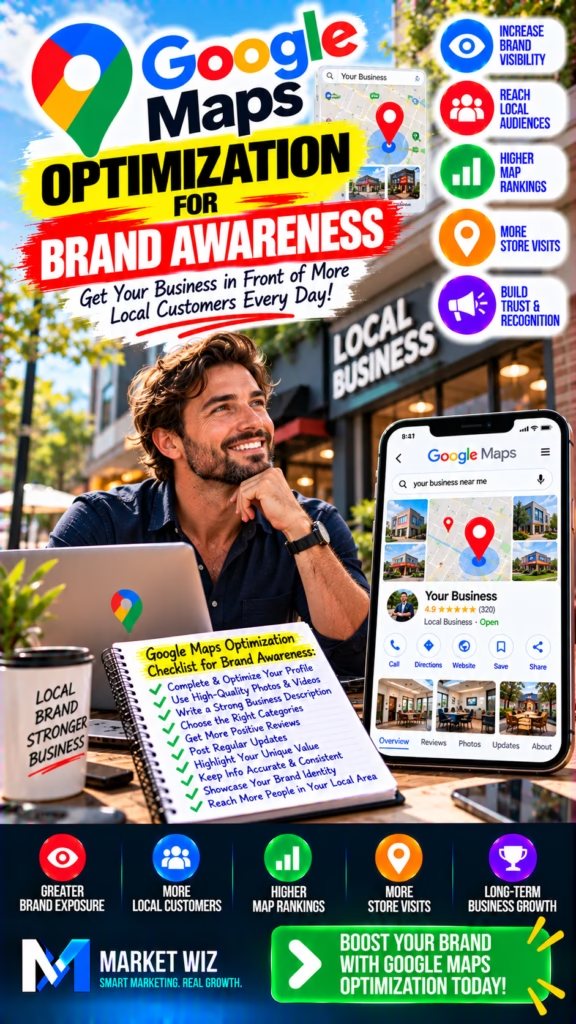
Google Maps Optimization for Brand Awareness
Discover how Google Maps optimization helps local businesses increase recognition, establish customer trust, strengthen their digital presence, and become more familiar names in the communities they serve.
Building a recognizable local brand requires more than creating a logo, publishing social media posts, or launching occasional advertising campaigns. Customers need repeated opportunities to discover a business, understand what it offers, and develop confidence in its reputation.
Google Maps provides an important opportunity for that discovery. When people search for nearby contractors, restaurants, retailers, professional services, or home improvement companies, Google Maps may introduce them to businesses they have never encountered before.
A well-maintained Google Business Profile can communicate a company's identity through its official name, business category, photographs, customer reviews, website information, and service descriptions.
Effective Google Maps optimization for brand awareness focuses on making a business more visible, recognizable, and credible to relevant local audiences. The objective is not simply to increase impressions. It is to create meaningful familiarity that can influence future customer decisions.
This comprehensive guide explains how businesses can use Google Maps SEO, visual consistency, reputation management, local content, and performance measurement to strengthen brand recognition and support long-term customer acquisition.
Google Maps visibility introduces customers to a business. Consistent information helps them recognize it. Authentic reviews and useful content build credibility. Positive customer experiences help transform initial awareness into lasting reputation.
01 What Is Google Maps Optimization for Brand Awareness?
Google Maps optimization for brand awareness involves improving how a business appears and communicates with potential customers across Google Maps and related Google Search experiences.
The process includes maintaining an accurate Google Business Profile, selecting appropriate categories, publishing authentic photographs, developing genuine customer feedback, and providing useful website information.
Traditional local SEO often emphasizes rankings and lead generation. Brand awareness optimization considers additional outcomes, such as recognition, familiarity, customer confidence, and the likelihood that people remember the business when a future need arises.
For example, a homeowner may discover a painting contractor while researching exterior home improvements but postpone the project for several months.
If the company's name, visual identity, and reputation remain memorable, that initial interaction may contribute to a later inquiry.
Brand awareness is therefore a long-term marketing objective rather than a guarantee of immediate sales.
02 Why Google Maps Matters for Local Brand Recognition
Google Maps helps customers discover businesses within geographic areas relevant to their needs.
Unlike broad advertising that may reach people with little interest in a service, local search often connects businesses with customers actively researching nearby options.
A customer searching for "roofing contractors near me" may encounter several companies, examine their reviews, and remember one or two names even without making immediate contact.
Repeated exposure across relevant searches can contribute to familiarity, although the actual effect depends on the customer and the competitive environment.
Google Maps also provides context. Business categories, photographs, operating hours, and customer feedback help people associate a brand with particular services and experiences.
This combination of discovery and information makes Google Maps a useful component of a broader local branding strategy.
03 Understand the Relationship Between Visibility and Awareness
Visibility and brand awareness are related, but they are not identical.
Visibility describes whether a business appears where potential customers may encounter it. Awareness describes whether customers recognize or remember that business.
A company can receive substantial search exposure without becoming memorable if its presentation is generic, inconsistent, or unclear.
Conversely, a business with distinctive branding, authentic customer feedback, and a clear service identity may create a stronger impression during fewer interactions.
Visibility
Customers encounter the business in relevant local search results.
Recognition
Customers begin associating the business name with a specific category or service.
Credibility
Reviews, accurate information, and genuine project examples support confidence.
Preference
Positive familiarity may influence which business a customer considers later.
An effective strategy addresses each stage instead of assuming that search impressions automatically create brand loyalty.
04 Build a Complete Google Business Profile
Google Business Profile is the foundation of a business's managed presence on Google Maps.
A complete profile helps prospective customers understand the company's identity, services, geographic coverage, and contact options.
Businesses should maintain accurate official names, telephone numbers, websites, operating hours, categories, and address or service-area information.
Missing information can weaken the customer experience. For example, a company with outdated hours or an incorrect website address may create frustration even if it appears prominently in search results.
A complete profile also provides a more consistent representation of the business across Google Search and Maps.
Regular maintenance is important because business information can change as companies expand, relocate, or introduce new offerings.
05 Choose Categories That Reinforce Your Brand Identity
Business categories communicate the nature of a company's operations.
The primary category should accurately describe the business's principal activity. Additional categories may represent legitimate secondary offerings.
For example, a residential painting company should choose an appropriate painting-related category rather than a broad or unrelated category simply because it may attract more searches.
Accurate categories help establish a clear association between the business name and its actual services.
This matters for brand awareness because customers are more likely to understand and remember a company when its identity is consistent.
Category choices should reflect real operations rather than attempts to manipulate local rankings.
06 Create a Memorable and Accurate Business Description
A business description provides an opportunity to explain what the company does and what makes its approach distinctive.
Effective descriptions identify the primary services, typical customers, operating area, and meaningful qualities of the business.
Brand messaging should be clear rather than exaggerated. Unsupported claims such as being the best company in an entire region can reduce credibility when no evidence is provided.
Our residential improvement team helps homeowners create more comfortable and attractive living spaces through interior updates, exterior projects, and carefully planned renovations. We emphasize clear communication, dependable workmanship, and attention to each property's unique needs.
The description should reflect the company's real capabilities and avoid repetitive keyword stuffing.
07 Maintain Consistent Branding Across Google Maps and Your Website
Consistency helps customers recognize a business across multiple digital channels.
The official business name, visual identity, contact information, and service descriptions should remain aligned wherever customers encounter the company.
For example, a customer who discovers a contractor on Google Maps should recognize the same company when visiting its website.
Conflicting names, unrelated visual styles, or inconsistent service descriptions can create uncertainty.
Businesses should establish practical brand guidelines covering typography, imagery, tone of voice, and the presentation of key information.
These guidelines do not need to be complicated. Their purpose is to create a recognizable and professional customer experience.
08 Use Authentic Photography to Strengthen Brand Recognition
Photographs can communicate a business's identity more quickly than lengthy descriptions.
For home improvement companies, authentic project photography can demonstrate workmanship and help customers associate the brand with particular types of projects.
Retail businesses may benefit from clear product photographs and accurate images of their facilities.
Restaurants can use authentic food and interior photography to help customers understand the dining experience.
- Use clear, current images representing real business activity.
- Maintain a consistent visual presentation.
- Show different aspects of the company's legitimate services.
- Protect customer privacy when photographing projects.
- Avoid misleading alterations or unrelated stock imagery.
- Update photographs as the business evolves.
Professional imagery can strengthen recognition when it accurately reflects what customers can expect.
09 Build Brand Credibility Through Genuine Customer Reviews
Customer reviews help prospective customers understand the experiences of people who have previously interacted with a business.
A strong review history may reinforce associations between the brand and qualities such as professionalism, communication, or reliability.
Businesses can develop an ethical review process by requesting honest feedback from genuine customers after appropriate interactions.
Review requests must not involve incentives, purchased ratings, pressure to leave positive feedback, or selective solicitation based on expected sentiment.
Authentic reviews are valuable because they provide independent customer perspectives rather than promotional claims written by the business itself.
10 Respond to Reviews in a Consistent Brand Voice
Public review responses contribute to how customers perceive a company's communication style.
A business that responds thoughtfully and professionally can demonstrate its commitment to customer care.
Positive reviews can receive concise expressions of appreciation that acknowledge the customer's experience.
Negative feedback should be addressed calmly and without disclosing private information.
Maintaining a consistent tone across review responses can reinforce the company's identity.
However, responses should remain natural. Repeating identical promotional language under every review may appear impersonal.
11 Improve Visibility for Relevant Local Keywords
Local keyword research helps businesses understand the services and geographic terms customers use during discovery.
A company should prioritize search themes that accurately reflect its operations and target customers.
| Keyword Type | Example | Brand Awareness Opportunity |
|---|---|---|
| Category | Painting contractors near me | Introduce the business to relevant customers |
| Service | Kitchen cabinet painting company | Associate the brand with a specialty |
| Geographic | Local roofing company in Rochester | Strengthen regional recognition |
| Comparison | Top-rated HVAC companies nearby | Support customer evaluation |
| Branded | Business name reviews | Reflect direct interest in the company |
Keyword research should inform useful website content and accurate profile information rather than encourage unnatural repetition.
12 Strengthen Google Local Pack Visibility
The Google local pack is a group of business results that may appear prominently within Google Search for geographically relevant queries.
Local pack exposure can introduce a brand to customers who may not already know its name.
Google identifies relevance, distance, and prominence as major local ranking factors.
Businesses can improve many aspects of their online presence, but they cannot guarantee specific positions in local results.
Because rankings vary by search location and query, brand awareness strategies should emphasize relevant geographic visibility rather than attempting to appear everywhere.
13 Build Recognition Through Service-Specific Content
Dedicated service pages can help customers associate a business with its specialties.
For example, a painting contractor may create informative pages about interior painting, exterior painting, cabinet refinishing, and fence staining.
Each page should explain the service, answer common customer questions, and demonstrate the company's actual capabilities.
This content can support organic search discovery while reinforcing a consistent brand identity.
The strongest pages provide original, useful information rather than repeating the same generic promotional statements.
14 Develop Location-Specific Brand Awareness
Businesses serving multiple communities may benefit from content that demonstrates their genuine relationship with those areas.
Location-specific pages can highlight actual projects, local customer needs, and accurate service coverage.
For example, a landscaping company may explain its services in different communities while addressing relevant property conditions and seasonal considerations.
However, businesses should avoid creating thin pages that simply replace city names or imply the existence of offices that do not exist.
Authentic geographic relevance is more valuable than artificial location expansion.
15 Create a Recognizable Visual Identity
Visual identity includes the design elements customers associate with a business.
These elements may include a logo, brand colors, typography, photography style, and consistent presentation across digital platforms.
A recognizable visual identity can help customers connect the business's Google Maps listing with its website, social media profiles, vehicles, or printed materials.
Visual consistency should support clarity rather than overwhelm customers with excessive decoration.
The objective is to make the brand familiar while keeping important business information accessible.
16 Use Google Business Profile Updates Strategically
Google Business Profile updates can communicate relevant business news, seasonal information, and project highlights when posting features are available.
For example, a contractor may share a completed renovation, while a retail business may announce an upcoming event or relevant product update.
These updates can provide additional context for customers evaluating the business.
Posting frequently does not guarantee higher rankings, and businesses should avoid publishing repetitive content solely to maintain activity.
A practical update strategy emphasizes accuracy, usefulness, and consistency with the company's broader brand identity.
17 Connect Google Maps With Social Media Branding
Google Maps and social media can support different stages of customer awareness.
Social platforms may introduce a business through project photographs, educational content, or community discussions.
Later, a customer may search for the business on Google Maps to review its location, operating hours, and customer feedback.
Consistent branding across these channels can help customers recognize the same company during multiple interactions.
Businesses should maintain accurate information and avoid making conflicting claims about services or availability.
18 Strengthen Your Local Reputation Through Community Involvement
Brand awareness can develop through genuine participation in the communities a business serves.
Professional associations, local events, charitable projects, and legitimate business partnerships may create opportunities for recognition.
These activities can also lead to referrals and authentic online mentions.
Businesses should prioritize meaningful participation rather than treating community relationships solely as opportunities to acquire search engine links.
A strong local reputation develops through consistent conduct and positive customer experiences over time.
19 Maintain Accurate Business Information Across Platforms
Customers may encounter a company through Google Maps, industry directories, social media, its website, or community recommendations.
Consistent business information helps them recognize the company and locate reliable contact details.
Important information includes the official business name, website address, telephone number, operating hours, and publicly displayed location where appropriate.
Service-area businesses should follow platform requirements regarding address visibility.
Directory listings should be maintained for accuracy and customer usefulness rather than created in large quantities solely for search rankings.
20 Improve Your Website's Brand Experience
A website often provides the most detailed presentation of a company's identity.
Customers arriving from Google Maps should encounter a recognizable visual style, consistent messaging, and clear information about the business.
The website should explain services, provide credible evidence, and make contact information accessible.
A strong brand experience also requires usability. Slow pages, confusing navigation, or inconsistent design can create frustration.
Mobile optimization is especially important because many local searches occur on smartphones.
21 Use Educational Content to Establish Expertise
Educational content can help customers associate a business with useful knowledge in its industry.
For example, an HVAC company may publish information about seasonal maintenance, while a painting contractor may explain different interior finishes.
Useful articles should answer genuine customer questions and reflect the company's actual expertise.
Content should avoid unsupported claims or attempts to create unnecessary concern.
Over time, helpful resources can support organic discovery and reinforce the brand's professional identity.
22 Understand Branded Search Behavior
Branded searches occur when someone includes a company's name or a recognizable variation of that name in a search query.
Examples may include searches for the company's website, customer reviews, telephone number, or location.
Changes in branded search interest can provide useful context about recognition, but they should not be interpreted as proof that a particular marketing channel caused the change.
Businesses can review available search performance data and compare trends over meaningful periods.
Brand awareness measurement should combine several indicators rather than relying on a single metric.
23 Measure Google Maps Brand Awareness Performance
Brand awareness is more difficult to measure directly than a completed form or booked appointment.
Businesses can nevertheless evaluate several indicators to understand how their local visibility and recognition are developing.
| Metric | What It Shows | Limitation |
|---|---|---|
| Profile visibility | Exposure within Google experiences | Does not prove recognition |
| Branded searches | Interest involving the business name | May reflect multiple marketing sources |
| Website visits | Additional customer interest | Not all visits create awareness |
| Customer inquiries | Active contact behavior | Does not capture future consideration |
| Customer surveys | Reported brand familiarity | Depends on sample quality |
Combining these measures can provide a more balanced understanding of brand development.
24 Distinguish Brand Awareness From Lead Generation
Brand awareness and lead generation support different but related marketing objectives.
Brand awareness focuses on recognition and familiarity. Lead generation focuses on encouraging prospective customers to make contact or express interest.
A customer may recognize a business long before needing its services.
For example, a homeowner might repeatedly encounter a local roofing company but only request an estimate after discovering roof damage months later.
Businesses should therefore avoid judging every awareness activity solely by immediate inquiries.
At the same time, awareness campaigns should be evaluated against clear business objectives and reasonable measurement methods.
25 Build Customer Trust Through Consistent Experiences
Brand recognition becomes more valuable when customers associate the business with positive experiences.
A consistent customer experience begins with accurate marketing and continues through communication, project delivery, and follow-up.
Businesses should ensure that the expectations created by their Google Maps listings and websites match their actual capabilities.
For example, a company should not advertise immediate appointments if it cannot reliably provide them.
Trust develops when the business communicates clearly, delivers on reasonable commitments, and responds professionally to customer concerns.
26 Avoid Common Google Maps Branding Mistakes
Several practices can weaken local brand credibility or create compliance problems.
- Using inconsistent business names across platforms.
- Adding unnecessary keywords to the official business name.
- Publishing misleading photographs.
- Purchasing or incentivizing customer reviews.
- Creating ineligible duplicate business listings.
- Advertising services the company does not provide.
- Ignoring outdated contact information.
- Publishing repetitive, low-value content.
- Measuring awareness only through rankings.
A sustainable branding strategy depends on accuracy, consistency, genuine customer experiences, and useful communication.
27 Create a 90-Day Google Maps Brand Awareness Plan
A structured plan can help businesses improve their local presence without relying on disconnected promotional activities.
Days 1–30: Establish Brand Consistency
- Audit Google Business Profile information.
- Verify the official business name and categories.
- Review website branding and contact information.
- Identify relevant local search themes.
- Establish baseline visibility and branded search measurements.
Days 31–60: Strengthen Credibility
- Publish authentic business photography.
- Improve major service pages.
- Develop a compliant customer review request process.
- Review business information across relevant directories.
- Create useful educational content.
Days 61–90: Evaluate and Refine
- Review available Google Business Profile performance data.
- Evaluate branded search trends.
- Compare website engagement patterns.
- Identify opportunities for improved local content.
- Develop an ongoing maintenance schedule.
This roadmap provides a practical framework rather than a guarantee of specific rankings, awareness levels, or revenue.
28 Develop a Monthly Brand Visibility Routine
Local brand awareness requires ongoing attention because business information, customer expectations, and competitive conditions change.
A monthly review can include checking profile accuracy, reviewing customer feedback, updating relevant photographs, and evaluating website performance.
Businesses may also identify opportunities to share genuine project examples or educational resources.
The goal is not to publish unnecessary content simply to appear active.
Instead, each improvement should help customers understand, recognize, or evaluate the business more effectively.
29 Connect Brand Awareness With Long-Term Customer Value
A recognizable local brand may benefit from repeat customers, referrals, and direct customer inquiries.
For example, a homeowner who previously hired a painting contractor may remember the company when planning another project.
Similarly, satisfied customers may recommend a familiar business to friends or family members.
These outcomes depend on actual customer experiences, service quality, and the relevance of future needs.
Businesses should evaluate customer retention, repeat purchases, referrals, and acquisition costs when considering the long-term value of their brand.
Google Maps can support discovery and recognition, but sustained customer relationships depend on the business itself.
30 Turn Google Maps Visibility Into Lasting Local Brand Awareness
Effective Google Maps optimization for brand awareness combines relevant search visibility, consistent identity, authentic credibility, and useful customer information.
A complete Google Business Profile helps potential customers discover the business. Accurate categories and service descriptions communicate its specialties. Photographs and reviews provide additional context for evaluating the company.
A recognizable website and consistent communication reinforce the brand across multiple interactions.
Businesses should also measure awareness using a combination of available visibility data, branded search trends, customer inquiries, and direct customer feedback.
The objective is not simply to appear more frequently in local search results. It is to become a recognizable, credible option when customers need the services the company provides.
Google Maps optimization can help local businesses move from being unfamiliar search results to recognizable names in their communities. The strongest results come from accurate information, consistent branding, authentic customer experiences, and ongoing improvement.
30 Frequently Asked Questions About Google Maps Optimization for Brand Awareness
1. What is Google Maps optimization for brand awareness?
It involves improving a business's local visibility, Google Business Profile information, visual identity, reputation, and customer experience to support recognition and familiarity.
2. Can Google Maps help build brand awareness?
Yes. Relevant Google Maps visibility can introduce businesses to potential customers and help them become more familiar with local brands.
3. Is Google Maps optimization the same as local SEO?
Google Maps optimization is an important part of local SEO, which also includes website optimization, local content, and broader search visibility.
4. How does Google determine local rankings?
Google identifies relevance, distance, and prominence as major local ranking factors.
5. Does a higher Google Maps ranking guarantee brand recognition?
No. Visibility can create opportunities for awareness, but recognition depends on customer attention, brand presentation, and other factors.
6. How long does Google Maps brand awareness take?
Results vary according to competition, existing recognition, local search demand, and marketing consistency.
7. Is Google Business Profile free?
Yes. Eligible businesses can create and manage a Google Business Profile without paying a listing fee.
8. Do customer reviews improve brand credibility?
Authentic customer reviews can help prospective customers evaluate a business and develop confidence in its reputation.
9. Can businesses purchase Google reviews?
No. Purchased or incentivized reviews violate Google's review policies.
10. Are business photographs important for branding?
Authentic photographs can help communicate a company's identity, facilities, products, and workmanship.
11. What is a branded search?
A branded search includes a company's name or recognizable variation of that name within the search query.
12. Can Google Maps increase branded searches?
Google Maps exposure may contribute to recognition, but changes in branded search interest can also result from other marketing activities.
13. What is the Google local pack?
The local pack is a group of business results that may appear prominently in Google Search for geographically relevant queries.
14. Should businesses add keywords to their official names?
No. Business names should reflect the real-world company name and follow Google's naming guidelines.
15. Can service-area businesses build brand awareness on Google Maps?
Yes. Eligible service-area businesses can maintain profiles while following Google's geographic and address-display requirements.
16. Do Google Business Profile posts improve rankings?
Frequent posting does not guarantee higher rankings. Posts can communicate relevant information to customers.
17. Why is consistent branding important?
Consistent branding helps customers recognize the same business across Google Maps, websites, social media, and other channels.
18. Should businesses use stock photos on Google Maps?
Authentic photographs are generally more useful for demonstrating actual business operations and customer experiences.
19. How can businesses measure local brand awareness?
They can evaluate profile visibility, branded search trends, website engagement, customer surveys, and related indicators.
20. Is brand awareness different from lead generation?
Yes. Brand awareness focuses on recognition and familiarity, while lead generation focuses on encouraging customer inquiries.
21. Can local SEO support long-term brand growth?
Yes. Relevant local visibility and useful content can support discovery and recognition over time.
22. Do local business directories help branding?
Relevant directories can help customers find consistent business information and recognize a company across platforms.
23. Should businesses create multiple Google Maps listings?
Only when each listing independently meets Google's eligibility requirements. Ineligible duplicates should be avoided.
24. Can social media strengthen Google Maps branding?
Yes. Consistent branding across social media and Google Maps can help customers recognize a company during multiple interactions.
25. How important is website design for local branding?
A recognizable, usable website reinforces brand identity and helps customers understand the business.
26. What is the biggest Google Maps branding mistake?
A major mistake is focusing on visibility while neglecting accurate information, customer credibility, and consistent brand presentation.
27. Can Google Maps help new businesses become recognizable?
Yes. A complete, eligible Google Business Profile can help introduce a new company to relevant local customers.
28. How often should a Google Business Profile be updated?
Important changes should be corrected promptly, and businesses should review profile accuracy regularly.
29. Does brand awareness guarantee more customers?
No. Brand awareness can support future consideration, but customer acquisition also depends on demand, competition, service quality, and conversion processes.
30. How can businesses build lasting local brand recognition?
They can combine relevant Google Maps visibility, consistent branding, authentic customer reviews, useful content, and dependable customer experiences.
30 Additional SEO Keywords for Google Maps Brand Awareness
These keyword themes can support local SEO research, brand-focused content development, and Google Maps marketing strategies. Incorporate them naturally where relevant rather than repeating them mechanically.
Conclusion: Make Your Business a Recognizable Name in Local Search
Google Maps optimization can play an important role in helping local businesses build recognition, credibility, and familiarity among relevant customers.
A complete Google Business Profile introduces the company to potential customers. Accurate categories and descriptions explain its offerings. Authentic photographs and customer reviews provide evidence that supports trust.
Consistent branding across the website, Google Maps, social media, and other relevant platforms helps customers recognize the same company during multiple interactions.
However, brand awareness is not created through rankings alone. Businesses must provide useful information, maintain accurate profiles, and deliver customer experiences that support their public reputation.
By combining local SEO fundamentals with thoughtful branding and performance measurement, companies can build a stronger foundation for long-term visibility and customer consideration.
At MarketWiz.ai, the focus is on practical digital marketing strategies that help businesses strengthen local visibility, build recognizable brands, and create meaningful customer acquisition opportunities.
Ready to Make Your Business More Recognizable on Google Maps?
Discover how conversion-focused Google Maps optimization and local SEO can help your business strengthen its online presence, build customer confidence, and become a more familiar name in your local market.
Strengthen Your Local Brand →