
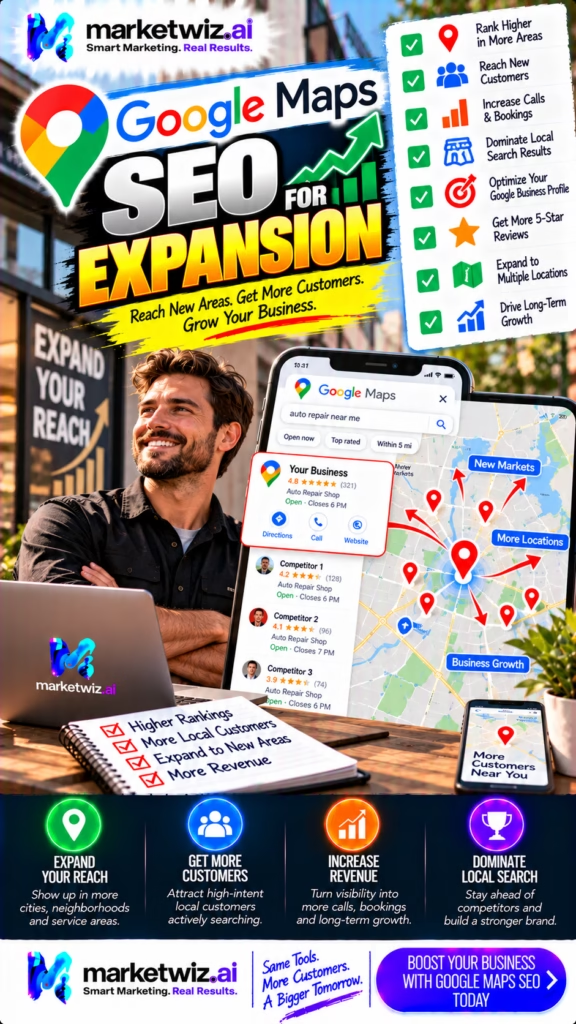
Google Maps SEO for Expansion
Discover how strategic Google Maps SEO can help businesses expand into new markets, improve local search visibility, attract qualified customers across multiple service areas, and build a sustainable foundation for geographic growth.
Business expansion is one of the most exciting opportunities for an established company. Whether the goal is reaching neighboring cities, opening additional locations, expanding service territories, or introducing an existing brand to new communities, sustainable growth depends on being discoverable by the right customers.
For businesses that rely on local customers, Google Maps SEO for expansion can become an important component of their growth strategy. Google Maps and local search results help customers discover nearby companies, compare providers, review business information, and make purchasing decisions.
However, expanding through Google Maps requires more than adding city names to a website or updating a Google Business Profile. Effective geographic expansion involves understanding local search behavior, evaluating market demand, maintaining accurate business information, building customer trust, and creating a consistent experience across every location or service territory.
A business may already perform well in its original market while remaining almost invisible to potential customers in nearby communities. Another company may operate several locations but struggle to maintain consistent local search performance across its network.
These situations demonstrate why expansion requires a structured approach to local SEO.
Core principle: Successful Google Maps expansion is not about appearing in every possible city. It is about developing credible, relevant visibility in markets where your business genuinely operates and can deliver a strong customer experience.
1. Understanding Google Maps SEO for Expansion
Google Maps SEO refers to the process of improving a business's visibility in Google Maps and related local search results.
When applied to expansion, the strategy focuses on strengthening visibility in additional geographic markets while preserving accurate business representation and customer relevance.
What Geographic Expansion Means in Local SEO
Geographic expansion can involve several different business models. A contractor may begin serving neighboring communities. A retailer may open a second storefront. A healthcare organization may establish another practice location. A franchise may launch additional independently operating branches.
Each scenario creates different local SEO requirements.
A company expanding its service territory does not automatically qualify for another Google Business Profile. A business opening a genuinely eligible staffed location may have different profile management options.
Why Existing Rankings Do Not Automatically Transfer
A strong Google Maps presence in one city does not guarantee similar visibility in another. Local search results are influenced by geographic distance, relevance, prominence, and competition.
Customers searching from different neighborhoods may see different businesses, even when using identical search terms.
This means expansion requires market-specific research rather than assuming that success in one location will automatically extend to another.
Expansion Should Follow Operational Reality
A sustainable strategy begins with identifying where the business can genuinely operate, respond to customers, and fulfill its promises.
Marketing visibility should support real business capabilities rather than creating expectations the company cannot meet.
2. Why Google Maps Matters for Business Expansion
Google Maps plays an important role in the way customers discover local businesses. Many searches involving contractors, retailers, restaurants, healthcare providers, and professional organizations include a geographic component.
Local Search Connects Businesses With Active Demand
A person searching for a roofing contractor in a specific city may already have a project in mind. Someone searching for an emergency plumber may need immediate assistance.
These searches can create opportunities for businesses that are relevant, accessible, and capable of meeting customer expectations.
Expansion Requires Brand Discovery
Entering a new market means introducing the company to customers who may not recognize its name.
A complete Google Business Profile, accurate website information, and authentic customer feedback can help establish initial credibility.
Local Visibility Supports Multiple Customer Actions
- Discovering business locations and service areas.
- Reviewing operating hours and contact information.
- Comparing relevant providers.
- Reading authentic customer reviews.
- Visiting a business website.
- Calling or requesting information.
- Obtaining directions to eligible storefront locations.
Visibility Must Produce Meaningful Outcomes
Higher impression counts do not necessarily mean successful expansion.
A business should evaluate whether visibility produces qualified inquiries, profitable appointments, completed transactions, and sustainable customer relationships.
The strongest local growth strategy connects search visibility with actual market demand, operational capacity, and customer acquisition economics.
3. Understanding Google's Local Ranking Factors
Google identifies three primary factors that influence local search rankings: relevance, distance, and prominence.
Relevance
Relevance describes how closely a business matches the customer's search.
Accurate categories, business information, and relevant service descriptions help communicate the nature of a company's operations.
Distance
Distance concerns how far a business is from the location associated with a search.
A company located in one city may appear for some searches in surrounding areas, but visibility can become more difficult as geographic distance increases.
Prominence
Prominence concerns how well-known or established a business appears to be. Google considers information available about businesses, including certain links, references, and review signals.
Why These Factors Matter During Expansion
A company entering a new market may have strong relevance but limited local recognition. Another business may have a recognizable brand but be geographically distant from prospective customers.
Understanding these limitations helps businesses set realistic expectations and avoid misleading optimization tactics.
Google does not provide a way to purchase a better organic local ranking. Paid advertising and organic Google Maps visibility operate through separate systems.
4. Researching New Geographic Markets Before Expansion
One of the most important steps in Google Maps SEO for expansion happens before a business begins creating new content or modifying profiles.
The company must first determine which markets offer realistic commercial opportunities.
Evaluate Customer Demand
Research whether prospective customers in a target city are actively searching for the company's offerings.
Relevant considerations include population, local business activity, housing patterns, industry demand, and seasonal conditions.
Understand the Competitive Landscape
Review businesses already appearing for important searches in the target market.
Examine their offerings, public profiles, customer feedback, and website content.
This research can reveal gaps in the market and help identify areas where the expanding company offers meaningful differentiation.
Evaluate Operational Feasibility
Search demand alone does not make a market profitable.
Consider travel time, staffing requirements, equipment availability, delivery costs, customer support capacity, and project profitability.
Prioritize Markets Strategically
Businesses can compare potential expansion areas using a structured market evaluation framework.
| Evaluation Factor | Key Question | Business Importance |
|---|---|---|
| Customer demand | Are customers searching for these offerings? | Identifies potential opportunity |
| Competition | How established are existing providers? | Helps assess market difficulty |
| Geographic distance | Can the business serve the area efficiently? | Supports operational planning |
| Customer profitability | Do expected projects justify expansion costs? | Supports financial decisions |
| Brand awareness | How familiar are local customers with the company? | Guides trust-building efforts |
| Growth capacity | Can operations support additional demand? | Protects customer experience |
Build a Market Priority List
Rather than targeting dozens of cities simultaneously, businesses may benefit from selecting a smaller group of promising markets.
This creates an opportunity to evaluate results, refine processes, and expand more deliberately.
5. Google Business Profile Optimization for Expansion
A Google Business Profile is an important customer-facing asset for eligible local businesses.
It can communicate business identity, location information, operating hours, offerings, photos, and contact options.
Review Existing Profile Accuracy
Before expanding, verify that the current profile accurately represents the company.
Outdated contact information, incorrect categories, or confusing service descriptions can undermine customer confidence.
Choose Accurate Business Categories
The primary category should describe the company's main business activity.
Additional categories should reflect legitimate business operations rather than unrelated keywords.
Maintain Consistent Business Identity
Use the company's real-world business name and accurate contact details.
Avoid inserting city names or promotional keywords into the profile name unless they genuinely form part of the business's established name.
Clarify Available Services
Use appropriate profile features to explain what the company offers.
Clear information helps prospective customers determine whether the business is relevant to their needs.
Keep Business Hours Updated
Regular hours, holiday schedules, and temporary changes should be reviewed whenever operations change.
Use Authentic Visual Content
Real photographs of facilities, completed work, products, and customer-facing environments can strengthen credibility.
Photos should accurately represent the business and comply with Google's content policies.
6. Building a Multi-Location Google Maps SEO Strategy
Businesses operating through multiple legitimate locations face additional local SEO challenges.
Each eligible location must be represented accurately while maintaining consistency across the broader brand.
Understand Location Eligibility
A separate Google Business Profile may be appropriate for a genuinely distinct business location that satisfies Google's eligibility and representation requirements.
Virtual offices, artificial locations, and addresses used solely to create additional rankings should not be treated as legitimate branches.
Maintain Accurate Location Information
Each eligible profile should contain correct information about its actual location, contact methods, operating hours, and offerings.
Create Useful Location Pages
Businesses with multiple branches can develop dedicated website pages for their real locations.
A useful location page may include the address, directions, operating hours, relevant services, contact information, and distinctive details about the location.
Balance Brand Consistency and Local Relevance
Customers should recognize the same brand across different locations while still receiving accurate information about the branch they intend to contact.
Centralize Important Management Processes
Larger organizations may benefit from consistent procedures for profile updates, customer feedback, website changes, and performance reporting.
Each location should be represented as it actually operates. Consistent branding is valuable, but inaccurate or artificial location signals can create policy and customer experience problems.
7. Google Maps Expansion for Service-Area Businesses
Service-area businesses often travel to customer locations rather than serving customers at a traditional storefront.
Examples include plumbers, HVAC contractors, painters, electricians, roofers, cleaning companies, and other mobile professionals.
Understand Service-Area Profile Rules
Eligible service-area businesses should configure their profiles according to Google's current guidelines.
Businesses that do not receive customers at their address should follow the applicable address-display requirements.
Service Areas Are Not Ranking Guarantees
Adding additional cities to a service-area list does not automatically create prominent rankings throughout those locations.
Distance, relevance, prominence, and local competition continue to influence visibility.
Expand Only Where You Can Deliver
A contractor should not claim coverage in distant markets without the operational capacity to serve those customers.
Realistic geographic coverage helps improve customer expectations and reduces wasted inquiries.
Use Website Content to Explain Coverage
Service-area pages can help customers understand where the company operates.
These pages should provide meaningful information rather than simply repeating city names.
Consider Travel Economics
The value of an expansion market depends partly on how efficiently the business can fulfill customer requests.
Travel expenses, scheduling complexity, and job size should influence which areas receive marketing priority.
8. Geographic Keyword Research for New Markets
Geographic keyword research helps businesses understand how prospective customers search for local solutions.
The objective is to identify phrases that connect actual business offerings with relevant locations and customer intentions.
Service Plus City Keywords
Examples include:
- Exterior house painting in Fort Worth.
- Emergency plumbing in Tampa.
- Roof replacement in Orlando.
- Commercial cleaning in Dallas.
- Air conditioning repair in Rochester.
Neighborhood-Specific Searches
Customers may search using neighborhood names, nearby landmarks, or smaller geographic areas.
Understanding these patterns can help businesses create more useful location content.
High-Intent Search Phrases
Searches involving estimates, appointments, urgent repairs, or specific project requirements may indicate stronger commercial intent.
Specialized Local Keywords
A business may find valuable opportunities in specialized searches rather than broad industry terms.
For example, a company focused on commercial roof coatings may benefit more from relevant commercial searches than general residential roofing traffic.
| Keyword Category | Example | Potential Intent |
|---|---|---|
| General local | Painting company near me | Finding local providers |
| City-specific | House painters in Austin | Searching within a city |
| Urgent | Emergency plumber in Tampa | Seeking prompt assistance |
| Specialized | Commercial HVAC installation Dallas | Finding specific expertise |
| Comparison | Best roofing companies in Orlando | Evaluating providers |
| Transactional | Schedule AC repair near me | Preparing to contact a provider |
Prioritize Relevance Over Search Volume
A keyword with fewer searches may still produce more valuable opportunities if it closely matches the company's capabilities and ideal customer profile.
9. Creating City-Specific Landing Pages That Support Expansion
City-specific landing pages can help businesses explain their actual geographic coverage and connect customers with relevant information.
However, effective location pages must provide genuine value rather than existing solely to repeat geographic keywords.
Explain the Service Clearly
Each page should communicate what the business provides and whether customers in that location can access the offering.
Include Meaningful Local Information
Useful details may include service availability, local project examples, relevant customer questions, and accurate geographic coverage.
Use Authentic Project Examples
Where available, real examples from the area can demonstrate the company's experience.
Avoid claiming projects, customer relationships, or local experience that the business does not have.
Avoid Duplicate City Pages
Creating many nearly identical pages with only the city name changed can produce a weak customer experience.
Each location page should serve a clear purpose and contain sufficiently distinctive information.
Optimize for Mobile Visitors
Local customers frequently research businesses using mobile devices.
Pages should be readable, easy to navigate, and designed to make important contact information accessible.
Connect Pages With Logical Internal Links
A clear website structure can help customers navigate between relevant services, locations, and supporting information.
Build pages for real customer needs and actual business coverage. Helpful geographic content is more sustainable than mass-produced pages designed only to capture search variations.
10. Building Local Reputation and Customer Trust in New Markets
A company entering a new market may face a credibility challenge.
Potential customers may already recognize established local competitors while knowing little about the expanding business.
Encourage Authentic Reviews
Businesses can invite customers to provide honest feedback about their experiences.
Review requests should comply with Google's policies and should not require positive ratings or involve prohibited incentives.
Show Relevant Customer Experiences
Reviews describing real projects, communication, reliability, and customer outcomes can help prospective buyers understand the company's capabilities.
Respond Professionally
Thoughtful responses to customer feedback demonstrate attention to customer experience.
Responses should remain respectful and protect private customer information.
Build Recognition Beyond Reviews
Community participation, legitimate local partnerships, industry relationships, and useful educational content can contribute to broader brand awareness.
Maintain Consistent Standards
Expansion should not create significant differences in customer experience between locations.
Operational consistency helps protect the brand's reputation as the business grows.
11. Local Citations and Consistent Business Information
Local citations are references to a business on websites such as directories, professional associations, and relevant community resources.
They may include the business name, address, phone number, website, and other identifying information.
Audit Existing Listings
Before expanding, review important directory listings for outdated addresses, phone numbers, or business names.
Maintain Accurate Location Details
Businesses operating multiple eligible locations should ensure that listings refer to the correct branch.
Prioritize Trustworthy Sources
Industry directories, professional organizations, and appropriate local resources can help customers discover a business.
Avoid Artificial Citation Campaigns
Submitting a business to large numbers of irrelevant directories may offer little practical customer value.
Accuracy and usefulness should take priority over raw citation volume.
Update Information During Changes
Business relocations, new phone numbers, location openings, and operating changes should trigger a review of important public business information.
12. Analyzing Google Maps Competitors in Expansion Markets
Competitive research helps businesses understand what prospective customers already encounter when searching in a new market.
Identify Relevant Competitors
Search for the services your company genuinely provides and review businesses appearing in the target area.
Different search phrases may reveal different competitor groups.
Compare Business Positioning
Review how competitors describe their specialties, customer types, service areas, and offerings.
Evaluate Customer Feedback
Public reviews can reveal common customer priorities and recurring frustrations.
These insights may help your company communicate meaningful strengths without making unsupported claims about competitors.
Review Website Experiences
Evaluate whether competing websites clearly explain services, geographic coverage, and contact options.
Identify Market Gaps
A market may contain many general providers but fewer companies emphasizing a particular legitimate specialty.
This can create an opportunity for differentiated positioning, provided the company can deliver the offering.
Use Competitive Research Ethically
Competitor analysis should focus on public information, customer needs, and legitimate business differentiation.
Avoid misleading representations, fake reviews, or attempts to manipulate competing business profiles.
13. Turning Google Maps Expansion Into Qualified Leads
The ultimate objective of Google Maps SEO for expansion is not simply increasing the number of locations where a business appears.
It is creating valuable customer acquisition opportunities in markets the business can serve.
Define an Ideal Customer Profile
Identify the customer types, project sizes, service requirements, and geographic areas that best align with the company's operations.
Clarify Services and Expectations
Accurate profile descriptions and website content can help customers determine whether the company is a suitable provider.
Build Relevant Contact Experiences
Customers arriving from local searches should be able to contact the business without unnecessary confusion or friction.
Qualify Inquiries Efficiently
Useful qualification information may include:
- Customer location.
- Requested service or product.
- Project scope.
- Preferred timeline.
- Relevant budget expectations.
- Appointment availability.
Track Sales Outcomes by Market
A city generating many inquiries may not be the most profitable expansion opportunity.
Evaluate which markets produce completed sales, healthy margins, and sustainable customer relationships.
Expansion succeeds when new geographic visibility connects the business with customers it can serve profitably and reliably.
14. Tracking Google Maps SEO Performance Across Markets
Reliable measurement helps businesses determine whether their geographic expansion strategy is producing meaningful results.
Establish a Baseline
Before entering a new market, document existing visibility, customer inquiries, website traffic, and sales performance.
Review Google Business Profile Performance
Available profile performance metrics can provide insight into customer interactions and discovery activity.
These measurements should be interpreted alongside actual lead and revenue data.
Track Website Visits
Appropriate analytics configuration and tagged profile links can help identify traffic associated with local search activity.
Measure Geographic Lead Quality
Record the city or service territory associated with each inquiry where appropriate.
This helps identify markets that produce relevant customer opportunities.
| Performance Metric | What It Reveals | Expansion Value |
|---|---|---|
| Local search visibility | Presence for relevant searches | Market discovery |
| Profile interactions | Customer engagement | Initial interest |
| Website traffic | Visits from tracked sources | Research activity |
| Qualified leads | Relevant customer inquiries | Market suitability |
| Booked appointments | Sales process progression | Conversion effectiveness |
| Closed customers | Completed transactions | Business growth |
| Attributed revenue | Sales connected to marketing | Financial contribution |
Useful Expansion Formulas
Qualified lead rate: Qualified leads divided by total leads, multiplied by 100.
Lead-to-customer conversion rate: New customers divided by total leads, multiplied by 100.
Revenue per qualified lead: Attributed revenue divided by qualified leads.
Customer acquisition cost: Relevant acquisition costs divided by new customers acquired.
Compare Markets Fairly
Account for differences in population, competition, seasonality, service demand, and operational capacity.
A smaller market may generate fewer inquiries but produce stronger margins or lower acquisition costs.
15. Common Google Maps SEO Expansion Mistakes
Creating Fake Business Locations
Using virtual offices, unoccupied addresses, or artificial branches to pursue rankings can violate Google Business Profile policies.
Creating Duplicate Profiles
Multiple profiles for the same business without a legitimate eligibility basis can create confusion and management problems.
Keyword-Stuffing Business Names
Adding city names and marketing phrases that are not part of the real-world business name can violate Google's representation guidelines.
Assuming Service Areas Guarantee Rankings
Listing additional cities does not override geographic distance or guarantee visibility throughout those areas.
Publishing Thin Location Pages
Mass-produced pages that offer little unique value may create a poor customer experience.
Ignoring Operational Capacity
Expanding marketing coverage before the company can reliably fulfill demand can damage customer trust.
Measuring Rankings Without Revenue
A high ranking does not necessarily mean a market is profitable.
Businesses should connect visibility with qualified leads, sales, and financial outcomes.
Expecting Immediate Results
Local SEO performance depends on numerous factors, and no provider can guarantee a particular organic ranking or timeframe.
16. Google Maps Expansion Strategies by Industry
Different industries require different approaches to geographic growth.
HVAC Companies
HVAC businesses expanding into nearby cities can focus on accurate service coverage, emergency repair availability, maintenance offerings, and installation capabilities.
Market research should consider seasonal demand, technician availability, travel requirements, and equipment logistics.
Plumbing Contractors
Plumbing businesses can differentiate emergency repairs, drain cleaning, water heater work, sewer projects, and commercial plumbing.
Expansion planning should account for response times and the ability to serve urgent customers.
Painting Contractors
Painting companies can use authentic residential and commercial project examples to demonstrate their specialties.
Useful location content can clarify whether the company handles interior painting, exterior painting, cabinet refinishing, or larger commercial work.
Roofing Companies
Roofing businesses can research demand for inspections, repairs, replacements, and specialized commercial roofing projects.
Operational planning should consider crew availability, project economics, and realistic geographic coverage.
Retail Businesses
Retailers opening additional storefronts can maintain accurate eligible location profiles with correct addresses, hours, photographs, and contact information.
Medical and Dental Practices
Healthcare organizations should clearly communicate legitimate practice locations, specialties, appointment processes, and relevant patient information.
Accuracy and compliance are particularly important when customers make health-related decisions.
Franchise Organizations
Franchise networks may benefit from centralized brand standards combined with accurate information for each eligible branch.
Location-specific reporting can help identify performance differences across the network.
Professional Services
Attorneys, accountants, consultants, and other professionals can clarify their actual practice areas, office locations, and client requirements.
Geographic expansion should follow applicable professional and business regulations.
17. A Practical 90-Day Google Maps SEO Expansion Roadmap
A structured roadmap can help businesses organize expansion efforts while maintaining realistic expectations.
Days 1–15: Market Research and Baseline Audit
- Identify target expansion cities.
- Evaluate local customer demand.
- Research relevant competitors.
- Review operational coverage and profitability.
- Audit existing Google Business Profiles.
- Document current performance metrics.
Days 16–30: Profile Accuracy and Eligibility
- Correct outdated business information.
- Review primary and additional categories.
- Confirm service-area settings.
- Evaluate eligibility for genuine new locations.
- Update operating hours and contact details.
- Review important directory references.
Days 31–45: Website and Geographic Content
- Improve important service pages.
- Create useful location-specific content.
- Clarify geographic coverage.
- Add authentic project examples where available.
- Improve mobile navigation.
- Review contact and inquiry processes.
Days 46–60: Local Reputation Development
- Implement compliant review requests.
- Respond professionally to customer feedback.
- Update authentic business photographs.
- Review appropriate local business references.
- Identify useful community relationships.
- Improve customer-facing information.
Days 61–75: Lead Tracking and Conversion
- Configure appropriate traffic attribution.
- Track inquiries by geographic market.
- Define qualified lead criteria.
- Review appointment booking processes.
- Evaluate customer response times.
- Identify high-value service opportunities.
Days 76–90: Performance Evaluation
- Compare results with the baseline.
- Review geographic search visibility.
- Analyze qualified inquiries by market.
- Evaluate sales conversion rates.
- Review operational profitability.
- Prioritize the next optimization cycle.
Establish a stronger foundation for geographic visibility, accurate business representation, customer trust, and measurable expansion performance. Ranking improvements and revenue growth are not guaranteed within a specific timeframe.
18. Advanced Google Maps SEO Strategies for Sustainable Expansion
Once the foundation is established, businesses can refine their approach using more detailed market and customer data.
Segment Performance by Geographic Market
Separate lead and sales reporting by city, service territory, or eligible location.
This helps identify which markets produce the strongest commercial results.
Evaluate Geographic Ranking Variation
Google Maps results can change according to searcher location.
Businesses should avoid assuming that a single ranking position accurately represents an entire city.
Representative geographic testing can provide a more useful view of local visibility.
Analyze Service-Level Profitability
Not every offering has the same financial value.
Track which services generate profitable customers in each expansion market.
Develop Local Content Based on Customer Needs
Useful content may address project costs, service comparisons, maintenance considerations, appointment preparation, and common local questions.
The purpose should be to help customers make informed decisions.
Improve Lead Routing
Multi-location businesses can direct inquiries to the appropriate branch or team based on geography and customer requirements.
Connect Marketing With Operations
Marketing teams should coordinate with sales, scheduling, customer support, and field operations.
A new market may produce strong demand but require additional staffing or operational changes before further expansion is practical.
Evaluate Customer Lifetime Value
Some markets may generate customers who make repeat purchases or maintain long-term relationships.
Where reliable data is available, lifetime value can provide additional context beyond the first transaction.
Protect Brand Consistency
As a company expands, customers should continue to receive accurate information and dependable experiences.
Consistent processes, authentic representation, and professional customer communication can support long-term reputation.
Build an Ongoing Optimization Cycle
Google Maps SEO should be reviewed regularly as business operations, competition, customer behavior, and local search conditions evolve.
The most useful strategy is one that adapts to real business results rather than chasing isolated ranking changes.
Google Maps SEO for expansion works best when geographic visibility supports real business operations. Accurate profiles, useful local content, authentic customer trust, market research, and measurable lead quality can help businesses grow into additional markets with greater confidence.
Frequently Asked Questions About Google Maps SEO for Expansion
1. What is Google Maps SEO for expansion?
Google Maps SEO for expansion is the process of improving local search visibility while growing a business into additional geographic markets or strengthening its presence across existing service areas.
2. Can Google Maps SEO help a business expand into new cities?
Yes. Accurate business information, useful location-focused website content, and stronger local recognition can support discovery in additional markets, although rankings are not guaranteed.
3. How does Google determine local rankings?
Google identifies relevance, distance, and prominence as the main considerations for local search rankings.
4. Can one Google Business Profile rank in multiple cities?
One eligible profile may appear for searches across multiple nearby areas, but visibility depends on the search context, business location, relevance, and prominence.
5. Should every business location have a separate Google Business Profile?
Genuinely distinct eligible business locations may qualify for separate profiles, provided they meet Google's location and representation guidelines.
6. Can a business create Google profiles for cities without physical offices?
Businesses should not create profiles for virtual offices or locations that do not satisfy Google's eligibility requirements.
7. Does adding service areas improve rankings in those cities?
Service-area settings communicate coverage but do not guarantee higher rankings in the listed locations.
8. What is multi-location local SEO?
Multi-location local SEO involves managing local search visibility for a business operating through multiple legitimate locations.
9. How long does Google Maps expansion SEO take?
Results vary according to competition, location, existing authority, market demand, and implementation quality. There is no guaranteed timeline.
10. Are city-specific landing pages useful?
Useful city-specific pages can help explain actual geographic coverage and support relevant organic searches when they contain distinctive information.
11. Can Google Maps SEO generate expansion leads?
Relevant local visibility can help potential customers discover and contact a business as it expands into new markets.
12. What is geographic keyword targeting?
Geographic keyword targeting involves researching and creating relevant content for searches connected to specific cities, neighborhoods, or service territories.
13. Do customer reviews help local expansion?
Authentic reviews can strengthen customer confidence, and Google states that review count and positive ratings can contribute to local ranking.
14. How important are business categories?
Accurate categories help Google understand the nature of a business and its relevance to appropriate searches.
15. Can service-area businesses expand through Google Maps?
Eligible service-area businesses can use Google Business Profiles and supporting website content while following Google's eligibility and service-area rules.
16. Does Google Maps SEO replace paid advertising?
No. Organic local SEO and paid advertising can serve complementary purposes, particularly when entering competitive markets.
17. How can businesses measure expansion performance?
Businesses can track local search visibility, profile interactions, qualified leads, customer locations, appointments, and attributed revenue.
18. What is local search prominence?
Prominence concerns how well-known a business appears to be based on information Google can find about it.
19. Are local citations useful for expansion?
Accurate references on reputable directories and relevant websites can support business discovery and reduce confusion about locations and contact details.
20. Can Google Maps rankings vary by neighborhood?
Yes. Results may differ according to searcher location, query wording, distance, competition, and other local ranking considerations.
21. Should expanding businesses target every nearby city?
Businesses should prioritize markets they genuinely serve and where demand, operating costs, and customer opportunities justify expansion.
22. How do photos support expansion?
Authentic photos can help customers in new markets evaluate a business's work, facilities, and capabilities.
23. What is a local SEO expansion audit?
An expansion audit reviews business eligibility, existing visibility, competitors, geographic demand, website content, and customer acquisition opportunities.
24. How can businesses avoid duplicate Google profiles?
Maintain profiles only for legitimate eligible businesses or locations and review existing listings before creating new ones.
25. Does website optimization help Google Maps expansion?
Helpful service and location pages can support local organic discovery and provide relevant information to visitors arriving from Google Business Profiles.
26. What industries benefit from Google Maps expansion?
Home improvement, HVAC, plumbing, roofing, retail, healthcare, professional services, and many other eligible local businesses may benefit from stronger geographic visibility.
27. Can Google Maps SEO support franchise growth?
Yes. Eligible franchise locations can benefit from consistent profile management, accurate location information, and locally relevant content.
28. What mistakes should businesses avoid when expanding?
Common mistakes include fake locations, keyword-stuffed business names, duplicate profiles, misleading service areas, thin city pages, and failing to measure lead quality.
29. What is the best Google Maps expansion strategy?
A sustainable strategy combines market research, eligible business profiles, accurate information, helpful location content, authentic reviews, and performance tracking.
30. How can MarketWiz.ai help with Google Maps expansion?
MarketWiz.ai can help businesses explore local marketing strategies designed to improve geographic visibility, attract relevant inquiries, and support measurable business growth.
30 Additional SEO Keywords for Google Maps Business Expansion
The following related keywords provide additional topical coverage for businesses researching geographic expansion, multi-location SEO, Google Maps optimization, and local lead generation.
These keywords should be incorporated naturally where they accurately describe the subject matter. Excessive repetition, irrelevant keyword insertion, and artificial location targeting do not guarantee improved search performance.
Expand Your Local Reach With Smarter Google Maps Marketing
MarketWiz.ai helps businesses explore marketing strategies focused on stronger local visibility, qualified customer inquiries, geographic growth, and measurable acquisition opportunities. Build a more strategic foundation for reaching customers in the markets that matter most.
Explore MarketWiz.ai