
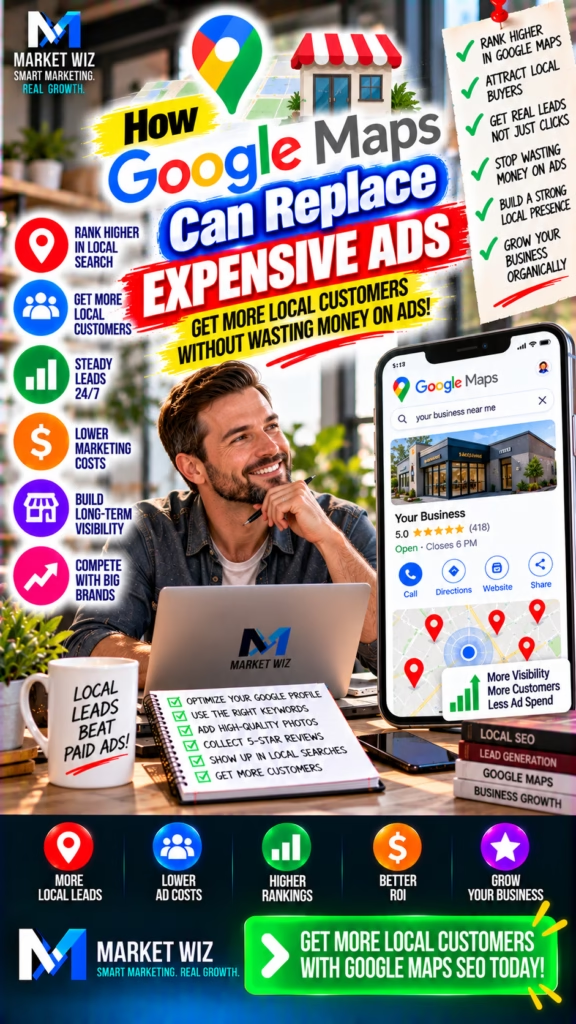
How Google Maps Can Replace Expensive Ads
What if your business could generate more local customer inquiries without paying for every click? Google Maps SEO gives eligible local businesses an opportunity to reach customers who are already searching for their products and services. By combining Google Business Profile optimization, local SEO, authentic reviews, website improvements, customer response systems, and measurable lead tracking, businesses can build organic visibility that may reduce their dependence on increasingly expensive advertising campaigns.
Why Businesses Are Looking for Alternatives to Expensive Advertising
For many local businesses, customer acquisition has become one of the most important operational challenges. Companies need a predictable flow of new inquiries, but they also need those inquiries to produce enough revenue to justify the marketing investment.
Paid advertising can be effective. Google Ads, Facebook Ads, Instagram campaigns, and other paid channels can introduce businesses to potential customers and create measurable opportunities.
However, paid advertising also creates an ongoing financial obligation. Businesses must continue funding campaigns to maintain the traffic and exposure those campaigns provide.
When competition increases, customer acquisition can become more expensive. Advertisers may compete for the same audiences, search terms, locations, and high-value customer segments.
A contractor may be paying to reach homeowners who are also being targeted by several competing contractors. A furniture store may be competing against regional retailers and national chains. A local professional business may be trying to acquire customers in a market where larger competitors have significantly greater advertising budgets.
These conditions create a natural question: Can a business generate qualified customers without relying on paid advertising for every new opportunity?
Google Maps SEO is one potential answer.
Instead of purchasing every visitor through advertising, a business can invest in becoming more visible when customers search organically for relevant local products and services.
This does not mean every business should immediately stop advertising. Paid campaigns can remain valuable, especially for new launches, promotions, seasonal demand, and markets where organic visibility is still developing.
The more useful objective is to create a balanced customer acquisition system that does not depend entirely on one paid channel.
The goal is not simply to spend less on advertising. The goal is to acquire qualified customers more efficiently. Google Maps SEO can support that objective by helping businesses become visible when local buyers are already searching for solutions.
1. The Hidden Cost of Depending Entirely on Paid Ads
Paid advertising is often evaluated using straightforward metrics such as cost per click, cost per lead, and return on advertising spend.
Those metrics are useful, but they do not always capture the entire customer acquisition process.
A business may pay for a click that never becomes an inquiry. It may pay for an inquiry from someone outside its service area. It may generate a lead from a customer who is not ready to purchase.
Even when the lead is legitimate, the business still needs to qualify the opportunity, provide information, schedule an appointment, prepare an estimate, and complete the sale.
Advertising costs therefore represent only one part of the customer acquisition equation.
Sales labor, administrative time, missed calls, delayed follow-up, and unqualified opportunities can also affect profitability.
A company that depends entirely on paid advertising may also experience sudden changes in lead volume when its advertising budget changes.
If the company pauses campaigns, the flow of paid traffic can decline immediately.
Organic local search provides a different model.
A strong Google Maps presence can continue to create discovery opportunities without requiring the company to pay Google for each organic customer action.
That does not make organic marketing free.
SEO requires time, expertise, content, reputation management, website maintenance, and ongoing operational attention.
But its economics differ from a system where every additional paid click carries a direct advertising charge.
2. Google Maps Captures Customers Who Are Already Searching
One of the most important differences between organic local search and many forms of advertising is the way customers discover businesses.
Advertising frequently introduces an offer to someone who may or may not be actively looking for it.
Local search often begins with a customer who has already identified a need.
A homeowner searches for a roofing company.
A property owner searches for a local HVAC contractor.
A customer searches for a mattress store nearby.
A business owner searches for commercial cleaning.
A driver searches for an auto repair shop.
A homeowner searches for a window replacement company.
These searches may indicate meaningful commercial intent because the customer is actively evaluating a product, service, or provider.
Google Maps can help eligible businesses appear within that decision-making process.
The customer can review business information, evaluate reputation, visit the website, and contact the company.
The business is not necessarily creating demand from scratch.
It is becoming visible where relevant demand already exists.
3. Why Google Maps Leads Can Have Strong Purchase Intent
Lead quality is often more important than raw lead volume.
A business can receive hundreds of inquiries and still struggle if those inquiries do not match its products, location, budget requirements, or sales process.
Local search can offer an advantage because the search itself provides clues about customer intent.
A person searching for a local business may already understand what they need.
They may be comparing options.
They may be researching reviews.
They may be looking for business hours.
They may want a phone number.
They may be ready to schedule an appointment.
They may be evaluating pricing or availability.
This does not mean every Google Maps inquiry will become a customer.
Some searchers are researching. Some are comparing prices. Some are outside the company's ideal market.
However, the presence of active local search intent can make Google Maps a valuable customer acquisition channel.
4. Understand the Difference Between Organic Google Maps SEO and Paid Advertising
Google Maps SEO and paid advertising operate through different mechanisms.
Organic local SEO focuses on improving a business's legitimate visibility in local search results.
Paid advertising purchases eligible sponsored placements through advertising platforms.
Paying for advertising does not purchase higher organic local rankings.
| Factor | Google Maps SEO | Paid Advertising |
|---|---|---|
| Primary Approach | Improve organic local visibility | Purchase eligible advertising exposure |
| Per-Click Charge | No advertising charge for an organic click | May involve per-click or other paid pricing models |
| Speed | Visibility may take time to develop | Campaigns can often launch quickly |
| Ongoing Investment | SEO, content, reputation, website, and operations | Media budget, management, creative, and operations |
| Customer Intent | Often connected to active local searches | Depends on campaign targeting and format |
| When Spending Stops | Existing organic visibility may continue but can change | Paid placements generally stop when campaigns stop |
| Primary Business Goal | Qualified organic customer acquisition | Qualified paid customer acquisition |
Neither model is automatically superior.
The best strategy depends on customer demand, competition, available resources, margins, conversion rates, and business objectives.
For many established local businesses, the strongest approach is developing organic search visibility while using paid advertising selectively.
5. Build a Google Business Profile That Customers Can Trust
A Google Business Profile is a foundational part of local search visibility for eligible businesses.
It helps customers understand who the business is, what it offers, where it operates, and how to contact it.
A profile should accurately represent the real business.
Important information may include the business name, phone number, website, business hours, appropriate categories, address or service-area details where applicable, and other available features.
Incomplete or inaccurate information can create friction.
A customer may encounter a disconnected phone number.
They may arrive when the business is closed.
They may visit an outdated website.
They may misunderstand what the company offers.
These problems can undermine the value of local search visibility.
Accurate business information supports both discoverability and customer confidence.
6. Understand Google's Local Ranking Factors
Google describes local ranking as primarily influenced by three broad factors: relevance, distance, and prominence.
Relevance
Relevance concerns how well a business matches what the customer is searching for.
Accurate categories, business details, website content, and other relevant information can help communicate what the business actually does.
Distance
Distance considers the relationship between the searcher or location specified in the search and the business location.
A company cannot legitimately change its physical location simply by adding more city keywords.
Prominence
Prominence reflects how well-known or established a business appears across relevant signals.
Reputation, links, reviews, and other information may contribute to local prominence.
There is no legitimate shortcut that guarantees a number-one Google Maps ranking. The sustainable approach is improving business accuracy, relevance, reputation, website quality, and legitimate local prominence while delivering a strong customer experience.
7. Select Business Categories That Match Your Actual Offer
Business categories help communicate what a company does.
Choosing the correct primary category is an important profile setup decision.
Additional categories should represent genuine business activities.
A company should not select unrelated categories simply because they appear to offer additional search traffic.
For example, a business specializing in window replacement should choose categories that accurately represent its legitimate activities.
A furniture retailer should identify the categories that reflect its actual retail operation.
A contractor should use categories that accurately describe the work the company performs.
Category accuracy supports relevance and reduces confusion for customers.
8. Target Local Keywords That Represent Real Customer Demand
Effective local SEO begins with understanding how customers search.
Businesses often use industry language that differs from the words their customers use.
A contractor may describe a specialized installation process while homeowners search for a simpler phrase.
A retailer may use a manufacturer's product terminology while customers search for a general product category.
Keyword research helps connect the business's offer with customer search behavior.
Core Product Searches
Keywords describing the products or services the business actually sells.
Local Searches
Relevant city, neighborhood, regional, and nearby search themes.
Problem-Based Searches
Customer searches describing problems the business is qualified to solve.
Purchase-Intent Searches
Searches involving providers, appointments, quotes, installation, availability, or purchasing decisions.
Keyword research should guide useful content rather than encourage repetitive keyword stuffing.
The business should explain its products and services clearly, answer relevant questions, and accurately describe its geographic coverage.
9. Use Authentic Google Reviews to Build Customer Confidence
Customer reviews can influence how prospective buyers evaluate local businesses.
A homeowner considering a major improvement project may want evidence of reliability.
A shopper considering an unfamiliar retailer may want reassurance about product quality and service.
A customer comparing several local providers may read reviews before making contact.
Authentic feedback can help answer those questions.
Businesses should develop legitimate processes for requesting reviews from real customers.
Review requests should not depend on whether a customer is expected to leave positive feedback.
Businesses should not purchase fake reviews, invent customer experiences, or use incentives that violate platform policies.
A genuine reputation is more valuable than a manipulated review profile.
10. Add Useful Photos That Help Customers Evaluate Your Business
Photos can make a business profile more informative.
For a contractor, completed project photography can demonstrate workmanship.
For a retailer, accurate product and store photos can help customers understand what is available.
For a professional business, appropriate photos can help communicate the environment and customer experience.
Businesses should prioritize realistic, current, accurate images that represent their operations.
Photos should not mislead customers about products, facilities, staff, locations, or completed work.
11. Connect Google Maps With a Strong Local SEO Website
A Google Business Profile provides an important point of discovery.
The website provides room for more detailed information.
Customers may want to understand pricing considerations, available products, project examples, business qualifications, service areas, or the purchasing process.
A strong website can answer those questions.
It can also create additional organic search opportunities beyond the map interface.
The website should be technically sound, easy to navigate, mobile-friendly, and organized around real customer needs.
Its contact information should match the business's legitimate identity.
Its calls to action should make the next step clear.
12. Create Local Landing Pages for Markets You Actually Serve
Businesses serving multiple communities may benefit from useful geographic content.
However, local landing pages should not be created merely to repeat the same text with different city names.
Each page should provide meaningful value.
That might include relevant products, legitimate service-area information, local project examples, customer questions, or other helpful details.
A company should avoid claiming physical offices it does not actually operate.
Service-area content should reflect the business's real operating capabilities.
The objective is helping customers understand whether the business can serve them.
13. Improve Website Speed, Mobile Usability, and Technical SEO
A business can generate local search visibility and still lose opportunities through a poor website experience.
Slow pages can frustrate visitors.
Broken navigation can prevent customers from finding important information.
Confusing mobile layouts can make it difficult to contact the business.
Forms that do not submit correctly can silently lose inquiries.
Technical SEO should support both search accessibility and customer usability.
Important priorities include efficient loading, working mobile navigation, clear internal links, accessible content, correct indexing, and functional conversion elements.
14. Build Legitimate Local Authority Instead of Buying More Exposure
A business's local presence extends beyond its website and Google Business Profile.
Customers may encounter the company through directories, community organizations, industry associations, local publications, partnerships, and other relevant sources.
Accurate business information across reputable sources helps create consistency.
Legitimate local relationships can also contribute to brand awareness and prominence.
The objective should not be acquiring large quantities of low-quality links.
Instead, businesses should focus on genuine connections that reflect their real operations and reputation.
15. Turn Google Maps Visibility Into Calls, Website Visits, and Leads
Visibility alone does not create business growth.
Customers must be able to take action.
An eligible business profile may provide options for calling the company, visiting its website, requesting directions, or taking other available actions.
The website can provide additional opportunities to request information, schedule consultations, or complete purchases.
The business should make these next steps clear.
A customer who has already decided to contact the company should not have to search through multiple pages to find a phone number.
Simple, accurate contact paths can improve the customer experience.
16. Compare the True Cost of Organic and Paid Leads
Businesses should compare marketing channels using actual economics rather than assumptions.
A paid lead may carry an identifiable advertising cost, but the total cost can also include management fees, creative production, software, and sales labor.
Organic leads also have costs.
SEO work, content, website maintenance, review management, analytics, and lead handling all require resources.
A useful comparison considers the complete investment required to generate qualified customers.
Illustrative example: If a business spends $3,000 on a paid campaign and receives 60 leads, its direct advertising cost per lead is $50 before management and sales expenses. If an organic SEO program costs $1,200 during a month and produces 40 leads, the simple program cost per lead is $30. These are hypothetical numbers, not expected results, and the comparison is incomplete until lead quality, attribution, closing rates, project values, and other costs are considered.
The lower cost per lead is not automatically the better business outcome.
One channel may produce higher-value customers.
Another may generate more qualified appointments.
The correct comparison follows leads through to actual revenue and profitability.
17. Understand How Organic Local Visibility Can Create Continuing Value
One reason businesses invest in SEO is the possibility of building marketing assets that continue providing value over time.
A useful website page can remain available after publication.
An authentic customer review can continue helping future prospects evaluate the business.
A completed project case study can remain useful long after the project ends.
A well-maintained business profile can continue serving as a point of discovery.
These assets do not guarantee permanent rankings or traffic.
Competition changes.
Customer behavior changes.
Search systems change.
Business information requires maintenance.
However, the ability to build useful assets is one of the important differences between organic SEO and short-term advertising exposure.
18. Help Smaller Businesses Compete Without Matching Large Advertising Budgets
Large competitors may have significant advertising resources.
They may operate multiple locations.
They may have dedicated marketing teams.
They may spend heavily on paid search and social campaigns.
Smaller businesses cannot always compete by matching that spending.
Local search offers another way to compete.
A smaller company may have a strong reputation in its community.
It may have detailed knowledge of local customer needs.
It may provide excellent customer communication.
It may have authentic project examples and positive reviews.
It may be geographically relevant to a particular searcher.
These strengths can support local visibility and customer confidence.
19. Which Businesses Can Benefit From Google Maps SEO?
Google Maps SEO can be useful for eligible businesses that serve customers in defined geographic markets.
Home Improvement
Roofing, painting, window replacement, remodeling, flooring, fencing, and other eligible contractors.
Home Maintenance
HVAC, plumbing, electrical, cleaning, appliance repair, and related local businesses.
Local Retail
Furniture stores, mattress retailers, appliance stores, and other eligible physical retail businesses.
Professional Businesses
Eligible professional practices, consultants, repair shops, and appointment-based operations.
The value of Google Maps SEO depends on whether customers actually search locally for the business's offer.
Companies should research search demand before assuming that organic local search will replace existing advertising channels.
20. Expand Google Maps Visibility Across Legitimate Service Areas
Some businesses operate across multiple cities or regional markets.
Others maintain several legitimate staffed locations.
Local SEO strategies should reflect the actual business structure.
A service-area business should represent its operations accurately under Google's current eligibility and profile guidelines.
A multi-location business should avoid creating duplicate or fictitious profiles.
Website content can describe legitimate geographic coverage.
Project examples can demonstrate experience in relevant areas.
Marketing teams can evaluate local performance by city or region.
Expansion should be guided by actual demand, operational capacity, and profitability.
21. Respond Quickly When Google Maps Generates a Customer Inquiry
Generating a lead is only the beginning of customer acquisition.
A customer may contact several businesses during the same research session.
If a company does not answer the phone or respond to an inquiry, the customer may continue evaluating competitors.
Businesses should develop dependable response processes.
Calls should route to appropriate people.
Website forms should deliver notifications.
Qualified inquiries should be recorded.
Appointments should be coordinated.
Follow-up responsibilities should be clear.
Improving response operations can help a company capture more value from the visibility it already has.
22. Use AI to Support Organic Lead Response and Follow-Up
AI-supported workflows can help businesses manage repetitive lead-handling tasks.
A new inquiry can trigger a notification.
Contact information can be organized.
A qualification workflow can collect relevant details.
An appointment request can be routed to the appropriate team.
Follow-up reminders can be generated.
CRM records can be updated through integrated systems.
Reporting can summarize pipeline activity.
Automation should support clear, accurate communication.
It should not invent prices, guarantees, availability, or business policies.
Human oversight remains important, especially for complex or high-value customer decisions.
23. Track Google Maps Leads Through a CRM
A CRM can help connect marketing activity with sales outcomes.
Without a central record, businesses may struggle to understand which inquiries became real customers.
A structured pipeline can include the initial inquiry, qualification, appointment, estimate, follow-up, sale, and post-sale stages.
Salespeople can record relevant customer information.
Managers can identify stalled opportunities.
Marketing teams can evaluate which sources produce qualified leads.
This makes it easier to judge whether organic local SEO is supporting profitable growth.
24. Measure Google Maps Performance Beyond Rankings
Ranking improvements can be encouraging, but rankings alone do not establish marketing profitability.
A business should also measure customer actions and sales results.
| Metric | What It Measures | Business Value |
|---|---|---|
| Relevant Local Visibility | Discovery for searches matching the business | Shows potential organic reach |
| Calls | Phone inquiries associated with local search | Measures direct customer contact |
| Website Inquiries | Forms and other measurable website actions | Measures lead creation |
| Qualified Leads | Prospects fitting the business's sales criteria | Measures lead relevance |
| Appointments | Prospects moving into the sales process | Measures pipeline progression |
| Closed Customers | Qualified opportunities becoming sales | Measures acquisition effectiveness |
| Revenue | Sales associated with acquired customers | Measures financial contribution |
| Acquisition Cost | Total relevant marketing cost per acquired customer | Supports channel comparisons |
Not every customer journey can be attributed perfectly.
Customers may interact with several channels before making a purchase.
The business should use available analytics, CRM records, customer feedback, and sales data to build the clearest practical picture of performance.
25. Reduce Paid Advertising Gradually as Organic Leads Improve
One of the biggest mistakes a business can make is stopping profitable advertising before an alternative lead source is ready.
Google Maps SEO usually requires development and ongoing optimization.
The transition should be measured.
Start by establishing baseline performance.
Track current paid lead volume, qualified appointments, sales, revenue, and acquisition costs.
Build the organic local search program.
Measure the qualified leads it produces.
Compare conversion rates and revenue.
Evaluate whether organic leads are sufficiently consistent.
Only then consider reducing paid spending in areas where the economics support the decision.
A successful transition is based on evidence, not assumptions. Google Maps SEO may allow some businesses to replace a meaningful portion of expensive advertising, while others may benefit more from combining organic visibility with carefully managed paid campaigns.
26. Use Paid Ads Selectively Instead of Funding Every Lead
Reducing dependence on advertising does not require eliminating advertising entirely.
Paid campaigns may still be useful for specific business objectives.
A company may use advertising to introduce a new product.
It may promote a seasonal offer.
It may test demand in a new market.
It may use appropriate remarketing to reconnect with eligible audiences.
It may support a major launch or expansion.
Organic Google Maps visibility can provide one customer acquisition foundation while paid marketing is used where it adds measurable value.
This can create a more diversified marketing system.
27. Combine Google Maps With SEO, Social Media, and Organic Marketing
Customer journeys rarely involve only one channel.
A customer may first encounter a business through social media.
Later, the customer may search Google for the company.
They may review its Google Business Profile.
They may read customer feedback.
They may visit the website.
Then they may call.
These interactions can reinforce one another.
Google Maps SEO can work alongside website SEO, social media, email marketing, referrals, eligible marketplace listings, and other legitimate organic channels.
The objective is not merely more exposure.
It is helping customers recognize, evaluate, and contact the business through a consistent digital presence.
28. Common Mistakes When Trying to Replace Paid Ads With Google Maps
- Expecting instant organic rankings
- Stopping profitable advertising too early
- Using inaccurate Google Business Profile information
- Selecting irrelevant business categories
- Creating duplicate or fictitious business locations
- Ignoring Google's eligibility and verification rules
- Purchasing fake customer reviews
- Using misleading photos or business descriptions
- Building thin, repetitive local landing pages
- Ignoring mobile website usability
- Failing to answer incoming calls
- Failing to respond to website inquiries
- Neglecting lead qualification
- Failing to follow up with qualified prospects
- Not recording leads in a CRM
- Measuring rankings without measuring revenue
- Assuming organic marketing has no operating costs
- Comparing channels without accounting for lead quality
- Targeting cities the business cannot realistically serve
- Expecting guaranteed rankings or permanent visibility
Avoiding these mistakes can help businesses build a more reliable organic customer acquisition strategy.
29. A Step-by-Step Google Maps SEO Strategy to Reduce Advertising Costs
Audit Current Advertising Performance
Document spending, lead volume, qualified inquiries, appointments, sales, revenue, and acquisition costs. Establish a baseline before making budget changes.
Identify Local Search Demand
Research the products, services, customer problems, and geographic markets relevant to the business.
Optimize the Google Business Profile
Maintain accurate information, appropriate categories, working contact details, current hours, and useful photos.
Improve the Website
Strengthen technical SEO, mobile usability, product information, local content, and conversion paths.
Develop Authentic Customer Reviews
Create legitimate review-request processes and respond professionally to customer feedback.
Publish Useful Local Content
Answer real customer questions and describe legitimate products, projects, and service areas.
Strengthen Local Prominence
Build accurate business citations, relevant relationships, community connections, and other legitimate authority signals.
Improve Lead Response
Ensure calls, forms, appointments, and other inquiries reach the appropriate team quickly.
Track Leads Through the CRM
Connect qualified inquiries with appointments, estimates, sales, revenue, and acquisition costs.
Adjust Advertising Based on Real Results
Reduce paid spending selectively when organic lead volume, quality, consistency, and profitability justify the change.
30. Build a Sustainable Local Customer Acquisition System
The strongest marketing strategies are built around customer acquisition economics.
Businesses need qualified demand.
They need a credible reputation.
They need effective communication.
They need organized sales processes.
They need accurate performance reporting.
Google Maps SEO can support these objectives by creating another path for local customers to discover the business.
Over time, a company may develop stronger organic visibility, a more useful website, a larger body of authentic customer feedback, and better lead-management processes.
Those improvements can make the business less dependent on purchasing every new customer interaction.
The result may be a more balanced, efficient, and resilient marketing system.
The objective is not to declare paid advertising unnecessary.
It is to give the business more control over how customers are acquired.
30 FAQs About Replacing Expensive Ads With Google Maps SEO
1. Can Google Maps really replace expensive advertising?
Google Maps SEO can reduce or sometimes replace portions of paid advertising for businesses that generate sufficient qualified customers through organic local search. Results depend on demand, competition, visibility, conversion rates, and business goals.
2. Is Google Maps marketing free?
Creating and managing an eligible Google Business Profile is free. However, professional SEO, content development, website improvements, reputation management, and marketing operations may involve costs.
3. How does Google Maps generate leads?
Google Maps can connect businesses with nearby people searching for relevant products and services. Customers may call, visit the website, request directions, or take other available actions.
4. Why are Google Maps leads often high intent?
Many local searches reflect an existing customer need. Someone searching for a nearby contractor, store, or professional may already be researching a purchase or appointment.
5. Is Google Maps SEO better than Google Ads?
Neither channel is universally better. Organic local SEO can support sustained visibility without paying per click, while Google Ads can provide faster targeted exposure. The best choice depends on objectives, economics, and market conditions.
6. Can businesses generate leads without paying for clicks?
Yes. Organic Google Maps visibility can generate customer actions without a per-click advertising charge, although achieving and maintaining visibility may require ongoing investment.
7. How long does Google Maps SEO take to work?
Timelines vary based on existing visibility, competition, location, website quality, reputation, and optimization work. No specific ranking or lead-generation timeline is guaranteed.
8. What determines Google Maps rankings?
Google describes local ranking as primarily influenced by relevance, distance, and prominence. Businesses can improve the accuracy and usefulness of their online presence, but cannot guarantee a particular ranking.
9. Do Google reviews help local businesses?
Authentic reviews can help prospective customers evaluate a business and contribute to its online reputation. Businesses should request and manage reviews in accordance with Google's policies.
10. Does Google Business Profile optimization improve lead generation?
An accurate and complete Google Business Profile can make it easier for relevant customers to understand the business, evaluate its reputation, and contact it.
11. Can small businesses compete with large advertisers on Google Maps?
Yes. Local relevance, proximity, reputation, prominence, and useful business information can create opportunities for smaller companies to compete for local visibility.
12. Can Google Maps SEO work for contractors?
Yes. Eligible contractors can use local SEO to reach homeowners searching for relevant work in their geographic service areas.
13. Can Google Maps generate phone calls?
Yes. Eligible Google Business Profiles can display phone contact options that allow customers to call directly from local search experiences.
14. Does a business need a website for Google Maps SEO?
A website is not universally required for an eligible Google Business Profile, but a strong website can support customer trust, local search relevance, and conversions.
15. Should businesses create local landing pages?
Useful local landing pages can help explain products, services, and legitimate service areas. They should contain original, meaningful content rather than repetitive city-name substitutions.
16. Can Google Maps SEO reduce customer acquisition costs?
It can reduce acquisition costs when the total cost of organic marketing produces qualified customers more efficiently than alternative channels. Businesses should compare actual costs and closed revenue.
17. What businesses benefit most from Google Maps SEO?
Businesses serving customers in defined geographic markets may benefit, including contractors, retailers, professional practices, home improvement companies, repair businesses, and other eligible local operations.
18. Can Google Maps SEO replace Facebook Ads?
For some businesses, organic local search can generate enough qualified demand to reduce dependence on Facebook Ads. However, Facebook advertising and Google Maps reach customers in different ways.
19. Does Google Maps SEO require monthly spending?
Google does not charge a monthly fee for an eligible Google Business Profile. Businesses may choose to invest in ongoing SEO, website maintenance, content, reputation management, and lead handling.
20. How can a business improve Google Maps visibility?
Businesses can maintain accurate profile information, choose appropriate categories, keep hours current, add useful photos, build an authentic reputation, improve their websites, and strengthen legitimate local prominence.
21. Can Google Maps SEO support multiple service areas?
Yes. Businesses can accurately describe legitimate service areas and create useful geographic content. Visibility varies by search location, relevance, competition, and other factors.
22. Should businesses stop paid ads immediately after starting SEO?
Usually not. A measured transition is safer. Businesses should evaluate organic lead volume, quality, conversion rates, and revenue before reducing advertising that is currently profitable.
23. Can AI improve Google Maps lead generation?
AI-supported workflows can help businesses respond to inquiries, organize lead information, route opportunities, support appointment coordination, and maintain follow-up.
24. What is the difference between Google Maps SEO and paid search?
Google Maps SEO focuses on improving organic local visibility, while paid search uses advertising budgets to obtain eligible sponsored placements. Paying for ads does not purchase higher organic local rankings.
25. Can businesses track Google Maps leads?
Yes. Businesses can use available Business Profile performance data, website analytics, appropriate call tracking, CRM records, and sales reporting to understand lead activity.
26. What metrics show whether Google Maps SEO is working?
Important metrics include relevant visibility, calls, website inquiries, qualified leads, appointments, estimates, closed customers, revenue, and total acquisition costs.
27. Can Google Maps SEO produce long-term results?
A strong local search presence can create continuing opportunities, but visibility and results may change with competition, search systems, business information, and customer behavior.
28. Does Google Maps SEO work without a large marketing budget?
Businesses can begin with accurate profile information, useful website content, authentic customer reviews, and basic local SEO practices. More competitive markets may require greater resources.
29. Can organic Google Maps leads be more profitable than paid leads?
They can be, depending on total marketing costs, lead quality, close rates, project values, and the business's operating expenses. Profitability should be evaluated using actual data.
30. What is the best strategy for replacing expensive ads with Google Maps?
Build accurate Google Business Profile visibility, strengthen website and local SEO, develop an authentic reputation, improve conversion and lead response, measure closed revenue, and gradually reduce paid advertising only when organic performance supports the decision.
30 Additional SEO Keywords
These keyword themes can support future local SEO articles, Google Maps marketing resources, educational content, business growth guides, website pages, and organic customer acquisition campaigns.
How Google Maps Can Help Businesses Spend Less on Ads and Build Stronger Organic Growth
For many local businesses, marketing has become closely associated with advertising spending.
When the company needs more leads, the immediate response may be to increase the advertising budget.
When inquiries decline, the business may launch another campaign.
When competition intensifies, the company may increase bids or expand targeting.
This approach can produce results, but it also creates dependence.
The company may begin to feel that every new customer requires another advertising expense.
Google Maps SEO offers a different way to approach local customer acquisition.
Instead of relying exclusively on paid exposure, the business can invest in becoming more visible when customers search organically for relevant solutions.
This difference matters.
A person searching for a nearby business may already have a specific need.
They may want to schedule an appointment.
They may need a contractor.
They may be comparing local retailers.
They may be researching a high-value purchase.
They may want a phone number or directions.
They may be ready to make a decision.
A strong local search presence can help the business enter that process.
But visibility is only the beginning.
A customer who discovers a business still needs reasons to trust it.
That trust may develop through authentic reviews.
It may develop through accurate business information.
It may develop through professional project photography.
It may develop through a useful website.
It may develop through clear product descriptions.
It may develop through transparent communication.
It may develop through a positive customer experience.
These elements work together.
A Google Business Profile can provide the first point of discovery.
Reviews can help a prospect evaluate the company.
Photos can demonstrate what the business offers.
Website content can answer important questions.
Local pages can clarify geographic coverage.
Clear contact options can encourage the next step.
The business then needs to respond.
A missed call can represent a missed opportunity.
A delayed reply can allow a competitor to continue the conversation first.
An unanswered website form can undermine the value of marketing work that successfully attracted the prospect.
That is why Google Maps SEO should be connected with customer response systems.
The business should know when inquiries arrive.
It should have clear responsibility for responding.
It should identify which prospects fit its offer.
It should organize qualified leads.
It should coordinate appointments.
It should track estimates.
It should maintain appropriate follow-up.
It should record sales outcomes.
A CRM can help manage those activities.
AI-supported workflows can assist with repetitive tasks.
Reporting can connect the marketing channel with revenue.
This creates a more complete customer acquisition system.
The business is no longer measuring only how many people saw an advertisement.
It is measuring how many people became qualified prospects.
How many scheduled appointments?
How many requested estimates?
How many completed purchases?
How much revenue did those customers generate?
What did it cost to acquire them?
These questions are essential when deciding whether organic marketing can replace expensive advertising.
A company may discover that its organic leads convert more efficiently than some paid leads.
Another company may find that paid advertising produces excellent customers and should remain a major channel.
A third company may discover that different channels perform best for different products or markets.
The correct strategy depends on actual business data.
This is why immediately shutting off paid advertising is rarely the best starting point.
Organic local SEO should first be developed and measured.
The business should establish baseline performance.
It should understand current acquisition costs.
It should identify the products and markets generating profitable customers.
It should improve its Google Business Profile.
It should strengthen the website.
It should build useful local content.
It should develop an authentic reputation.
It should improve lead response.
It should track the resulting opportunities.
Then the company can evaluate whether organic performance supports a reduction in paid spending.
This measured approach helps protect the sales pipeline.
It also allows the business to identify which paid campaigns remain valuable.
For example, a contractor may find that Google Maps generates a steady flow of local estimate requests.
The company may continue using paid ads for seasonal promotions or expansion into new markets.
A furniture retailer may generate organic discovery through local search while using paid campaigns for specific product launches.
A professional business may use Google Maps to attract local customers while continuing advertising for specialized offerings.
There is no requirement that organic and paid marketing compete against one another.
They can serve different purposes.
The important difference is that the business has more than one dependable path to customer acquisition.
That diversification can be valuable.
If one advertising campaign becomes less efficient, organic visibility may still provide opportunities.
If organic rankings fluctuate, paid campaigns may help support demand.
If a new market needs immediate exposure, paid advertising may help test customer interest.
If a mature market develops strong organic visibility, the company may have an opportunity to reduce advertising costs.
The result is a more flexible marketing strategy.
Google Maps SEO can also create value through the development of long-term marketing assets.
A useful website page can continue answering customer questions.
A genuine review can continue supporting trust.
A project gallery can continue demonstrating experience.
An accurate business profile can continue helping customers find contact information.
A well-developed local page can continue explaining a company's geographic coverage.
These assets require maintenance, and none guarantees permanent rankings.
However, they can remain useful beyond the moment they are created.
That creates a different economic structure from campaigns that depend entirely on continuous media spending.
For businesses with limited marketing resources, this distinction can be especially important.
A smaller company may not be able to match a national competitor's advertising budget.
But it may be able to build a stronger local reputation.
It may be able to document excellent work.
It may be able to answer customer questions more clearly.
It may be able to improve response times.
It may be able to create better local content.
It may be able to deliver a more personal customer experience.
Those strengths can help support local competitiveness.
The business should also recognize the limitations of Google Maps.
Not every industry has the same local search demand.
Not every market has the same competition.
Not every business model qualifies for a Google Business Profile.
Not every customer begins their buying journey with Google Maps.
And no SEO provider can guarantee a particular organic ranking.
These limitations make realistic planning essential.
Businesses should understand what local SEO can reasonably contribute.
They should invest in legitimate optimization.
They should avoid manipulative shortcuts.
They should measure actual customer acquisition results.
They should continue improving the experience after the lead arrives.
Ultimately, the question is not whether Google Maps can eliminate every advertising expense.
The more useful question is whether a business can generate enough qualified organic demand to reduce unnecessary paid spending.
For some businesses, the answer may be yes.
For others, organic search may become a powerful complement to advertising.
In both cases, the business benefits from understanding its customer acquisition economics.
The company can identify which marketing activities produce real customers.
It can determine which channels generate profitable revenue.
It can reduce waste.
It can improve response systems.
It can invest more intelligently.
It can build a stronger digital presence.
It can become less dependent on a single marketing source.
That is the larger opportunity behind Google Maps SEO.
It is not simply a way to appear on a map.
It is a way to connect local customer demand with a credible, discoverable, responsive business.
When accurate business information, useful website content, authentic reviews, local authority, fast response, CRM workflows, and performance tracking work together, Google Maps can become a meaningful part of a sustainable customer acquisition strategy.
And when that organic strategy produces enough qualified business, companies may gain the flexibility to spend less on expensive advertising without sacrificing their growth objectives.
Generate More Local Leads Without Relying on Expensive Ads
Market Wiz AI helps established businesses build stronger organic customer acquisition systems through Google Maps optimization, local SEO, website SEO, Facebook Marketplace, Craigslist, social media, AI-powered lead response, CRM integration, qualification, follow-up automation, and performance tracking. Build a more diversified marketing strategy designed around qualified leads, customer conversations, and measurable growth.
Get Started With Market Wiz AI© Market Wiz AI. Google, Google Maps, Google Ads, and Google Business Profile are trademarks of Google LLC. Facebook and Instagram are trademarks of Meta Platforms, Inc. Market Wiz AI is not affiliated with or endorsed by these companies unless expressly stated. Google Business Profile eligibility, verification requirements, local ranking systems, search features, advertising products, reporting tools, and platform policies may change. Businesses should review current platform requirements before implementing marketing campaigns. Organic rankings, lead volume, advertising savings, customer acquisition costs, and revenue results are not guaranteed. Performance varies based on competition, geographic relevance, market demand, website quality, reputation, prominence, customer behavior, marketing investment, sales processes, operational capacity, and other factors.