
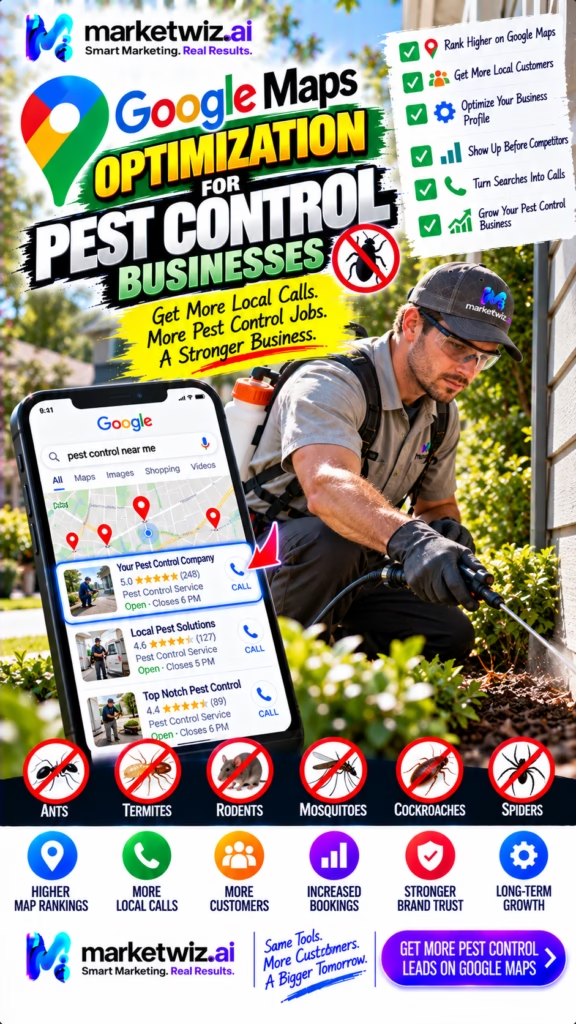
Google Maps Optimization for Pest Control Businesses
When homeowners discover ants in the kitchen, roaches in a property, rodents in the attic, termites around a structure, mosquitoes throughout the yard, or another unwanted pest, Google is often one of the first places they search for local help. This guide explains how pest control businesses can strengthen Google Maps visibility using Google Business Profile optimization, authentic reviews, pest-specific SEO, service-area content, website optimization, AI-assisted marketing, lead tracking, and revenue-focused local growth.
Updated October 20261. Understand the Google Maps Opportunity for Pest Control Businesses
Pest control is naturally local. A homeowner dealing with ants, roaches, rodents, termites, mosquitoes, bed bugs, spiders, fleas, ticks, wasps, or another pest generally needs a company capable of operating at that specific property.
That geographic requirement makes local search especially relevant to pest control customer acquisition.
Many prospects begin with searches related to the pest they see, the type of help they need, or a general request for a nearby pest control company. Google may then display local business results prominently within the search experience.
A pest control company with a strong local presence has an opportunity to become visible during a high-intent moment when a customer is actively evaluating what to do next.
Google Maps optimization should connect visibility with customer acquisition. The objective is not simply to make a profile appear more often. The objective is to help qualified local prospects discover a legitimate pest control business, evaluate it, make contact, and move toward an appropriate appointment or inspection.
2. Understand Pest Control Search Intent
Pest control searches can carry significant urgency because the customer is often reacting to a problem already occurring inside or around a home, apartment, commercial property, or other structure.
The specific search can reveal what the customer believes is happening.
Common search themes may include:
- Pest control company
- Exterminator
- Ant control
- Roach control
- Rodent control
- Mouse control
- Rat control
- Termite control
- Mosquito control
- Bed bug control
- Spider control
- Flea control
- Tick control
- Wasp or hornet control
- Commercial pest control
- Local pest control searches
A strong local marketing system should organize content around the real pest categories and customer situations the company handles rather than trying to rank one generic page for every possible search.
3. Build a Strong Google Business Profile Foundation
Google Business Profile is one of the central assets in a Google Maps optimization strategy.
The profile should accurately represent the real pest control company and provide useful information to prospective customers.
Important information to review includes:
- Business name
- Primary category
- Relevant additional categories
- Phone number
- Website
- Operating hours
- Service-area information where applicable
- Business description
- Photos
- Eligible attributes
- Other current profile information
Optimization should improve accuracy, usefulness, and customer understanding rather than relying on artificial keyword additions or misleading business information.
4. Choose Accurate Pest Control Business Categories
Categories help search engines and customers understand the type of company represented by the profile.
Pest control businesses should select the most accurate eligible primary category for their core operation.
Additional categories may be appropriate when they represent legitimate areas of the company, but they should not be added simply because they appear related to attractive keywords.
Keep Categories Grounded in Real Operations
The strongest profile is not necessarily the profile with the largest number of categories. It is the profile that clearly and accurately represents the real business.
5. Keep Pest Control Business Information Accurate
Local customers need dependable information when they are trying to contact a pest control provider.
Incorrect hours, outdated phone numbers, broken website links, or inconsistent company information can create unnecessary friction during a high-intent search.
Regularly verify:
- Company name
- Primary phone number
- Website URL
- Operating hours
- Holiday hours where relevant
- Real operating territory
- Contact pathways
- Important directory information
Accuracy sounds basic, but it is foundational to both customer experience and local marketing.
6. Define the Real Pest Control Service Area
Pest control businesses often serve a central city plus multiple surrounding communities.
However, the largest theoretical service area is not always the most profitable service area.
Technician drive time, appointment density, recurring customer routes, traffic, pest seasonality, property types, and job value can all affect the economics of a particular market.
Evaluate markets using:
- Technician availability
- Drive time
- Appointment density
- Historical pest demand
- Recurring customer concentration
- Average customer value
- Property density
- Competition
- Seasonal demand
- Operational profitability
Local SEO should reinforce the areas the company can realistically and profitably serve.
7. Build Pest-Specific Website Pages
One generic pest control page may not provide enough information for customers dealing with very different pest problems.
When the company genuinely handles those pests, dedicated pages can create a more useful customer experience and a stronger topical structure.
Ant Control
Explain the company's legitimate ant-related offerings, operating areas, customer process, and relevant frequently asked questions.
Rodent Control
Build useful information for customers dealing with mice, rats, or other rodent concerns when those problems are within the company's scope.
Termite Control
Create accurate termite-focused information for companies that legitimately perform termite inspections, treatments, prevention, or related work.
Mosquito Control
Explain relevant mosquito offerings, seasonal considerations, operating areas, and what customers should expect.
Additional pages may cover roaches, bed bugs, spiders, fleas, ticks, wasps, hornets, wildlife-related categories where applicable, and commercial pest control.
8. Build Local SEO Around Termite Searches
Termite-related searches can be highly important because property owners may be concerned about structural damage, active infestations, inspection findings, or prevention.
Companies that legitimately perform termite-related work can create focused content explaining what they offer and where they operate.
Potential termite content themes include:
- Termite control
- Termite inspection
- Termite treatment
- Termite prevention
- Signs that may indicate termite activity
- Frequently asked termite questions
- Local termite-related customer concerns
- Residential termite work
- Commercial termite work where offered
Technical or treatment claims should accurately reflect the company's real capabilities, applicable regulations, product labels, and professional procedures.
9. Build Local SEO Around Rodent Control
Rodent problems can create immediate concern for homeowners and commercial property operators.
Searches may relate to mice, rats, noises in walls or attics, droppings, entry points, or broader rodent activity.
Useful rodent content may address:
- Mouse control
- Rat control
- Rodent control
- Rodent inspection
- Potential entry-point concerns
- Attic rodent concerns
- Residential rodent problems
- Commercial rodent problems
Content should educate customers without making a definitive diagnosis that requires an actual property evaluation.
10. Build SEO Around Ants, Roaches, Spiders, and Common Insects
General household insects can represent a significant share of recurring pest control demand.
Rather than forcing all of that demand through one generic page, the website can create useful resources for important pest categories the company handles.
Potential categories include:
- Ant control
- Roach control
- Spider control
- Flea control
- Tick control
- Wasp control
- Hornet control
- Other locally relevant pests
The content should reflect local pest patterns and the company's actual capabilities.
11. Create Useful Pest Control Location Pages
Pest control companies serving multiple cities may benefit from local pages that clearly explain where the company operates.
The important word is useful.
A city page should not exist merely because a marketer wants another geographic keyword on the website.
Useful location-page elements may include:
- Real operating coverage
- Pest categories handled in that market
- Seasonal pest considerations where relevant
- Residential or commercial focus
- Nearby communities legitimately served
- Customer contact information
- Frequently asked local questions
- Links to relevant pest-specific pages
A location page should provide local value. Publishing dozens of nearly identical pages and changing only the city name creates a weaker customer experience than building useful information around real operating markets.
12. Strengthen the Pest Control Website
A prospective customer may discover the company through Google Maps and then visit the website before making contact.
The website should continue the trust-building process rather than creating a disconnected experience.
A strong pest control website can include:
- Clear company information
- Pest-specific pages
- Accurate operating areas
- Residential pest control information
- Commercial pest control information where applicable
- Frequently asked questions
- Educational content
- Customer reviews or testimonials used appropriately
- Professional branding
- Mobile-friendly design
- Fast page performance
- Clear customer contact options
The website should make it easy for a prospective customer to understand what the company does and whether the property falls within its operating territory.
13. Improve Technical SEO and Mobile Performance
Local pest control searches frequently happen on mobile devices.
A homeowner may notice pest activity and immediately search from a phone. A slow, broken, or confusing website can lose attention during that moment.
Technical areas to review include:
- Mobile usability
- Page speed
- HTTPS
- Indexability
- Internal linking
- Broken links
- Page titles
- Meta descriptions
- Heading structure
- Image optimization
- Structured data where appropriate
- Duplicate content
Technical SEO supports local visibility by making the website easier for both customers and search engines to use and understand.
14. Build a Consistent Google Review Process
Trust matters in pest control because technicians may enter homes, inspect private areas of a property, work around families or pets, and address problems customers may find stressful.
Authentic customer feedback can help prospective customers evaluate the company.
Deliver the Customer Experience
Professional communication, clear expectations, reliable scheduling, and competent work should come before the review request.
Request Honest Feedback
Invite legitimate customers to share their experience without pressuring them toward a particular rating.
Monitor New Feedback
Watch recurring themes so the company can understand what customers appreciate and where the customer experience may need improvement.
Respond Professionally
Use appropriate responses to show that the company pays attention to customer feedback while protecting private information.
15. Focus on Authentic Pest Control Reviews
Reputation should grow from real customer experiences.
Fake reviews, purchased reviews, misleading incentives, and other manipulative tactics can undermine the credibility the company is trying to build.
A better approach is to integrate review requests into the normal customer workflow.
When legitimate jobs are completed, customers can be given a simple opportunity to provide honest feedback.
Improve the Experience Behind the Reviews
Better communication, reliable appointment windows, professional technicians, clear explanations, and consistent follow-up can improve the underlying customer experience that produces authentic reputation growth.
16. Respond to Pest Control Reviews Professionally
Review responses become part of the public reputation of the business.
Future customers may read both the original review and the company's response when deciding whether to make contact.
Useful response principles include:
- Use natural language
- Remain professional
- Thank customers appropriately
- Protect private customer information
- Avoid unnecessary arguments
- Address legitimate concerns constructively
- Avoid repetitive keyword stuffing
- Keep responses relevant to the actual feedback
A response should demonstrate customer care rather than look like a search-engine optimization tactic.
17. Add Authentic Pest Control Business Photos
Visual content can help prospective customers understand that they are evaluating a legitimate local company.
Useful photo categories may include:
- Company vehicles
- Technicians where appropriate
- Professional uniforms
- Company branding
- Approved equipment imagery
- Office or legitimate business environment
- Team photos
- Company signage
- Approved field-work imagery
- Community involvement where relevant
Photos should respect customer privacy and any applicable safety, regulatory, or product-label requirements.
18. Strengthen Local Relevance Across the Pest Control Brand
Local relevance is not created by repeatedly inserting a city name into every paragraph.
It develops from the company's real presence and activity within the markets it serves.
Local relevance can be reinforced through:
- Accurate operating areas
- Useful local website content
- Authentic customer reviews
- Legitimate location pages
- Consistent business information
- Local links and mentions earned naturally
- Google Business Profile activity
- Community involvement where applicable
- Local customer experiences
The goal is to make the company's real geographic footprint clear to customers and search engines.
19. Keep Important Pest Control Citations Accurate
Pest control companies may appear across local directories, mapping systems, industry platforms, social profiles, business listings, and other online sources.
Important profiles controlled by the company should contain accurate information.
Review details such as:
- Business name
- Phone number
- Website
- Business location or operating-area information where applicable
- Business category
- Hours
- Company description
Citation building should prioritize legitimate and relevant sources instead of creating large volumes of low-quality profiles solely for SEO.
20. Publish Useful Pest Control Content
Pest control businesses have a large range of educational topics that can support local SEO while answering real customer questions.
Content themes may include:
- Common signs of pest activity
- Seasonal pest patterns
- Ant-related questions
- Rodent-related questions
- Termite-related questions
- Mosquito-related questions
- Bed bug-related questions
- Commercial pest considerations
- Preparing for a pest control appointment
- Questions to ask a pest control company
- Preventive property considerations
- Frequently asked customer questions
Content should remain accurate and should avoid unsafe recommendations, unsupported treatment claims, or advice that conflicts with applicable regulations and product requirements.
21. Use AI to Support Pest Control Local SEO
AI can reduce the amount of repetitive work required to organize and maintain a large local marketing system.
It is especially useful for drafting, categorization, repurposing, lead summaries, and reporting.
AI-assisted workflows may include:
- Organizing pest-related keyword themes
- Preparing content outlines
- Drafting pest-specific page structures
- Creating FAQ drafts
- Preparing review-response drafts
- Summarizing customer inquiries
- Creating CRM notes
- Preparing monthly reports
- Repurposing educational content
- Organizing local content calendars
Human review remains important because pest control marketing can involve technical, safety, regulatory, treatment, and product-specific information that should not be invented or presented inaccurately.
22. Connect Google Maps Visibility to Fast Lead Response
Strong Google Maps visibility has limited business value if customer inquiries are missed or poorly managed.
Pest control customers may contact multiple providers, particularly when they are concerned about active pest activity.
A useful lead workflow can capture:
- Customer name
- Contact information
- Property location
- Residential or commercial property type
- Reported pest type
- Basic problem description
- Urgency or timeline
- Relevant appointment information
- Lead source
- Next action
The objective is to move qualified local inquiries into an organized customer process instead of allowing leads to disappear between marketing and operations.
23. Track Pest Control Leads in a CRM
A CRM can help connect Google Maps marketing to the actual customer journey.
This becomes especially useful for pest control businesses that have one-time jobs, inspections, recurring pest plans, commercial accounts, seasonal programs, or multiple technicians.
Useful CRM fields may include:
- Lead source
- Customer name
- Phone or email
- City
- Property type
- Pest category
- Qualification status
- Appointment date
- Inspection status where applicable
- Completed-job status
- Recurring-plan status where applicable
- Revenue
- Follow-up status
- Review-request status
This creates a clearer connection between search visibility and financial outcomes.
24. Optimize for Qualified Pest Control Appointments
Search visibility is the beginning of the customer journey, not the end.
Pest control companies should evaluate how effectively local visibility turns into qualified customer opportunities.
| Stage | What to Evaluate |
|---|---|
| Visibility | Is the company appearing for relevant local pest searches? |
| Engagement | Are searchers taking meaningful actions after discovering the company? |
| Inquiry | Are calls and website inquiries related to pests and markets the company handles? |
| Qualification | Does the property, pest category, location, and customer need fit the company? |
| Appointment | Does the qualified inquiry move into an inspection, appointment, or appropriate next step? |
| Customer | Does the opportunity become completed work or an appropriate recurring customer relationship? |
25. Adapt Google Maps Marketing to Seasonal Pest Demand
Pest demand can change substantially throughout the year.
Different climates and markets experience different seasonal patterns, which means pest control marketing should be based on actual local demand rather than a single national calendar.
Seasonal planning can consider:
- Historical call volume
- Local weather patterns
- Past pest categories by month
- Technician capacity
- Recurring route schedules
- Local customer questions
- Seasonal website traffic
- Past conversion data
Use Real Local Data
Seasonal pest behavior differs by geography. Historical company data can help determine which content and markets deserve greater attention at different points in the year.
26. Separate Residential and Commercial Pest Control Marketing
Residential and commercial pest control prospects may have different concerns, buying processes, property types, decision makers, and long-term value.
A homeowner may want help with an immediate pest problem.
A restaurant, warehouse, multifamily property, retail location, hospitality property, or other commercial operation may be evaluating an ongoing pest-management relationship.
Commercial-focused content can address:
- Property types genuinely served
- Commercial operating territory
- Account-management process
- Inspection process where applicable
- Recurring programs where offered
- Documentation processes where applicable
- Scheduling considerations
- Customer communication
Separating residential and commercial messaging can help each audience find information more relevant to its needs.
27. Build a Multi-Channel Pest Control Marketing System
Google Maps can be a powerful customer acquisition channel, but pest control businesses should avoid depending entirely on one source of leads.
A broader local marketing system can include:
- Google Maps optimization
- Local SEO
- Organic website content
- Social media
- Facebook marketing where appropriate
- Local marketplace channels where appropriate
- Customer referrals
- Email follow-up
- Reputation marketing
- CRM management
- AI-assisted customer workflows
- Paid advertising where appropriate
Multiple channels can reinforce one another and reduce dependence on a single customer acquisition source.
28. Measure Google Maps Optimization by Business Outcomes
Pest control businesses should distinguish between marketing indicators and actual business results.
Both matter, but they measure different stages of the customer journey.
| Metric | What It Helps Measure |
|---|---|
| Local Visibility | Whether the business is being discovered for relevant local searches. |
| Organic Website Traffic | How much unpaid search discovery is reaching the website. |
| Calls & Inquiries | Initial customer response to the company's search presence. |
| Qualified Leads | How many inquiries match the company's markets and capabilities. |
| Appointments | How many qualified opportunities progress into scheduled customer activity. |
| Completed Work | How much marketing activity becomes real pest control business. |
| Revenue | The financial value associated with customer acquisition efforts. |
The closer measurement gets to qualified customers and revenue, the more useful it becomes for strategic decision-making.
29. Avoid Common Pest Control Google Maps Optimization Mistakes
Local marketing can underperform when businesses chase shortcuts rather than building a useful and trustworthy digital presence.
Common mistakes include:
- Inaccurate Google Business Profile information
- Keyword stuffing
- Using irrelevant business categories
- Ignoring customer reviews
- Using artificial review tactics
- Failing to respond professionally to feedback
- Using outdated or weak photos
- Creating thin pest pages
- Creating duplicated city pages
- Ignoring important pest categories
- Targeting markets outside the real operating territory
- Ignoring mobile website performance
- Publishing inaccurate pest information
- Failing to track lead sources
- Failing to track appointments
- Failing to track recurring customer value
- Measuring only rankings
- Ignoring revenue
Google Maps optimization works best when it is connected to the entire customer acquisition system. Search visibility, reputation, website quality, lead response, appointment scheduling, CRM tracking, recurring customer value, and revenue should reinforce one another.
30. Follow a 90-Day Pest Control Google Maps Growth Plan
Pest control companies can strengthen local search systematically by beginning with accuracy, expanding relevant content and reputation, and then optimizing around actual lead and revenue data.
Days 1–30: Build the Foundation
- Audit the Google Business Profile.
- Confirm accurate business information.
- Review the primary category.
- Review legitimate additional categories.
- Verify operating hours.
- Define the real service area.
- Audit important citations.
- Review existing customer reviews.
- Build a legitimate review-request process.
- Audit website speed and mobile usability.
- Review pest-specific pages.
- Set up lead-source tracking.
Days 31–60: Expand Local Relevance
- Improve termite content where relevant.
- Improve rodent content.
- Improve ant and roach content.
- Improve mosquito content where offered.
- Improve bed bug content where offered.
- Strengthen legitimate city pages.
- Add authentic company photos.
- Continue collecting honest customer feedback.
- Improve internal linking.
- Publish useful educational content.
- Track qualified leads.
- Measure appointment conversions.
Days 61–90: Optimize Around Customer Value
- Compare markets.
- Compare pest categories.
- Compare residential and commercial lead quality.
- Track booked appointments.
- Track completed work.
- Track recurring customer value where applicable.
- Measure average customer value.
- Improve weak conversion points.
- Use AI to streamline repetitive marketing tasks.
- Expand successful local content themes.
- Continue reputation growth.
- Connect marketing reporting to revenue.
The Pest Control Google Maps Optimization Formula
Accurate Google Business Profile + legitimate operating territory + authentic reviews + useful photos + pest-specific pages + local content + technically sound website + accurate citations + reliable lead response + CRM tracking + AI-assisted workflows + customer and revenue measurement.
Turn Google Maps Into a Stronger Pest Control Growth Channel
Google Maps optimization can become an important part of a pest control company's local customer acquisition strategy because pest-related searches often happen when a property owner already has a problem.
Ants may be appearing throughout the kitchen.
A homeowner may hear rodents moving through an attic.
Roaches may suddenly become visible inside a property.
A customer may discover signs they believe could indicate termites.
Mosquito activity may make an outdoor space difficult to enjoy.
A commercial property may need a more consistent pest-management process.
These are situations in which customers may actively search for a local company.
The pest control businesses that create strong, accurate, useful local search experiences can be better positioned to participate in that customer journey.
The process starts with the Google Business Profile.
The company name should accurately represent the business.
The phone number should work.
The website link should be correct.
Hours should reflect real availability.
Categories should reflect real operations.
Operating areas should reflect where the company can actually serve customers.
Photos should help customers understand the real company.
That foundation sounds simple, but many local marketing problems begin with basic information that was never properly maintained.
The next layer is reputation.
Pest control requires trust.
Customers may be allowing technicians into their homes.
They may be concerned about children, pets, tenants, employees, customers, or the condition of the property.
They want to know whether the company appears professional and dependable.
Authentic reviews help provide additional customer perspective.
A consistent review process can therefore become part of normal business operations.
Complete the work.
Communicate clearly.
Provide a professional customer experience.
Then give legitimate customers an opportunity to share honest feedback.
Review quality should matter more than artificial review volume.
The company's website should reinforce that trust.
A generic homepage that says little about the company's pest capabilities leaves important customer questions unanswered.
Pest-specific pages can create a much stronger structure.
A customer dealing with rodents should be able to find relevant rodent information.
A customer concerned about termites should be able to find termite-related information when the company offers that work.
A customer searching for mosquito control should be able to understand whether that is part of the company's offering.
The same applies to ants.
Roaches.
Bed bugs.
Spiders.
Fleas.
Ticks.
Wasps.
Hornets.
And other pest categories genuinely handled by the business.
Each page should have a reason to exist.
It should explain the company's relevant offering.
It should answer useful customer questions.
It should explain the operating area.
It should help the customer understand what to do next.
Local pages should follow the same standard.
If a pest control company operates in several cities, those cities can become part of the website architecture.
But every city page should represent a real market.
The company should actually operate there.
The content should provide useful local context.
It should not simply repeat the same generic paragraphs across dozens of pages.
Better local SEO begins with understanding the actual territory.
Which communities generate the most calls?
Which communities generate stronger customers?
Which cities have efficient technician routes?
Which markets create recurring pest plans?
Which markets have strong commercial opportunities?
Which markets produce excessive travel?
Which pest categories dominate different parts of the territory?
That information can make the SEO strategy much more valuable.
Instead of treating every city equally, the company can prioritize markets based on real business data.
Technical website quality supports the entire system.
Mobile performance matters.
Page speed matters.
Internal links matter.
Clear page titles matter.
Search-engine accessibility matters.
Broken links should be corrected.
Important pest pages should be easy to discover.
Important city pages should be connected logically to the rest of the website.
The customer should not have to fight the website to understand what the company does.
Educational content can expand the strategy even further.
Pest control customers have questions before they schedule.
They may want to understand common signs of pest activity.
They may want to know what information to provide when calling.
They may want to know how to prepare for an appointment.
They may want to understand seasonal pest activity.
They may want to understand what happens during an inspection.
Useful educational content can answer these questions while creating additional opportunities for organic search discovery.
Content should still be handled responsibly.
Pest control can involve regulated products, treatment methods, safety considerations, and professional judgment.
Marketing content should not invent treatment claims.
It should not provide unsafe instructions.
It should not contradict product labels or applicable regulations.
It should not pretend to diagnose a property without appropriate inspection when one is needed.
AI can help companies produce and organize this marketing content more efficiently.
It can organize keyword themes.
It can help create content outlines.
It can prepare first drafts.
It can turn customer questions into FAQ ideas.
It can draft review responses.
It can summarize leads.
It can create CRM notes.
It can repurpose a long article into shorter social content.
It can help prepare marketing reports.
It can help organize seasonal campaigns.
But the company should maintain control over factual accuracy.
AI should work from verified business information.
It should not invent licenses.
It should not invent certifications.
It should not invent customer results.
It should not invent products used by the company.
It should not invent warranties.
It should not create unsupported safety claims.
Marketing efficiency matters, but accuracy matters more.
Google Maps visibility must also connect to lead response.
A strong ranking does not automatically become revenue.
Someone must answer the inquiry.
The customer needs to be qualified appropriately.
The company needs to understand the location.
It needs to understand the reported pest problem.
It needs to determine whether the request falls within its operating scope.
It needs to move qualified customers toward the correct next step.
That may be an inspection.
It may be an appointment.
It may be a consultation.
It may be the beginning of a recurring pest-management relationship.
The exact process depends on the business.
A CRM can then track what happens after the initial inquiry.
Which lead source generated the customer?
What pest was reported?
Which city was involved?
Was the lead qualified?
Was an appointment scheduled?
Was work completed?
Did the customer enter a recurring program?
What revenue was generated?
Did the customer later leave a review?
This creates a feedback loop.
Marketing creates visibility.
Visibility creates inquiries.
Lead handling creates appointments.
Operations create customer experiences.
Customer experiences create reviews, referrals, repeat business, and revenue.
Those outcomes then help the company determine which marketing activities deserve additional investment.
Rankings should therefore be treated as one layer of measurement.
They are useful.
They can show whether visibility is changing.
They can identify markets that need attention.
They can help diagnose SEO progress.
But they should not become the only metric.
Track calls.
Track website inquiries.
Track qualified leads.
Track appointments.
Track completed work.
Track recurring customer value when relevant.
Track customer acquisition cost.
Track revenue.
Compare markets.
Compare pest categories.
Compare residential and commercial opportunities.
Compare seasons.
Compare marketing channels.
Then use those insights to improve the strategy.
Pest control companies should also avoid depending entirely on Google Maps.
Local SEO can support additional organic discovery.
Educational website content can capture informational searches.
Social media can support local brand recognition.
Customer referrals can create high-trust opportunities.
Marketplace channels may provide additional visibility where appropriate.
Email can support customer retention and follow-up.
Paid advertising may support selected markets or campaigns where the economics make sense.
AI-assisted workflows can help connect these channels more efficiently.
Market Wiz AI approaches local growth as a connected marketing system. Google Maps optimization, local SEO, AI-assisted content, social marketing, lead tracking, customer follow-up, and multi-channel customer acquisition can work together instead of functioning as isolated activities.
For pest control businesses, the objective should not simply be more impressions.
It should be better local visibility.
More qualified customers.
Better lead response.
More appointments.
More completed work.
Stronger recurring customer relationships where applicable.
Better understanding of which markets and pest categories create value.
And better visibility into the revenue produced by the entire marketing system.
Start with an accurate Google Business Profile.
Strengthen authentic reviews.
Add useful company photos.
Build pest-specific pages.
Create legitimate local pages.
Improve the technical website foundation.
Keep important citations accurate.
Publish useful educational content.
Use AI to streamline repetitive work.
Build a reliable lead response process.
Track customers in a CRM.
Measure appointments.
Measure completed work.
Measure recurring customer value where appropriate.
Measure revenue.
Then continually improve the markets, pages, pest categories, reputation assets, and customer workflows that produce the strongest business outcomes.
When those components work together, Google Maps optimization for pest control businesses becomes much more than a ranking exercise. It becomes part of a complete local customer acquisition engine designed to connect high-intent searchers with a legitimate pest control company and turn that visibility into measurable business growth.
Frequently Asked Questions About Google Maps Optimization for Pest Control Businesses
1. What is Google Maps optimization for pest control businesses?
Google Maps optimization for pest control businesses is the process of strengthening a pest control company's local search presence through an accurate Google Business Profile, relevant business information, reviews, photos, local website content, service-area relevance, and consistent customer experience.
2. Why is Google Maps important for pest control companies?
Pest control is highly local and many searches occur when a homeowner or business has an immediate pest problem. Google Maps can help local customers discover pest control companies operating in their area.
3. Can Google Maps generate pest control leads?
A strong Google Maps presence can contribute to calls, website visits, and other customer actions from people actively researching local pest control providers.
4. How should a pest control business optimize its Google Business Profile?
A pest control company should maintain accurate business information, appropriate categories, current hours, useful photos, relevant descriptions, website information, and other eligible profile elements that truthfully represent the business.
5. What Google Business Profile category should a pest control company use?
The business should select the most accurate eligible primary category for its actual operations and add secondary categories only when they truthfully represent additional work the company performs.
6. Do Google reviews matter for pest control companies?
Authentic reviews can help prospective customers evaluate a pest control company and can strengthen the overall credibility and usefulness of its local business presence.
7. How can pest control businesses get more Google reviews?
Pest control companies can consistently ask legitimate customers for honest feedback after completed work while following applicable platform policies and avoiding review manipulation.
8. Should pest control companies respond to Google reviews?
Professional review responses can demonstrate that the business pays attention to customer feedback and can provide useful context for future customers evaluating the company.
9. Do photos help pest control Google Maps optimization?
Authentic photos can help customers understand the pest control company, technicians, vehicles, equipment, branding, team, and legitimate local operation.
10. Should pest control companies create pest-specific website pages?
Yes. When the company genuinely handles those pests, separate pages for ants, roaches, rodents, termites, mosquitoes, bed bugs, spiders, fleas, ticks, wasps, and other relevant pest problems can provide more useful information.
11. Should pest control businesses create city pages?
Useful city pages can support local SEO when they represent real operating areas and contain meaningful local information instead of duplicated content with only city names changed.
12. How important is a pest control website for Google Maps optimization?
The website can reinforce the company's local presence by clearly explaining pest categories, operating areas, company information, customer resources, and relevant local content.
13. Should pest control companies keep business information consistent online?
Important business information should remain accurate and consistent across profiles and citations the company controls or maintains.
14. Can local SEO help termite control companies?
Companies that legitimately perform termite-related work can build useful termite-focused pages and local content explaining their offerings and operating areas.
15. Can local SEO help rodent control companies?
Yes. Rodent-focused website content can support relevant local search visibility when rodent control is genuinely part of the company's operations.
16. Can local SEO help mosquito control businesses?
Mosquito-focused local content can be valuable for companies that legitimately provide mosquito control, especially when marketing is aligned with real seasonal demand and operating areas.
17. Can pest control companies optimize for bed bug searches?
Companies that genuinely provide bed bug-related work can create accurate pages explaining their offerings, customer process, operating areas, and frequently asked questions.
18. How can pest control businesses improve local relevance?
Local relevance can be strengthened through accurate operating areas, useful location content, authentic customer reviews, consistent business information, local website content, and legitimate community or market signals.
19. Should pest control businesses update their Google Business Profile?
Businesses should keep important profile information current and use relevant available profile features to maintain a useful and accurate customer-facing presence.
20. Can AI help pest control companies with local SEO?
AI can support content organization, first drafts, keyword grouping, lead summaries, review-response drafts, reporting, and other repetitive workflows when humans verify accuracy.
21. How should pest control companies track Google Maps leads?
Companies can track calls, website inquiries, pest type, customer location, qualification status, appointments, completed jobs, recurring plans where applicable, revenue, and available source information.
22. What local SEO metrics should pest control companies monitor?
Useful metrics can include local visibility, organic traffic, calls, inquiries, qualified leads, appointments, completed jobs, recurring customers where applicable, conversion rates, customer acquisition cost, and revenue.
23. Should pest control companies optimize only for their main city?
Companies serving multiple legitimate markets can build broader local SEO strategies, but every targeted location should reflect a real operating territory.
24. How long does pest control Google Maps optimization take?
There is no universal timeline. Results depend on competition, market conditions, the existing profile, website quality, reputation, content, technical SEO, and many other factors.
25. Can pest control companies rank in nearby cities?
Local visibility varies by searcher location and market. Companies can strengthen their broader local presence with legitimate service-area content and strong overall local SEO, but rankings should not be assumed or guaranteed.
26. Should pest control companies combine Google Maps and website SEO?
Yes. Google Maps optimization and website SEO can support one another as parts of a broader local search strategy.
27. Should pest control companies use social media?
Social media can support education, brand awareness, trust, seasonal pest content, and broader local visibility as part of a diversified marketing strategy.
28. What are common Google Maps mistakes for pest control companies?
Common mistakes include inaccurate business information, neglected reviews, irrelevant categories, weak websites, thin location pages, keyword stuffing, outdated photos, poor lead tracking, and focusing on rankings without measuring customers.
29. Should pest control businesses measure rankings or revenue?
Rankings can help diagnose visibility, but qualified leads, appointments, completed jobs, recurring customer value, customer acquisition cost, and revenue provide stronger business-level measurement.
30. What is the best Google Maps strategy for pest control businesses?
A strong strategy combines an accurate Google Business Profile, authentic reviews, useful photos, pest-specific content, legitimate location pages, a technically sound website, consistent business information, lead tracking, AI-assisted workflows, and revenue-focused measurement.
30 Additional SEO Keywords
These supporting keyword themes expand topical relevance around pest control Google Maps optimization, Google Business Profile management, local SEO, exterminator marketing, pest control lead generation, reputation marketing, and AI-assisted local customer acquisition.
Build a Stronger Local Pest Control Lead Engine
Market Wiz AI helps local businesses strengthen Google Maps visibility, local SEO, AI-assisted marketing, social content, lead tracking, and multi-channel customer acquisition.
Call MarketWiz.ai: (910) 601-2938