

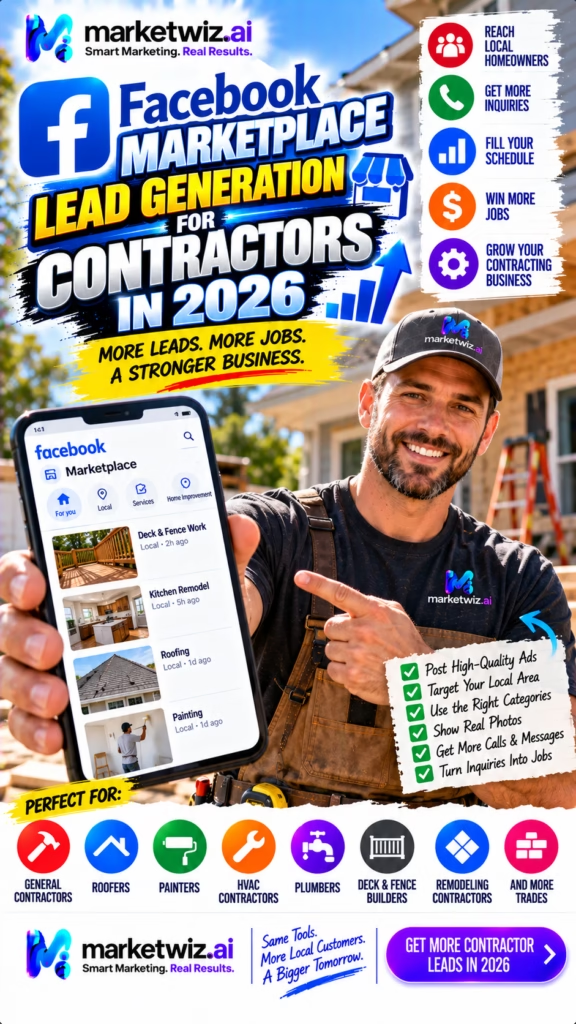
Facebook Marketplace Lead Generation for Contractors in 2026
Facebook Marketplace can give contractors another way to reach local prospects, showcase relevant projects, create conversations, and support customer acquisition. The strongest strategy in 2026 goes far beyond simply publishing listings. It connects local visibility with compelling creative, lead qualification, estimate tracking, CRM organization, follow-up, Google Maps, local SEO, AI automation, and measurable revenue.
Updated October 20261. Understand the Facebook Marketplace Opportunity for Contractors
Contractors operate in markets where geography matters. A homeowner looking for help with a property project typically needs a business that can actually work in the surrounding area, evaluate the project, provide an estimate, schedule the job, and complete the work.
That local buying environment is one reason Facebook Marketplace can be worth evaluating as part of a broader contractor marketing strategy.
The important distinction is that Marketplace should not be viewed only as a place to accumulate listing views or messages. The business objective is to create qualified local opportunities that can progress through a real sales process.
For contractors, that process may move from initial discovery to a conversation, qualification, property information, estimate, appointment, follow-up, scheduled project, completed work, and eventually revenue.
Contractors should measure Marketplace by business outcomes, not activity alone. Views and messages may help diagnose campaign performance, but qualified leads, estimates, booked projects, completed jobs, and revenue provide a clearer picture of actual marketing value.
2. Build a 2026 Marketplace Strategy Around the Entire Customer Journey
Local digital marketing has become increasingly interconnected. A homeowner may discover a contractor in one place and research the company somewhere completely different before making contact.
A prospect who first encounters a business through Facebook may later search the company on Google, look for reviews, visit its website, browse project photos, or compare the company with other contractors.
For that reason, Facebook Marketplace lead generation should be connected to the contractor's larger digital presence.
The complete customer journey may involve:
- Marketplace discovery
- Listing engagement
- Initial inquiry
- Business research
- Google search
- Review evaluation
- Website visit
- Project qualification
- Estimate request
- Appointment
- Follow-up
- Project scheduling
- Completed work
- Customer review or referral
A contractor that improves several of these stages can create more value from the same amount of initial attention.
3. Define the Ideal Contractor Customer Before Generating Leads
Lead generation becomes easier to evaluate when the business first defines the type of customer it actually wants.
Not every inquiry has equal value. A lead may fall outside the operating territory, involve a project the company does not perform, be too small for the business model, or require scheduling the contractor cannot support.
The ideal customer should therefore be defined before campaign expansion.
Useful characteristics may include:
- Customer location
- Project category
- Property type
- Approximate project scope
- Potential project value
- Customer timeline
- Required materials
- Company capabilities
- Crew availability
- Travel and routing requirements
When these factors are clear, the marketing system can be designed to attract better-fit opportunities.
4. Adapt Marketplace Lead Generation to Different Contractor Categories
Contractor marketing should not be treated as one universal category. A roofing company, painting contractor, flooring installer, fence builder, concrete contractor, and remodeling company may all sell very different projects.
Their visuals, qualification questions, project values, sales cycles, customer concerns, and geographic economics may also differ.
Painting Contractors
Showcase authentic interior, exterior, cabinet, trim, and completed home transformation projects where appropriate.
Roofing Contractors
Focus marketing around relevant roofing projects, completed work, property needs, local coverage, and a clear qualification process.
Concrete Contractors
Use real driveways, patios, slabs, walkways, and other completed concrete projects to communicate capabilities.
Fence Contractors
Organize marketing around real fence styles, materials, completed installations, and the geographic territory the company serves.
The more closely the marketing reflects the contractor's actual work, the easier it becomes for the right prospect to recognize relevance.
5. Build Marketplace Campaigns Around Real Local Service Areas
Contractor lead generation is heavily influenced by geography.
Travel time affects crews. Distance affects scheduling. Different cities may produce different project values. Some territories may be more efficient because the contractor already has customers or crews nearby.
Before scaling local marketing, map the company's true operating territory.
This can include:
- Primary city
- Secondary cities
- Nearby suburbs
- Counties served
- Preferred ZIP codes
- Maximum practical travel radius
- Markets reserved for larger projects
- Territories with existing crew density
Think in Terms of Territory Economics
The market producing the most inquiries is not automatically the best market. A nearby territory producing fewer but larger, easier-to-route projects may be more profitable.
6. Separate Marketplace Marketing by Contractor Project Type
A homeowner looking for a kitchen remodel has a different intent from someone researching exterior painting. A customer needing a fence has different questions from someone planning a concrete driveway.
Campaign segmentation makes the marketing more specific.
A contractor may segment campaigns by:
- Project category
- Material type
- Residential versus commercial work
- New installation versus replacement
- Interior versus exterior work
- Small versus larger projects
- Geographic market
- Seasonal demand
Segmentation also improves reporting because the company can determine which project categories create stronger leads and better revenue.
7. Write Marketplace Titles That Communicate the Project Clearly
Contractors often lose attention by trying to make listing titles too clever, vague, or promotional.
A better approach is to make the subject easy to understand.
When appropriate under current platform rules, the title should help the prospect identify what the listing represents, where it is relevant, and why it may matter to their project.
Title themes may center on:
- Project type
- Product or material
- Finished result
- Property improvement
- Local relevance
- Specific contractor category
Clarity usually beats generic promotional language. A prospect should be able to understand the core subject of the listing before opening the full description.
8. Create Marketplace Descriptions That Answer Real Customer Questions
The description should help a prospect determine whether the listing is relevant to the project they are considering.
Contractors can use descriptions to provide meaningful context rather than filling the page with repetitive promotional statements.
Useful information may include:
- What the listing represents
- Relevant project categories
- Materials or options when applicable
- Geographic availability
- Important project considerations
- Information needed for qualification
- A clear next step
Accurate information can reduce unnecessary back-and-forth and help interested prospects begin the conversation with better expectations.
9. Use Authentic Contractor Project Images to Build Trust
Contractor marketing is highly visual because customers want to understand what the business can actually build, install, repair, improve, or transform.
Strong project photography can communicate workmanship and project relevance before a prospect reads the entire listing.
Useful visual assets can include:
- Completed projects
- Before-and-after transformations
- Detailed craftsmanship
- Finished exterior work
- Finished interior work
- Materials and finishes
- Multiple angles of completed projects
- Real project environments
Every Completed Project Can Become a Marketing Asset
With appropriate permission and accurate representation, a completed project can provide photos and video that support Marketplace, Google, the website, social media, portfolio pages, and future sales conversations.
10. Build a Contractor Creative Library for Faster Marketing
Contractors can improve marketing efficiency by organizing project assets as the work is completed rather than trying to locate photos months later.
A structured creative library gives the marketing team access to approved content for future campaigns.
Organize assets by:
- Project type
- City
- Before photos
- After photos
- Material
- Property type
- Residential or commercial
- Video clips
- Customer-approved testimonials
- Completed project date
This can significantly reduce the amount of time required to produce future local marketing content.
11. Make Marketplace Marketing Locally Relevant
A contractor does not need to pretend to operate everywhere. Strong local marketing can focus on the communities the company genuinely serves.
Where accurate and appropriate, local relevance can be reinforced through real geographic information and supporting online assets.
Local signals can include:
- Actual cities served
- Nearby communities
- Local project photography
- Google Business Profile presence
- Customer reviews
- Location-specific website pages
- Local project case studies
These elements help prospects connect the business with their own market.
12. Build a Trust Layer Around Every Marketplace Lead
Hiring a contractor can involve a significant financial and practical commitment. Prospects may research the business before inviting someone to the property, requesting an estimate, or approving a project.
Marketplace should therefore connect with a broader trust layer.
That trust layer can include:
- Consistent business information
- Professional website
- Google Business Profile
- Authentic customer reviews
- Completed project galleries
- Clear communication
- Accurate project information
- Professional follow-up
Marketplace may create the initial discovery, while the contractor's wider digital presence helps reinforce credibility.
13. Create a Reliable Marketplace Lead Response Workflow
Marketing performance does not end when a prospect sends a message.
That moment is where lead management begins.
Contractors should define exactly how Marketplace inquiries move through the organization.
The workflow should answer:
- Where do new inquiries appear?
- Who monitors them?
- Who is responsible for responding?
- What information should be collected?
- How is a lead qualified?
- When should sales become involved?
- How is an estimate scheduled?
- Where is the lead recorded?
- How is follow-up managed?
Lead Generation and Lead Handling Are One System
Increasing inquiry volume without improving lead handling can simply create more opportunities for prospects to be missed.
14. Qualify Contractor Marketplace Leads Before Sending Them to Sales
Qualification helps separate casual inquiries from realistic project opportunities.
The contractor should collect enough information to understand whether the project fits its territory, capabilities, schedule, and business model.
Qualification questions may cover:
- Project location
- Project type
- Residential or commercial property
- Approximate size or scope
- Current condition
- Desired outcome
- Customer timeline
- Relevant measurements
- Photos when available and appropriate
- Additional project details
Qualification should make the next step easier for both the customer and the contractor.
15. Turn Marketplace Conversations Into Estimate Opportunities
A contractor does not generate revenue from conversations alone. Qualified conversations need a path into the estimating process.
Depending on the type of work, an estimate may require an on-site appointment, photos, measurements, drawings, material selections, or additional project details.
The business should define when a lead is ready to move from qualification to estimating.
Track whether the lead:
- Responded to qualification
- Fits the service area
- Fits the project category
- Needs an on-site appointment
- Received an estimate
- Needs follow-up
- Approved the project
- Scheduled the work
16. Connect Marketplace Leads to a Contractor CRM
A contractor receiving opportunities from multiple channels needs a central place to track what happens after the first inquiry.
A CRM or structured lead management system can organize Marketplace prospects alongside Google, website, referral, social media, and other leads.
A simple contractor pipeline might include:
- New inquiry
- Contacted
- Qualified
- Estimate scheduled
- Estimate delivered
- Follow-up
- Project won
- Project scheduled
- Project completed
- Lost
Keep the original source attached to the lead. When a project closes, the contractor should still know whether the opportunity originated from Facebook Marketplace, Google Maps, organic search, a referral, Craigslist, social media, or another channel.
17. Build Follow-Up Into Marketplace Lead Generation
Contractor sales cycles vary dramatically.
Some homeowners may be ready to schedule quickly. Others may be gathering quotes, planning financing, waiting for another project to finish, discussing the decision with a spouse or business partner, or targeting a future date.
Those prospects should not disappear simply because they did not hire immediately.
A useful follow-up record can include:
- Original project request
- Location
- Estimate date
- Project timeline
- Previous conversation notes
- Customer questions
- Next recommended action
Structured follow-up gives the sales team context and prevents valuable opportunities from being forgotten.
18. Improve Marketplace Messaging Without Making It Robotic
Contractors can create consistent response frameworks without forcing every conversation into the same rigid script.
The initial goal is usually to understand the customer's project and determine the appropriate next step.
Messages should be clear, natural, and focused on gathering useful information.
Early conversations may need to establish:
- What the customer needs
- Where the property is located
- Approximate project scope
- Customer timeline
- Whether additional information is needed
- Whether the opportunity should move to estimating
AI can assist with organization and response preparation, but businesses should maintain accurate information and appropriate human oversight.
19. Use AI Automation to Support Marketplace Lead Management
Contractor teams frequently balance field work, estimates, scheduling, customer communication, project management, and marketing simultaneously.
AI can help reduce repetitive administrative work throughout the lead generation process.
Potential AI-assisted workflows include:
- Listing draft creation
- Title variation development
- Project-specific content preparation
- Lead summarization
- Inquiry categorization
- Qualification support
- CRM preparation
- Follow-up reminders
- Campaign reporting
- Content repurposing
Automation is most useful when it supports a defined business process rather than attempting to replace one that has never been organized.
20. Test Marketplace Campaigns Systematically
Contractors should avoid making random campaign changes and then guessing which change affected performance.
A better approach is to compare meaningful variables and track downstream outcomes.
Potential tests include:
- Different project categories
- Different legitimate local markets
- Different primary project images
- Before-and-after versus finished-project photography
- Different title structures
- Different description structures
- Different qualification flows
- Different follow-up workflows
The Winning Campaign Is Not Always the One With the Most Messages
A campaign producing fewer messages may be more valuable if those prospects become qualified estimates and profitable projects at a higher rate.
21. Compare Marketplace Performance by City and Territory
Multi-market contractors should not assume every city will perform the same way.
Lead quality, project size, competition, customer behavior, travel time, crew availability, and close rates may vary substantially across territories.
Compare markets using:
- Inquiry volume
- Qualified lead rate
- Estimate rate
- Appointment rate
- Close rate
- Average project value
- Revenue
- Travel requirements
- Crew efficiency
- Customer acquisition cost
This gives management a stronger basis for deciding where to expand or reduce marketing activity.
22. Combine Facebook Marketplace With Google Maps Marketing
Marketplace and Google Maps can support different stages of the same customer journey.
Marketplace may create initial discovery. Google can then become part of the customer's verification process.
A strong Google Business Profile can reinforce:
- Business identity
- Local presence
- Customer reviews
- Project photography
- Business hours
- Website access
- Contact information
Contractors should keep major business information accurate and consistent so prospects do not encounter conflicting details during research.
23. Support Marketplace Lead Generation With Local Contractor SEO
Local SEO creates another path for customers who begin their search directly on Google instead of Facebook.
Contractors can build website content around the real projects and geographic markets they serve.
Useful SEO assets can include:
- Core project pages
- Location pages
- Project galleries
- Frequently asked questions
- Educational articles
- Material-specific pages
- Commercial project pages
- Residential project pages
- Case studies
Marketplace and SEO can therefore contribute to the same overall customer acquisition system through different discovery paths.
24. Use Reviews to Strengthen Marketplace Lead Conversion
Reviews can influence prospects who discover a contractor through one platform and research the business on another.
A consistent review strategy can help strengthen the contractor's overall local reputation.
Strong review practices include:
- Requesting feedback from legitimate customers
- Making the review process simple
- Responding professionally
- Keeping business information accurate
- Continuing to collect reviews over time
Reviews should reflect real customer experiences and should not rely on fabricated or misleading activity.
25. Turn Completed Contractor Projects Into a Content Engine
Contractors continuously create potential marketing content while completing projects.
A single project can potentially support multiple future assets when the business captures and organizes the material properly.
One completed project may produce:
- Marketplace creative
- Before-and-after images
- Google Business Profile content
- Website portfolio material
- Facebook content
- Instagram content
- TikTok videos
- YouTube Shorts
- Local SEO case studies
- Sales presentation material
This allows completed work to continue contributing to future customer acquisition.
26. Build a Multi-Channel Contractor Lead Generation Engine
A contractor should avoid making its entire pipeline dependent on one platform.
Platforms change, customer behavior changes, competition changes, and different channels may perform better for different project categories.
A broader local marketing system can include:
- Facebook Marketplace where appropriate
- Google Maps
- Local SEO
- Company website
- Facebook social content
- TikTok
- YouTube Shorts
- Craigslist where appropriate
- Referral marketing
- Customer reviews
- CRM follow-up
Build Channels That Support One Another
Marketplace can create discovery, Google can reinforce trust, SEO can capture search demand, project content can demonstrate quality, and the CRM can convert opportunities over time.
27. Measure Facebook Marketplace by Contractor Revenue Metrics
The closer reporting gets to revenue, the more useful it becomes for business decisions.
Contractors should understand not only how much attention a campaign creates but what happens after that attention becomes an inquiry.
| Metric | What It Helps Measure |
|---|---|
| Inquiries | Initial response generated by campaign activity. |
| Qualified Leads | How many prospects genuinely fit the contractor. |
| Estimate Opportunities | How often leads advance into meaningful sales conversations. |
| Projects Won | How often opportunities become paying customers. |
| Average Project Value | The financial quality of acquired work. |
| Revenue | The direct business value associated with the channel. |
| Customer Acquisition Cost | The cost required to acquire actual customers. |
This reporting framework makes it easier to compare Marketplace with other local marketing channels.
28. Avoid Common Facebook Marketplace Lead Generation Mistakes
Contractors can reduce campaign performance through mistakes that occur before, during, and after the listing receives attention.
Common problems include:
- Using weak or irrelevant project images
- Using generic listing titles
- Writing descriptions with little useful information
- Using inaccurate business or project details
- Targeting areas the contractor does not realistically serve
- Failing to segment different project categories
- Responding inconsistently to inquiries
- Failing to qualify prospects
- Failing to track estimate opportunities
- Losing leads between messaging and sales
- Ignoring follow-up
- Failing to track original lead source
- Judging success by messages alone
- Ignoring Google reviews and reputation
- Depending on one marketing channel
- Scaling without understanding project economics
The listing is only one component of conversion. Strong performance requires the marketing, messaging, qualification, estimating, follow-up, reputation, and tracking systems to work together.
29. Scale Marketplace Lead Generation Using Real Contractor Data
Scaling should follow evidence.
Once the contractor has enough campaign and sales data, it can identify which combinations create the strongest business outcomes.
Look for patterns such as:
- Markets producing better-qualified leads
- Project categories producing larger contracts
- Images associated with stronger engagement
- Campaigns producing more estimates
- Territories producing higher close rates
- Markets with lower travel requirements
- Projects that fit crew capacity efficiently
- Customer segments producing repeat work
- Campaigns producing stronger acquisition economics
The goal is not simply to multiply activity. The goal is to expand the portions of the system that are producing valuable customers.
30. Follow a 90-Day Facebook Marketplace Contractor Growth Plan
A structured 90-day implementation plan can help contractors move from scattered Marketplace activity to a more organized lead generation system.
Days 1–30: Build the Foundation
- Review current Marketplace policies and eligibility
- Define the ideal customer
- Define real operating territories
- Identify priority project categories
- Organize authentic project photography
- Build a creative library
- Create listing concepts
- Create title frameworks
- Create detailed descriptions
- Define qualification questions
- Create lead tracking
- Assign lead ownership
Days 31–60: Improve Conversion
- Compare project categories
- Compare legitimate local markets
- Compare creative approaches
- Improve listing clarity
- Improve lead response
- Improve qualification
- Track estimate opportunities
- Connect qualified leads to the CRM
- Create follow-up workflows
- Track won and lost projects
- Strengthen Google Business Profile content
Days 61–90: Optimize Around Revenue
- Identify campaigns producing completed projects
- Identify higher-value project categories
- Identify stronger local territories
- Reduce low-quality activity
- Use AI to streamline repetitive tasks
- Measure close rate
- Measure average project value
- Measure customer acquisition cost
- Expand local SEO
- Repurpose completed projects into social content
- Improve review generation
- Strengthen multi-channel customer acquisition
The 2026 Contractor Marketplace Growth Formula
Accurate local targeting + eligible project-focused listings + authentic creative + clear descriptions + reliable messaging + lead qualification + estimate tracking + CRM organization + follow-up + revenue attribution + Google Maps + local SEO + reviews + AI-assisted operations + multi-channel customer acquisition.
Build a Complete Facebook Marketplace Lead Generation System for Contractors in 2026
Facebook Marketplace lead generation becomes more valuable when contractors stop thinking only about listings and begin thinking about the complete path from local discovery to revenue.
The listing is the beginning of that path.
A prospect may see a project, recognize a need, open the listing, review the information, and start a conversation.
What happens after that moment determines whether the marketing creates business value.
The contractor needs to know what type of customer it wants, which project categories are most valuable, where those customers are located, and whether the business has the operational capacity to handle the work.
That information should guide the marketing strategy.
Different project categories deserve different positioning.
Painting, roofing, flooring, concrete, fencing, remodeling, garage construction, and other contractor categories involve different customer needs.
A homeowner planning a fence does not evaluate the project in exactly the same way as a homeowner planning an interior renovation.
Marketing should reflect those differences.
Geography should also be intentional.
Contractors operate with crews, vehicles, equipment, schedules, materials, and travel requirements. A lead that appears attractive online may become less attractive when the job is far outside the company's efficient operating area.
That is why the strongest local marketing does not simply chase maximum reach.
It focuses on relevant territories.
The creative itself should accurately represent the business.
Contractor marketing has an enormous visual advantage because completed projects can demonstrate capabilities in a way generic advertising cannot.
A freshly completed exterior, new fence, finished floor, concrete driveway, renovated room, new roof, or other authentic project can become a powerful marketing asset.
Before-and-after photography can make that transformation even easier to understand when it truthfully represents the company's work.
Contractors should therefore treat project documentation as part of marketing operations.
Organize approved photos by project type, location, material, property type, and completion date.
Capture multiple useful angles.
Save short video clips when appropriate.
Build a creative library that grows as the company completes more work.
Those assets can support more than Marketplace.
They can support Google Business Profile content, website portfolios, local SEO, Facebook posts, Instagram content, TikTok, YouTube Shorts, sales presentations, and future campaign creative.
This creates a compounding content advantage.
Every successful project can help attract the next customer.
When an inquiry arrives, the business needs a defined response system.
Someone should own the conversation.
The prospect should receive accurate information.
The contractor should collect the details required to understand the project.
Location, project type, property type, approximate scope, timing, measurements, photos, and other relevant details can help determine whether the opportunity is qualified.
Once qualified, the opportunity should move toward an estimate rather than remaining trapped inside a message thread.
This transition is critical.
Contractors do not generate revenue from message counts.
They generate revenue from customers who hire them.
That means the marketing system should track the stages between initial inquiry and completed project.
Was the lead qualified?
Was an estimate scheduled?
Was the estimate delivered?
Did the customer require follow-up?
Was the project won?
What was the final project value?
Which campaign generated that customer?
A CRM can organize these answers.
More importantly, the original lead source should remain attached to the opportunity throughout the sales cycle.
If a Marketplace lead eventually becomes a valuable project several weeks later, the business should still be able to attribute that revenue correctly.
Follow-up is part of the same system.
Contractor purchases are not always immediate.
Homeowners may compare estimates, plan budgets, coordinate schedules, select materials, or wait for another stage of a property project.
A qualified prospect who is not ready today may still become a customer later.
Organized follow-up protects those opportunities.
As the contractor accumulates data, marketing decisions can become more precise.
The company can compare cities.
It can compare project categories.
It can compare images.
It can compare qualified lead rates.
It can compare estimate rates.
It can compare close rates.
It can compare average project values.
It can compare customer acquisition costs.
That information is much more useful than simply knowing which listing received the most messages.
AI can help make this system more manageable in 2026.
It can assist with content preparation, campaign variation, lead summaries, categorization, CRM organization, follow-up workflows, reporting, and content repurposing.
The strongest use of AI is not random automation.
It is automation connected to a clear business process.
Marketplace should also work alongside the contractor's other local marketing assets.
Google Maps can reinforce trust and local visibility.
Local SEO can capture homeowners actively searching for specific projects.
A professional website can explain capabilities in greater detail.
Reviews can reinforce credibility.
Social media can continuously display completed work.
Short-form video can extend the reach of project transformations.
CRM follow-up can convert opportunities that do not close immediately.
These channels do not need to operate independently.
They can reinforce one another.
A customer may discover the contractor through Marketplace, verify the company on Google, visit the website, read reviews, view more projects, request an estimate, and later convert through a follow-up conversation.
That entire journey belongs to the marketing and sales system.
Contractors that understand this can make better decisions about where to invest time and resources.
The objective for 2026 is therefore not simply more Marketplace activity.
It is a more intelligent local customer acquisition system.
Create relevant local marketing. Use authentic project visuals. Communicate clearly. Respond reliably. Qualify leads. Move opportunities into estimating. Track them in a CRM. Follow up. Measure revenue. Strengthen Google Maps and SEO. Use AI to reduce repetitive work. Repurpose completed projects. Diversify lead sources. Scale based on real customer economics.
When those pieces work together, Facebook Marketplace can become one meaningful component of a contractor's broader lead generation strategy in 2026.
Frequently Asked Questions About Facebook Marketplace Lead Generation for Contractors in 2026
1. Can contractors use Facebook Marketplace for lead generation in 2026?
Contractors can evaluate Facebook Marketplace as a local discovery and lead generation channel when their listings, products, offers, and activity comply with current Meta policies and Marketplace eligibility requirements.
2. What types of contractors can benefit from Facebook Marketplace marketing?
The strategy can be relevant to many local contractor categories when the business has an eligible and appropriate Marketplace use case, including painting, roofing, flooring, concrete, fencing, remodeling, garage building, HVAC-related businesses, landscaping, and other home improvement companies.
3. How do contractors generate better Facebook Marketplace leads?
Better lead generation starts with accurate local targeting, clear listings, strong authentic visuals, useful descriptions, reliable response, qualification, CRM tracking, and measurement of booked work rather than raw message volume.
4. What should contractors put in a Facebook Marketplace listing?
Where permitted, listings should accurately communicate the relevant offer, location, important details, realistic expectations, quality visuals, and a clear path for an interested prospect to continue the conversation.
5. Are photos important for contractor Marketplace lead generation?
Yes. Authentic project photography can help prospects understand workmanship, project types, materials, finished results, and the overall quality of the contractor's work.
6. Should contractors use before-and-after photos?
Before-and-after photography can be useful when it truthfully represents completed work and clearly demonstrates a project transformation.
7. How important is local targeting on Facebook Marketplace?
Local targeting is important because contractor economics are influenced by travel distance, crew routing, project size, service territory, scheduling, and the value of the job.
8. Should contractors create different Marketplace campaigns for different project types?
Separating major project categories can make marketing more relevant because homeowners researching a fence, roof, painting project, concrete job, or remodel have different needs.
9. How quickly should contractors respond to Marketplace inquiries?
Contractors should create a reliable response workflow that handles qualified inquiries promptly during their normal operating process rather than allowing opportunities to sit unassigned.
10. How should contractors qualify Facebook Marketplace leads?
Qualification can include location, project type, approximate scope, property type, timeline, relevant measurements or photos when available, and other information needed to determine whether the opportunity fits the contractor.
11. Should every Facebook Marketplace message count as a lead?
No. Businesses should distinguish initial messages from qualified opportunities so reporting reflects prospects that genuinely fit the company's location, capabilities, project requirements, and sales process.
12. Can Marketplace leads be connected to a CRM?
Qualified opportunities can be organized in a CRM or lead management system so the contractor can track contact, qualification, estimates, appointments, follow-up, won projects, and lost opportunities.
13. Why is follow-up important for contractor leads?
Many property owners research projects before they are ready to hire. Organized follow-up helps contractors preserve qualified opportunities and maintain context from earlier conversations.
14. Can AI help contractors manage Marketplace leads?
AI can assist with content drafts, lead summaries, categorization, response preparation, CRM organization, follow-up workflows, reporting, and other repetitive marketing tasks.
15. Can Facebook Marketplace work with Google Maps marketing?
Yes. Marketplace can create discovery while a well-maintained Google Business Profile can reinforce trust through reviews, photos, business information, and local search visibility.
16. Can Facebook Marketplace work with contractor SEO?
Yes. Local SEO can capture search demand while Marketplace can provide an additional discovery channel, giving contractors multiple ways to reach local prospects.
17. What contractor metrics should be tracked from Marketplace?
Track inquiries, qualified leads, estimate opportunities, appointments, estimates delivered, projects won, close rate, average project value, revenue, and customer acquisition cost.
18. What is more important: Marketplace messages or booked projects?
Booked and completed projects are more meaningful business outcomes than raw message volume because they connect marketing activity to actual revenue.
19. Should contractors track Marketplace results by city?
Yes. Contractors operating in multiple legitimate territories can compare qualified lead rate, estimate rate, close rate, project value, revenue, and acquisition economics by market.
20. Should contractors track Marketplace results by project category?
Yes. Tracking project categories separately can reveal which types of opportunities produce stronger lead quality, higher average project values, and better close rates.
21. How can contractors improve Marketplace conversion rates?
Contractors can improve conversion by strengthening listing clarity, authentic visuals, local relevance, lead response, qualification, estimate processes, customer trust, and follow-up.
22. Can small contractors use Facebook Marketplace?
Small contractors can evaluate Marketplace as part of a broader local marketing system when their use case is eligible and they have a process for responding to and tracking opportunities.
23. Can larger contracting companies scale Marketplace lead generation?
Larger companies can use performance data, structured lead routing, CRM workflows, market segmentation, creative libraries, and automation to manage campaigns across multiple territories.
24. What are common Marketplace mistakes contractors make?
Common mistakes include weak images, vague copy, inaccurate information, poor local targeting, inconsistent response, weak qualification, no lead tracking, no follow-up, and measuring success only by message volume.
25. Should contractors rely only on Facebook Marketplace?
A stronger local marketing system usually combines multiple appropriate channels such as Google Maps, local SEO, a website, social media, reviews, referrals, and other lead sources.
26. Can contractor project photos be reused across marketing channels?
Yes. Authentic project photography can support Marketplace content, Google Business Profile updates, websites, social media, short-form videos, portfolio pages, and other marketing assets.
27. How does Facebook Marketplace fit into contractor customer acquisition?
Marketplace can serve as one discovery channel within a larger customer acquisition process that includes qualification, estimating, CRM management, follow-up, reviews, Google visibility, SEO, and revenue tracking.
28. What should contractors test in Marketplace campaigns?
Contractors can compare eligible listing concepts, project categories, legitimate markets, images, titles, descriptions, response workflows, and other variables while measuring downstream lead quality.
29. How should contractors scale Facebook Marketplace marketing in 2026?
Scale based on qualified lead quality, project economics, operational capacity, conversion data, territory performance, and current platform requirements rather than simply increasing listing volume.
30. What is the best Facebook Marketplace lead generation strategy for contractors in 2026?
A strong strategy combines compliant local marketing, project-specific positioning, authentic visuals, reliable response, qualification, estimate tracking, CRM organization, follow-up, revenue attribution, Google Maps, local SEO, and AI-assisted operations.
30 Additional SEO Keywords
These supporting keyword themes expand topical coverage around Facebook Marketplace, contractor lead generation, local customer acquisition, contractor marketing, Google Maps, SEO, CRM tracking, and AI automation in 2026.
Build a Smarter Contractor Lead Generation System
Market Wiz AI helps local businesses strengthen customer acquisition through Facebook Marketplace marketing, Craigslist strategies, Google Maps optimization, local SEO, AI automation, social marketing, lead tracking, and multi-channel local growth systems.
Call MarketWiz.ai: (910) 601-2938












