

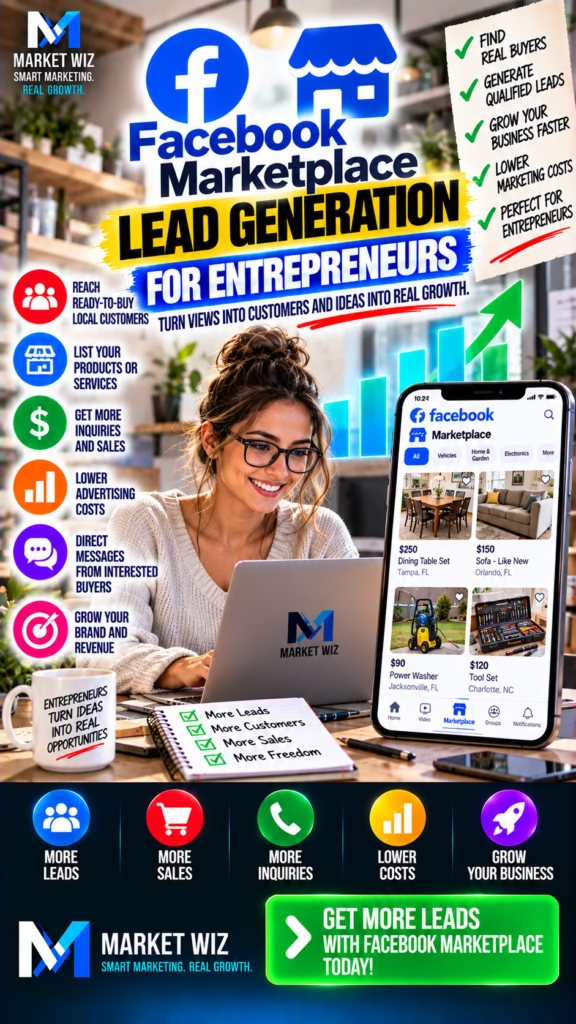
Facebook Marketplace Lead Generation for Entrepreneurs
Facebook Marketplace can give entrepreneurs another path to customer discovery by connecting eligible products with people already browsing locally and regionally. The strongest strategy goes beyond publishing listings by combining accurate offers, compelling visuals, rapid lead response, qualification, CRM tracking, AI-supported workflows, consistent follow-up, sales conversion, and measurable customer acquisition.
Why Facebook Marketplace Lead Generation Matters for Entrepreneurs
Entrepreneurs constantly face the same fundamental challenge: finding customers efficiently.
A great product does not automatically create demand.
A professional website does not guarantee traffic.
A strong offer does not generate revenue unless the right people discover it.
That makes customer acquisition one of the most important systems an entrepreneur can build.
Facebook Marketplace can become one component of that system for businesses with appropriate eligible products and a sales model that fits the platform.
Marketplace users are already browsing.
They may be comparing products, researching prices, evaluating local options, looking for specific inventory, or searching for something they intend to purchase.
The real opportunity is not simply getting a listing in front of more people. The opportunity is turning relevant Marketplace visibility into qualified conversations that can move through a structured sales process and become customers.
Entrepreneurs who understand this distinction can build a much stronger Marketplace strategy.
Understand Marketplace Customer Intent
Marketplace visitors often behave differently from people scrolling through a traditional social feed.
Many are actively browsing products.
Some have a specific item in mind.
Others are comparing alternatives.
Some are price-sensitive.
Others care more about availability, condition, delivery, location, specifications, financing, or convenience.
Entrepreneurs should create listings around the information customers actually use to make buying decisions.
That means understanding the customer's questions before the conversation begins.
Choose the Right Products for Facebook Marketplace
Marketplace lead generation begins with product selection.
Not every offer is equally suited to every platform.
Entrepreneurs should prioritize legitimate eligible inventory that is easy for potential customers to understand and evaluate.
Visual Products
Products customers can understand quickly through accurate photographs may fit naturally with Marketplace browsing behavior.
Local Inventory
Products available within a practical customer or delivery area can align well with local discovery.
Clear Specifications
Size, model, dimensions, configuration, year, materials, or other details can help customers compare options.
Strong Customer Demand
Inventory that solves an active customer need can produce more commercially useful conversations.
Entrepreneurs should also monitor which products actually generate qualified leads and completed sales.
Create Clear Facebook Marketplace Titles
Marketplace titles should make the offer easy to understand.
Customers should not need to open the listing just to determine what the product is.
Depending on the category, useful title elements may include the product type, brand, model, year, size, material, configuration, condition, or another important characteristic.
Clarity can improve relevance.
Relevant titles can also help reduce conversations from people who are looking for something completely different.
Use Authentic Marketplace Photos That Build Confidence
Images are one of the most important parts of a Marketplace listing.
The customer often sees the image before reading anything else.
Strong photography should make the product easy to identify while accurately representing what is available.
Entrepreneurs do not necessarily need elaborate commercial photography for every listing.
In many categories, clear and authentic images of the actual product can be extremely useful.
Useful Marketplace photography can show:
- The full product
- Multiple angles
- Important features
- Materials and finishes
- Condition
- Size or scale
- Interior details when relevant
- Product configuration
- Included components
- Realistic context for how the product is used
Write Marketplace Descriptions That Help Customers Buy
Entrepreneurs should think of the description as a sales assistant.
It should answer important questions before the prospect needs to ask them.
A useful description can explain what the product is, who it may be appropriate for, its important specifications, its condition, price, availability, location, delivery information, financing details when relevant, and the appropriate next step.
Good descriptions can reduce repetitive conversations while helping serious customers evaluate the offer more quickly.
Use Accurate Pricing to Generate Better Leads
Pricing can influence both lead volume and lead quality.
A misleading price may create more initial interest but produce conversations with customers whose budgets do not match the actual offer.
That increases the entrepreneur's workload without necessarily increasing sales.
Accurate pricing can help prospects self-qualify.
When pricing varies because of legitimate product configurations, quantities, financing structures, or options, the listing should communicate those details clearly enough to avoid unnecessary confusion.
Target Markets Where You Can Actually Serve Customers
A lead is valuable only when the entrepreneur can realistically complete the transaction.
Geography therefore matters.
A furniture seller may have a defined delivery radius.
A vehicle dealer may draw customers from a wider region.
A building supplier may sell across multiple states.
Another entrepreneur may depend almost entirely on nearby customers.
The lead generation strategy should reflect the actual operating footprint of the business.
Build Consistent Marketplace Visibility Without Sacrificing Quality
Consistency can create more opportunities for discovery.
But entrepreneurs should not confuse consistency with indiscriminate volume.
Publishing inaccurate, repetitive, irrelevant, unavailable, or low-quality inventory creates more work without necessarily producing more customers.
A better strategy balances coverage with quality.
Each listing should have a legitimate purpose and represent real, appropriate inventory accurately.
Respond Quickly to Facebook Marketplace Leads
Entrepreneurs often focus heavily on generating leads while overlooking what happens after the message arrives.
Response speed can be a major conversion factor.
Marketplace users can contact multiple sellers within minutes.
A prospect who is highly interested right now may be much less engaged several hours later.
Lead generation without lead response is incomplete. Entrepreneurs should build a system that identifies new inquiries quickly and moves legitimate customer interest into an active sales conversation.
Qualify Marketplace Leads Efficiently
A message is not automatically a qualified lead.
Some people are simply asking a question.
Some are outside the sales territory.
Some need a different product.
Some have a budget mismatch.
Others may be ready to purchase immediately.
Entrepreneurs need a simple qualification process that separates general activity from real opportunities.
Qualification questions may cover:
- Which product are you interested in?
- Where are you located?
- When are you planning to purchase?
- Do you need delivery?
- Are you interested in financing?
- What size or configuration do you need?
- Would you like to schedule a call or appointment?
The exact questions should fit the business and the transaction.
Move Qualified Marketplace Leads Toward Direct Sales Conversations
Some purchases can happen quickly.
Others require several sales steps.
Qualified Marketplace prospects may need a phone call, appointment, demonstration, quote, financing discussion, delivery estimate, or additional product information.
Entrepreneurs should create a clear transition from initial Marketplace messaging to the next appropriate step.
The transition should feel useful rather than forced.
The goal is to help the customer continue making progress toward a purchase.
Track Facebook Marketplace Leads in a CRM
Entrepreneurs can quickly lose track of opportunities when every lead remains inside individual message conversations.
A CRM creates structure.
It allows the entrepreneur or sales team to track customer information, product interest, lead source, qualification status, follow-up, appointments, quotes, and sales outcomes.
| Lead Stage | What It Means | Recommended Action |
|---|---|---|
| New Inquiry | A Marketplace customer initiated contact | Respond quickly |
| Responded | The conversation has started | Identify customer need |
| Qualified | The customer meets meaningful sales criteria | Move toward next sales action |
| Appointment / Call | The prospect has moved beyond initial messaging | Prepare for sales conversation |
| Quote / Financing | The customer is evaluating transaction details | Answer objections and follow up |
| Sold | The prospect became a customer | Record revenue and source |
| Follow-Up | The lead remains viable but is not ready | Continue appropriate follow-up |
Use AI Automation to Support Marketplace Lead Management
Entrepreneurs frequently operate with limited time.
The owner may also be the marketer, salesperson, manager, inventory coordinator, and customer support person.
That makes operational efficiency especially important.
AI-supported workflows can help organize repetitive parts of lead management.
AI and automation can assist with:
- New lead notifications
- Information organization
- Qualification support
- CRM updates
- Lead routing
- Appointment workflow support
- Sales alerts
- Follow-up organization
- Lead-source attribution
- Performance reporting
Entrepreneurs should use automation to improve speed and consistency while maintaining appropriate human involvement in important customer conversations.
Follow Up With Marketplace Leads That Are Not Ready Today
Not every qualified customer is ready to purchase immediately.
A prospect may need more time.
They may be comparing alternatives.
They may be waiting for financing.
They may need another decision-maker.
They may be planning a purchase around a future date.
Without a follow-up system, entrepreneurs can repeatedly spend time generating new leads while allowing existing opportunities to disappear.
Structured follow-up helps extract more value from the leads already generated.
Create a Repeatable Marketplace Sales Process
Entrepreneurs gain leverage when successful actions become repeatable.
Instead of improvising every customer interaction, the business can define a basic process.
Customer Discovers the Listing
The product receives relevant visibility inside Marketplace.
Customer Sends an Inquiry
The business receives an initial signal of customer interest.
Respond Quickly
The entrepreneur or sales workflow engages the prospect while interest remains active.
Understand the Need
Determine which product, configuration, price range, or outcome the customer needs.
Qualify the Opportunity
Confirm location, timing, budget, availability, and other relevant sales criteria.
Move the Lead Into the CRM
Preserve the opportunity and create visibility across the sales pipeline.
Create the Next Sales Action
Move toward a call, appointment, quote, demonstration, financing discussion, or purchase.
Follow Up
Continue working qualified prospects who are not ready immediately.
Record the Sale
Connect completed transactions to the original Marketplace source.
Use the Data to Improve
Identify which products, markets, listings, and processes generate the strongest business results.
Measure Marketplace Lead Generation With Business Metrics
Entrepreneurs should avoid measuring success using only the metrics that are easiest to see.
Views and messages can provide useful information, but the business needs to understand what happens afterward.
| Metric | What It Shows | Business Question |
|---|---|---|
| Listing Views | Visibility | Are customers discovering the inventory? |
| Messages | Initial engagement | Are listings generating conversations? |
| Qualified Leads | Commercial relevance | How many conversations represent realistic opportunities? |
| Response Time | Operational speed | How quickly are prospects receiving attention? |
| Appointments | Sales progression | Are qualified prospects moving forward? |
| Close Rate | Sales effectiveness | How many qualified leads become customers? |
| Revenue | Financial output | How much business did Marketplace generate? |
| Gross Profit | Economic value | How profitable were Marketplace-generated sales? |
Prioritize Qualified Marketplace Leads Over Raw Message Volume
Entrepreneurs can easily become distracted by activity.
A listing that produces dozens of messages may feel successful.
But the more important question is how many of those conversations create meaningful business opportunities.
Ten qualified prospects can be more valuable than 100 irrelevant inquiries.
Lead quality affects sales efficiency.
Better-qualified prospects allow entrepreneurs to spend more time on people who have a realistic path toward purchasing.
Keep Marketplace Inventory Accurate
Entrepreneurs with changing inventory need a process for keeping listings current.
Sold products should not continue creating unnecessary customer conversations.
Price changes should be reflected accurately.
Product specifications should match what is actually available.
New inventory should be organized so appropriate products can be marketed efficiently.
Inventory accuracy improves both customer experience and operational efficiency.
Combine Facebook Marketplace With Google Maps
Customer discovery does not always end where it begins.
Someone may discover an entrepreneur's product through Marketplace and then search the business on Google.
They may want to see reviews.
They may want directions.
They may want to verify the company.
They may want to inspect additional photos.
They may want to visit the website.
Strong Google Maps visibility can support this research stage for relevant local businesses.
Use SEO to Create Another Customer Discovery Channel
Marketplace reaches people browsing inside Marketplace.
Search engine optimization can reach people searching through Google and other search experiences.
These users may search for specific products, product categories, local businesses, comparison information, or answers to buying questions.
Entrepreneurs can create useful website content around those search needs.
Diversifying discovery channels reduces dependence on any single platform.
Use Short-Form Video to Create More Customer Touchpoints
Video can make products easier to understand.
A short video can demonstrate size, movement, features, configuration, quality, use cases, before-and-after differences, or product details that may be difficult to communicate through a single image.
Entrepreneurs can distribute video across appropriate social channels while Marketplace listings create another discovery path.
The objective is not simply to create more content.
The objective is to give potential customers useful information that supports a buying decision.
Combine Marketplace With Paid Advertising When Appropriate
Organic and paid customer acquisition do not need to compete.
They can solve different problems.
Marketplace may provide organic discovery for appropriate inventory.
Paid advertising can provide targeted reach, retargeting, website traffic, lead forms, audience expansion, and campaigns around specific business objectives.
Entrepreneurs can compare the channels using actual acquisition economics rather than assuming one must replace the other.
Understand Customer Acquisition Cost
Entrepreneurs should understand what it actually costs to acquire a customer.
Marketplace may not require the same media spending structure as traditional paid advertising, but it still consumes resources.
There may be software costs.
There may be employee time.
There may be photography or content expenses.
There may be sales labor.
There may be CRM, automation, management, or technology expenses.
Understanding total cost allows entrepreneurs to compare Marketplace with other acquisition channels more accurately.
Connect Marketplace Leads to Revenue
Lead generation should eventually connect to financial results.
Entrepreneurs can assign Marketplace as the original source when a prospect enters the CRM.
That source can remain attached to the customer record as the lead moves through qualification, appointments, quotes, financing, follow-up, and sales.
When a transaction closes, the entrepreneur can attribute revenue to the original source.
Over time, this creates a much clearer picture of Marketplace performance.
Test and Improve Marketplace Lead Generation
Entrepreneurs should use performance data to improve future marketing.
Different products may perform differently.
Different images may create different engagement.
Different titles may affect relevance.
Different locations may produce different lead quality.
Different response workflows may produce different conversion rates.
Testing should focus on meaningful business outcomes rather than superficial activity alone.
Scale Marketplace Lead Generation Based on Proven Results
Scaling works best after entrepreneurs identify repeatable patterns.
If a particular product category consistently produces profitable customers, the entrepreneur can evaluate expanding coverage within that category.
If a particular geographic market produces stronger leads, the business can investigate additional opportunities there.
If a particular lead workflow improves response and conversion, it can be standardized.
The objective is not simply more activity.
It is more of the activity that creates customers.
Expand Into Multiple Markets Carefully
Some entrepreneurs eventually expand beyond one local market.
Expansion can create new customer opportunities, but it also creates operational complexity.
Inventory needs to match the market.
Fulfillment needs to work.
Delivery or pickup logistics need to be realistic.
Sales teams need sufficient capacity.
Lead routing needs to remain organized.
Listings need accurate local information.
Platform rules and current eligibility requirements need to be respected.
Expansion should follow operational readiness rather than simply a desire for more listing volume.
Common Facebook Marketplace Lead Generation Mistakes Entrepreneurs Should Avoid
- Using unclear listing titles
- Publishing poor or misleading photos
- Using inaccurate prices
- Advertising unavailable products
- Providing incomplete product information
- Ignoring current Marketplace rules
- Responding too slowly
- Failing to qualify leads
- Leaving qualified prospects inside message threads
- Failing to track leads in a CRM
- Failing to follow up
- Measuring messages instead of customers
- Ignoring customer acquisition cost
- Scaling before establishing a repeatable system
- Depending on Marketplace as the only source of customers
The strongest entrepreneurs build systems rather than isolated tactics. Marketplace can generate discovery, but response, qualification, sales, follow-up, tracking, and optimization determine how much business value that discovery ultimately creates.
Build a Complete Facebook Marketplace Lead Generation System
Entrepreneurs can organize Marketplace marketing into a repeatable operating system.
Select Eligible Inventory
Choose legitimate products that fit the business model, customer demand, and current Marketplace requirements.
Build Accurate Listings
Create clear titles, authentic images, useful descriptions, accurate pricing, and current product information.
Generate Relevant Discovery
Align inventory and location strategy with markets where the entrepreneur can realistically sell.
Capture New Inquiries
Ensure customer messages are identified quickly and do not disappear inside unmanaged conversations.
Respond Quickly
Engage interested prospects while their purchase intent remains active.
Qualify the Prospect
Collect the minimum useful information needed to determine whether the customer represents a realistic sales opportunity.
Track the Lead
Move qualified opportunities into a CRM or structured lead management system.
Advance the Sale
Create the next appropriate action, such as a call, appointment, quote, financing discussion, demonstration, or purchase.
Follow Up
Continue working qualified leads that need more time before making a decision.
Measure and Optimize
Connect Marketplace activity to customers, revenue, profitability, and acquisition cost, then use the data to improve the system.
Turn Marketplace Into a Long-Term Entrepreneur Growth Channel
Entrepreneurs create leverage when marketing systems become repeatable.
Instead of wondering where the next customer will come from, the business develops multiple predictable paths for discovery.
Marketplace can become one of those paths.
Google Maps can become another.
SEO can become another.
Social media can become another.
Paid advertising can become another.
Referrals can become another.
The entrepreneur's advantage comes from connecting those channels to a disciplined sales and lead management process.
This reduces dependence on one platform while creating more ways for customers to discover and trust the business.
30 FAQs About Facebook Marketplace Lead Generation for Entrepreneurs
1. What is Facebook Marketplace lead generation for entrepreneurs?
Facebook Marketplace lead generation for entrepreneurs is the process of using eligible Marketplace listings and structured lead management to attract potential customers and move qualified inquiries toward sales.
2. Can entrepreneurs use Facebook Marketplace to generate leads?
Entrepreneurs with appropriate eligible products and business models may use Marketplace as one customer discovery channel, subject to current platform policies, category rules, and account requirements.
3. Why is Facebook Marketplace useful for entrepreneurs?
Marketplace can provide access to users already browsing products and offers, giving some entrepreneurs another way to create local or regional customer discovery.
4. What makes a strong Facebook Marketplace listing?
Strong listings generally use accurate titles, clear images, truthful pricing, useful product details, current availability, relevant location information, and a straightforward customer next step.
5. Do entrepreneurs need professional photos for Marketplace?
Photos should be clear, accurate, and useful. Professional photography can help in some categories, but authenticity and an accurate representation of the actual product are especially important.
6. How quickly should entrepreneurs respond to Marketplace leads?
Businesses should respond as quickly as operationally practical because Marketplace shoppers may be comparing multiple alternatives at the same time.
7. Should entrepreneurs qualify Facebook Marketplace leads?
Yes. Basic qualification can help determine whether an inquiry matches the product, location, budget, timing, delivery requirements, financing needs, or other relevant sales criteria.
8. Can Marketplace leads be moved into a CRM?
Businesses can use a CRM or another structured lead management system to track customer information, source, sales stage, follow-up, appointments, quotes, and outcomes.
9. Can AI help entrepreneurs manage Marketplace leads?
AI-supported workflows can assist with notifications, information organization, qualification support, CRM updates, lead routing, follow-up organization, and reporting.
10. Is Facebook Marketplace only useful for local businesses?
Marketplace often has strong local relevance, but the practical geographic opportunity depends on the product, fulfillment capabilities, delivery area, business model, and current platform functionality.
11. Can entrepreneurs generate leads without paid ads?
Some entrepreneurs can generate organic customer discovery through channels such as Marketplace, Google Maps, SEO, social media, referrals, and content, although every channel still requires time, resources, or operational investment.
12. How do entrepreneurs improve Marketplace lead quality?
Lead quality can improve when listings accurately communicate the product, price, specifications, location, availability, and other information customers need to determine whether the offer is relevant.
13. Should Marketplace pricing be accurate?
Yes. Pricing information should accurately represent the offer and should not intentionally create misleading expectations about the actual cost.
14. Can entrepreneurs advertise multiple products on Marketplace?
Entrepreneurs with multiple legitimate eligible products may be able to create separate listings, depending on current Marketplace policies, account requirements, and category rules.
15. Should sold products remain advertised as available?
Businesses should keep inventory information current and avoid knowingly presenting unavailable products as available.
16. What metrics should entrepreneurs track from Marketplace?
Useful metrics include inquiries, qualified leads, response time, contact rate, appointments, quotes, close rate, sales, revenue, gross profit, and customer acquisition cost.
17. Are Marketplace messages the same as qualified leads?
No. A message indicates interest or a question, while a qualified lead meets meaningful criteria that make the prospect more relevant to the business.
18. How can entrepreneurs convert Marketplace messages into sales?
Conversion can improve through rapid response, useful answers, qualification, direct contact when appropriate, sales follow-up, appointments, accurate offers, and consistent lead tracking.
19. Does follow-up matter for Marketplace leads?
Yes. Many qualified prospects do not purchase immediately, so organized follow-up can help entrepreneurs continue working opportunities that remain commercially relevant.
20. Can Facebook Marketplace work for high-ticket products?
Some eligible higher-value products can use Marketplace for initial discovery, while the final transaction may require calls, appointments, financing, demonstrations, inspections, or additional sales steps.
21. Should entrepreneurs combine Marketplace with Google Maps?
For relevant local businesses, Google Maps can complement Marketplace by helping customers research the company, location, reviews, photos, website, and contact information.
22. Can SEO support Facebook Marketplace lead generation?
SEO can create an additional discovery channel and can help customers find the business when they search for products, categories, company information, or related local queries.
23. Can social media support Marketplace leads?
Social content can reinforce customer trust through product videos, company information, educational posts, demonstrations, testimonials, FAQs, and ongoing brand visibility.
24. Should entrepreneurs use paid ads with Marketplace?
Paid advertising and Marketplace can serve different purposes. Entrepreneurs can evaluate both based on customer acquisition cost, lead quality, conversion, profitability, and strategic goals.
25. How can entrepreneurs track Marketplace revenue?
Marketplace can be recorded as the original lead source in a CRM so qualified leads can be tracked through sales stages and connected to completed transactions and revenue.
26. What causes poor Facebook Marketplace lead generation?
Poor performance can result from weak products, inaccurate listings, unclear photos, poor pricing, irrelevant markets, slow response, weak qualification, poor follow-up, policy problems, or ineffective sales execution.
27. Can Marketplace lead generation scale?
It can scale for some businesses when inventory, staffing, lead management, fulfillment, sales processes, technology, and platform compliance can support additional activity.
28. Should entrepreneurs automate all Marketplace conversations?
Automation is generally most useful for supporting repetitive workflow tasks while maintaining appropriate human involvement for complex questions, negotiations, recommendations, and important sales conversations.
29. Can Marketplace become a long-term lead source for entrepreneurs?
Marketplace can become one component of a diversified long-term acquisition system when businesses maintain accurate eligible inventory, consistent lead handling, tracking, follow-up, and ongoing optimization.
30. What is the goal of Facebook Marketplace lead generation for entrepreneurs?
The goal is to turn appropriate Marketplace visibility into qualified customer opportunities, sales conversations, transactions, and profitable business growth.
30 Additional SEO Keywords
These additional search themes can support related landing pages, educational articles, videos, social media content, local marketing campaigns, and broader entrepreneur customer acquisition strategies.
Turn Facebook Marketplace Visibility Into Qualified Entrepreneur Leads
Entrepreneurs do not need more marketing activity simply for the sake of activity.
They need customer acquisition systems that create measurable business opportunities.
Facebook Marketplace can become part of that system when the business, products, and platform eligibility align.
The process begins with understanding what customers are actually looking for.
Marketplace users are often browsing with some level of purchase interest.
They may know exactly what they want.
They may be comparing prices.
They may be exploring several alternatives.
They may be trying to find something available nearby.
They may need a specific size, model, configuration, material, year, style, or feature.
Entrepreneurs who understand those needs can build more useful listings.
The title can identify the product clearly.
The primary image can show the customer what is available.
Additional images can answer visual questions.
The description can explain specifications and important details.
The price can create realistic expectations.
The location can help customers understand whether the transaction is practical.
Accurate information can improve the quality of the conversation before it begins.
That matters because entrepreneurs have limited time.
Every unnecessary conversation consumes attention.
Every irrelevant inquiry takes time away from potentially valuable customers.
Better listing information can help customers self-qualify.
But listing quality is only the beginning.
The entrepreneur also needs to respond.
Response speed can significantly influence whether a Marketplace inquiry develops into a real opportunity.
Customers can browse quickly.
They can compare several sellers.
They can message multiple businesses.
Their attention can shift rapidly.
A business that responds while purchase intent is active has an opportunity to continue the conversation.
A business that responds much later may discover the customer already purchased elsewhere.
This is why lead response belongs inside the marketing strategy.
Marketing does not stop when the message arrives.
The message is simply the transition between customer discovery and sales.
Qualification comes next.
Entrepreneurs need to understand whether the prospect represents a realistic opportunity.
The customer may need the correct product.
They may need to be within a practical sales area.
Their budget may need to align.
Their timing may matter.
Delivery may matter.
Financing may matter.
Product configuration may matter.
The exact criteria depend on the entrepreneur's business model.
Qualification should be efficient.
Customers should not be forced through unnecessary friction.
The objective is simply to gather enough useful information to decide what should happen next.
A qualified prospect may need a call.
They may need an appointment.
They may need a quote.
They may need financing information.
They may need a demonstration.
They may simply need clear instructions for completing the purchase.
Entrepreneurs should design the lead process around helping the customer reach that next step.
Once the opportunity becomes meaningful, it should be tracked.
A CRM can provide that structure.
This is particularly important as the business grows.
An entrepreneur may initially remember every customer conversation.
That becomes difficult as inquiry volume increases.
Leads begin to overlap.
Follow-ups are forgotten.
Customer details become scattered.
Sales attribution becomes unclear.
The entrepreneur may know that Marketplace feels busy without knowing whether it is actually profitable.
CRM tracking changes that.
The entrepreneur can see how many leads entered the pipeline.
They can see which products generated them.
They can see which leads became qualified.
They can see which prospects scheduled calls or appointments.
They can see which customers requested quotes.
They can see which opportunities required follow-up.
They can see which leads ultimately purchased.
That data transforms Marketplace from a collection of conversations into a measurable customer acquisition channel.
AI automation can help entrepreneurs manage that process more efficiently.
Entrepreneurs frequently wear many hats.
The same person may oversee marketing, sales, operations, purchasing, customer communication, and strategy.
Repetitive administrative work can consume hours that would be better spent on high-value activities.
Automation can help organize those repetitive tasks.
A new inquiry can trigger a notification.
Customer details can be organized.
Qualified leads can be routed.
CRM records can be updated.
Salespeople can receive alerts.
Follow-up tasks can be organized.
Performance data can be consolidated.
The objective is not automation for its own sake.
The objective is a faster, more organized customer journey.
Human interaction remains important.
Customers may have unusual questions.
They may need expert recommendations.
They may want to negotiate.
They may need reassurance.
They may have complex financing or delivery questions.
Technology can support the process while entrepreneurs and salespeople handle conversations that require judgment.
Follow-up is another major opportunity.
Many entrepreneurs focus almost entirely on generating new leads.
But existing qualified prospects can contain substantial unrealized value.
A customer who did not purchase today may still purchase next week.
Another may purchase next month.
Another may be waiting for inventory.
Another may be waiting for financing.
Another may need to discuss the purchase with someone else.
Entrepreneurs who follow up systematically can continue working those opportunities instead of constantly starting from zero.
Measurement then closes the loop.
Marketplace views can tell the entrepreneur whether inventory is being discovered.
Messages can indicate customer engagement.
Qualified lead counts can show commercial relevance.
Response time can show operational efficiency.
Appointments can show sales progression.
Close rate can show conversion effectiveness.
Revenue can show financial output.
Gross profit can show economic value.
Customer acquisition cost can show marketing efficiency.
These measurements help entrepreneurs make better decisions.
If one product generates many inquiries but few qualified leads, the listing or offer may need improvement.
If another product generates fewer inquiries but closes at a much higher rate, it may deserve additional attention.
If one market produces profitable customers while another creates mostly irrelevant conversations, geography may need to be adjusted.
If response times are slow, automation or staffing may need improvement.
If qualified leads fail to close, the bottleneck may be in sales rather than marketing.
Data helps entrepreneurs identify the real problem.
Marketplace should also be connected to a broader marketing system.
Customers rarely make decisions from one isolated touchpoint.
A customer may first see a Marketplace listing.
Then they may search the company on Google.
They may inspect a Google Business Profile.
They may read reviews.
They may visit the website.
They may watch social videos.
They may encounter a paid advertisement later.
They may finally call or purchase after several interactions.
Entrepreneurs should therefore think in terms of customer acquisition ecosystems rather than isolated platforms.
Marketplace can create product discovery.
Google Maps can create local trust and additional discovery.
SEO can capture active search demand.
Social media can create repeated exposure.
Video can demonstrate products.
Paid advertising can expand reach and support retargeting.
CRM systems can preserve opportunities.
AI automation can improve speed and organization.
Sales teams can convert qualified prospects.
Follow-up can recover opportunities that need more time.
Together, those systems create a more resilient approach to growth.
Entrepreneurs should also avoid becoming dependent on one platform.
Platforms evolve.
Policies change.
Features change.
Customer behavior changes.
Competition changes.
A diversified acquisition strategy gives the entrepreneur more ways to reach customers when one channel changes.
Marketplace can still play an important role within that diversified system.
The key is building the process correctly.
Select the right inventory.
Present it accurately.
Reach relevant customers.
Respond quickly.
Qualify efficiently.
Move serious prospects into the sales process.
Track them.
Follow up.
Record the outcome.
Measure revenue and profitability.
Improve the system using real performance data.
When those pieces work together, Facebook Marketplace can become much more than a place where entrepreneurs publish listings.
It can become a structured lead generation channel that supports customer acquisition, sales growth, and a broader multi-channel marketing strategy.
Build a Smarter Marketplace Lead Generation System
Market Wiz AI helps businesses connect Facebook Marketplace marketing, Google Maps optimization, SEO, social media, AI-powered lead response, CRM workflows, qualification, follow-up, automation, and performance tracking into a more organized customer acquisition system.
Get Started With Market Wiz AI© Market Wiz AI. Facebook and Facebook Marketplace are trademarks of Meta Platforms, Inc. Market Wiz AI is not affiliated with or endorsed by Meta unless expressly stated. Marketplace eligibility, commerce policies, account requirements, listing rules, categories, features, and availability may change over time. Businesses should review current platform requirements before publishing content. Marketing results vary based on product, market, pricing, competition, customer demand, sales execution, operating costs, and other factors.














Use Social Media to Reinforce Marketplace Lead Generation
Marketplace is often focused on individual products.
Social media can help entrepreneurs communicate more of the business story.
Content can showcase new inventory, demonstrations, comparisons, customer experiences, educational information, frequently asked questions, behind-the-scenes activity, and short-form videos.
Repeated exposure can increase familiarity with the business.
That familiarity can support conversion when a customer later sees a Marketplace listing.