
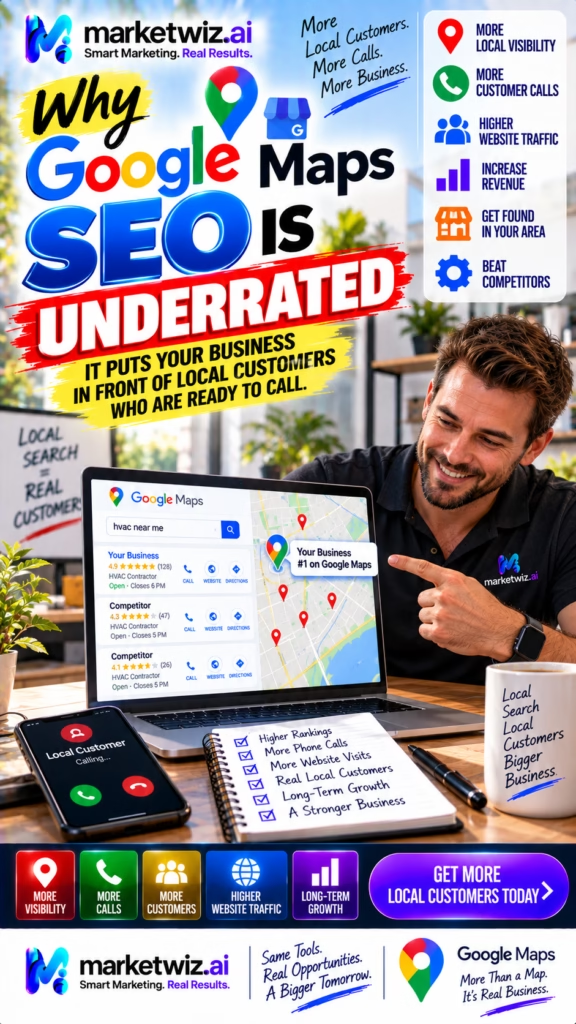
Why Google Maps SEO Is Underrated
Many businesses invest heavily in social media, paid advertising, websites, email, and traditional SEO while giving surprisingly little attention to one of the most commercially relevant areas of local search: Google Maps. For companies that depend on nearby customers, Google Maps SEO can strengthen visibility at the exact moment people are searching for local businesses, comparing options, reading reviews, checking locations, visiting websites, and deciding who to contact.
Updated September 20261. Google Maps Captures Valuable Local Search Intent
One reason Google Maps SEO is frequently underrated is that businesses underestimate the commercial intent behind local searches. Someone searching for a nearby contractor, furniture store, apartment community, repair company, restaurant, medical practice, warehouse, dealer, or professional business is often much further along in the customer journey than someone casually consuming content on social media.
Local search frequently begins because a customer has a specific need. The customer may want to call a business, compare reviews, visit a website, get directions, evaluate operating hours, research products, request an estimate, or determine which nearby company appears most relevant.
Google Maps SEO is not only about rankings. It is about improving the business's visibility and credibility during a local customer's decision-making process.
This makes local search visibility strategically different from marketing channels that depend primarily on interrupting or creating demand. In many local searches, demand already exists. The business is competing to become one of the options the customer evaluates.
2. Google Maps SEO Is Different From Traditional SEO
Traditional SEO and Google Maps SEO overlap, but they are not identical. Traditional organic SEO often focuses heavily on website pages, backlinks, content, technical performance, search intent, and broader organic rankings.
Local search adds another layer. The business's physical or service-area context, Google Business Profile, categories, reputation, local relevance, geographic relationship to the searcher, and broader prominence all become important considerations.
Traditional SEO
Often focuses on website visibility for informational, commercial, transactional, and navigational searches.
Google Maps SEO
Focuses on strengthening local business discovery and relevance for customers searching within geographic markets.
The strongest strategies frequently connect both. A well-optimized business profile can be supported by a strong website, while locally relevant website content can reinforce the overall digital presence of the business.
3. Google Maps Appears During Critical Customer Decisions
Local search is often part of the final research process before a customer contacts a company. Customers can use Google to compare businesses, read reviews, examine photographs, visit websites, check hours, evaluate locations, and determine whether a company appears legitimate.
This means Google Maps visibility can influence more than initial discovery. It can also influence validation.
A customer journey may look like this:
4. Local Visibility Can Put a Business in Front of New Customers
Businesses often think about Google only in terms of their company name. Ranking for branded searches is useful, but the larger growth opportunity often comes from non-branded searches.
A non-branded search occurs when the customer is searching for a category, product, solution, or business type rather than a specific company.
Those searches can introduce the business to customers who did not already know the brand existed.
Brand Discovery Matters
Local SEO becomes especially valuable when a business can appear during relevant category-based searches rather than depending exclusively on people who already know its name.
5. The Google Business Profile Is More Important Than Many Businesses Realize
A Google Business Profile can act as a highly visible digital representation of a local company. Customers may encounter it before they ever reach the company's website.
The profile can communicate important business information such as the company name, category, contact details, website, location or service-area context, hours, reviews, photos, and other relevant profile features.
A strong profile should prioritize:
- Accurate business information
- Appropriate categories
- Current hours
- Correct contact details
- Useful business descriptions
- Relevant photographs
- Authentic customer reviews
- Consistent updates when business information changes
The goal is not to stuff the profile with unnecessary information. The goal is to make it accurate, complete, useful, and representative of the actual business.
6. Relevance Is a Core Part of Local Search
Google needs to understand what a business does before it can meaningfully match that business with relevant customer searches.
This makes clarity extremely important. Business categories, profile information, website content, products, services, and other available signals should consistently communicate the real nature of the company.
A business that offers multiple products or solutions should organize its website and local presence so customers can clearly understand those offerings.
Local SEO begins with accurate business identity. Before chasing advanced tactics, make sure Google and customers can clearly understand what the business is, what it offers, and where it legitimately operates.
7. Geographic Distance Makes Google Maps SEO Unique
Local rankings can change as the searcher's location changes. A company that appears prominently from one neighborhood may appear differently several miles away.
This is one reason a single manual search from the business owner's office is not enough to understand local visibility across an entire market.
Businesses serving large metropolitan areas should think geographically. Customer density, business location, legitimate service coverage, competition, and searcher proximity can all influence the local search landscape.
This creates an important distinction:
- Website rankings can be evaluated nationally or regionally
- Local rankings can change across short geographic distances
- One ranking position does not describe the entire city
- Visibility should be evaluated across meaningful target areas
8. Prominence Rewards Businesses That Build a Stronger Digital Footprint
Local search does not exist in isolation. A business's broader reputation and presence across the web can contribute to how established the company appears.
Reviews, links, website authority, mentions, directories, industry sources, local organizations, media coverage, and other legitimate signals can all contribute to the wider digital footprint surrounding a company.
This is why Google Maps SEO should not be reduced to editing a profile once. Strong local marketing often involves improving the entire ecosystem around the business.
9. Business Categories Can Change How Google Understands the Company
Category selection is one of the foundational components of a Google Business Profile. Businesses should choose categories that accurately describe their real operations.
The primary category should represent the company's central business type, while relevant additional categories may help communicate other legitimate areas of operation when appropriate.
Accuracy Is More Important Than Quantity
Adding categories simply because they appear related can create a less accurate profile. Categories should reflect what the business actually is and does.
10. Reviews Influence Both Trust and Local Marketing Performance
Reviews are one of the most visible elements customers encounter while comparing local businesses. A strong review profile can help reduce uncertainty because prospective customers can learn from previous customer experiences.
Review quality is not only about accumulating the largest possible number. Authenticity, recency, customer detail, business responses, and the overall reputation pattern can all matter to customers.
A healthy review strategy can include:
- Requesting reviews from legitimate customers
- Making the review process easy to understand
- Responding professionally
- Addressing negative feedback constructively
- Monitoring new reviews
- Learning from repeated customer themes
Businesses should avoid fabricated reviews, misleading incentives, or other practices that undermine authenticity.
11. Review Responses Are an Underrated Conversion Tool
Many businesses collect reviews but rarely respond to them. That misses an opportunity to communicate with both the original reviewer and future customers reading the profile.
Professional responses can show that the business pays attention to customer feedback. Positive reviews can be acknowledged naturally, while critical reviews can receive calm and useful responses.
Responses should sound human rather than repetitive. Copying the exact same generic sentence under every review can reduce authenticity.
12. Photos Can Strengthen the Customer's First Impression
Customers often use profile photographs to understand what a business looks like, what it sells, the type of work it performs, the people behind the company, or the environment they can expect.
Relevant images can therefore support both trust and conversion.
Depending on the business, useful photos can include:
- Exterior business photographs
- Interior photographs
- Products
- Completed projects
- Team members
- Equipment
- Vehicles
- Before-and-after examples
- Customer-facing spaces
- Real work environments
Images should accurately represent the business rather than creating a false impression.
13. The Website and Google Maps Should Support Each Other
Businesses sometimes treat the Google Business Profile and company website as completely separate marketing assets. A stronger approach is to make them work together.
The website can provide deeper information about the company, products, services, locations, projects, expertise, customer questions, and contact options.
Meanwhile, the business profile can become a highly visible entry point into that website for local customers.
Think of Google Maps and the website as connected customer touchpoints. A local search can create discovery, while the website can provide the depth needed to turn that discovery into confidence and action.
14. Local Website Pages Can Support Geographic Relevance
Businesses operating across legitimate markets may benefit from website content that explains their presence, offerings, projects, or customer relevance within those areas.
Local pages should not exist merely to repeat a city name hundreds of times. They should provide genuine value.
Useful local page information may include:
- Products or solutions available in the market
- Local project examples
- Market-specific customer questions
- Relevant neighborhoods or coverage information
- Local contact information when legitimate
- Business hours
- Directions for real locations
- Customer testimonials
- Local photographs
15. Consistent Business Information Still Matters
Customers encounter business information across many places: the company website, Google, industry directories, local organizations, social profiles, review platforms, and other sources.
Inconsistent names, phone numbers, addresses, websites, hours, or business descriptions can create confusion.
Local SEO campaigns should therefore include an audit of important online business information and correct meaningful inaccuracies where possible.
16. Local Content Can Build More Than Rankings
Local content is often discussed only as an SEO tactic, but its real value can be broader. Useful content helps potential customers understand the company and make better decisions.
Examples can include:
- Local buying guides
- Project case studies
- Frequently asked questions
- Market-specific product information
- Local pricing explanations
- Seasonal advice
- Neighborhood or regional considerations
- Customer education
Strong content can support organic SEO, local SEO, sales conversations, social media, email marketing, and customer education at the same time.
17. Google Maps Can Influence High-Value Phone Calls
For many local businesses, a phone call remains one of the most commercially important customer actions.
Contractors, repair companies, medical practices, professional businesses, property companies, dealers, retailers, and other local organizations can all receive valuable opportunities from customers who prefer to speak with someone directly.
This is why ranking reports alone provide an incomplete picture. A local SEO campaign should connect visibility with actual customer behavior whenever possible.
18. Local Visibility Can Generate Valuable Website Traffic
Some customers are not ready to call immediately. They want more information first.
A website visit from a local search can be highly valuable because the visitor may already have geographic and commercial relevance.
The website should therefore be prepared to continue the journey. Pages should load properly, explain the business clearly, provide relevant information, work well on mobile devices, and make next steps easy to understand.
19. Google Maps SEO Can Be Especially Valuable for Contractors
Contractors frequently operate in markets where customers search locally and compare several companies before requesting an estimate.
Roofing companies, painters, HVAC contractors, plumbers, electricians, flooring companies, fence installers, concrete contractors, garage door companies, remodelers, landscapers, and other local contractors can all benefit from a stronger local search presence.
Contractor customers often evaluate:
- Reviews
- Project photographs
- Business location or coverage
- Website quality
- Years in business
- Relevant expertise
- Availability
- Contact options
20. Google Maps SEO Is Powerful Beyond Home Services
Local SEO is sometimes discussed primarily in the context of contractors, but its value extends to many business categories.
Retail
Furniture stores, appliance stores, dealerships, specialty retailers, and local product businesses can benefit from nearby discovery.
Professional Businesses
Lawyers, accountants, consultants, medical practices, and other professionals can strengthen local research visibility.
Real Estate
Brokerages, apartment communities, property companies, and related businesses can build geographic visibility.
Hospitality
Hotels and other destination-based businesses can benefit when customers evaluate nearby options.
21. Multi-Location Businesses Need a Scalable Local SEO System
Businesses with multiple legitimate locations face a different challenge from single-location companies. They need to maintain local relevance while also protecting brand consistency.
Each eligible location may have its own customer patterns, competitors, reviews, photos, market opportunities, and performance.
A multi-location framework can track:
- Profile accuracy
- Review activity
- Local visibility
- Calls
- Website visits
- Leads
- Appointments
- Revenue
- Market-specific opportunities
Centralized reporting can help identify which markets are strong and which need additional attention.
22. Traditional Rank Tracking Can Miss the Local Picture
A business owner may search from one location, see a favorable result, and assume the entire market sees the same thing. Local search does not always work that way.
Because geographic context matters, local visibility should be evaluated across meaningful areas rather than from a single search point.
Think in Geographic Coverage, Not One Ranking
The better question is often not, “What position are we?” but, “Where across our legitimate target market are we visible for the searches that matter to our customers?”
23. Competitor Analysis Reveals Local SEO Opportunities
Businesses should understand what the local search environment looks like around them. That does not mean copying competitors. It means identifying gaps and understanding the standard required to compete.
Useful competitor observations can include:
- Primary business categories
- Review patterns
- Website quality
- Local content depth
- Profile completeness
- Photo quality
- Brand prominence
- Directory presence
- Geographic strengths
Competitor analysis should lead to better customer value and a stronger business presence rather than imitation.
24. AI Can Make Google Maps SEO More Scalable
Local SEO can involve substantial data. Businesses may need to research keywords, analyze markets, organize reviews, compare locations, monitor website content, identify missing information, and create reports.
AI can support these workflows by processing information more efficiently and helping teams identify patterns.
AI can assist with:
- Local keyword research
- Content planning
- Review sentiment analysis
- Competitor research organization
- Location reporting
- Local page outlines
- FAQ analysis
- Lead attribution analysis
- Performance summaries
- Optimization opportunity identification
AI-generated information should still be reviewed for accuracy, especially when dealing with business facts, locations, pricing, policies, or customer-facing claims.
25. Google Maps SEO Can Diversify Customer Acquisition Beyond Paid Ads
Paid advertising can be extremely useful, but a business that depends entirely on paid traffic is exposed to changing costs, competition, budgets, and campaign performance.
Organic local visibility creates another acquisition path.
That does not mean Google Maps SEO should automatically replace advertising. A stronger strategy often uses multiple channels together so the company is not dependent on one source of customers.
Build a Balanced Acquisition Mix
Google Maps SEO, traditional SEO, paid search, social media, Facebook Marketplace, Craigslist, referrals, email, repeat business, and direct outreach can each play different roles depending on the company.
26. Google Maps SEO Can Strengthen Facebook Marketing
Customer journeys are rarely confined to one platform. A person may discover a company through Facebook Marketplace, a Facebook Page, a group, an advertisement, or a social post and then search the business on Google before making contact.
A strong Google presence can support that research phase.
Reviews, photographs, business information, website content, and local visibility can reinforce trust created elsewhere.
The reverse can also happen. A customer may first discover the business through Google and later examine social profiles before making a decision.
27. Google Maps SEO Can Support Craigslist and Other Local Channels
Craigslist, local classifieds, social channels, directories, and other discovery sources can generate initial awareness. Customers may then search the business name on Google to verify the company.
This means Google Maps optimization can indirectly strengthen leads that originated somewhere else.
A customer who finds consistent business information, legitimate reviews, useful photos, and a professional website may feel more confident continuing the conversation.
28. Google Maps SEO Should Be Measured by Business Outcomes
Rankings matter because visibility matters. But rankings are not the final business objective.
Local SEO should ultimately contribute to customer acquisition, revenue, or another meaningful organizational goal.
| Metric | What It Helps Measure |
|---|---|
| Local Visibility | Whether the business is being discovered for relevant searches |
| Calls | Direct customer interest generated through local discovery |
| Website Visits | Customers moving from local search into deeper research |
| Forms or Appointments | Prospects progressing toward a sales or booking event |
| Qualified Leads | Commercially relevant opportunities |
| Sales & Revenue | The actual business impact of local search activity |
The closer reporting gets to real business outcomes, the easier it becomes to determine whether local SEO is creating value.
29. Common Google Maps SEO Mistakes That Hold Businesses Back
Google Maps SEO is often underrated partly because many businesses have never implemented it as a complete system. They may create a profile, make a few edits, and then stop.
Common weaknesses include:
- Incomplete business information
- Incorrect categories
- Outdated hours
- Inconsistent contact information
- Weak websites
- Thin local content
- Neglected reviews
- No review response strategy
- Few useful photos
- Duplicate or ineligible profiles
- Ignoring local competitor strength
- Weak directory consistency
- No local rank measurement
- No lead attribution
- No connection between SEO and CRM data
- Focusing only on one keyword
- Expecting identical rankings across an entire city
- Creating low-value city pages
- Using inaccurate business information
- Measuring rankings without measuring customers
30. Build a 90-Day Google Maps SEO Growth Plan
Local SEO becomes easier to manage when improvements are organized into stages. Businesses do not need to change everything simultaneously.
Days 1–30: Establish the Foundation
- Audit the Google Business Profile
- Verify business information
- Review category selection
- Check operating hours
- Audit photographs
- Review customer feedback
- Audit the website
- Check major business listings
- Identify target local search themes
- Establish baseline performance metrics
Days 31–60: Strengthen Relevance and Trust
- Improve weak website pages
- Create useful local content
- Improve product or offering information
- Build an authentic review process
- Respond to customer reviews
- Add useful business photographs
- Correct important directory inaccuracies
- Improve internal website linking
- Strengthen conversion paths
Days 61–90: Measure and Expand
- Measure local visibility
- Compare target geographic areas
- Analyze calls and website visits
- Track qualified leads
- Connect lead sources with CRM data
- Identify content gaps
- Analyze competitor movement
- Improve underperforming pages
- Expand successful local content themes
- Measure sales and revenue where possible
The Google Maps SEO growth formula: accurate profile + relevant categories + strong website + useful local content + authentic reviews + professional review responses + quality photos + consistent business information + local authority + geographic measurement + lead tracking + continuous improvement.
Google Maps SEO Deserves a Bigger Role in Local Marketing
Google Maps SEO is underrated because its value is easy to underestimate when businesses look only at rankings. The real opportunity is much larger than a position on a map.
Local search connects businesses with people who are actively researching nearby options. These customers may be comparing contractors, stores, professional businesses, properties, dealers, restaurants, medical practices, or other organizations in their area.
That makes Google Maps visibility part of the buying journey. A strong local presence can help a business become discoverable, but it can also help the company appear more credible once the customer begins comparing alternatives.
The Google Business Profile is an important foundation. Accurate categories, business information, hours, photographs, reviews, and relevant profile details help customers understand the company.
But Google Maps SEO should not stop at the profile. The website matters. Reviews matter. Local content matters. Business information consistency matters. Reputation matters. Geographic relevance matters. The broader digital footprint surrounding the business matters.
This is also why local SEO can become stronger over time. Businesses can continue improving their website, earning legitimate reviews, publishing useful content, strengthening local authority, correcting inaccurate information, and improving the customer experience.
Geographic measurement is another major advantage of a mature local SEO strategy. Instead of assuming one ranking represents an entire market, businesses can evaluate where visibility is strong and where additional work may be needed.
For multi-location organizations, this becomes even more valuable. Individual locations can be compared by visibility, reviews, customer actions, leads, conversion, and revenue.
AI can make the process more scalable by supporting keyword research, review analysis, content planning, local market research, reporting, performance analysis, and identification of optimization opportunities.
The strongest local marketing systems also connect Google Maps SEO with other acquisition channels. Facebook Marketplace, Craigslist, social media, paid advertising, email, referrals, repeat customers, traditional SEO, and direct outreach can all introduce customers to a company.
Google can then become an important verification and discovery layer within that broader system.
Most importantly, businesses should measure more than rankings. Calls, website visits, appointments, forms, qualified leads, estimates, purchases, and revenue provide a clearer picture of whether local visibility is producing meaningful business results.
For companies that depend on customers within defined geographic markets, Google Maps SEO is not simply another SEO tactic. It can become an important part of how the business is discovered, researched, trusted, contacted, and ultimately chosen.
Frequently Asked Questions About Google Maps SEO
1. What is Google Maps SEO?
Google Maps SEO is the process of improving a business's local search presence so relevant customers can more easily discover and evaluate the business through Google Maps and local search results.
2. Why is Google Maps SEO underrated?
Google Maps SEO is often underrated because businesses may focus heavily on websites, social media, or paid advertising while overlooking the value of being visible when nearby customers are actively searching for a business, product, or solution.
3. Is Google Maps SEO the same as traditional SEO?
No. They overlap, but Google Maps SEO focuses heavily on local relevance, business profile information, prominence, customer reviews, geographic context, and local search visibility, while traditional SEO often focuses more broadly on organic web pages and search queries.
4. Can Google Maps SEO generate phone calls?
A strong local presence can help customers discover a business and use available contact options such as phone calls, website visits, directions, or other actions supported by the business profile.
5. Does a Google Business Profile help local SEO?
A complete and accurate Google Business Profile is an important part of local search visibility because it gives Google and potential customers useful information about the business.
6. How important is the primary Google Business Profile category?
Category selection is important because it helps describe what the business primarily does. Businesses should choose categories that accurately represent their real operations.
7. Do Google reviews help local visibility?
Reviews contribute to customer trust and are among the signals associated with local prominence. Businesses should focus on earning authentic reviews and responding professionally.
8. Do review responses matter?
Review responses can demonstrate that a business is engaged with customers and can provide useful context to people researching the company.
9. Do photos matter for Google Maps SEO?
Photos can strengthen a business profile by helping potential customers understand the business, its products, team, location, projects, or customer experience.
10. Does the business website affect local search marketing?
The website can support local search marketing by providing clear business information, relevant local content, product or service details, contact information, and additional context about the company.
11. Why is business information consistency important?
Consistent business information reduces confusion for customers and helps maintain a clear online identity across the business's website, profile, directories, and other relevant sources.
12. Can local landing pages support Google Maps SEO?
Useful local landing pages can support a broader local SEO strategy when they accurately describe legitimate markets, locations, products, or services and provide meaningful information to customers.
13. Does proximity affect Google Maps rankings?
Distance is one of the major concepts Google identifies in local ranking. Search results can therefore vary depending on where the searcher is located.
14. What does relevance mean in Google Maps SEO?
Relevance concerns how well a local business profile matches what a customer is searching for. Accurate categories, business information, website content, and profile details can help communicate what the business offers.
15. What does prominence mean in local SEO?
Prominence relates broadly to how well known or established a business appears, with factors such as information found across the web, links, reviews, and other signals contributing to that broader picture.
16. Can a new business compete in Google Maps?
A new business can build a stronger local presence over time by maintaining accurate information, improving its website, earning legitimate reviews, creating useful local content, strengthening its reputation, and consistently improving its overall local search presence.
17. Should businesses add products or services to their Google Business Profile?
Businesses should complete relevant profile features that accurately represent what they offer when those features are available and appropriate for their business type.
18. Can Google Maps SEO help contractors?
Local search can be valuable for contractors because customers frequently search for nearby companies when they need estimates, repairs, installations, maintenance, or project help.
19. Can Google Maps SEO help multi-location businesses?
Yes. Multi-location businesses can manage legitimate locations individually while maintaining accurate information, local relevance, reviews, website support, and consistent brand standards.
20. Can AI help with Google Maps SEO?
AI can assist with keyword research, content planning, review analysis, reporting, local market research, data organization, website content workflows, and identifying optimization opportunities.
21. Should businesses track Google Maps leads?
Businesses should track meaningful customer outcomes whenever possible, including calls, forms, appointments, quotes, opportunities, sales, and revenue rather than evaluating local SEO only through ranking positions.
22. Why can Google Maps rankings differ across a city?
Local search results can vary by search location, query, competition, relevance, prominence, and other contextual factors, so a business may not appear in the same position everywhere.
23. Are citations still useful for local SEO?
Accurate listings on relevant directories and industry sources can support a consistent online business identity and can help customers discover and verify business information.
24. Can Google Maps SEO reduce dependence on paid ads?
A stronger organic local search presence can diversify customer acquisition and potentially reduce how dependent a business is on any single paid advertising channel, although results vary by market and business.
25. Does Google Maps SEO work with Facebook marketing?
Yes. Customers who discover a business through Facebook may later research it on Google, while customers who discover it through Google may later interact with the business on social media.
26. Does Google Maps SEO work with Craigslist marketing?
Yes. Craigslist can create discovery while Google Maps and local search can support business research, reputation checks, website visits, and additional customer touchpoints.
27. What are common Google Maps SEO mistakes?
Common mistakes include incomplete profiles, inaccurate information, inappropriate categories, weak websites, neglected reviews, inconsistent business information, poor local content, duplicate or ineligible profiles, and failing to track customer outcomes.
28. How long does Google Maps SEO take?
There is no universal timeline. Results can vary based on competition, location, business history, website strength, reputation, profile quality, and the amount of optimization required.
29. What should businesses measure in Google Maps SEO?
Businesses can evaluate visibility alongside calls, website visits, forms, appointments, qualified leads, estimates, sales, revenue, reviews, and conversion performance.
30. Is Google Maps SEO worth investing in?
For businesses that depend on local customers, improving local search visibility can be an important part of a diversified marketing strategy because it helps the business compete for customers searching in relevant geographic markets.
30 Additional SEO Keywords
These supporting search themes expand the article around Google Maps SEO, Google Business Profile optimization, local search rankings, reviews, geographic visibility, local lead generation, AI optimization, and multi-channel customer acquisition.
Turn Google Maps Visibility Into More Local Customer Opportunities
Market Wiz AI helps businesses build stronger local customer acquisition systems through Google Maps optimization, local SEO, AI-powered lead generation, Facebook Marketplace marketing, Craigslist marketing, social marketing, CRM workflows, and conversion-focused automation.
Call MarketWiz.ai: (910) 601-2938