
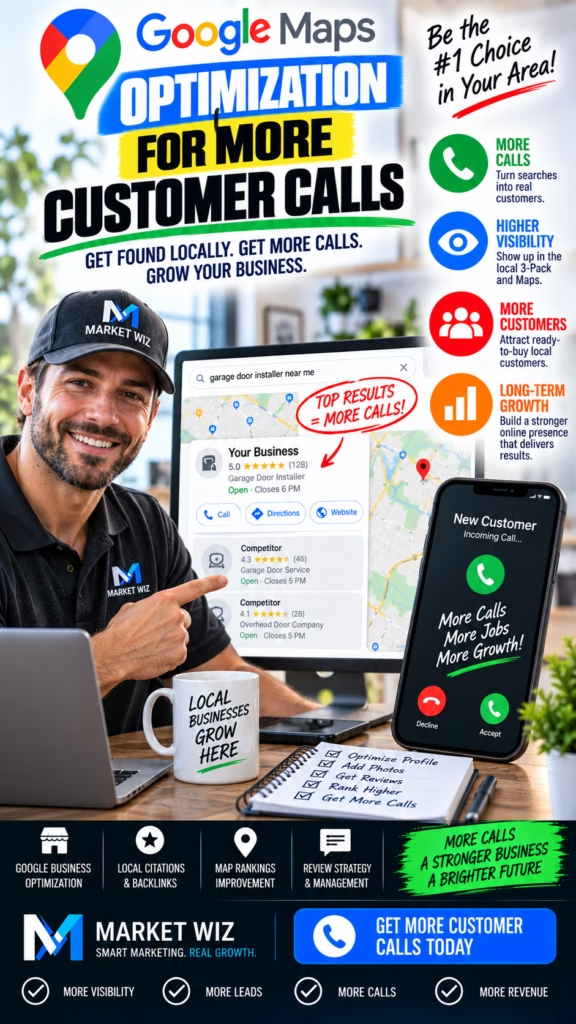
Google Maps Optimization for More Customer Calls
Local customers often turn to Google when they need a nearby business, product, contractor, professional, or solution. A structured Google Maps optimization strategy can help your business strengthen local visibility, build trust, capture high-intent searches, and turn more of that visibility into qualified customer phone calls.
Why Google Maps Optimization Matters for Customer Calls
For many local businesses, the phone call is still one of the most valuable customer actions. A homeowner looking for a contractor, a driver searching for an automotive business, a property owner looking for repairs, or a customer searching for a nearby store may want to speak with someone before making a decision.
Google Maps can become an important connection point between those customers and local businesses.
When someone performs a location-oriented search, Google may display nearby businesses alongside information that helps the customer decide where to call. This can include business names, categories, reviews, photos, hours, websites, contact information, and other profile details.
That means Google Maps optimization is not simply about trying to move a listing higher on a screen. The larger objective is to create a complete local search presence that helps the right customers discover the business, trust what they see, and take action.
More local visibility becomes valuable when it produces real customer action. The strongest Google Maps strategy connects search visibility with calls, inquiries, appointments, estimates, purchases, and measurable revenue.
Understand the Search Intent Behind Customer Calls
Not every Google search has the same commercial value. Some people are gathering general information. Others are comparing options. Some are ready to contact a local business immediately.
Google Maps optimization should focus heavily on searches that align with the products, services, and geographic markets a business actually serves.
High-intent local searches often include themes such as:
- Businesses near me
- Contractors near me
- Local companies in a specific industry
- Product or service plus city name
- Repair companies near me
- Installation companies near me
- Emergency or urgent local solutions
- Best local company for a specific need
- Nearby stores or providers
- Companies open now
These searches can represent customers who are already relatively far into the buying process. Building visibility around relevant local intent can therefore create meaningful customer acquisition opportunities.
Build a Complete Google Business Profile
A Google Business Profile can act as a digital storefront inside Google Search and Maps. Customers may use it to evaluate a business before they ever visit the company website.
Businesses should make sure their profile accurately reflects their real-world operations. Important information should remain current, especially details customers depend on when deciding whether to call.
Important profile information can include:
- Accurate business name
- Appropriate primary category
- Relevant additional categories when applicable
- Correct phone number
- Website address
- Business hours
- Business description
- Accurate location or operating information
- Photos
- Customer reviews
- Other relevant profile features
A complete profile can reduce friction because customers have access to important information without having to search across multiple websites.
Select Accurate Google Business Profile Categories
Categories help describe what a business actually does. They should accurately represent the company's primary operation and legitimate secondary offerings.
Businesses should avoid choosing unrelated categories simply because those categories appear attractive from a keyword perspective.
Keep categories aligned with the real business
A roofing company should be represented as a roofing business. A furniture store should use categories appropriate to furniture retail. An HVAC contractor should select categories relevant to the work the company genuinely performs.
Accurate categorization creates a stronger foundation for the entire local search campaign.
Write a Clear Local Business Description
The business description gives customers another opportunity to understand what the company provides.
The description should communicate the company's primary offerings, customer focus, and relevant expertise naturally. It should not read like a long list of repeated keywords.
Focus on customer clarity
Someone discovering the business for the first time should be able to quickly understand what the company does and whether it may be relevant to their needs.
Search optimization and customer communication should support each other rather than compete with each other.
Make the Business Phone Number Easy to Find
If generating phone inquiries is a major business objective, customers should not have to work hard to find the correct phone number.
The number associated with the company's local presence should be accurate and actively managed. The website should also make phone contact easy, particularly for mobile users.
Reduce friction between discovery and contact
Every additional obstacle between a prospective customer and the business creates another opportunity for that customer to leave.
Clear contact information helps turn local visibility into an actual customer conversation.
Build a Local Keyword Strategy Around Customer Demand
Keyword research helps businesses understand what potential customers search for when they need a local product or service.
Instead of focusing on one broad phrase, businesses can organize keywords around multiple forms of customer intent.
Useful keyword groups can include:
- Primary product or service keywords
- Business category keywords
- Problem-oriented searches
- Installation searches
- Repair searches
- Replacement searches
- Purchase-oriented searches
- Near-me searches
- City-modified searches
- Neighborhood or regional searches
The specific keyword strategy should reflect the company's actual offerings and customer base.
Strengthen Visibility for Near-Me Searches
Near-me searches are an important part of local customer behavior. People often want a business that can realistically serve them rather than a company located hundreds of miles away.
However, businesses should not treat near-me optimization as a matter of repeatedly inserting the phrase near me throughout their website.
The stronger approach is to develop genuine local relevance through accurate business information, useful local content, customer reputation, website optimization, citations, and other legitimate signals.
Optimize for the customer who is nearby, not simply the words "near me." Local relevance is built through the complete relationship between the business, its market, website, reputation, profile, and customers.
Strengthen the Website Connected to Google Maps
A local listing can introduce the company, but the website gives the business more room to explain why a prospective customer should make contact.
The website should clearly communicate what the company offers, where it operates, and how customers can take the next step.
Important local business website elements can include:
- Clear homepage positioning
- Detailed product or service pages
- Location or operating-area information
- Authentic business photography
- Customer reviews or testimonials when appropriate
- Company background information
- Frequently asked questions
- Clear contact information
- Mobile-friendly layouts
- Strong website performance
Create Dedicated Pages for Important Products and Services
A company offering several distinct solutions may benefit from dedicated website pages for its most important products or services.
This creates more relevant destinations for prospective customers and gives the business room to explain each offering in detail.
Each page should answer customer questions
Strong pages explain what is offered, who the solution is for, what customers should consider, and how to contact the business.
Avoid creating dozens of nearly identical pages that provide little unique information.
Create Useful Location Pages for Real Markets
Businesses serving multiple cities may create location-focused content for important markets.
These pages should correspond to places the business genuinely serves and should provide meaningful information for customers in those areas.
Useful local page elements can include:
- Products or services available in the market
- Local customer considerations
- Relevant project examples
- Frequently asked questions
- Nearby areas served
- Clear company contact information
High-quality local content is more valuable than mass-producing thin pages that differ only by city name.
Improve On-Page SEO for Local Searches
Important website pages should clearly communicate their primary topic. Descriptive titles, headings, body content, internal links, image information, and metadata can all contribute to that clarity.
Local terminology can be used naturally when geography is genuinely relevant to the page.
Avoid unnatural keyword repetition
Search optimization should not make the page difficult to read. Customers need useful information, not paragraphs filled with repeated city names and search phrases.
The strongest content serves the visitor first while remaining clear about its subject.
Build a Consistent Google Review Strategy
Customer reviews can become an important part of the local buying process. Prospective customers often want evidence that other people have worked with the business successfully.
Businesses can create a consistent process for requesting honest feedback from genuine customers after appropriate interactions or completed work.
Focus on authentic customer experiences
The goal should be to make it easier for real customers to share real experiences, not to manufacture artificial reputation signals.
Review collection practices should follow applicable platform requirements.
Respond to Reviews With Future Customers in Mind
A review response is visible not only to the original reviewer but also to people researching the business later.
Professional responses can show that the company pays attention to customer feedback.
Positive feedback can receive concise appreciation. More difficult feedback can be addressed professionally without exposing private information or turning the response into an argument.
Use Authentic Photos to Build Local Trust
Photos can help customers understand whether a business appears active, established, professional, and relevant to what they need.
The best imagery depends on the industry. A contractor may showcase completed projects. A furniture retailer may show products and showroom displays. An automotive company may feature inventory and facilities.
Potential business photos include:
- Completed projects
- Products
- Before-and-after work
- Team members
- Company vehicles
- Equipment
- Storefront or office
- Showroom
- Real customer environments when appropriate
Authentic images can strengthen the connection between online discovery and the real-world business.
Maintain Accurate Local Business Citations
Local citations are references to a business across relevant online directories, mapping systems, business resources, and industry platforms.
Businesses should prioritize accuracy and legitimate sources rather than simply creating the largest possible number of directory listings.
Review core business information
Business names, addresses when applicable, phone numbers, and website URLs should be reviewed for inconsistencies.
Old phone numbers or outdated information can create customer confusion and should be corrected where practical.
Build Local Website Authority
Local visibility can also be supported by the broader authority of the company website.
Relevant and legitimate links from other websites can introduce the company to additional audiences and contribute to the site's organic search presence.
Potential authority-building opportunities include:
- Local organizations
- Industry associations
- Business partnerships
- Supplier relationships
- Community involvement
- Local sponsorships
- Useful editorial resources
- Relevant business directories
Authority should be built through legitimate business relationships and useful content rather than low-quality link schemes.
Optimize the Website for Mobile Customer Calls
Many local searches happen on smartphones. That makes mobile usability especially important when phone calls are a major conversion goal.
Customers should be able to understand the company, browse important pages, and locate contact information without fighting with tiny text, broken menus, overlapping elements, or slow pages.
Mobile visitors should have a clear path to action
A well-designed mobile experience reduces the distance between local search discovery and customer contact.
Strengthen Technical SEO and Website Performance
Local search marketing works better when it is supported by a technically sound website.
Search engines should be able to access important pages, while customers should be able to navigate the site without unnecessary friction.
Technical priorities can include:
- Mobile-responsive layouts
- Reasonable loading performance
- Secure HTTPS connections
- Logical website structure
- Working internal links
- Search-friendly URLs
- Proper indexing controls
- Useful structured data when appropriate
- Optimized image delivery
- Clear navigation
Create Local Content That Answers Customer Questions
Prospective customers do not always begin with a direct search for a company. Many begin by researching a problem, product, price range, project, or decision.
Helpful content allows a local business to participate earlier in that customer journey.
Content can address topics such as:
- Common customer problems
- Product comparisons
- Repair versus replacement decisions
- Installation considerations
- Frequently asked questions
- Seasonal concerns
- Maintenance information
- Local buying considerations
- Project preparation
- How to choose the right provider
Useful educational content can strengthen the website while helping customers make better-informed decisions.
Expand Google Maps Visibility Across Legitimate Markets
Many businesses serve multiple communities rather than operating only within one city.
Local SEO can support broader market visibility through useful website content, customer relationships, local references, projects, reviews, and other legitimate signals.
However, businesses should remain accurate about where and how they operate.
Geographic SEO should reflect geographic reality. Build visibility in markets the company genuinely serves instead of creating artificial local signals for places unrelated to the actual business.
Turn Google Maps Visibility Into Customer Calls
Getting discovered does not guarantee that a customer will call. The information customers encounter after discovery influences whether they continue toward contact.
A business should therefore think about its local search presence as a conversion path.
A prospective customer may evaluate:
- Whether the business appears relevant
- Whether the company serves their area
- Whether reviews create confidence
- Whether photos appear authentic
- Whether the website looks professional
- Whether the company explains its offerings clearly
- Whether the phone number is easy to find
- Whether the business appears available and active
Optimization should improve this entire journey rather than focusing exclusively on search position.
Improve the Customer Experience After the Phone Rings
Local SEO creates opportunities, but the business still needs an effective process for handling those opportunities.
A missed call, confusing conversation, or slow follow-up can reduce the value of an otherwise successful marketing campaign.
Create an organized lead-handling process
Businesses can define how incoming calls are answered, how customer needs are documented, how appointments or estimates are scheduled, and how prospects are followed up with when a sale does not happen immediately.
The marketing and sales process should work together.
Track the Customer Calls Generated by Local Search
Businesses should measure whether Google Maps visibility is producing meaningful customer activity.
Rankings and impressions can provide useful context, but customer acquisition metrics show whether visibility is translating into business results.
Useful metrics can include:
- Local keyword visibility
- Organic website traffic
- Google Business Profile interactions
- Phone inquiries
- Website forms
- Qualified leads
- Appointments
- Estimates
- Sales
- Revenue
Measure Call Quality, Not Just Call Volume
More calls do not automatically mean better marketing. A business can receive a high volume of irrelevant inquiries that consume staff time without creating revenue.
Local SEO should therefore be evaluated partly by the quality of the customer conversations it creates.
Useful call-quality questions include:
- Was the caller looking for something the company provides?
- Was the caller located in an area the company serves?
- Did the inquiry become an appointment?
- Did the company provide an estimate?
- Did the prospect become a customer?
- What revenue resulted from the lead?
This connects local SEO to actual business performance.
Monitor Local Search Visibility by Market
Google Maps visibility can vary based on geography. A business may have strong visibility close to its core location while appearing differently in surrounding areas.
Local rank monitoring can help identify these geographic patterns.
Evaluate groups of searches instead of one keyword
A business usually serves customers through multiple products, services, and search themes. Performance should therefore be evaluated across meaningful groups rather than one isolated phrase.
Continuously Improve Google Maps Performance
Google Maps optimization is an ongoing process. Business information changes, new reviews appear, websites evolve, competitors improve, and customer search behavior shifts.
Companies should periodically review their local presence and identify areas that need improvement.
An ongoing optimization process can include:
- Review business profile accuracy.
- Check relevant categories.
- Review operating information.
- Add useful authentic photos.
- Request genuine customer reviews.
- Respond appropriately to feedback.
- Improve website pages.
- Publish useful local content.
- Review citation consistency.
- Build legitimate authority.
- Track customer calls and leads.
- Use performance data to guide future improvements.
Combine Google Maps With a Multi-Channel Marketing Strategy
Google Maps can be powerful because it reaches customers who are actively searching, but local businesses can create additional discovery opportunities through other marketing channels.
Organic website SEO can reach broader searches. Social media can showcase products and completed projects. Video can demonstrate expertise. Paid campaigns can provide additional reach. Appropriate local listing and advertising platforms can connect the business with other audiences.
The objective is not necessarily to make every channel perform the same job. Each channel can support a different stage of customer discovery and conversion.
Common Google Maps Optimization Mistakes
Businesses sometimes focus on isolated ranking tactics while ignoring the larger customer experience.
Common mistakes include:
- Incomplete business information
- Outdated phone numbers
- Incorrect business hours
- Using irrelevant categories
- Ignoring customer reviews
- Using weak or outdated photos
- Inconsistent business citations
- Thin website content
- Mass-produced low-value location pages
- Keyword stuffing
- Ignoring mobile visitors
- Slow or poorly functioning websites
- Tracking rankings without tracking leads
- Failing to answer customer calls effectively
- Making optimization a one-time project
Build a Repeatable Google Maps Customer Call System
The strongest strategy combines local visibility, trust, conversion, call handling, and measurement into one repeatable process.
A practical system can follow this sequence:
- Maintain an accurate Google Business Profile.
- Identify valuable local customer searches.
- Optimize important website pages.
- Develop useful service and product content.
- Create legitimate local content.
- Publish authentic business photography.
- Build a consistent customer review process.
- Maintain citation accuracy.
- Develop legitimate local authority.
- Make phone contact easy.
- Respond to calls efficiently.
- Track qualified leads and sales.
- Use performance data to improve the campaign.
This approach turns Google Maps optimization from a collection of SEO tasks into a structured customer acquisition process.
Turn Local Search Visibility Into Long-Term Business Growth
One of the advantages of a well-developed local search presence is that many of its components can continue creating value over time.
Useful website pages remain available to future customers. Authentic reviews can strengthen reputation. Project photos can demonstrate experience. Helpful articles can answer questions long after they are published. Legitimate local references can strengthen the broader digital presence.
As these assets accumulate, the business can build a stronger local marketing foundation.
Performance data can also reveal which products, services, markets, and customer searches produce the strongest opportunities. Those insights can guide future SEO, content, sales, geographic expansion, and marketing decisions.
Frequently Asked Questions About Google Maps Optimization for More Customer Calls
1. What is Google Maps optimization?
Google Maps optimization is the process of improving a local business's presence across Google Maps and related local search results through accurate business information, Google Business Profile optimization, website SEO, reviews, citations, photos, and other legitimate local search signals.
2. Can Google Maps optimization generate more customer calls?
It can increase opportunities for calls by helping relevant customers discover a business when they are searching locally for the products or services it provides.
3. Why do customers call businesses from Google Maps?
Customers can use Maps to quickly identify nearby businesses, evaluate reviews and photos, check hours, visit websites, and locate contact information.
4. What is a Google Business Profile?
It is the business listing that can display company information such as name, category, phone number, website, hours, reviews, photos, and other details across Google Search and Maps.
5. What information should be included in a Google Business Profile?
Businesses should provide accurate information relevant to their operations, including the correct business name, appropriate categories, phone number, website, hours, description, and other applicable profile details.
6. Do Google reviews help generate customer calls?
Reviews can influence how prospective customers evaluate a company and may help customers decide whether they want to make contact.
7. Should businesses respond to Google reviews?
Professional responses can demonstrate customer engagement and provide useful context for people researching the company.
8. Do photos matter for Google Maps optimization?
Authentic photos can help prospective customers understand the company's products, projects, team, location, equipment, and real-world operation.
9. What are local SEO keywords?
Local SEO keywords are search themes associated with products, services, businesses, and geographic intent that local customers may use while searching.
10. Should businesses target near-me searches?
Businesses can strengthen overall local relevance for nearby customers rather than relying on repetitive use of the literal phrase near me.
11. Does a website help Google Maps optimization?
A strong website can support local search by providing detailed information about the company, its products or services, operating areas, expertise, and customer contact options.
12. What are local citations?
Local citations are online references to a business that can include its name, address when applicable, phone number, website, and other identifying business information.
13. Why is business information consistency important?
Consistent information reduces customer confusion and supports a more accurate digital presence across local websites, directories, maps, and other platforms.
14. Can location pages improve local SEO?
Useful location pages can support legitimate operating markets when each page provides meaningful information specific to customers in that area.
15. Should businesses create separate service pages?
Dedicated pages can help customers and search engines understand distinct products or services when each page contains genuinely useful information.
16. Can blog content support Google Maps SEO?
Helpful educational content can answer customer questions and strengthen the overall usefulness and topical depth of the company website.
17. Do backlinks help local SEO?
Relevant and legitimate backlinks can contribute to broader website authority and organic search visibility.
18. What is the Google local pack?
The local pack is a prominent search result format that can display nearby businesses and map information for searches with local intent.
19. How long does Google Maps optimization take?
There is no universal timeline. Results vary based on competition, geography, existing authority, website quality, profile condition, reputation, and ongoing optimization.
20. Can businesses improve Google Maps visibility in multiple cities?
Businesses can strengthen their local presence across legitimate operating areas through useful local content, accurate information, customer reputation, and broader local SEO work.
21. Should Google Maps performance be tracked?
Yes. Tracking helps determine whether local visibility is contributing to meaningful business outcomes such as calls, inquiries, appointments, sales, and revenue.
22. What metrics should a local business track?
Useful metrics can include local search visibility, website traffic, profile interactions, calls, forms, qualified leads, appointments, sales, and revenue.
23. Why is call tracking important?
Call tracking can help a business understand which marketing activities generate phone inquiries and whether those inquiries contribute to customer acquisition.
24. Does mobile optimization affect local customer acquisition?
A mobile-friendly website makes it easier for smartphone users to understand the company and contact it after discovering the business through local search.
25. Does page speed matter for local SEO?
Website performance affects customer experience and is one component of maintaining a technically strong website for organic and local search.
26. Can Google Maps SEO work with paid advertising?
Yes. Organic local visibility and paid advertising can function as different components of a broader customer acquisition strategy.
27. Can Google Maps optimization work for service businesses?
Local search can be particularly relevant for businesses serving customers within specific cities, neighborhoods, regions, or operating areas.
28. What is a common Google Maps optimization mistake?
Common mistakes include incomplete information, inaccurate categories, weak website content, inconsistent citations, neglected reviews, outdated profile details, and focusing on rankings without measuring customer outcomes.
29. Should a business optimize Google Maps once or continuously?
Local SEO is generally an ongoing process involving profile maintenance, website improvements, content, reviews, citations, authority building, tracking, and continued optimization.
30. What is the goal of Google Maps optimization?
The goal is to strengthen relevant local visibility and turn that visibility into meaningful outcomes such as qualified customer calls, inquiries, appointments, sales, and long-term customer acquisition.
30 Additional SEO Keywords for Google Maps Optimization
Related keyword themes businesses can consider when developing a comprehensive local search and customer call strategy include:
Build a Google Maps Strategy That Produces More Customer Calls
Google Maps optimization is most effective when businesses look beyond rankings and focus on the entire path between local search and customer acquisition.
An accurate Google Business Profile gives customers essential company information. Appropriate categories clarify what the business does. Authentic reviews and photos can strengthen customer confidence. A useful website gives prospects deeper information about products, services, markets, expertise, and the next step.
Local keyword research can reveal what customers are searching for. Dedicated service and product pages can create stronger destinations for high-intent searches. Useful location content can support legitimate operating areas. Citations and relevant authority signals can strengthen the company's broader digital presence.
Mobile optimization and clear contact information can then reduce the friction between discovery and the phone call.
Finally, businesses should measure what happens after the call arrives. Qualified inquiries, appointments, estimates, sales, and revenue provide a clearer picture of marketing effectiveness than rankings alone.
By combining visibility, reputation, website quality, conversion, customer response, and ongoing measurement, local businesses can turn Google Maps into a more structured and sustainable customer acquisition channel.
Want More Customer Calls From Google Maps?
Market Wiz AI helps local businesses build scalable Google Maps and local SEO strategies designed to strengthen search visibility, expand keyword reach, improve customer discovery, and turn local search activity into more qualified business opportunities.
Get Started With Market Wiz AI© Market Wiz AI. Google, Google Maps, and Google Business Profile are trademarks of their respective owner. Market Wiz AI is not affiliated with or endorsed by Google.













