

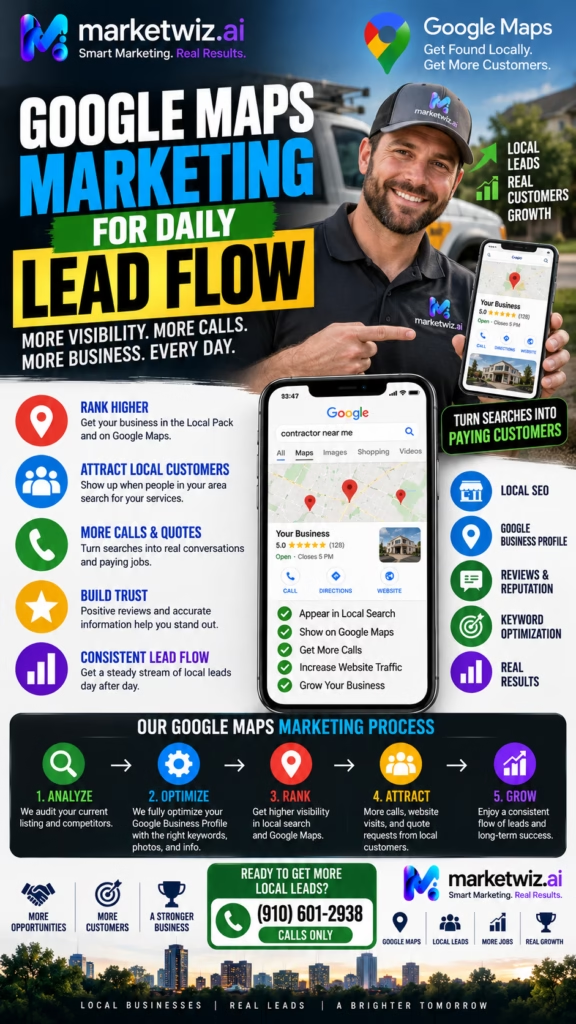
Google Maps Marketing for Daily Lead Flow
Local businesses do not simply need visibility. They need a repeatable system that turns local search demand into calls, inquiries, appointments, estimates, sales opportunities, and customers. Google Maps marketing can become a powerful part of that system when Google Business Profile optimization, local SEO, reputation, website conversion, lead response, CRM tracking, and automation work together.
Most local businesses do not want marketing that produces one good week followed by two quiet weeks. They want a pipeline that stays active. They want people calling, visiting, requesting estimates, asking about inventory, booking appointments, and moving into the sales process on a consistent basis.
Google Maps marketing can help support that objective because it captures a particularly valuable type of customer behavior: people actively searching for businesses near them.
A homeowner searching for an HVAC company is probably not casually browsing.
A customer searching for a mattress store may already be comparing purchase options.
A property owner searching for a paving contractor may already have a project developing.
A buyer searching for an RV dealership may be ready to investigate inventory.
That is why local search can be such a valuable customer acquisition channel.
The customer often arrives with existing intent.
Your job is to become visible, establish trust, make the next step simple, respond quickly, and track what happens after the inquiry arrives.
1. Define the Lead Flow Your Business Actually Needs
Before trying to generate more local leads, determine what "more" means.
A company with a $500 average transaction and a company with a $50,000 average project do not need the same lead volume.
Lead goals should consider:
- average transaction value,
- average gross profit,
- sales close rate,
- current operational capacity,
- available sales staff,
- desired monthly revenue,
- seasonality,
- target customer type.
For example, if a company wants ten additional closed customers per month and closes approximately one out of every four qualified opportunities, the company may need roughly forty qualified opportunities to reach that goal.
That creates a much better marketing target than simply saying:
"We want more calls."
Qualified Lead Flow Is the Real Goal
A company can receive large numbers of inquiries and still have weak marketing results if most inquiries are:
- outside the service area,
- requesting services the company does not provide,
- outside the target customer type,
- poor economic fits,
- spam or irrelevant contacts.
Google Maps marketing should therefore be designed around qualified demand.
2. Understand Why Local Search Intent Is So Valuable
Some advertising channels create demand.
Google local search often captures demand that already exists.
That is an important distinction.
Someone scrolling through entertainment content may not currently be shopping for a roof.
Someone typing:
"roof replacement company near me"
is giving a much stronger commercial signal.
The same principle applies across many industries.
Home Services
Customers search when plumbing, HVAC, roofing, painting, flooring, fencing, paving, or other property needs arise.
Retail
Customers search for nearby mattresses, appliances, furniture, flooring, jewelry, and other products.
Automotive
Buyers search for vehicles, trucks, RVs, dealerships, repairs, and specialty inventory.
Professional Services
Customers search for attorneys, accountants, healthcare providers, real estate professionals, and other local specialists.
Google Maps marketing positions the company closer to these moments of customer intent.
3. Map the Entire Local Customer Search Journey
Lead generation does not begin and end with a ranking.
The customer goes through a sequence.
A typical journey may look like:
- The customer realizes they have a need.
- They search Google.
- They see local businesses.
- They compare profiles.
- They look at reviews.
- They examine photos.
- They read service information.
- They visit websites.
- They call or submit an inquiry.
- They compare responses.
- They choose a business.
Every stage creates an opportunity to either win or lose the customer.
4. Build a Complete Google Business Profile
The Google Business Profile is one of the central assets in a local search strategy.
A complete profile can help prospective customers quickly determine:
- what the business does,
- where it operates,
- when it is open,
- what customers think,
- what services or products are available,
- how to contact the company.
Important profile information can include:
- business name,
- primary category,
- secondary categories,
- phone number,
- website,
- hours,
- address or service-area information where applicable,
- business description,
- services,
- photos,
- other legitimate profile attributes.
Completeness should always be combined with accuracy.
Do not add information simply because it might contain a keyword.
5. Choose Categories That Match Real Customer Demand
Categories help communicate what type of business Google and customers are evaluating.
The primary category should generally represent the company's main business activity.
Secondary categories can help describe other legitimate offerings.
A category strategy should answer two questions:
- Does this category accurately represent the business?
- Does it connect the business with customers searching for a service the company genuinely provides?
If the answer to either question is no, the category may not belong on the profile.
Avoid Category Inflation
Businesses sometimes add every category remotely connected to their industry.
That can make the profile less focused.
More categories do not automatically equal more quality leads.
The objective is relevant visibility.
6. Build the Profile Around High-Value Services
If a company wants leads for a particular service, customers need clear evidence that the company actually provides it.
That evidence should exist across:
- Google Business Profile,
- website service pages,
- project examples,
- reviews where naturally mentioned,
- local content.
For example, a painting company may legitimately provide:
- interior painting,
- exterior painting,
- cabinet painting,
- commercial painting,
- deck painting,
- fence painting.
A flooring business may offer:
- luxury vinyl plank,
- laminate,
- engineered hardwood,
- commercial flooring materials,
- other genuine flooring categories.
Specificity helps customers understand what the company can actually provide.
7. Write a Business Description That Supports Conversion
The business description should help prospects understand the company quickly.
A strong description may explain:
- the primary business category,
- major services or products,
- customer types served,
- general geographic coverage,
- legitimate differentiators.
Avoid turning the description into an unnatural block of repeated keywords.
The best local SEO copy still needs to make sense to a human reader.
Clarity Improves Lead Quality
If the description clearly communicates what the company does, customers can qualify themselves before contacting the business.
That can reduce:
- irrelevant calls,
- service-area mismatches,
- requests for unavailable services,
- sales-team friction.
8. Use Photos as Sales Proof
Photos should not be treated only as profile decoration.
They are part of the sales presentation.
A prospect can often learn more from ten strong images than from several paragraphs of marketing language.
Contractor Photo Ideas
- before-and-after transformations,
- finished projects,
- work in progress,
- equipment,
- crew photos,
- project details.
Retail Photo Ideas
- showroom,
- inventory examples,
- product displays,
- store exterior,
- interior layout.
Dealer Photo Ideas
- inventory,
- lot presentation,
- vehicle details,
- service department,
- customer delivery moments where appropriate.
Use authentic imagery.
Customers should not discover that the impressive project or showroom they saw online does not belong to the business.
9. Turn Reviews Into an Ongoing Lead-Generation Asset
Reviews influence trust at a critical point in the buying process.
A customer may see several businesses with similar services.
Reviews help answer:
- Do people trust this company?
- Do customers describe good experiences?
- Is feedback recent?
- Does the company respond?
- Are there patterns in customer satisfaction?
Businesses should create a legitimate review workflow that fits naturally into the customer journey.
For example:
Complete the Customer Experience
Deliver the product, complete the project, or finish the service interaction.
Request Genuine Feedback
Ask real customers to share their experience without fabricating or manipulating feedback.
Respond Professionally
Acknowledge customer feedback and maintain a visible pattern of professional engagement.
10. Treat Review Responses Like Public Sales Communication
Review responses are visible to future customers.
That means the business is not only replying to the person who wrote the review.
It is also communicating with every future prospect who reads it.
Strong responses can demonstrate:
- professionalism,
- customer appreciation,
- attention to feedback,
- communication quality.
Negative feedback should be handled calmly.
Avoid public arguments.
A professional response can sometimes strengthen trust even when the original review is critical.
11. Make the Website the Second Half of Google Maps Marketing
Many local customers do not contact a business directly from the map result.
They click the website first.
This creates another evaluation stage.
A strong website should make it easy to understand:
- what the business provides,
- which customers it serves,
- where it operates,
- why it is credible,
- how to contact it.
Important website elements can include:
- clear service pages,
- location or service-area pages,
- authentic photos,
- reviews,
- project examples,
- mobile optimization,
- fast loading,
- clear contact paths.
12. Build Service Pages Around Customer Intent
Major revenue-producing services deserve more than one sentence on a generic services page.
A dedicated service page can explain:
- what the service is,
- common reasons customers need it,
- how the process works,
- who the service is for,
- relevant project examples,
- frequently asked questions,
- related services,
- next steps.
This creates stronger content for both users and search engines.
Match Pages to High-Value Search Themes
If a roofing company earns most of its revenue from:
- roof replacement,
- commercial roofing,
- storm damage repair,
those services may deserve particularly strong pages.
Marketing resources should follow business economics.
13. Build Location Pages for Legitimate Service Markets
Businesses serving multiple cities often want more geographic search coverage.
Useful location pages can support that strategy.
A strong local page can include:
- services available in the area,
- local project examples,
- customer questions,
- nearby service coverage,
- local testimonials where appropriate,
- relevant market information.
Avoid creating hundreds of nearly identical pages.
Changing only the city name does not create strong local content.
Each page should have a reason to exist.
14. Keep Local Citations Accurate
Citations are references to a business across directories, maps platforms, associations, industry sites, and other relevant online properties.
A citation strategy should prioritize:
- accuracy,
- quality,
- relevance,
- consistency.
Periodically review:
- business name,
- phone number,
- website,
- address where applicable,
- hours,
- duplicate listings.
An old phone number can directly cost leads.
An old address can create customer frustration.
Local SEO fundamentals often have direct business consequences.
15. Expand Lead Flow With High-Intent Keyword Coverage
A business should understand the range of searches customers use.
Keyword groups can include:
Business-Type Searches
- painting company,
- HVAC company,
- fence contractor,
- flooring store,
- used RV dealer.
Service Searches
- cabinet painting,
- AC repair,
- privacy fence installation,
- commercial flooring,
- RV service.
Problem Searches
- AC not cooling,
- roof leaking,
- cracked driveway,
- damaged fence,
- old flooring replacement.
Geographic Searches
- city names,
- neighborhoods,
- regional terms,
- near-me searches.
The goal is not to stuff these terms into one page.
Build a logical content structure around real customer intent.
16. Publish Content That Creates More Entry Points
Google Maps marketing and organic local SEO can reinforce each other.
Educational content can attract customers who are still researching.
Useful topics can include:
- service cost factors,
- repair versus replacement,
- how to choose a contractor,
- product comparisons,
- maintenance guidance,
- project timelines,
- common customer problems,
- local considerations.
A customer who discovers the business through informational content today may become a high-intent prospect later.
17. Use Google Business Profile Posts to Reinforce Activity
Google Business Profile posts can communicate recent and relevant information.
Possible topics include:
- new projects,
- service highlights,
- new products,
- recent inventory,
- seasonal reminders,
- customer education,
- company updates.
A real completed job can often generate multiple marketing assets:
- Google Business Profile post,
- website project example,
- Facebook post,
- Instagram content,
- short-form video,
- review request opportunity.
This helps businesses create more marketing value from work they are already doing.
18. Track Visibility Across the Entire Service Area
One ranking position does not tell the full story.
Local search results can vary substantially based on where the customer is located.
A company may perform strongly near one part of a city and weakly in another.
Geographic rank tracking can help identify:
- strong visibility zones,
- weak visibility zones,
- competitive areas,
- service-area opportunities,
- search terms requiring more work.
This provides a more useful picture than checking one keyword from one computer.
19. Optimize Google Maps Traffic for Conversion
More visibility is valuable only when it creates action.
Prospects may compare several businesses simultaneously.
They may examine:
- ratings,
- review quality,
- photos,
- services,
- website quality,
- professional presentation.
Ask:
"Why should the customer contact us instead of the next business in the map results?"
Possible conversion improvements include:
- better project photos,
- stronger service explanations,
- more recent genuine reviews,
- better website design,
- clearer contact information,
- stronger proof of expertise.
20. Respond Quickly When Google Maps Generates a Lead
The customer's search intent may be strongest immediately after they submit an inquiry.
Waiting too long creates risk.
The prospect may already be contacting competing businesses.
A good first-response process can:
- acknowledge the inquiry,
- identify the requested service,
- confirm the location,
- collect necessary information,
- route the lead appropriately,
- move toward an appointment or next step.
Speed should not come at the expense of professionalism.
A fast but confusing response can still lose the prospect.
21. Qualify Leads Efficiently
A strong lead system separates genuine opportunities from poor fits without creating unnecessary friction.
A contractor may need to know:
- customer location,
- service needed,
- property type,
- project timeline,
- project scope.
A retailer may need:
- product type,
- size,
- budget range,
- availability needs,
- delivery requirements.
Commercial businesses may require more qualification.
Keep the process proportional to the opportunity.
22. Track Every Local Lead in a CRM
Consistent marketing cannot be managed accurately when leads disappear into personal phones, inboxes, sticky notes, and disconnected spreadsheets.
A CRM can centralize:
- lead name,
- contact information,
- lead source,
- service requested,
- geographic area,
- lead status,
- appointment date,
- proposal or estimate,
- follow-up,
- closed revenue.
This makes Google Maps marketing measurable.
23. Build Follow-Up Into the Lead Flow System
Many customers do not make a decision during the first conversation.
They may be:
- comparing companies,
- waiting for another estimate,
- planning a future project,
- waiting for financing,
- waiting for a business partner or spouse,
- researching multiple options.
Without structured follow-up, valuable leads can disappear.
Follow-up workflows can include:
- appointment reminders,
- estimate follow-up,
- proposal follow-up,
- future-date reminders,
- CRM tasks,
- appropriate automated communication.
The objective is consistent professional follow-up, not overwhelming the prospect.
24. Use AI to Strengthen Local Lead Handling
AI can help businesses reduce the administrative burden associated with larger lead volumes.
Possible applications include:
- lead acknowledgment,
- basic lead qualification,
- lead routing,
- conversation summaries,
- CRM data entry,
- follow-up reminders,
- content drafting,
- review response drafting,
- report generation,
- performance analysis.
AI should operate from verified business information.
It should not invent:
- pricing,
- services,
- locations,
- availability,
- warranties,
- licenses,
- reviews,
- project history.
Automation works best when it improves speed while maintaining accuracy.
25. Track Leads All the Way to Revenue
Ranking reports provide useful marketing information.
Revenue reports provide business information.
Both matter.
A complete funnel can track:
| Stage | Metric | Question Answered |
|---|---|---|
| Visibility | Local search coverage | Are customers finding us? |
| Engagement | Calls and website activity | Are prospects interested? |
| Qualification | Qualified leads | Are we attracting good opportunities? |
| Pipeline | Appointments and estimates | Are leads progressing? |
| Sales | Closed customers | Are opportunities becoming customers? |
| Financial | Revenue and profit | Is the marketing producing business value? |
This helps businesses identify exactly where the funnel needs improvement.
26. Focus on Profitable Lead Quality
Businesses sometimes try to rank for every related search.
That can create unnecessary lead volume without increasing profit.
Marketing should align with the company's ideal customer.
Ask:
- Which services generate the best margin?
- Which locations are most profitable?
- Which customer types close most often?
- Which jobs create repeat or referral business?
- Which services consume too much time for too little profit?
These answers should influence:
- keyword strategy,
- service-page investment,
- local content,
- sales qualification,
- geographic targeting.
27. Analyze Competitors From the Customer's Perspective
Competitor research is more useful when viewed through the eyes of the customer.
Compare:
- profile completeness,
- categories,
- review quality,
- review recency,
- photo quality,
- service descriptions,
- website experience,
- local pages,
- project proof.
Look for opportunities to create a better buying experience.
A competitor may have more reviews but weaker photos.
Another may have strong rankings but poor mobile website performance.
Another may fail to explain important services.
Those weaknesses can become your opportunities.
28. Combine Google Maps With Other Marketing Channels
Google Maps can be a core local lead source without being the only lead source.
Businesses can create stronger customer acquisition systems by combining channels.
Depending on the business, that can include:
- Google Maps,
- organic SEO,
- social media,
- short-form video,
- paid search,
- paid social,
- marketplace marketing where appropriate,
- email follow-up,
- referral campaigns.
Channels can support each other.
A customer might first see a business on social media, later search for the company on Google, read reviews, visit the website, and finally call.
Marketing attribution is rarely as simple as one click.
29. Avoid the Mistakes That Break Daily Lead Flow
Focusing Only on Rankings
A ranking without conversion does not pay the bills.
Using Inaccurate Information
Wrong phone numbers, hours, websites, or addresses can directly lose leads.
Keyword Stuffing the Business Name
Maintain the legitimate real-world business identity.
Adding Irrelevant Categories
Focus on real services and useful customer intent.
Creating Fake Locations
Use legitimate eligible locations and follow current platform requirements.
Fabricating Reviews
Build genuine customer reputation instead.
Ignoring Photos
Customers often need visual proof.
Sending Traffic to a Weak Website
Strong visibility can still produce weak conversion.
Responding Too Slowly
Prospects may quickly move to competitors.
Failing to Follow Up
Many qualified opportunities require multiple interactions.
Ignoring Lead Quality
More inquiries are not necessarily more profitable.
Ignoring Revenue Attribution
Marketing should eventually connect to measurable financial results.
30. Build a 90-Day Google Maps Daily Lead Flow System
A structured plan can help businesses move from scattered optimization tasks to a more complete local customer acquisition system.
Days 1–30: Build the Foundation
Audit the Google Business Profile
Review business information, categories, services, website, phone number, hours, location or service-area settings, business description, photos, and reviews.
Map Customer Search Intent
Identify the most important business-type, service, problem, product, and geographic search themes.
Audit the Website
Review service pages, local pages, mobile usability, loading speed, contact paths, reviews, project proof, and content gaps.
Build Lead Tracking
Set up a CRM or structured system to track source, service, location, qualification, appointment status, estimates, sales, and revenue.
Create a Review Workflow
Build a consistent process for requesting genuine feedback from real customers after successful interactions.
Days 31–60: Expand Visibility
- Improve high-value service pages.
- Create useful location pages.
- Publish authentic business photos.
- Create recent project content.
- Improve review-response consistency.
- Clean up local citations.
- Create relevant educational content.
- Improve internal linking.
- Measure geographic search visibility.
- Analyze important competitors.
Days 61–90: Improve Conversion and Follow-Up
- Improve first-response speed.
- Create lead qualification rules.
- Connect leads to the CRM.
- Build estimate and appointment follow-up.
- Track qualified leads.
- Track appointments.
- Track close rates.
- Track revenue by service.
- Track revenue by geography.
- Use AI to reduce repetitive work.
- Focus future optimization on the services and markets producing the strongest business outcomes.
Final Thoughts: Build a Local Lead Engine, Not Just a Google Maps Listing
Google Maps marketing can be much more than profile management.
For a local business, it can become part of a complete customer acquisition system.
The customer searches.
The business appears.
The customer evaluates reviews and photos.
They visit the website.
They call or submit an inquiry.
The business responds.
The lead enters the sales process.
The customer buys.
The customer leaves a genuine review.
That review strengthens the company's reputation for future prospects.
This creates a reinforcing marketing cycle.
The strongest systems combine:
- Google Business Profile optimization,
- Google Maps SEO,
- local keyword strategy,
- service pages,
- location pages,
- review generation,
- reputation management,
- authentic business photos,
- local content,
- citation accuracy,
- lead response,
- CRM integration,
- follow-up workflows,
- AI automation,
- revenue tracking.
The goal is not simply to appear on Google Maps.
The goal is to turn local search demand into measurable business growth.
When visibility, trust, conversion, sales processes, and tracking all work together, a Google Business Profile can evolve from a basic online listing into one of the most important assets in a local marketing strategy.
Frequently Asked Questions About Google Maps Marketing for Daily Lead Flow
1. What is Google Maps marketing for daily lead flow?
It is a local customer acquisition strategy designed to increase relevant visibility and turn local search demand into calls, website inquiries, appointments, estimates, and qualified sales opportunities.
2. Can Google Maps generate leads every day?
Google Maps can become a consistent source of local inquiries, although actual daily volume depends on market demand, competition, geography, search visibility, reputation, conversion, and sales execution.
3. Why is Google Maps valuable for local lead generation?
Google Maps can connect businesses with customers actively searching for nearby products or services, creating opportunities to capture high-intent local demand.
4. How does Google Business Profile help generate leads?
The profile gives customers quick access to business information, services, reviews, photos, hours, website links, phone numbers, and location or service-area information.
5. What should I optimize first?
Start with accurate profile information, relevant categories, legitimate services, authentic photos, genuine reviews, a strong website, clear conversion paths, and reliable lead tracking.
6. Do Google reviews help increase local leads?
Genuine reviews can strengthen trust and help prospective customers evaluate whether a business appears credible before contacting it.
7. Should businesses respond to reviews?
Yes. Professional review responses demonstrate customer engagement and show prospective customers how the company communicates.
8. Do Google Business Profile photos help conversion?
Authentic images can provide visual proof of products, projects, facilities, inventory, team members, or other legitimate parts of the business.
9. Does a website improve Google Maps lead generation?
Yes. Many prospects visit the website before contacting the company, making service information, reviews, project proof, speed, mobile usability, and clear contact paths important.
10. Should businesses create individual service pages?
Major legitimate services often deserve dedicated pages that answer customer questions and strengthen relevance for specific local searches.
11. Should local businesses create city pages?
Useful location pages can help when a business genuinely serves the area and the content provides meaningful local value rather than merely duplicating another page.
12. What keywords can generate local leads?
Useful keyword themes include business categories, specific services, products, customer problems, city searches, neighborhoods, and other local high-intent queries.
13. Do local citations help Google Maps marketing?
Accurate citations across trustworthy local and industry platforms can support a clearer online business footprint and provide customers with consistent information.
14. Does consistent business information matter?
Yes. Accurate names, phone numbers, websites, hours, and address information where applicable can reduce customer confusion and lost opportunities.
15. Should businesses use Google Business Profile posts?
Posts can highlight recent projects, products, services, company updates, seasonal information, and useful customer education.
16. Can service-area businesses generate Google Maps leads?
Yes. Service-area businesses can build local visibility while following Google's current eligibility and address requirements and strengthening legitimate local relevance.
17. Should businesses create fake locations for additional leads?
No. Businesses should use legitimate eligible locations and follow current Google requirements rather than creating misleading offices, addresses, or profiles.
18. How quickly should local leads receive a response?
Businesses should respond as quickly and professionally as practical because prospects may be comparing several providers at the same time.
19. How does a CRM improve Google Maps lead generation?
A CRM can track lead source, requested service, geography, qualification, appointment status, estimate or proposal value, follow-up, closed sales, and revenue.
20. Should lead follow-up be automated?
Automation can support acknowledgment, reminders, CRM updates, routing, and follow-up when used responsibly with accurate business information and appropriate oversight.
21. How should Google Maps marketing performance be measured?
Track visibility, calls, website inquiries, qualified leads, appointments, estimates, proposals, sales, revenue, conversion rates, and customer acquisition economics where possible.
22. Are rankings enough to measure success?
No. Rankings measure visibility, while qualified leads, appointments, customers, revenue, and profitability provide stronger business-performance metrics.
23. How long does it take to build Google Maps lead flow?
The timeline depends on local competition, search demand, geography, existing visibility, reviews, website authority, content, conversion rate, and optimization consistency.
24. Can AI help manage Google Maps leads?
AI can assist with lead acknowledgment, qualification, CRM routing, follow-up workflows, content planning, review-response drafting, reporting, and analysis when connected to accurate business data.
25. Should Google Maps marketing be combined with social media?
Yes. Social media can reinforce awareness, credibility, project proof, and customer engagement while Google Maps captures active local search demand.
26. Should Google Maps marketing be combined with paid advertising?
Paid advertising can complement local organic marketing by generating additional immediate visibility while longer-term Google Maps and SEO visibility develops.
27. What businesses benefit from Google Maps lead generation?
Contractors, retailers, dealers, healthcare providers, restaurants, professional service companies, home-service businesses, and many other geographically focused companies can benefit.
28. What mistakes reduce Google Maps lead flow?
Common mistakes include inaccurate information, irrelevant categories, fake locations, fake reviews, weak photos, poor websites, thin content, inconsistent citations, slow lead response, weak follow-up, and poor tracking.
29. Can strong Google Maps rankings still produce poor sales?
Yes. Poor reviews, weak websites, unclear services, slow response, ineffective qualification, weak follow-up, or an uncompetitive customer experience can prevent visibility from turning into revenue.
30. What is the best Google Maps marketing strategy for daily lead flow?
A strong strategy combines accurate Google Business Profile optimization, relevant categories and services, authentic reviews and photos, useful websites, service and location pages, citation accuracy, geographic rank tracking, fast response, CRM workflows, follow-up, AI automation, and continuous optimization based on real business results.
30 Additional SEO Keywords
These additional keyword ideas can support future Google Maps marketing articles, local SEO pages, service pages, lead-generation resources, location content, and internal linking strategies.
Build a Stronger Daily Local Lead Engine
MarketWiz.ai combines AI-powered Google Maps optimization, local SEO, lead generation, review workflows, CRM integration, marketing automation, and customer acquisition technology designed to help local businesses improve visibility, generate more qualified opportunities, strengthen follow-up, and turn local search demand into measurable growth.
Call MarketWiz.ai: (910) 601-2938












