

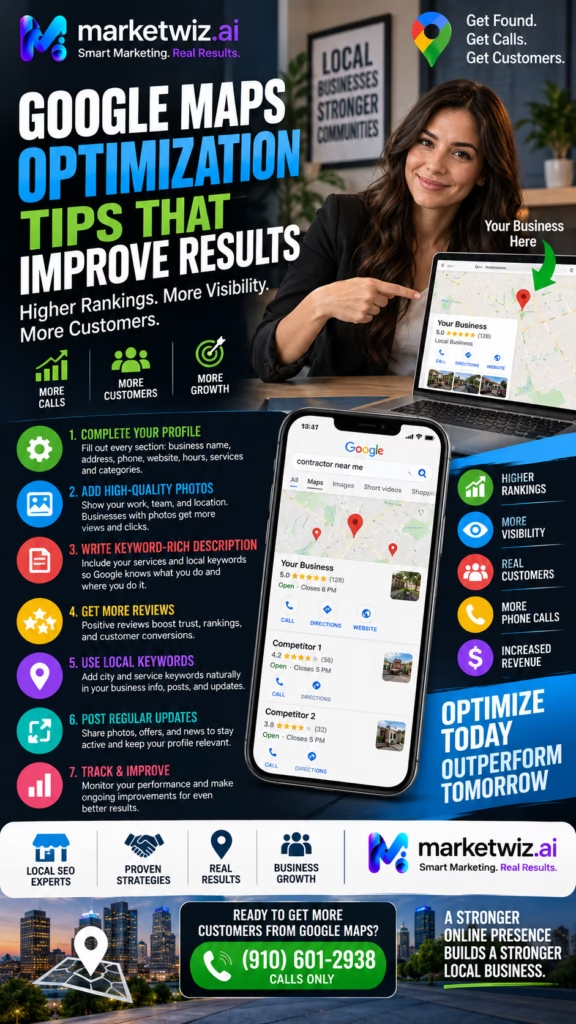
Google Maps Optimization Tips That Improve Results
Google Maps can become one of the most valuable customer acquisition channels for a local business, but strong results usually require more than simply creating a Google Business Profile. The businesses that build durable local visibility typically combine profile optimization, website relevance, reviews, authentic content, local authority, conversion strategy, lead tracking, and consistent improvement.
Google Maps optimization can look deceptively simple. A business creates a Google Business Profile, adds its phone number and website, uploads a few photos, collects some reviews, and expects local rankings to improve. In competitive markets, however, that basic approach is rarely enough to create a sustainable advantage.
Strong local search performance is usually built from many connected improvements rather than one isolated optimization.
A business may need to improve:
- Google Business Profile accuracy,
- business categories,
- service information,
- customer reviews,
- project or business photos,
- website structure,
- service pages,
- location pages,
- local citations,
- content relevance,
- lead response,
- conversion tracking.
The best optimization strategy is therefore not about finding one secret setting.
It is about creating a complete local search ecosystem that helps Google understand the business while also giving customers enough confidence to make contact.
1. Complete Every Relevant Google Business Profile Field
One of the simplest ways to improve a local presence is to make sure the Google Business Profile is complete and accurate.
A profile with missing information creates unnecessary uncertainty.
Depending on the business, important fields may include:
- business name,
- primary category,
- secondary categories,
- phone number,
- website,
- business hours,
- location or service areas,
- services,
- business description,
- photos,
- other relevant profile attributes.
The business should periodically review the profile rather than assuming information will remain accurate indefinitely.
Hours change. Phone numbers change. Services change. Websites are redesigned. Companies move. Teams expand.
If the Google profile is not updated, customers can receive outdated information.
Think Like a New Customer
Look at the profile as if you have never heard of the company.
Can you immediately determine:
- what the business does,
- where it operates,
- when it is open,
- what services it provides,
- how to contact it,
- whether it appears trustworthy?
If basic questions are difficult to answer, the profile still needs work.
2. Keep the Business Name Accurate
One of the most common local SEO mistakes is treating the business name field like a keyword field.
A company may be tempted to add service phrases, cities, promotional language, or "near me" terms directly into its name.
That can produce a confusing public identity and may conflict with current platform guidelines.
If the legitimate business name is:
Evergreen Home Services
it should not arbitrarily become:
Evergreen Home Services Best Plumber HVAC Electrician Near Me Dallas Texas
Optimization should happen through legitimate profile elements, services, website content, reviews, local pages, and other relevant signals.
3. Choose the Strongest Relevant Primary Category
The primary category is one of the most important profile decisions because it helps define what type of business Google is evaluating.
The best category is generally the most accurate available category for the company's main commercial activity.
A roofing contractor should not choose an unrelated category because that category appears to have more search volume.
A mattress retailer should not choose a furniture category as its primary identity if mattress retail is clearly the main business and a more accurate category is available.
The category should reflect reality.
Review Categories Periodically
Google's available categories can change over time.
Businesses should periodically review whether:
- the current primary category is still the best fit,
- new relevant categories have become available,
- old secondary categories are no longer relevant,
- the company's service mix has changed.
4. Use Secondary Categories Strategically
Secondary categories can help clarify additional legitimate aspects of a business.
The key word is legitimate.
Adding every vaguely related category is not a sophisticated strategy.
A better approach is to identify the company's major revenue-producing services and use categories that accurately describe those offerings.
For example, a contractor that genuinely provides multiple specialized services may have a broader category strategy than a company focused on one narrow service.
The profile should accurately reflect the business customers will encounter.
5. Add Detailed and Accurate Services
The services section is an opportunity to communicate the company's actual offerings in a structured way.
Instead of relying on one broad label, businesses can accurately identify the services that customers frequently request.
A home-service contractor might list legitimate offerings such as:
- installation,
- repair,
- replacement,
- maintenance,
- inspection,
- commercial service,
- residential service.
A flooring company might identify:
- luxury vinyl plank,
- laminate,
- engineered hardwood,
- commercial flooring,
- other genuine offerings.
A service list should be based on the business, not on whatever keywords happen to appear attractive.
Improve Lead Quality With Better Service Information
Specific service information does more than support visibility.
It can reduce irrelevant inquiries.
If the company clearly explains what it does and does not provide, prospective customers can better determine whether the business is a match.
6. Write a Useful Business Description
The business description should help a customer understand the company.
A good description can communicate:
- the primary service or product category,
- major offerings,
- general geographic coverage,
- customer types served,
- legitimate differentiators,
- relevant business history where appropriate.
Avoid turning the description into an unreadable list of keywords and city names.
A customer should be able to read the description naturally.
Use clear language instead of awkward SEO copy.
7. Add Authentic, High-Quality Photos
Photos can dramatically improve how a profile communicates trust.
The best image strategy depends on the business.
A contractor may use:
- completed projects,
- before-and-after images,
- crews at work,
- equipment,
- service vehicles,
- finished details.
A retailer may use:
- storefront photos,
- product displays,
- showroom images,
- inventory examples,
- interior photos.
A restaurant may use:
- food photography,
- interior seating,
- exterior signage,
- menu highlights,
- team imagery.
The important principle is authenticity.
Photos should represent the real business.
Show the Work
Project-based businesses should demonstrate completed work rather than relying entirely on generic promotional graphics.
Show the Business
Retail and location-based companies can use images to help customers recognize the property and understand the environment.
Keep Images Current
Recent images can communicate that the business is active and continuing to serve customers.
Avoid Misleading Content
Do not present another company's projects, stock imagery, or unrelated properties as if they represent the business.
8. Build a Consistent Google Review Strategy
Reviews are one of the strongest trust signals visible directly on a Google Business Profile.
A business with a steady history of genuine customer feedback may appear more credible than one with little recent evidence of customer activity.
Review generation should therefore become a business process rather than an occasional marketing experiment.
A simple workflow might include:
- complete the customer transaction or project,
- confirm that the customer experience was successful,
- request genuine feedback,
- make the review process easy,
- respond professionally after reviews are published.
Businesses should not fabricate reviews, purchase fake reviews, or create misleading customer experiences.
Authenticity matters.
9. Respond to Reviews Professionally
Review responses are often overlooked.
They should not be.
A customer reading reviews may also read the company's replies.
Those responses provide a public demonstration of the company's communication style.
Positive review responses can:
- thank the customer,
- acknowledge the experience,
- reinforce professionalism,
- show that the business pays attention.
Negative review responses require even more discipline.
Avoid:
- insults,
- public arguments,
- emotional accusations,
- revealing unnecessary customer information.
Remain professional and move detailed dispute resolution into the appropriate private channel.
10. Focus on Review Consistency, Not Short Bursts
Some businesses ignore reviews for months and then suddenly attempt to generate a large number at once.
A healthier long-term strategy is consistency.
Build the review request process into:
- project completion,
- post-purchase communication,
- customer follow-up,
- CRM workflows,
- staff procedures.
The objective is to create a legitimate stream of recent customer feedback over time.
This also produces better reputation data for management.
If multiple customers repeatedly mention the same strength, that may become a useful marketing message.
If multiple customers repeatedly mention the same problem, that may reveal an operational issue worth fixing.
11. Strengthen the Website Connected to Google Business Profile
Google Maps optimization should not stop at the profile.
The linked website can help customers confirm what they saw on Google.
The site should clearly communicate:
- business identity,
- products or services,
- location or service areas,
- contact information,
- customer proof,
- relevant expertise,
- next steps.
A weak website can create a disconnect.
Imagine a customer finding an impressive Google profile, clicking the website, and seeing:
- an outdated design,
- broken mobile formatting,
- missing services,
- incorrect phone numbers,
- no project examples,
- no obvious contact path.
That can reduce conversion even if Google Maps visibility is strong.
12. Create Strong Individual Service Pages
A generic page listing every service in a few sentences may not provide enough depth.
Major services often deserve dedicated pages.
A strong service page can explain:
- what the service is,
- who needs it,
- common problems it solves,
- how the process works,
- what customers should expect,
- relevant project examples,
- frequently asked questions,
- how to contact the business.
This creates more useful content for customers while also helping search engines understand the company's expertise.
Avoid Thin Service Pages
A service page should not exist simply because someone found a keyword.
If the page offers no meaningful information beyond the phrase itself, it is unlikely to create a strong customer experience.
Build pages around actual services and actual customer needs.
13. Build Useful Location Pages
Businesses serving multiple markets often create city or service-area pages.
This can be effective when done carefully.
A useful location page may include:
- services genuinely available in the area,
- local project examples,
- local customer questions,
- nearby service coverage,
- relevant market information,
- customer testimonials where appropriate,
- clear contact information.
The problem occurs when businesses create hundreds of nearly identical pages.
Changing:
"Roofing Services in Dallas"
to:
"Roofing Services in Fort Worth"
while leaving every other sentence identical does not create meaningful local content.
Location pages should provide real local value.
14. Clean Up Local Citations
Citations are references to the business across online directories and other websites.
Common citation sources can include:
- major business directories,
- maps platforms,
- industry directories,
- local chambers of commerce,
- professional associations,
- regional business organizations.
The goal is not to accumulate thousands of low-quality listings.
The goal is to create an accurate, credible business footprint.
Audit Existing Citations
Look for:
- old phone numbers,
- old addresses,
- incorrect business names,
- duplicate listings,
- old website domains,
- closed locations,
- incorrect hours.
Citation cleanup can be especially important for businesses that have operated for many years.
15. Maintain Accurate Business Information Everywhere
Local search optimization depends on clarity.
When different websites show different business information, customers can become confused.
Important information should be reviewed across the company's major digital properties.
That can include:
- Google Business Profile,
- company website,
- Facebook page,
- major directories,
- mapping platforms,
- industry profiles,
- local associations.
Businesses should especially review these platforms after:
- moving,
- changing phone numbers,
- rebranding,
- changing domains,
- opening or closing locations.
16. Target Local Keywords Based on Real Customer Intent
Keyword research is most useful when it reveals how customers actually search.
Local keyword categories often include:
Business-Type Keywords
- plumber,
- roofer,
- HVAC company,
- flooring store,
- fence contractor,
- paving company.
Service Keywords
- water heater repair,
- roof replacement,
- AC installation,
- vinyl flooring,
- privacy fence installation,
- driveway paving.
Problem Keywords
- leaking pipe,
- roof storm damage,
- AC not cooling,
- damaged flooring,
- broken fence,
- cracked driveway.
Location Intent
- near me,
- city-specific searches,
- neighborhood searches,
- regional service searches.
The business should build content around relevant search intent rather than forcing every possible keyword onto one page.
17. Publish Content That Supports Local Expertise
Useful content helps expand the business's topical footprint.
Instead of publishing generic filler, answer questions customers genuinely ask.
Examples include:
- how to choose between two service options,
- what customers should expect during a project,
- common maintenance questions,
- signs a repair may be needed,
- when replacement makes sense,
- how pricing variables work,
- what information is needed for an estimate,
- how local conditions influence the service.
This type of content can serve several purposes.
It can:
- support organic search traffic,
- strengthen service pages,
- educate leads,
- create internal linking opportunities,
- provide material for social posts,
- help sales teams answer common questions.
18. Improve Internal Linking
Local SEO strategies often focus heavily on new content while ignoring the relationships between existing pages.
Internal links help users move naturally between related topics.
For example:
- a roofing article can link to the roof replacement service page,
- a city page can link to relevant services,
- a service page can link to project examples,
- a FAQ can link to deeper educational content.
Internal linking can help search engines understand:
- site structure,
- important service pages,
- topic relationships,
- content hierarchy.
Anchor text should remain natural.
Do not turn every paragraph into a repetitive exact-match keyword link.
19. Build Legitimate Local and Industry Authority
A business's broader web authority can support local search.
Useful relationships may generate legitimate mentions and links from:
- local chambers,
- industry organizations,
- business associations,
- manufacturers,
- suppliers,
- community partnerships,
- local publications,
- relevant professional directories.
The emphasis should be on relevance and legitimacy.
Avoid treating backlinks as a numbers game where thousands of low-quality links are purchased simply to create volume.
A credible local mention can be more meaningful than a large amount of unrelated spam.
20. Use Google Business Profile Posts Strategically
Google Business Profile posts can make the profile more useful to customers.
Possible topics include:
- recent projects,
- new products,
- service highlights,
- seasonal reminders,
- business updates,
- customer education,
- events,
- important operating information.
The content should be written for people first.
Avoid publishing the same generic keyword paragraph repeatedly.
Repurpose Real Business Activity
Local businesses often have more content than they realize.
A completed job can become:
- a Google Business Profile post,
- a Facebook post,
- an Instagram post,
- a short-form video,
- a website project example,
- a review request opportunity.
This allows one real customer interaction to support multiple marketing channels.
21. Improve Mobile User Experience
Local searches frequently happen on mobile devices.
Someone may search while:
- standing at a damaged property,
- sitting in a vehicle,
- comparing nearby businesses,
- researching a service after work,
- trying to solve an urgent problem.
The mobile experience should therefore be fast and simple.
Review:
- page loading,
- font readability,
- navigation,
- tap targets,
- contact information,
- forms,
- image loading,
- layout stability.
A local SEO campaign can lose valuable leads if the website creates frustration on mobile.
22. Improve Conversion Instead of Focusing Only on Rankings
A ranking is only valuable if it helps produce meaningful business outcomes.
Imagine two local companies.
Company A ranks slightly higher but has:
- weak photos,
- few recent reviews,
- an outdated website,
- slow response time.
Company B ranks slightly lower but has:
- excellent project proof,
- strong reviews,
- a professional website,
- fast lead response,
- clear service information.
Company B may convert more customers despite ranking lower.
That is why conversion optimization belongs inside a Google Maps strategy.
23. Respond to Google Maps Leads Quickly
Better local visibility can increase lead volume, but those leads still need to be handled.
Customers often contact several local businesses.
A fast, professional response can help move the conversation forward while the customer is still actively evaluating options.
A basic lead response process can:
- acknowledge the inquiry,
- identify the service needed,
- confirm location or service area,
- collect essential project information,
- determine the appropriate next step,
- schedule an appointment, estimate, or sales conversation.
Response quality matters just as much as speed.
Automation should not create robotic conversations that frustrate customers.
24. Connect Google Maps Leads to a CRM
One of the biggest weaknesses in local marketing is attribution.
Businesses know the phone rings, but they do not always know:
- where the lead came from,
- which service was requested,
- whether the lead was qualified,
- whether an appointment was booked,
- whether the sale closed,
- how much revenue was generated.
A CRM can create that connection.
Useful fields may include:
- lead source,
- customer name,
- phone number,
- email,
- service requested,
- location,
- lead status,
- appointment date,
- proposal value,
- closed sale value.
This turns local SEO from a ranking exercise into a measurable customer acquisition system.
25. Track the Metrics That Actually Matter
Google Maps rankings can be useful, but they should not be viewed in isolation.
A business should track performance throughout the funnel.
| Metric | What It Shows | Why It Matters |
|---|---|---|
| Local Visibility | Where the business appears across target areas | Measures search exposure |
| Profile Engagement | Customer interactions with the local presence | Shows interest |
| Calls | Phone inquiries | Measures direct customer demand |
| Website Leads | Forms or digital contacts | Measures website conversion |
| Qualified Leads | Inquiries that match services and geography | Measures lead quality |
| Appointments | Leads progressing to sales activity | Measures pipeline movement |
| Closed Customers | Actual sales generated | Measures customer acquisition |
| Revenue | Sales attributable to marketing | Measures financial impact |
A campaign that increases rankings without increasing qualified business may need a different strategy.
26. Measure Rankings Across the Actual Service Area
One ranking position does not represent an entire city.
Local search visibility can vary based on where the customer searches from.
A business may appear strongly near its physical location but have weaker visibility in other parts of the market.
That makes geographic ranking analysis useful.
Instead of asking only:
"What position do we rank?"
ask:
- where are we visible,
- where are we weak,
- which services perform best,
- which areas generate leads,
- where do strong competitors dominate?
This creates a more realistic picture of local search performance.
27. Analyze Competitors Without Copying Them
Competitor research can reveal what customers encounter in the local market.
Evaluate competitors for:
- profile completeness,
- primary categories,
- secondary categories,
- review volume,
- review quality,
- review recency,
- photo quality,
- website quality,
- service pages,
- location content,
- customer messaging.
Do not simply copy the top-ranking business.
Instead, identify opportunities where the market is weak.
Look for Competitive Gaps
For example:
- competitors may have weak photos,
- competitors may not explain important services,
- competitors may have outdated websites,
- competitors may ignore reviews,
- competitors may have poor mobile experiences,
- competitors may respond slowly to inquiries.
Those gaps can become opportunities to create a better customer experience.
28. Use AI to Support Google Maps Optimization
AI can help local businesses execute marketing workflows more efficiently.
Useful applications can include:
- keyword organization,
- content planning,
- local topic generation,
- review response drafting,
- Google Business Profile post drafting,
- lead classification,
- conversation summaries,
- CRM automation,
- follow-up reminders,
- reporting,
- performance analysis.
AI should be connected to accurate business information.
It should not invent:
- reviews,
- locations,
- services,
- licenses,
- pricing,
- warranties,
- customer experiences,
- project history.
29. Avoid the Google Maps Optimization Mistakes That Hold Back Results
Using an Inaccurate Business Name
Keep the profile aligned with the legitimate real-world business identity.
Choosing the Wrong Primary Category
Use the category that most accurately represents the main business activity.
Adding Irrelevant Categories
More categories are not automatically better.
Creating Fake Locations
Use legitimate eligible locations and follow current platform guidelines.
Buying Fake Reviews
Build genuine customer feedback instead.
Ignoring Review Responses
Customer engagement should continue after a review is published.
Using Weak or Misleading Photos
Real business imagery creates stronger proof.
Ignoring the Website
The website should reinforce the local profile and help convert visitors.
Creating Thin City Pages
Location pages should provide useful local information.
Ignoring Citation Accuracy
Old phone numbers and addresses can create unnecessary confusion.
Focusing Only on Rankings
Track leads, appointments, customers, and revenue.
Responding Slowly to Leads
Visibility without a sales process wastes opportunity.
Making Constant Random Changes
Optimization should be intentional, documented, and measured rather than based on uncontrolled experimentation.
30. A 90-Day Google Maps Optimization Plan
A structured optimization plan can help businesses improve systematically rather than making random profile edits.
Days 1–30: Build the Foundation
Audit the Google Business Profile
Review the business name, primary category, secondary categories, phone number, website, hours, services, description, service areas, photos, and other important profile information.
Audit Business Information Across the Web
Identify outdated addresses, phone numbers, domains, duplicate listings, and inconsistent business information across important platforms.
Audit the Website
Review service pages, location pages, mobile performance, contact paths, project proof, reviews, content, and local relevance.
Build a Review Workflow
Create a consistent process for requesting genuine customer feedback after successful transactions or projects.
Set Up Tracking
Connect calls, website inquiries, qualified leads, appointments, proposals, sales, and revenue to marketing sources whenever practical.
Days 31–60: Build Relevance and Authority
- Improve major service pages.
- Build useful location pages for legitimate service areas.
- Add authentic photos.
- Publish recent project or business content.
- Respond to customer reviews.
- Improve citation accuracy.
- Create relevant educational content.
- Strengthen internal linking.
- Improve mobile usability.
- Develop legitimate local and industry relationships.
Days 61–90: Improve Conversion and Measurement
- Track local ranking patterns across target areas.
- Compare performance by service.
- Compare performance by geography.
- Improve lead response speed.
- Refine lead qualification.
- Connect leads to a CRM.
- Track appointment rates.
- Track sales conversion.
- Measure closed customer value.
- Use AI and automation to reduce repetitive administrative work.
Final Thoughts: Improve Google Maps Results by Improving the Entire Local Marketing System
Google Maps optimization is sometimes presented as a collection of small tricks.
Change a category.
Add a keyword.
Upload a photo.
Publish a post.
Those individual actions can be useful, but sustainable local search growth generally comes from something broader.
The strongest businesses build complete local marketing systems.
They maintain accurate profiles.
They describe their services clearly.
They publish authentic business proof.
They collect genuine reviews.
They build useful websites.
They create strong service pages.
They support legitimate service areas with useful content.
They maintain accurate citations.
They respond to leads quickly.
They track what happens after the lead arrives.
They measure revenue instead of celebrating ranking screenshots alone.
Most importantly, they continue improving.
Local search markets change.
Competitors improve.
Customer expectations change.
Services expand.
Websites age.
Reviews accumulate.
That makes Google Maps optimization an ongoing business process rather than a one-time technical project.
A complete strategy may connect:
- Google Business Profile optimization,
- local SEO,
- website strategy,
- review generation,
- reputation management,
- content creation,
- citations,
- local authority,
- lead response,
- CRM workflows,
- AI automation,
- sales tracking,
- customer acquisition measurement.
When these systems work together, Google Maps becomes more than a listing.
It becomes one component of a scalable local customer acquisition engine.
Frequently Asked Questions About Google Maps Optimization
1. What is Google Maps optimization?
Google Maps optimization is the process of improving a business's Google Business Profile, website, reviews, services, photos, local relevance, business information, citations, and other local search signals to strengthen visibility for relevant searches.
2. Why is Google Maps optimization important?
It can help local businesses appear in front of nearby customers who are actively searching for relevant products or services and can create opportunities for calls, website visits, appointments, estimates, and sales.
3. How can I improve my Google Maps rankings?
Improve profile accuracy, categories, services, authentic reviews, photos, website relevance, service pages, location content, citations, local authority, conversion, and lead tracking as part of a complete local SEO strategy.
4. Does completing a Google Business Profile help local SEO?
A complete profile provides customers and Google with clearer information about the business, including services, hours, contact information, website, location or service areas, and other relevant details.
5. What Google Business Profile category should I use?
Choose the most accurate available primary category for the company's real main business activity and use secondary categories only when they legitimately apply.
6. Should I add many Google Business Profile categories?
No. Categories should represent real business activities. Adding unrelated categories does not create a strong or credible local SEO strategy.
7. Do Google reviews improve local marketing results?
Genuine reviews can strengthen customer confidence and provide useful reputation signals. Businesses should build a consistent review request process around real customer experiences.
8. Should I respond to Google reviews?
Yes. Professional responses demonstrate customer engagement and allow future prospects to see how the company communicates.
9. Do photos help Google Business Profile performance?
Authentic, high-quality photos can improve customer understanding and trust by showing real products, services, projects, facilities, staff, or other legitimate aspects of the business.
10. How often should businesses add photos?
There is no single schedule that applies to every company, but adding useful current imagery regularly can help maintain a more informative and active business presence.
11. Does the website affect Google Maps SEO?
A strong local website can support Google Maps marketing by communicating services, locations or service areas, expertise, project proof, reviews, business information, and other relevant local content.
12. Should businesses create separate service pages?
Yes. Major legitimate services often deserve their own useful pages so customers and search engines can better understand what the company offers.
13. Should local businesses create city pages?
Useful city or location pages can support local SEO when the company genuinely serves those areas and the pages provide meaningful local information instead of thin duplicated content.
14. What are local citations?
Local citations are online references to the business and its identifying information across directories, mapping platforms, industry listings, chambers, associations, and other relevant websites.
15. Does NAP consistency matter?
Accurate business name, address information where applicable, phone number, website, and other details can reduce customer confusion and create a clearer online business footprint.
16. Should keywords be added to Google Business Profile?
Relevant services and descriptions can naturally reflect what a business offers, but business information should remain accurate and readable rather than being stuffed with repetitive keywords.
17. Should businesses use Google Business Profile posts?
Yes. Posts can highlight recent projects, services, products, company updates, educational topics, events, and other useful information for customers.
18. Can service-area businesses improve Google Maps visibility?
Yes. Service-area businesses can build local visibility while following Google's current eligibility and address requirements and strengthening legitimate local relevance.
19. Should businesses create fake locations to rank in more cities?
No. Businesses should use legitimate eligible locations and comply with current Google guidelines rather than creating misleading offices or profiles.
20. Can duplicate Google Business Profiles create problems?
Unnecessary or ineligible duplicate profiles can confuse customers and may create policy issues. Businesses should maintain accurate eligible profiles for legitimate operations.
21. How long does Google Maps optimization take?
Timelines vary based on competition, profile strength, website quality, reviews, local authority, geography, existing visibility, and the consistency of optimization work.
22. How should businesses track Google Maps performance?
Track local visibility, calls, website leads, qualified inquiries, appointments, estimates, sales, customer value, service areas, and revenue rather than relying on one ranking position.
23. Are Google Maps rankings the most important metric?
No. Rankings are useful, but qualified leads, appointments, sales conversion, customer acquisition cost, closed revenue, and profitability provide a more complete picture.
24. Can AI help with Google Maps optimization?
AI can assist with keyword organization, content planning, review response drafting, Google Business Profile posts, CRM workflows, lead classification, follow-up, reporting, and local marketing analysis.
25. Should Google Maps SEO be combined with social media?
Yes. Social media can build additional visibility and trust while Google Maps captures customers with local search intent.
26. Should Google Maps optimization be combined with paid ads?
Paid advertising can complement local SEO by generating immediate visibility while a business builds stronger long-term organic local search presence.
27. What Google Maps optimization mistakes should businesses avoid?
Avoid inaccurate business information, keyword-stuffed names, fake locations, irrelevant categories, fabricated reviews, misleading photos, weak websites, thin location pages, inconsistent citations, slow lead response, and poor tracking.
28. How important is lead response after improving Google Maps rankings?
Lead response is critical because increased visibility can create more inquiries, but those leads still require timely qualification, appointments, estimates, and follow-up to become customers.
29. What local SEO content should businesses create?
Useful content can include major service pages, legitimate location pages, project examples, educational articles, customer FAQs, comparison guides, problem-solving content, and other material built around real customer search intent.
30. What is the best Google Maps optimization strategy?
The strongest strategy combines an accurate Google Business Profile, relevant categories, detailed services, authentic photos, genuine reviews, a strong website, useful service and location content, accurate citations, local authority, fast lead response, CRM tracking, and continuous measurement and improvement.
30 Additional SEO Keywords
These additional keyword ideas can support future Google Maps optimization articles, local SEO service pages, location pages, educational resources, internal linking, and broader topical authority.
Build a Stronger Google Maps Growth Strategy
MarketWiz.ai combines AI-powered Google Maps optimization, local SEO, website strategy, lead generation, reputation workflows, CRM integration, marketing automation, and customer acquisition technology designed to help local businesses improve visibility, generate more qualified opportunities, and turn local search demand into measurable growth.
Call MarketWiz.ai: (910) 601-2938












