
Common Google Maps SEO Mistakes to Avoid
Google Maps can become one of the most valuable customer acquisition channels for a local business, but small optimization mistakes can weaken visibility, create customer confusion, reduce trust, and make it harder to compete in local search. Learn which Google Business Profile, website, review, citation, content, tracking, and local SEO mistakes businesses should avoid when building a long-term Google Maps growth strategy.
Google Maps SEO can place a local business directly in front of customers searching for nearby products and services. A strong local presence can generate phone calls, website visits, directions, appointments, estimates, and qualified leads. However, businesses often undermine that opportunity with avoidable optimization mistakes.
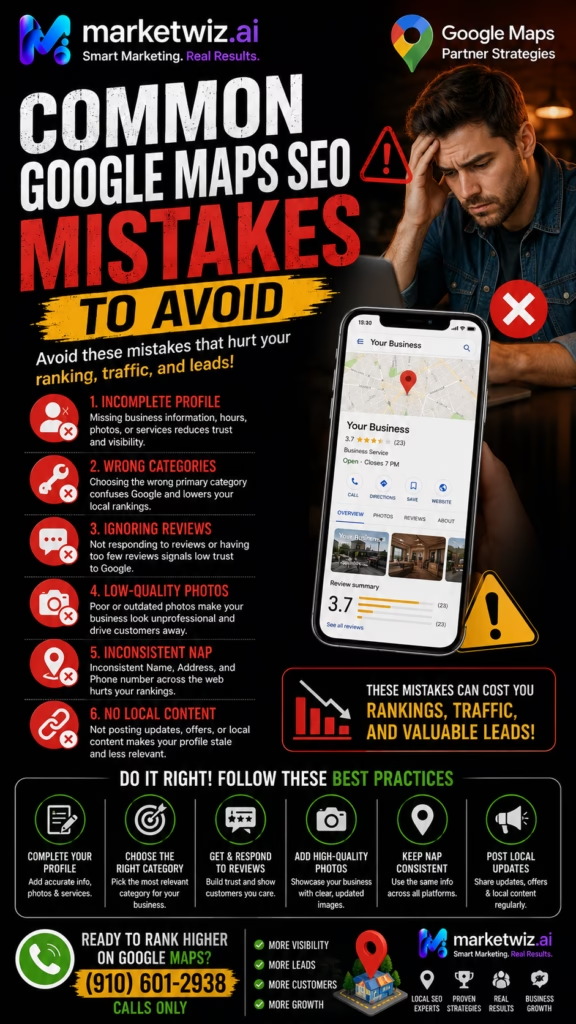
Some mistakes are obvious, such as publishing an incorrect phone number. Others are more subtle, including choosing weak business categories, relying on thin city pages, ignoring reviews, using inconsistent business information, measuring rankings incorrectly, or focusing on optimization tricks instead of building genuine local relevance and customer trust.
The problem is that local SEO rarely depends on a single factor. Google Maps visibility is influenced by a combination of business relevance, geography, prominence, profile quality, reputation, website support, local authority, and the competitive environment.
A business can therefore spend months working on local SEO while still leaving major weaknesses unresolved.
1. Using Inaccurate Business Information
One of the most basic Google Maps SEO mistakes is also one of the easiest to avoid: publishing inaccurate business information.
Customers rely on Google Business Profiles for practical details such as:
- business name,
- phone number,
- address,
- website,
- business hours,
- service information,
- directions.
If this information is wrong, the business can lose customers before they ever speak to someone.
For example, an outdated phone number can send a high-intent prospect to a disconnected line. Incorrect hours can send a customer to a closed location. A broken website link can prevent the prospect from reviewing services or requesting an estimate.
Accuracy should therefore be the foundation of every local SEO campaign.
What to Check
- Business name matches the real-world business name.
- Primary phone number works.
- Website link reaches the correct website.
- Address is accurate where applicable.
- Service-area configuration is correct.
- Hours reflect actual operating hours.
- Holiday hours are updated when needed.
2. Keyword Stuffing the Google Business Profile Name
Some businesses try to improve Google Maps rankings by adding extra keywords, cities, services, or promotional language to the business name field.
For example, a real-world company named:
Johnson Plumbing
might attempt to change the profile name to something like:
Johnson Plumbing – Best Emergency Plumber & Water Heater Repair Raleigh NC
This may appear attractive from a keyword perspective, but businesses should represent their real-world names according to current Google Business Profile rules.
The name field is not intended to become an advertisement.
3. Choosing the Wrong Primary Business Category
Category selection is one of the most important elements of Google Business Profile optimization.
The primary category helps Google understand what type of business the company is.
A flooring retailer, for example, should not select a category simply because it contains a valuable keyword if that category does not accurately represent the actual business.
Likewise, a roofing contractor should not choose an unrelated home improvement category only because a competitor appears under it.
The primary category should reflect the company's core business.
Why Category Accuracy Matters
Categories can influence:
- which searches the profile may be relevant to,
- which profile features are available,
- how customers understand the business,
- how the company compares with competitors.
Businesses should periodically review available categories because Google can change its category options over time.
4. Adding Irrelevant Secondary Categories
Secondary categories can help communicate additional legitimate business functions, but adding every remotely related category is not necessarily helpful.
A local company should choose categories because they genuinely describe the business, not simply because those categories might increase search exposure.
Overusing categories can make the profile less precise.
A strong category strategy asks:
- What is the business primarily?
- What additional business types accurately describe its operations?
- Would a customer reasonably expect this company to perform the work represented by the selected category?
Precision is usually more valuable than category quantity.
5. Ignoring Google Reviews
A Google Business Profile can rank well and still convert poorly if customers do not trust it.
Reviews are one of the clearest trust signals displayed in local search.
Prospects may compare:
- average rating,
- total review count,
- recent customer feedback,
- review quality,
- business responses.
Imagine two contractors appearing beside each other.
One has a strong collection of recent reviews and thoughtful responses. The other has very few reviews and has not received new feedback in years.
Even if both companies appear prominently, customer behavior may be very different.
Build a Consistent Review Process
Businesses should make review generation part of the customer lifecycle.
After a successful project, sale, appointment, delivery, or service call, the company can create a legitimate process for requesting customer feedback.
Review generation should never depend on fabricated or misleading activity.
6. Buying or Fabricating Reviews
Fake reviews can create serious reputation and platform risks.
Businesses may be tempted by services promising:
- instant five-star reviews,
- bulk Google reviews,
- guaranteed review growth,
- reviews from accounts with no real customer relationship.
This is not a sustainable local SEO strategy.
Customer reviews should represent genuine customer experiences.
A business that invests in real service quality, customer communication, and systematic review requests builds an asset that can strengthen both local search and customer trust.
7. Failing to Respond to Reviews
Review responses are an opportunity to demonstrate that the business is active and customer-focused.
Businesses often make one of two mistakes:
- never responding to any reviews,
- responding only when someone leaves negative feedback.
A more balanced strategy considers both positive and negative reviews.
Positive Reviews
A brief, personalized response can acknowledge the customer and reinforce professionalism.
Negative Reviews
The response should remain calm and professional.
Avoid public arguments. Address legitimate concerns, clarify misunderstandings carefully, and move sensitive discussions into an appropriate private customer-service process.
8. Letting Business Information Become Inconsistent Across the Web
A business may have existed for years and accumulated dozens of online listings.
Some may contain:
- an old address,
- a former phone number,
- a previous business name,
- an outdated website,
- incorrect hours.
This creates inconsistent business information.
The goal should not be perfect uniformity on every obscure website on the internet. Instead, prioritize important directories, local sources, industry websites, mapping platforms, and data providers that customers or search engines are likely to encounter.
9. Building Hundreds of Low-Quality Citations
Citation building can support a local SEO strategy, but volume is not automatically quality.
Some businesses submit their information to hundreds of low-value directories simply to increase citation count.
A stronger strategy prioritizes:
- major business directories,
- relevant industry directories,
- local chambers,
- professional organizations,
- local community websites,
- mapping platforms,
- reputable business databases.
A listing on a trusted industry source can be more meaningful than dozens of obscure directories that customers never use.
10. Creating Fake Locations to Rank in More Cities
One of the riskiest local SEO strategies is attempting to create artificial locations for the sole purpose of ranking in additional markets.
Businesses sometimes try to use:
- addresses where they do not genuinely operate,
- unqualified virtual addresses,
- temporary locations,
- unrelated businesses' addresses,
- other arrangements designed only to create map visibility.
Google Business Profiles should represent eligible real-world businesses according to current platform requirements.
If a company serves customers across a wide geographic region, website SEO, legitimate service-area configuration, local content, paid advertising, and other marketing strategies may be better tools for extending visibility than creating questionable locations.
11. Creating Duplicate Google Business Profiles
Businesses sometimes discover multiple profiles representing the same location or operation.
This can happen after:
- ownership changes,
- staff members create separate profiles,
- old locations remain online,
- agencies create profiles without checking existing listings,
- business names change.
Duplicate profiles can confuse customers and fragment important reputation information.
Businesses should review existing listings before creating new profiles and address duplicates according to Google's current guidance.
12. Neglecting Business Hours and Holiday Hours
Local search frequently happens immediately before a customer wants to contact or visit a business.
Incorrect hours therefore create an immediate customer-service problem.
A restaurant marked open when it is actually closed can lose a customer permanently. A repair company showing outdated weekend hours can miss an urgent service call.
Businesses should maintain:
- regular hours,
- holiday hours,
- special closures,
- temporary schedule changes where applicable.
13. Ignoring Photos and Visual Content
Google Maps SEO is not only about rankings.
It is also about what happens after the customer discovers the profile.
Photos can help customers understand:
- what the business looks like,
- what products it sells,
- what completed work looks like,
- what the team looks like,
- what a location or showroom looks like.
A contractor might show completed projects. A restaurant might show food and interior photos. A flooring business might show installed rooms. A hotel might show rooms and amenities.
Businesses should avoid misleading or outdated photos that no longer represent the customer experience.
14. Using Low-Quality or Irrelevant Images
Adding photos simply to increase image count is not a strategy.
Poor images can include:
- blurry pictures,
- dark photos,
- irrelevant stock photography,
- graphics with unreadable text,
- old images that no longer represent the company,
- duplicate photos added repeatedly.
Visual content should help a potential customer evaluate the business.
Quality, relevance, authenticity, and consistency matter more than uploading images for the sake of activity.
15. Ignoring the Website Behind the Google Business Profile
A common Google Maps SEO mistake is treating the website and Google Business Profile as completely separate marketing assets.
They should support one another.
The website can help search engines and customers understand:
- services,
- locations,
- experience,
- projects,
- specializations,
- business credibility.
A weak website can limit the overall local search strategy.
For example, if a plumbing company wants visibility for water heater repair but its website barely mentions water heaters, the business is missing an opportunity to build clearer topical relevance.
16. Creating Thin Service Pages
A service page should provide meaningful information to customers.
A weak page might contain only:
- a service title,
- two generic sentences,
- a phone number.
A stronger page can explain:
- what the service includes,
- who needs it,
- common customer problems,
- how the process works,
- relevant service options,
- frequently asked questions,
- service-area information,
- appropriate calls to action.
Useful service pages can support both traditional organic SEO and local relevance.
17. Mass-Producing Thin City Pages
Many local businesses serve multiple cities, so location pages can be valuable.
The mistake is creating dozens or hundreds of pages where the only meaningful difference is the city name.
For example:
"Best HVAC Company in Raleigh" becomes "Best HVAC Company in Durham," then "Best HVAC Company in Cary," while every other sentence remains identical.
This creates little unique value for customers.
Better Location Pages Can Include
- services available in the location,
- local project examples,
- neighborhood or market context,
- customer questions relevant to the location,
- real service-area information,
- local testimonials where appropriate.
18. Keyword Stuffing Local Website Content
A page should not read like:
"Looking for a Raleigh plumber? Our Raleigh plumbers provide Raleigh plumbing for Raleigh customers who need a plumber in Raleigh."
That may contain the keyword repeatedly, but it creates poor customer experience.
Modern local content should communicate relevance naturally.
Use location and service terminology where it helps the reader understand the page, not simply to increase repetition.
19. Ignoring Search Intent
Local SEO is not only about keywords.
It is about understanding what the customer wants when they search.
Consider the difference between:
- "what causes AC to freeze,"
- "AC repair near me,"
- "HVAC company Raleigh,"
- "new HVAC system cost."
Each search represents a different stage of the customer journey.
A strong website should have content aligned to different intents.
Google Maps is particularly valuable for high local intent, while traditional website content can capture customers during earlier research stages.
20. Ignoring Mobile User Experience
Many local searches happen from phones.
A customer may be standing in a parking lot, sitting in a broken-down car, dealing with a leaking pipe, searching for a restaurant, or comparing contractors from the couch.
If the website is difficult to use on mobile, visibility can be wasted.
Important mobile considerations include:
- fast page loading,
- readable text,
- simple navigation,
- clear contact information,
- easy forms,
- proper spacing,
- working buttons,
- minimal intrusive elements.
21. Ignoring Website Speed and Technical SEO
Local SEO cannot compensate indefinitely for a poorly functioning website.
Technical problems may include:
- slow loading pages,
- broken links,
- mobile usability problems,
- duplicate content,
- incorrect indexing settings,
- broken redirects,
- missing canonical signals,
- poor site architecture.
The website should give both customers and search engines a clean, reliable experience.
22. Chasing Low-Quality Backlinks
Backlinks can support website authority, but low-quality link building can become a distraction or a risk.
Businesses should avoid tactics designed primarily to manufacture large volumes of irrelevant links.
Better authority opportunities can come from:
- local organizations,
- industry associations,
- business partners,
- suppliers,
- community involvement,
- legitimate publications,
- local media,
- valuable resources worth referencing.
The goal is legitimate authority, not simply a large backlink count.
23. Ignoring Local Competitive Analysis
Businesses should understand the local environment they are competing in.
A useful competitive analysis can evaluate:
- primary categories,
- secondary categories,
- review counts,
- review velocity,
- website quality,
- service pages,
- location pages,
- photos,
- content depth,
- local authority.
The objective is not to copy competitors.
The objective is to understand the level of quality and authority required to compete.
24. Checking Rankings From Only One Location
Google Maps rankings can vary dramatically depending on where the searcher is located.
A contractor may rank very strongly near its business location but appear much lower five, ten, or fifteen miles away.
That means manually searching one keyword from one office computer gives only a limited picture.
Businesses should evaluate local visibility geographically whenever possible.
A grid-based view can help illustrate how rankings change across a service area.
This can reveal:
- strong zones,
- weak zones,
- competitive boundaries,
- areas where organic website SEO may be especially important.
25. Measuring Rankings but Not Leads
Rankings are useful marketing metrics, but they are not the final goal.
The business ultimately needs:
- calls,
- qualified leads,
- appointments,
- estimates,
- store visits,
- sales,
- revenue.
A business can improve from position ten to position three and still see weak results if customers do not trust the profile or the business fails to answer the phone.
A complete Google Maps SEO measurement system connects visibility to business outcomes.
| SEO Stage | Question | Useful Metric |
|---|---|---|
| Visibility | Are customers seeing the business? | Local rankings and impressions |
| Engagement | Are customers interacting? | Profile actions and website visits |
| Lead | Are interactions becoming opportunities? | Calls and form submissions |
| Qualification | Are the leads relevant? | Qualified lead rate |
| Conversion | Are leads becoming customers? | Appointments and sales |
| Revenue | Is SEO producing business value? | Revenue attributed to local search |
26. Failing to Optimize for Conversion
Traffic without conversion produces limited value.
A strong Google Business Profile should make it easy for customers to understand the business and take action.
The website should do the same.
Conversion Problems Can Include
- phone number difficult to find,
- confusing website navigation,
- slow forms,
- weak service explanations,
- poor mobile experience,
- few trust signals,
- no project examples,
- unclear service area,
- poor calls to action.
SEO brings the prospect to the business. Conversion strategy turns that opportunity into a lead.
27. Responding Too Slowly to Google Maps Leads
A customer who discovers a business through Google may contact several competitors.
This is especially common for:
- HVAC repair,
- plumbing,
- roofing,
- painting,
- flooring,
- automotive,
- real estate,
- medical appointments,
- home services.
Strong rankings cannot compensate for poor lead handling.
Businesses should build a process that helps new inquiries receive fast, professional attention.
A lead should move from:
Google search → contact → qualification → appointment or estimate → follow-up → sale.
28. Making Constant Profile Changes Without a Strategy
Google Business Profile optimization should be deliberate.
Businesses sometimes repeatedly change:
- categories,
- business descriptions,
- services,
- hours,
- website URLs,
- other information
without a clear reason.
Business information should change when the underlying business changes or when an important accuracy issue needs correction.
Constant experimentation with core identity information can create operational confusion and make performance harder to evaluate.
29. Treating AI as a Replacement for Local SEO Strategy
AI can dramatically improve local marketing efficiency, but it should not replace accurate business knowledge or strategic oversight.
AI can help with:
- keyword clustering,
- content planning,
- review response drafts,
- competitive research,
- reporting,
- local content ideas,
- technical audit organization,
- lead-response workflows.
However, AI should not invent:
- business locations,
- services,
- customer reviews,
- credentials,
- pricing,
- project details,
- business hours,
- claims about rankings.
Automation works best when it uses verified business information.
30. Expecting Google Maps SEO to Be a One-Time Project
Local SEO changes over time.
Competitors gain reviews. Businesses move. Websites improve. New content is published. Google changes search experiences. Customer behavior shifts. New competitors enter the market.
A profile that was highly competitive two years ago may no longer be competitive today.
Ongoing local SEO should include:
- business information checks,
- review growth,
- review responses,
- photo updates,
- website improvements,
- new service content,
- local content,
- technical maintenance,
- competitive monitoring,
- lead tracking,
- conversion improvements.
The Google Maps SEO Mistake-Proof Framework
Verify the Business Identity
Confirm the real-world business name, address or service-area configuration, phone, website, hours, and eligibility.
Choose Accurate Categories
Use the primary and secondary categories that most accurately reflect the business.
Strengthen the Profile
Maintain useful services, business information, photos, and other relevant profile details.
Build Authentic Reviews
Ask real customers for feedback and maintain professional review-response workflows.
Clean Important Citations
Correct meaningful inconsistencies across reputable business directories and data sources.
Improve the Website
Build fast, helpful, service-focused pages that reinforce the company's expertise and locations.
Create Useful Local Content
Develop genuinely helpful service, city, project, FAQ, and educational pages.
Build Legitimate Authority
Earn relevant local and industry mentions, relationships, citations, and backlinks.
Measure Geographic Visibility
Understand that Maps rankings can change from one part of the market to another.
Track Revenue, Not Just Rankings
Connect Google Maps visibility to qualified calls, appointments, estimates, sales, and customer value.
Frequently Asked Questions About Google Maps SEO Mistakes
1. What are the most common Google Maps SEO mistakes?
Common mistakes include inaccurate business information, weak category selection, ignored reviews, inconsistent citations, fake locations, keyword stuffing, poor website support, thin location pages, low-quality backlinks, and inadequate lead tracking.
2. Can the wrong business category hurt Google Maps SEO?
An inaccurate category can weaken relevance because it may not correctly communicate the business's primary function to Google or potential customers.
3. Is keyword stuffing the business name a mistake?
Yes. Businesses should use their legitimate real-world name according to Google's current profile guidelines rather than adding unnecessary search keywords.
4. Can inconsistent business information hurt local SEO?
Conflicting phone numbers, addresses, names, websites, and other information can create customer confusion and weaken business consistency across the local search ecosystem.
5. Is ignoring Google reviews a mistake?
Yes. Reviews are highly visible to local customers and can strongly influence trust and conversion.
6. Are fake reviews risky?
Yes. Businesses should avoid fabricated, purchased, or manipulated reviews and build reputation through genuine customer experiences.
7. Is creating fake business locations a mistake?
Yes. Google Business Profiles should represent legitimate eligible businesses and locations according to current platform requirements.
8. Should every Google Business Profile be completely filled out?
Businesses should provide relevant, accurate, useful information wherever appropriate so customers can understand and contact the company easily.
9. Does the website matter for Google Maps SEO?
Yes. The website can strengthen service relevance, geographic relevance, authority, customer trust, and conversion.
10. Are duplicate Google Business Profiles a problem?
Unnecessary duplicates can create confusion and should be handled according to Google's current profile guidelines.
11. Can businesses use virtual offices for Google Maps SEO?
Businesses should verify that any location they represent meets Google's current eligibility requirements rather than using an address solely to manufacture local visibility.
12. Why are accurate business hours important?
Incorrect hours can frustrate high-intent customers and reduce confidence in the business.
13. Do photos matter on Google Business Profile?
Useful, accurate photos can help customers understand the business, products, services, location, team, and completed work.
14. Should businesses keep adding photos?
Adding relevant, current imagery can keep the visual profile representative of the business, but quality matters more than uploading images simply for volume.
15. Is ignoring local keyword research a mistake?
Yes. Businesses should understand how local customers describe and search for their products and services.
16. Is keyword stuffing website content bad?
Yes. Local pages should use service and geographic terminology naturally rather than repeating keywords excessively.
17. Are thin city pages bad for local SEO?
Near-identical pages with only the city name changed provide limited value. Strong location pages should contain useful market-specific information.
18. Should businesses respond to reviews?
Professional review responses can show customers that the company actively manages its reputation and values feedback.
19. Can incorrect citations hurt local search consistency?
Outdated information across important directories can create confusion and should be corrected where practical.
20. Should businesses build hundreds of citations?
Citation quantity alone should not be the objective. Prioritize reputable, relevant, accurate local and industry sources.
21. Can low-quality backlinks hurt local SEO?
Businesses should avoid manipulative link schemes and prioritize legitimate authority from relevant local and industry sources.
22. Is mobile optimization important for Google Maps traffic?
Yes. Many local searchers use mobile devices, making fast pages, clear navigation, and easy contact options essential.
23. Does website speed matter?
A slow website can create poor user experience and reduce the value of traffic generated from Maps and organic search.
24. Is conversion optimization part of local SEO?
It should be. Search visibility becomes more valuable when customers can easily call, request information, book appointments, or complete other desired actions.
25. Why should Google Maps rankings be checked from multiple locations?
Local search results can vary based on the searcher's location, so one manual search does not represent the entire service area.
26. Should businesses track Google Maps leads?
Yes. Tracking calls, forms, appointments, estimates, sales, and revenue helps determine whether improved local visibility is generating real business value.
27. Is changing profile information frequently a good SEO strategy?
Core business information should remain accurate and stable. Changes should be made for legitimate business or optimization reasons, not random ranking experiments.
28. Should businesses analyze local competitors?
Yes. Competitive research can reveal differences in categories, reviews, websites, content, authority, and market coverage.
29. Can AI help prevent Google Maps SEO mistakes?
AI can support audits, data organization, keyword research, reporting, content planning, and review-response workflows, but verified business data and human oversight remain important.
30. What is the best way to avoid Google Maps SEO mistakes?
Build around accurate information, current platform guidelines, legitimate reviews, strong website content, relevant local authority, geographic tracking, customer conversion, and continuous optimization.
30 Additional SEO Keywords
These additional keyword ideas can support future local SEO articles, service pages, Google Maps optimization content, internal linking, FAQs, educational resources, and broader topical authority.
Build a Stronger Google Maps SEO Strategy
MarketWiz.ai combines AI-powered Google Maps optimization, local SEO, website strategy, lead generation, reputation workflows, CRM integration, marketing automation, and customer acquisition technology designed to help local businesses improve visibility, avoid costly SEO mistakes, and turn local search demand into measurable growth.
Call MarketWiz.ai: (910) 601-2938