

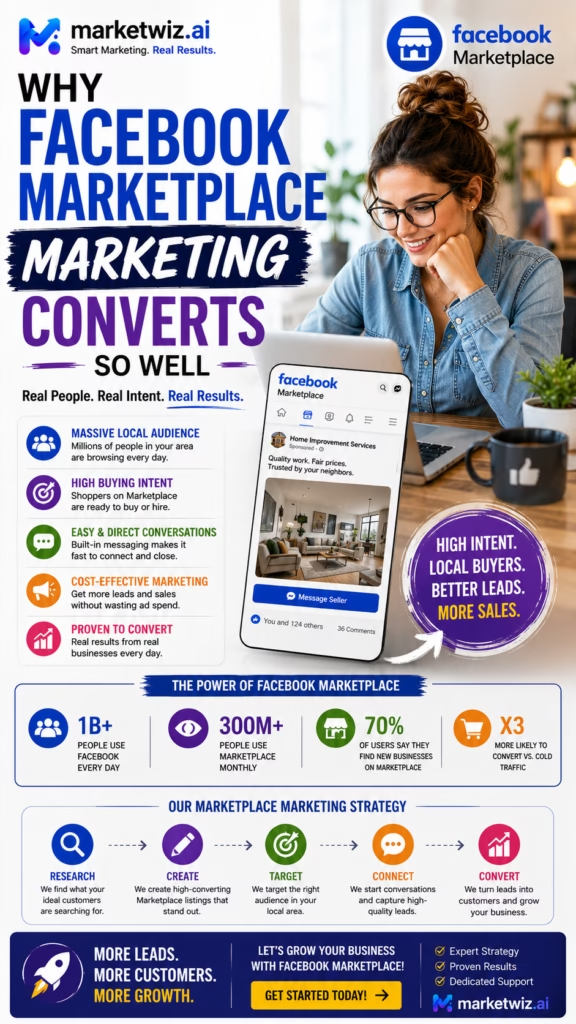
Why Facebook Marketplace Marketing Converts So Well
Why Facebook Marketplace marketing converts so well comes down to customer intent, local relevance, visual discovery, pricing transparency, and a relatively short path from browsing to conversation. Unlike advertising environments where users may be passively consuming content, Marketplace attracts people who are often actively comparing products, prices, inventory, sellers, locations, and options. When businesses combine that intent with stronger listings, fast response, qualification, follow-up, and CRM tracking, Marketplace can become a powerful source of measurable local customer acquisition.
Facebook Marketplace can convert differently from traditional interruption-based advertising because the customer is already in a shopping environment.
A person browsing Marketplace may be comparing furniture, flooring, appliances, equipment, vehicles, home improvement products, inventory, local deals, rental-related items, business supplies, or other products and offers.
That behavior matters.
The business does not always need to manufacture demand from scratch.
Instead, it can position the right offer in front of someone who already has an interest in purchasing, researching, comparing, or solving a problem.
The conversion advantage becomes stronger when listings are specific, visual, locally relevant, accurately priced, easy to understand, and supported by fast customer response.
The Marketplace Conversion Formula
Buyer Intent + Local Relevance + Strong Visuals + Clear Price + Specific Offer + Fast Messaging + Qualification + Easy Next Step + Follow-Up + Revenue Tracking = Strong Marketplace Conversion Potential
1. Facebook Marketplace Starts With Buyer Intent
One of the biggest reasons Marketplace can perform well is simple: many users open it because they want to shop.
Customers Are Already Looking
Marketplace visitors may already have a product category, budget, style, material, model, project, or desired outcome in mind.
They Are Closer to a Decision
A user comparing listings may be further along in the customer journey than someone who sees an unrelated advertisement while watching entertainment content.
Intent Creates Efficiency
Businesses can focus on matching demand rather than first convincing the customer that a category matters at all.
2. Local Intent Can Reduce Friction
Nearby Inventory
Customers may prefer products they can see, pick up, or receive locally.
Faster Availability
Local options can be attractive when customers do not want to wait for long shipping.
Local Appointments
Customers can move from a listing to a showroom visit, estimate, consultation, or pickup.
Local Trust
A nearby business can feel more accessible than a distant anonymous seller.
This local context can shorten the psychological distance between browsing and action.
3. Marketplace Is Built Around Visual Shopping
Images can communicate more information in seconds than a long paragraph of text.
Customers Can Evaluate Style Quickly
Furniture, flooring, fixtures, appliances, equipment, décor, materials, and other visually driven products benefit from strong images.
Customers Can Evaluate Condition
Multiple angles can help buyers understand real-world quality.
Customers Can Visualize Results
Home improvement businesses may benefit from real project photos, installed examples, or finished environments where permitted and relevant.
4. Specific Marketplace Listings Can Convert Better Than Broad Business Ads
A Specific Offer Is Easier to Understand
“Natural Oak Flooring Options” is more concrete than “We Do Flooring.”
A Specific Offer Attracts a Specific Buyer
More precise listings can reduce irrelevant inquiries.
Specific Offers Create Clear Conversations
When the listing already defines the product, category, style, or price point, the first customer message can begin closer to the buying decision.
5. Clear Pricing Helps Marketplace Customers Self-Qualify
Pricing is one of the most powerful conversion tools in a shopping environment.
Price Establishes Expectations
Customers can quickly decide whether an offer is worth exploring.
Price Reduces Unnecessary Friction
Transparent information can reduce repetitive “how much?” messages.
Price Helps Filter Leads
Customers whose expectations are dramatically different may self-select out before contacting the business.
Clearer Pricing Can Improve Conversion Quality
More transparency may reduce raw message volume while increasing the percentage of conversations that have a realistic chance of becoming sales.
6. Marketplace Makes Comparison Shopping Easy
Customers Compare Price
Businesses with clear value can stand out.
Customers Compare Photos
Better visuals can improve perceived quality.
Customers Compare Location
Convenience can become a deciding factor.
Customers Compare Responsiveness
A seller or business that responds quickly can gain an advantage.
Customers Compare Trust
Accuracy, professionalism, clarity, and broader online reputation may influence the final choice.
7. Direct Messaging Shortens the Conversion Funnel
A traditional marketing funnel may require a customer to click an advertisement, load a website, find a form, enter several fields, submit the form, wait for a response, and then begin a conversation.
Marketplace can create a shorter path.
Listing → Customer Question → Business Response → Qualification → Appointment, Quote, Pickup, Delivery, Visit, or Purchase
The fewer unnecessary steps between customer interest and useful communication, the easier it can be to preserve momentum.
8. Marketplace Fits Mobile Shopping Behavior
Customers Can Browse Quickly
Visual cards make it easy to compare several options.
Customers Can Message Immediately
They do not need to leave the browsing environment to ask a basic question.
Customers Can Share Listings
Buyers may send options to spouses, partners, coworkers, property managers, or decision makers.
Customers Can Return Later
Marketplace supports ongoing research behavior.
9. Marketplace Often Captures Immediate Customer Needs
Moving
Customers may need furniture, appliances, flooring, storage, equipment, or household items quickly.
Property Turnovers
Landlords and property managers may be sourcing products for a rental or renovation.
Home Projects
Homeowners may already be in an active buying cycle.
Commercial Needs
Businesses may need equipment, furnishings, flooring, inventory, or supplies on a specific timeline.
Immediate need can naturally increase conversion intent.
10. Real Availability Creates a Strong Conversion Trigger
Customers often respond when they believe the product or solution is available now.
In-Stock Products
Immediate inventory can reduce purchase delays.
Local Delivery
Clear delivery options can create convenience.
Pickup
Customers may value quick access.
Appointments
Available showroom, consultation, or estimate times can turn intent into action.
11. Original Marketplace Photos Build Confidence Faster
Authenticity
Real photos make the offer feel tangible.
Proof
Customers can see inventory, projects, condition, materials, or actual business capabilities.
Detail
Close-up images can answer questions before the customer asks them.
Context
Products shown in realistic settings can be easier to imagine in the customer's own space.
12. Strong Titles Improve Customer Relevance
Lead With the Product
Tell the customer exactly what they are seeing.
Add One Useful Differentiator
Style, condition, material, local stock, delivery, or price can improve relevance.
Avoid Vague Titles
Generic business-language headlines force customers to work too hard to understand the offer.
Examples
Warm Oak Luxury Vinyl Plank – Local Options Available
Modern Sectional Sofa – Delivery Options Available
Commercial Carpet Tiles for Offices and Rental Properties
Stainless Appliance Package for Home or Investment Property
13. Better Descriptions Remove Conversion Friction
Answer the Most Important Questions
- What is the product or offer?
- What does it cost?
- What options are available?
- Where is it located?
- Is delivery available?
- Are there minimum quantities?
- What condition is it in?
- What should the customer do next?
A listing that answers these questions allows the conversation to begin at a more advanced stage.
14. Trust Is One of the Biggest Marketplace Conversion Drivers
Accurate Information
Customers should receive the same facts in the listing and the conversation.
Professional Communication
Clear responses can make a local business feel more credible.
Consistent Business Identity
Customers may research the company elsewhere before buying.
Realistic Claims
Avoid exaggerated guarantees, misleading prices, fake scarcity, or inaccurate availability.
15. Fast Response Protects Marketplace Conversion Intent
Customer interest has a shelf life.
Someone who messages three local sellers may buy from the one who responds first with a useful answer.
A Strong First Response
Thanks for reaching out. Yes, this option is worth discussing. What city are you in, and which size, quantity, or option are you looking for? I can confirm availability and the best next step.
Answer Before Qualifying
Customers are more likely to engage when the business first addresses their immediate concern.
Ask One Useful Question
Avoid overwhelming shoppers with a long list of questions.
16. Lead Qualification Makes Marketplace Conversion More Efficient
Product or Service Fit
Confirm that the customer wants something the business actually provides.
Location Fit
Confirm pickup, delivery, installation, or service-area viability.
Quantity or Scope
Understand how much the customer needs.
Timing
Determine whether the customer is buying now or researching for later.
Next-Step Readiness
Identify customers ready for a call, appointment, quote, visit, or purchase.
17. Strong Marketplace Leads Can Move Naturally to Phone
Messenger is excellent for beginning a conversation, but more complex purchases may benefit from a phone conversation.
Provide Value First
Answer the customer's first question.
Explain Why a Call Helps
A phone conversation may make it easier to confirm options, timing, availability, pricing, or appointment details.
Respect Communication Requirements
Contact information should be handled in accordance with applicable consent and privacy requirements.
18. Marketplace Can Create Appointments Quickly
Showroom Appointments
Retail buyers can compare products in person.
Estimate Appointments
Project-based businesses may move qualified leads into an onsite evaluation.
Consultation Calls
Complex orders may benefit from scheduled conversations.
Pickup Appointments
Local product sales may simply need a confirmed time and location.
19. Marketplace Conversations Can Move Directly Into Quotes
For higher-value transactions, a qualified Marketplace inquiry can transition quickly into pricing or proposal stages.
Collect Required Details
Measurements, quantity, product type, location, project scope, or other information may be needed.
Explain the Quote
Customers should understand what is included.
Create a Decision Path
Every quote should have a clear next action.
20. Follow-Up Captures Customers Who Are Interested but Not Ready Yet
Price Researchers
Some customers need time to compare.
Project Planners
Home improvement buyers may be weeks or months away.
Commercial Buyers
Businesses may need approvals or purchasing decisions.
Inventory Watchers
Customers may be waiting for a specific color, style, model, or quantity.
Appropriate follow-up can convert interest that otherwise disappears.
21. AI Can Help Protect Marketplace Conversion Opportunities
AI Chat Applications
- Answer approved common questions
- Confirm product interest
- Collect customer location
- Ask qualification questions
- Request dimensions or quantities
- Offer appointment options
- Collect contact information when appropriate
- Create CRM records
AI Voice Applications
Voice systems can help with after-hours calls, missed-call recovery, appointment scheduling, and basic qualification.
Automation Should Support, Not Replace, Good Customer Service
Complex pricing, complaints, custom requests, financing, contractual questions, and sensitive situations should be escalated appropriately.
22. CRM Tracking Turns Marketplace Conversations Into a Sales Pipeline
Capture Source
Record the Marketplace listing or campaign that generated the lead.
Capture Customer Information
- Name
- Phone number
- Email when appropriate
- Listing source
- Product or service requested
- Customer location
- Quantity or scope
- Timing
- Appointment status
- Estimated value
Track the Next Action
Every strong lead should have a clear owner and follow-up task.
23. Lead Scoring Helps Teams Prioritize Marketplace Opportunities
Hot Lead
Good geographic fit, clear need, realistic pricing expectations, and ready to move forward.
Warm Lead
Good fit but still comparing options.
Future Lead
Strong fit but later timing.
Low-Fit Lead
Wrong location, wrong product, unrealistic scope, or a need the business cannot support.
24. Track Marketplace Conversion Metrics That Matter
Inquiry Metrics
- Total valid inquiries
- Qualified inquiries
- Average response time
- Phone numbers captured
- Lead source by listing
Sales Metrics
- Appointments scheduled
- Quotes created
- Store visits
- Purchases
- Booked projects
- Close rate
Value Metrics
- Average customer value
- Revenue per qualified lead
- Revenue per listing
- Repeat customer revenue
- Gross profit
25. Connect Facebook Marketplace Conversion to Revenue
Qualified Lead Rate
Qualified Lead Rate = Qualified Marketplace Leads ÷ Total Valid Marketplace Inquiries × 100
Appointment Rate
Appointment Rate = Marketplace Appointments ÷ Qualified Marketplace Leads × 100
Close Rate
Close Rate = Marketplace Customers ÷ Qualified Marketplace Opportunities × 100
Revenue per Qualified Lead
Revenue per Qualified Lead = Marketplace Revenue ÷ Qualified Marketplace Leads
26. Measure Facebook Marketplace Marketing ROI
Customer Acquisition Cost
Customer Acquisition Cost = Total Marketplace Marketing and Sales Cost ÷ New Marketplace Customers
Marketplace ROI
ROI = (Gross Profit From Marketplace Customers − Marketplace Marketing Cost) ÷ Marketplace Marketing Cost × 100
| Metric | Why It Matters |
|---|---|
| Total valid inquiries | Measures real customer conversations generated by Marketplace |
| Qualified lead rate | Shows whether listings attract customers who fit the offer |
| Appointment rate | Measures movement from conversation to meaningful sales activity |
| Close rate | Shows how often qualified opportunities become customers |
| Average customer value | Measures the financial value of customers acquired from Marketplace |
| Gross profit and ROI | Shows whether Marketplace creates profitable customer acquisition |
27. Marketplace Converts Even Better When Other Channels Reinforce Trust
Google Maps
Customers may research the company's Google Business Profile and reviews before moving forward.
Website
Service pages, product pages, FAQs, and company information can answer deeper questions.
Social Media
Video, before-and-after content, projects, products, and team content can reinforce legitimacy.
CRM
Follow-up systems prevent good leads from being forgotten.
Email and Phone
Higher-value purchases may require more communication before the final decision.
28. Common Mistakes That Reduce Marketplace Conversion
Generic Listings
Broad advertising attracts less-specific customer intent.
Poor Photos
Weak visuals reduce confidence.
Unclear Pricing
Customers hesitate when they cannot understand the real cost.
Missing Details
Incomplete listings create unnecessary friction.
Slow Response
High-intent customers may move to another option quickly.
Asking Too Many Questions
The first response should not feel like a complicated application.
No Follow-Up
Interested customers may need additional time.
No CRM Tracking
Businesses lose visibility into what happens after the message.
Measuring Messages Instead of Revenue
High message volume does not automatically equal strong business performance.
29. A 30-Day Facebook Marketplace Conversion Plan
Week 1: Audit Conversion Quality
- Review current listings
- Identify listings with the most inquiries
- Identify listings with the most customers
- Review pricing clarity
- Review image quality
- Review title specificity
- Review response time
- Document current conversion rate
Week 2: Improve Listings
- Create more specific offers
- Rewrite titles
- Improve descriptions
- Add original photos
- Clarify prices
- Clarify minimums
- Clarify local availability
- Use one clear CTA
Week 3: Improve Customer Response
- Create first-response templates
- Create qualification questions
- Improve phone capture
- Create appointment workflows
- Create quote workflows
- Create missed-call recovery
- Connect CRM tracking
- Add AI support where appropriate
Week 4: Measure Revenue
- Measure qualified lead rate
- Measure response time
- Measure appointment rate
- Measure quote rate
- Measure close rate
- Track average customer value
- Track Marketplace revenue
- Calculate ROI
End-of-Month Outcome
After 30 days, the business should understand which listings create the strongest buyer intent, which offers attract better customers, how quickly leads are being answered, which conversations become appointments or sales, and how Marketplace contributes to real revenue.
30. Final Takeaway: Marketplace Converts Well Because the Customer Is Already Shopping
The simplest explanation for why Facebook Marketplace marketing converts so well is that many users are already behaving like buyers.
They are comparing products, evaluating prices, looking at photos, checking local availability, reviewing options, and deciding which seller or business deserves the next conversation.
That makes Marketplace fundamentally different from marketing that interrupts a customer who was not actively shopping.
The strongest listings take advantage of this intent by making the offer easy to understand.
Specific titles attract relevant shoppers. Original photos provide visual proof. Clear descriptions reduce unanswered questions. Accurate pricing helps customers self-qualify. Local availability increases convenience. A simple call to action makes the next step obvious.
Once the customer sends a message, response speed becomes critical.
Businesses should answer the immediate question, ask one useful qualification question, and move good leads toward the next stage.
That stage may be a phone call, showroom visit, estimate, consultation, pickup, delivery, quote, or purchase.
AI chat, AI voice, missed-call recovery, appointment scheduling, CRM integration, lead routing, and automated follow-up can help businesses preserve more of the intent Marketplace generates.
Finally, conversion should be measured beyond messages.
Qualified lead rate, appointment rate, close rate, revenue per qualified lead, average customer value, gross profit, customer acquisition cost, and ROI provide a much clearer picture of whether Marketplace is creating meaningful growth.
When strong customer intent is matched with clear listings and an efficient sales process, Facebook Marketplace can become a high-value local customer-acquisition channel.
Frequently Asked Questions
1. Why does Facebook Marketplace marketing convert well?
Many users are already actively shopping, researching products, comparing prices, and considering local options, which can create stronger purchase intent.
2. Is Facebook Marketplace considered high-intent traffic?
Marketplace often contains higher-intent browsing because users may already be researching or trying to buy.
3. Why does local intent help Marketplace conversions?
Local pickup, delivery, inventory, appointments, and nearby availability can reduce purchase friction.
4. Do Marketplace images affect conversion?
Yes. Strong original images can communicate quality, condition, style, features, and trust quickly.
5. Does pricing help Marketplace conversion?
Clear pricing can help customers self-qualify and reduce uncertainty.
6. Do Marketplace titles matter for conversion?
Yes. Specific titles help customers understand the offer before opening the listing.
7. Do Marketplace descriptions affect conversion?
Yes. Useful descriptions reduce customer questions and clarify features, pricing, availability, and next steps.
8. Why do specific Marketplace listings convert better than generic ads?
Specific listings allow customers to evaluate a defined product, offer, style, or price point more easily.
9. Can Marketplace generate qualified leads?
Yes. Clear listings can attract customers whose needs, location, timing, and price expectations fit the offer.
10. Why is response speed important on Marketplace?
Customers may contact several sellers, so fast useful responses can protect buying momentum.
11. What should a Marketplace first response include?
Answer the customer's main question and ask one useful qualification question.
12. Why does Messenger make Marketplace conversion easier?
Customers can begin a conversation without immediately filling out a long form or leaving the platform.
13. Can Marketplace conversations become appointments?
Yes. Qualified conversations can lead to estimates, store visits, consultations, calls, pickups, deliveries, and other appointments.
14. Can Marketplace conversations become phone leads?
Yes. Strong leads may move naturally from messaging into a phone conversation.
15. Should Marketplace leads be tracked in a CRM?
Yes. CRM tracking helps connect conversations with appointments, quotes, customers, and revenue.
16. Can AI improve Marketplace conversion?
AI can help answer approved questions, qualify leads, collect details, route strong opportunities, and create CRM records.
17. Why does trust matter in Marketplace conversion?
Customers need confidence in the product, seller, business, pricing, and process before moving forward.
18. How can businesses build more trust in Marketplace listings?
Use accurate information, original photos, transparent pricing, realistic availability, and professional communication.
19. Do local pickup options improve Marketplace conversion?
For appropriate products, convenient pickup can simplify the purchase process.
20. Can delivery options improve Marketplace conversion?
Yes, when delivery is practical, clearly explained, and relevant to the product.
21. How can businesses improve Marketplace lead quality?
Use clearer pricing, availability, locations, minimums, original photos, qualification details, and focused CTAs.
22. Should Marketplace listings include minimums?
When relevant, order, delivery, quantity, or project minimums can improve customer fit.
23. What Marketplace conversion metrics should businesses track?
Track qualified leads, response time, appointments, quotes, customers, close rate, customer value, revenue, and ROI.
24. Should businesses measure Marketplace close rate?
Yes. Close rate shows how often qualified Marketplace opportunities become paying customers.
25. Should businesses measure revenue per Marketplace lead?
Yes. Revenue per lead helps identify the most valuable listings and customer segments.
26. Can Facebook Marketplace marketing be automated?
Certain qualification, routing, CRM, reminder, and follow-up workflows may be automated where allowed and appropriately configured.
27. Can Marketplace conversion rates be guaranteed?
No. Conversion depends on demand, offer quality, pricing, competition, location, response speed, customer fit, and sales execution.
28. Should Marketplace be combined with Google Maps and local SEO?
Yes. Customers may research the business through Google, reviews, websites, and other local channels before buying.
29. What is the biggest Marketplace conversion mistake?
Focusing only on message volume while ignoring lead quality, response, trust, conversion, follow-up, and revenue.
30. What is the ultimate goal of Facebook Marketplace marketing?
The goal is to turn buyer intent and Marketplace visibility into qualified conversations, appointments, customers, sales, revenue, and measurable growth.
30 Additional SEO Keywords
Use these supporting phrases naturally across Marketplace guides, local marketing pages, lead-generation content, FAQs, service pages, case studies, and internal links.
Turn Facebook Marketplace Buyer Intent Into More Customers and Revenue
MarketWiz.ai helps businesses organize Facebook Marketplace marketing, create stronger listings, improve titles and descriptions, organize original photos, clarify pricing and local availability, respond faster to inquiries, qualify leads, recover missed calls, connect AI voice and CRM systems, route stronger opportunities, follow up with interested customers, and measure appointments, sales, revenue, gross profit, customer acquisition cost, and return on investment.
This article provides general Facebook Marketplace marketing, lead-generation, conversion, automation, and business information and does not provide legal, financial, licensing, insurance, privacy, telecommunications, consumer-protection, platform-compliance, tax, or regulatory advice. Facebook Marketplace features, categories, eligibility requirements, interfaces, commerce tools, visibility systems, and platform policies may change. Businesses should review current Meta and Facebook Marketplace requirements and applicable advertising, licensing, privacy, calling, SMS, email, consumer-protection, delivery, warranty, product-safety, and industry-specific requirements before publishing listings or implementing customer communication systems. Conversion rates, qualified leads, appointments, customers, sales, revenue, and other results cannot be guaranteed and depend on platform systems, market demand, competition, listing quality, pricing, product or offer quality, location, response speed, customer fit, reputation, qualification, follow-up, and sales execution.













