
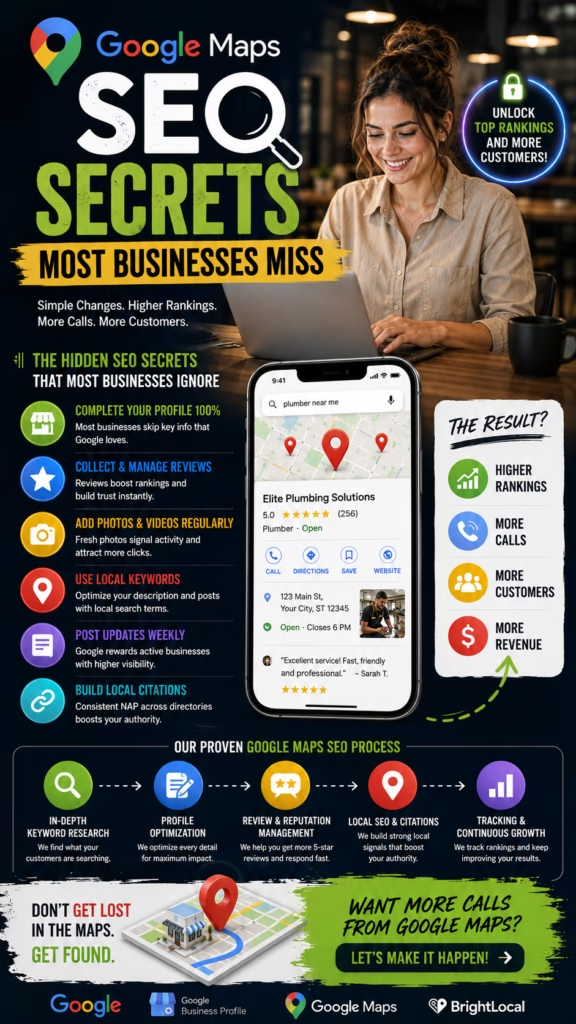
Google Maps SEO Secrets Most Businesses Miss
Google Maps SEO secrets most businesses miss are rarely mysterious tricks or shortcuts. The biggest opportunities usually come from overlooked fundamentals: better category alignment, stronger local landing pages, more useful service information, original photos, detailed customer reviews, faster lead response, cleaner business data, stronger profile conversion, and better tracking of which local interactions become customers and revenue.
Most businesses do not struggle with Google Maps because they are missing one magical trick. They struggle because several small but important parts of the local customer journey are disconnected.
A profile may have the wrong primary category, a weak website page, outdated hours, limited reviews, generic photos, poor phone coverage, or no system for following up with leads.
The business may track rankings but never determine whether profile views become qualified calls, appointments, store visits, estimates, purchases, revenue, or gross profit.
Another common problem is treating Google Business Profile as an isolated listing. In reality, the profile works together with the website, local pages, reviews, customer behavior, brand authority, phone response, appointment systems, and sales process.
The most valuable Google Maps SEO secrets are therefore not hidden loopholes. They are the overlooked connections between relevance, trust, conversion, response speed, and business outcomes.
The Core Google Maps SEO Secret
Local Visibility Only Creates Growth When Accurate Information, Strong Trust, Useful Content, Fast Response, and Sales Follow-Up Work Together.
Secret 1: Rankings Are Not the Final Goal
Many businesses judge local SEO by whether the profile appears in the top three results. Ranking visibility is important, but it is only the beginning of the customer journey.
A high-ranking profile with weak reviews, unclear services, outdated photos, incorrect hours, or an unanswered phone may produce fewer customers than a slightly lower-ranking competitor with stronger trust and conversion.
Track the Complete Journey
- Profile visibility
- Phone calls
- Website visits
- Direction requests
- Messages
- Appointments
- Qualified leads
- Sales and revenue
Secret 2: Relevance Is Often the Real Problem
Businesses frequently assume they need more reviews or more directory listings when the real issue is that the profile and website do not clearly match the search.
Relevance Comes From Alignment
- Primary category
- Secondary categories
- Service names
- Product information
- Business description
- Website service pages
- Location pages
- Customer review language
The business should clearly communicate what it offers, who it serves, and where those services are available.
Secret 3: The Primary Category Matters More Than Many Businesses Realize
The primary category should represent the main real-world business activity. Choosing a broad or secondary service as the primary category can weaken relevance for the most valuable searches.
Review the Primary Category When:
- The company changes its main service
- A new division becomes the primary revenue source
- The profile attracts irrelevant calls
- The website focuses on a different service
- Competitors consistently appear for a more accurate category
Accuracy Comes Before Keyword Opportunity
The goal is not to choose the category with the highest search volume. The goal is to choose the category that most accurately represents the primary business activity.
Secret 4: Secondary Categories Need Precision
Secondary categories can help communicate additional legitimate services, but adding every available category can dilute profile clarity and attract poor-quality leads.
Use Secondary Categories for:
- Real additional services
- Distinct business departments
- Related product specialties
- Customer-facing service lines
- Business activities explained on the website
Avoid categories that represent services the company rarely provides or cannot consistently deliver.
Secret 5: Profile Services Must Match Website Services
A profile may list several services while the website provides little or no supporting information. This creates a weak and confusing customer experience.
Each Important Service Should Have:
- A clear website section or page
- Customer-friendly language
- Service-area information
- Common questions
- Customer proof
- A clear next step
The website does not need a page for every minor service, but core revenue-producing services should be explained in depth.
Secret 6: Review Quality Beats Review Volume Alone
Review count matters to customer confidence, but businesses often overlook the value of detailed, genuine customer experiences.
Useful Reviews May Naturally Describe:
- The service provided
- The employee involved
- The location or service area
- The customer problem
- The communication experience
- The final outcome
Businesses should not script review wording. The goal is to provide a strong customer experience and make it easy for customers to share honest feedback.
Secret 7: Recent Reviews Build Confidence
A profile with many old reviews but little recent activity may appear less active than a competitor receiving steady current feedback.
Build a Consistent Review Workflow
- Trigger requests after completed service
- Send a direct review link
- Follow up once when appropriate
- Respond professionally
- Monitor repeated feedback themes
A steady process is usually more valuable than one large review campaign followed by months of inactivity.
Secret 8: Original Photos Improve Conversion
Most businesses treat photos as decoration. Customers use them as evidence.
Original Photos Can Show:
- Real employees
- Service vehicles
- Storefronts and entrances
- Products and inventory
- Equipment
- Completed projects
- Before-and-after results
- Customer-facing spaces
Original images help customers confirm that the business is active, legitimate, professional, and relevant to their needs.
Secret 9: Profile Conversion Is Part of Google Maps SEO
Businesses often separate rankings from conversion, but strong customer engagement depends on the profile’s usefulness.
Improve Conversion With:
- Accurate hours
- A working phone number
- Clear services
- Current products
- Original photos
- Recent reviews
- A useful website link
- An easy appointment path
A profile should remove uncertainty and help the customer choose the correct next step.
Secret 10: Location Pages Need Real Local Value
Many businesses create dozens of city pages by changing only the location name. These pages provide little value to customers.
A Strong Location Page Can Include:
- Local services
- Neighborhoods served
- Local customer questions
- Location-specific reviews
- Original local photos
- Nearby project examples
- Directions or service-area details
- Accurate contact information
Every location page should help a real customer make a decision.
Secret 11: Internal Linking Supports Local Pages
A location page should not remain isolated from the rest of the website.
Useful Internal Links May Connect:
- Location pages to service pages
- Service pages to relevant locations
- Blog posts to service pages
- Project pages to locations
- FAQs to appointment pages
- Homepage sections to important local pages
Internal linking helps customers navigate and clarifies the relationship between services, locations, expertise, and business offerings.
Secret 12: Business Data Must Stay Consistent
Businesses often correct the Google Business Profile but leave old phone numbers, addresses, hours, or business names across other customer-facing platforms.
Review These Fields:
- Business name
- Address
- Phone number
- Website URL
- Hours
- Categories
- Services
- Location status
Prioritize important directories, social profiles, industry platforms, customer portals, and local organizations.
Secret 13: Adding Service Areas Does Not Create Rankings
Service-area settings help describe where a business operates, but they do not automatically make the profile visible in every listed city.
Local Visibility Still Depends On:
- Distance
- Competition
- Profile relevance
- Review strength
- Website content
- Local authority
- Customer location
- Search intent
Use realistic service areas that reflect actual operational capacity.
Secret 14: Local Authority Must Be Real
Businesses sometimes focus on generating large numbers of weak directory listings while ignoring real local relationships.
Stronger Local Authority Can Come From:
- Local news coverage
- Community organizations
- Chambers of commerce
- Industry associations
- Local partnerships
- Sponsorships
- Events
- Useful local resources
Authentic local recognition usually provides more customer value than low-quality listing volume.
Secret 15: Customer Questions Reveal Content Gaps
Phone calls, reviews, forms, messages, and Google questions show what customers still do not understand.
Common Content Gaps Include:
- Pricing context
- Service areas
- Appointment timing
- Emergency availability
- Product availability
- Parking or directions
- Warranties
- Customer preparation
Use repeated customer questions to improve profile content, service pages, location pages, FAQs, sales scripts, and automated responses.
Secret 16: Business Hours Affect Conversion
Incorrect or incomplete hours can reduce calls, visits, and appointments even when the profile ranks well.
Maintain:
- Regular business hours
- Holiday hours
- Seasonal hours
- Temporary closures
- Emergency availability
- After-hours response procedures
The phone, scheduling system, and employee coverage should match the hours displayed.
Secret 17: Phone Response Changes Google Maps ROI
Local SEO cannot create revenue when high-intent calls are ignored, mishandled, or sent to the wrong employee.
A Strong Call Process Includes:
- A professional greeting
- Basic qualification
- Accurate service information
- Appointment options
- Clear employee ownership
- CRM source tracking
- Follow-up tasks
Simple Call Opening
Thank you for calling [Business Name]. What service or product can we help you with today?
Secret 18: Missed Calls Need an Immediate Recovery Workflow
Customers with urgent local intent may call the next business within minutes.
Missed-Call Recovery Can Include:
- Professional voicemail
- Immediate text acknowledgment
- AI voice assistance
- Callback task creation
- Appointment links
- Employee notifications
Thank you for calling [Business Name]. We are sorry we missed you. Please reply with the service you need and your location, and our team will follow up.
Secret 19: Website Speed Is Important, but It Is Not Enough
A fast website can still convert poorly when customers cannot find the phone number, understand the service, trust the business, or schedule easily.
Website Conversion Also Requires:
- Clear service information
- Visible calls to action
- Original photos
- Customer reviews
- Accurate hours
- Short forms
- Appointment options
- Mobile-friendly design
Secret 20: Mobile Conversion Must Be Simple
Many local searches happen on mobile devices. Customers should not need to zoom, search, or complete long forms.
Mobile Essentials
- Tap-to-call phone number
- Short contact form
- Visible appointment link
- Clear directions
- Readable service information
- Fast-loading images
- Simple navigation
- Strong trust signals
Secret 21: Local Content Needs Proof
Generic city content is easy to create and difficult to trust.
Local Proof Can Include:
- Real project examples
- Local customer reviews
- Original neighborhood photos
- Employee expertise
- Community involvement
- Location-specific questions
- Local service conditions
- Real business experience
The goal is to demonstrate genuine local relevance rather than simply repeating place names.
Secret 22: Profile Posts Should Support Customers
Posting frequently does not automatically produce stronger rankings. Posts should answer customer needs and support profile conversion.
Useful Post Topics
- Seasonal services
- Appointment openings
- New products
- Local projects
- Customer education
- Business updates
- Special hours
- Events
Each post should have a clear customer benefit and one relevant next step.
Secret 23: Duplicate and Inaccurate Profiles Create Risk
Duplicate listings can divide reviews, confuse customers, display incorrect information, and create ownership problems.
Review Profiles for:
- Old business names
- Previous locations
- Duplicate departments
- Former phone numbers
- Unverified listings
- Incorrect practitioner profiles
- Closed locations
- Unauthorized edits
Resolve duplicates carefully using current profile-management procedures.
Secret 24: Tracking Rankings Alone Creates Weak Decisions
A ranking report cannot show whether the customer called, booked, purchased, returned, or referred someone.
Track Business Outcomes
- Qualified calls
- Website form leads
- Appointment bookings
- Direction requests
- Store visits
- Estimates or proposals
- Sales revenue
- Gross profit
Secret 25: AI Must Use Accurate Local Business Data
AI can help organize services, draft posts, summarize reviews, answer calls, respond through chat, schedule appointments, and update CRM records.
However, AI can also distribute inaccurate hours, outdated services, incorrect pricing, unavailable appointments, or the wrong service area when the source information is weak.
Review AI Systems for:
- Current business hours
- Accurate services
- Correct locations
- Approved pricing information
- Real appointment availability
- Human escalation rules
- Customer privacy
- Response quality
Measure the Google Maps Metrics That Actually Matter
Visibility Metrics
- Local search visibility
- Profile views
- Keyword coverage
- Location coverage
- Website visits
- Photo engagement
Customer Action Metrics
- Phone calls
- Messages
- Direction requests
- Appointment clicks
- Product interactions
- Form submissions
Lead and Sales Metrics
- Qualified lead rate
- Appointment rate
- Show rate
- Proposal rate
- Sales conversion
- Average transaction value
Business Metrics
- Customer acquisition cost
- Revenue
- Gross profit
- Repeat customer rate
- Referral rate
- Customer lifetime value
Google Maps ROI Formula
ROI = (Gross Profit From Google Maps Customers − Total Google Maps SEO Cost) ÷ Total Google Maps SEO Cost × 100
Common Google Maps SEO Mistakes Businesses Still Make
Using an Inaccurate Business Name
Extra keywords, cities, and promotional phrases can create profile and trust problems.
Choosing Categories for Search Volume Instead of Accuracy
Categories should represent the real business.
Buying or Manipulating Reviews
Fake or controlled reviews can create policy, legal, and trust risks.
Publishing Generic Location Pages
Thin pages provide little customer value or local proof.
Ignoring Website Conversion
Local visibility cannot produce results when the website is confusing or difficult to use.
Failing to Update Hours
Incorrect hours can create lost calls, visits, and negative experiences.
Missing High-Intent Calls
Customers may immediately contact a competitor.
Using Too Many Disconnected Tools
Separate systems can create duplicate messages, inconsistent data, and weak attribution.
Tracking Only Rankings
Rankings should be connected with leads, sales, revenue, and profit.
Expecting Immediate Results
Local SEO performance varies based on competition, location, profile history, reviews, website quality, and business authority.
A 30-Day Google Maps SEO Improvement Plan
Week 1: Audit Relevance and Accuracy
- Confirm profile ownership
- Review the business name
- Review the primary category
- Review secondary categories
- Review services and products
- Confirm hours
- Test phone routing
- Document current results
Week 2: Improve Trust and Local Proof
- Add original photos
- Create a review-request workflow
- Respond to recent reviews
- Review public questions
- Update the business description
- Publish a useful profile post
- Correct major directory inconsistencies
- Review duplicate profiles
Week 3: Improve Website and Conversion
- Improve important service pages
- Improve location pages
- Add internal links
- Add visible mobile call buttons
- Shorten contact forms
- Add customer proof
- Create missed-call recovery
- Connect appointment links
Week 4: Connect Tracking and Follow-Up
- Track calls and forms
- Measure qualified leads
- Measure appointment rate
- Measure sales conversion
- Connect CRM source tracking
- Review lost opportunities
- Improve employee follow-up
- Calculate revenue and ROI
End-of-Month Outcome
After 30 days, the business should have stronger category alignment, more accurate profile information, better reviews and photos, more useful local pages, improved customer conversion, faster lead response, and clearer insight into which Google Maps interactions produce customers and revenue.
Final Takeaway: The Biggest Google Maps SEO Secrets Are Usually Overlooked Fundamentals
The most valuable Google Maps SEO secrets most businesses miss are not shortcuts, loopholes, or guaranteed ranking tricks.
They are the practical connections between profile relevance, category accuracy, services, reviews, original photos, useful website pages, local authority, customer conversion, response speed, CRM follow-up, and revenue measurement.
Businesses should begin with accurate profile information and the correct primary category. Important services should be clearly explained on both the profile and the website.
Reviews should be requested consistently from real customers. Original photos should show the actual business, employees, products, equipment, projects, and customer-facing locations.
Location pages should provide genuine local value rather than repeating identical content with different city names.
Phone calls, forms, messages, and appointment requests should receive fast professional responses. Missed calls should trigger recovery workflows instead of disappearing.
AI can support profile management, customer communication, scheduling, review workflows, and CRM updates, but only when the underlying business information is accurate and human oversight is maintained.
Performance should be measured through qualified calls, appointments, direction requests, website conversions, sales, acquisition cost, revenue, gross profit, repeat customers, and return on investment.
When these overlooked pieces work together, Google Maps can become a reliable local customer-acquisition system instead of simply another online listing.
Frequently Asked Questions
1. What are the Google Maps SEO secrets most businesses miss?
Commonly missed opportunities include category accuracy, service alignment, useful location pages, detailed reviews, original photos, profile conversion, fast lead response, and revenue tracking.
2. Why do some optimized profiles still perform poorly?
They may have weak relevance, limited reviews, generic photos, poor website support, inconsistent data, or slow customer response.
3. Does completing every profile field guarantee rankings?
No. Results also depend on relevance, distance, prominence, competition, customer location, reviews, and website quality.
4. What is the most overlooked ranking factor?
Relevance is frequently overlooked. Categories, services, website pages, and profile information should clearly match customer searches.
5. Why is the primary category important?
It describes the main business activity and can strongly influence the searches for which the profile is considered relevant.
6. Should businesses add every secondary category?
No. Use only categories that represent real services, products, or customer-facing business activities.
7. Do service descriptions help Google Maps SEO?
Accurate descriptions improve customer understanding and can reinforce relevance when aligned with real website content.
8. Do reviews need keywords?
Businesses should not script reviews. Genuine detailed feedback may naturally mention services, locations, employees, and outcomes.
9. Why do recent reviews matter?
Recent reviews show current business activity and provide updated customer information.
10. Should businesses respond to reviews?
Yes. Professional responses demonstrate attentiveness and help future customers understand the business.
11. Do original photos improve results?
Original photos can improve trust by showing real employees, products, locations, equipment, and completed work.
12. Are stock photos enough?
Stock photos may support design, but they do not provide the same local proof as original business images.
13. Do profile posts directly improve rankings?
Posts can improve profile usefulness and engagement but should not be treated as a guaranteed ranking shortcut.
14. Why are location pages important?
Useful location pages reinforce local relevance with services, reviews, photos, directions, neighborhoods, and customer information.
15. Can duplicate city pages hurt SEO?
Thin pages that only replace the city name provide limited customer value.
16. Does the website influence Google Maps?
A strong website supports services, locations, business data, customer proof, and local relevance.
17. Should the profile link to a location page?
Multi-location businesses often benefit from linking each profile to its matching location page.
18. Does business-data consistency matter?
Yes. Consistent names, addresses, phone numbers, hours, websites, and services reduce confusion and support trusted local information.
19. Do citations alone improve rankings?
Accurate listings can help, but large volumes of low-quality citations do not automatically create strong local authority.
20. Can service-area businesses rank without an address?
Eligible service-area businesses can hide the address and use accurate service areas while following current requirements.
21. Does adding more service areas improve rankings?
No. Distance, relevance, competition, reviews, content, and authority still influence visibility.
22. Why do some highly ranked profiles get few calls?
Weak reviews, outdated photos, unclear services, incorrect hours, poor phone access, or a weak website can reduce calls.
23. How can businesses improve profile conversion?
Improve reviews, photos, services, products, hours, phone accessibility, website pages, and appointment options.
24. How quickly should local leads receive a response?
Respond promptly because high-intent customers may contact several local businesses.
25. Can AI help with local lead response?
AI voice and chat systems can collect information, answer approved questions, schedule appointments, and route leads.
26. How should missed calls be handled?
Use voicemail, missed-call text response, callback tasks, AI voice support, appointment links, and CRM alerts.
27. How long does Google Maps SEO take?
Timing varies by competition, location, category, reviews, website quality, authority, and consistency.
28. Can rankings be guaranteed?
No responsible provider can guarantee one fixed position for every keyword, customer, location, device, or time.
29. What metrics should businesses track?
Track visibility, calls, visits, appointments, qualified leads, customers, revenue, gross profit, acquisition cost, and ROI.
30. What is the biggest Google Maps SEO secret?
Rankings alone do not create growth. Visibility must connect with trust, conversion, fast response, follow-up, and revenue measurement.
30 Additional SEO Keywords
Use these supporting phrases naturally across Google Maps guides, local SEO pages, service pages, location pages, profile optimization content, case studies, FAQs, and internal links.
Turn Overlooked Google Maps SEO Opportunities Into More Customers
MarketWiz.ai helps local businesses improve Google Maps visibility, strengthen Google Business Profile information, build review workflows, create local service and location content, improve lead response, recover missed calls, connect AI voice and CRM systems, book more appointments, and measure customers, revenue, gross profit, and return on investment.
This article provides general marketing, local SEO, automation, and business information and does not provide legal, financial, privacy, telecommunications, consumer-protection, platform-compliance, or regulatory advice. Google Business Profile features, requirements, interfaces, local results, and ranking behavior may change. Businesses should review current Google requirements and applicable call-recording, consent, SMS, email, privacy, data-use, advertising, review-request, and industry-specific requirements before collecting customer data, recording calls, using tracking numbers, requesting reviews, or implementing automated lead-response systems. Rankings, calls, appointments, customers, revenue, and other results cannot be guaranteed and depend on location, competition, market demand, profile quality, website quality, service quality, customer behavior, pricing, capacity, and sales execution.