
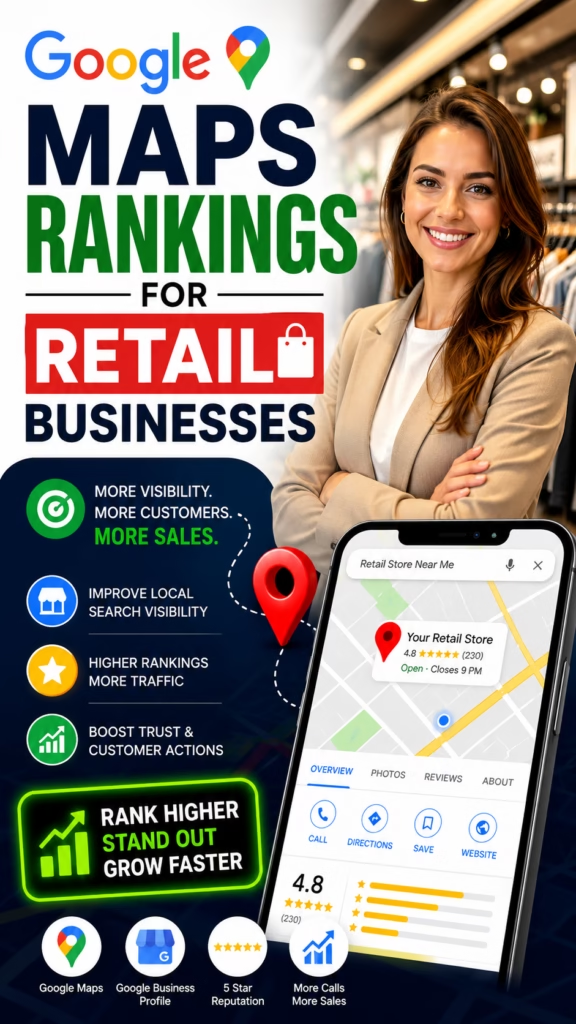
Google Maps Rankings for Retail Businesses
Google Maps Rankings for Retail Businesses helps local stores appear in nearby searches, earn the local pack, attract map-driven foot traffic, build trust through reviews and photos, and convert nearby searches into store visits, calls, and sales.
Introduction
Google Maps Rankings for Retail Businesses begins with understanding how customers actually search for nearby stores. A shopper looking for a mattress, appliance, hardware item, or gift rarely types a long query into a search engine and reads ten articles. They search a product or category near their location, glance at the map, and choose from the top few options that appear.
Google Maps and the local pack give retail businesses one of the most direct paths to nearby, high-intent customers. Unlike broader organic search rankings, local pack rankings are tied to physical proximity, business information accuracy, review strength, category relevance, and ongoing engagement signals.
Retail businesses can use Google Maps to attract customers searching for furniture stores, appliance dealers, hardware stores, clothing shops, electronics retailers, grocery stores, specialty shops, and countless other nearby categories.
The strongest Google Maps strategies focus on a complete Google Business Profile, accurate categories, strong review generation, real photos, consistent citations, and regular activity that signals the business is active and trustworthy.
Google Maps rankings for retail businesses work best when every profile detail confirms the same thing: this is a real, active, nearby, trustworthy store.
A retail profile should not be treated as a one-time setup task. It should function like an ongoing storefront that Google and customers both evaluate continuously through reviews, photos, posts, hours accuracy, and engagement.
Every element plays a role. The business name and category establish relevance. The address and service area establish proximity. The reviews and photos establish trust. The posts and updates establish activity. The website and calls establish conversion.
Main idea: Google Maps Rankings for Retail Businesses is not about gaming an algorithm. It is about building a complete, accurate, and actively maintained profile that gives Google every reason to show it to nearby customers.
Table of Contents
- 1) Why Google Maps matters for retail
- 2) Understanding local ranking factors
- 3) Setting up a complete profile
- 4) Choosing the right categories
- 5) Keeping name, address, and phone consistent
- 6) Using photos to build trust
- 7) Earning and managing reviews
- 8) Adding products and services
- 9) Publishing Google Business posts
- 10) Managing questions and answers
- 11) Building local citations
- 12) Connecting the website and local pages
- 13) Understanding proximity and service areas
- 14) Ranking multiple retail locations
- 15) Encouraging customer engagement
- 16) Using messaging and calls
- 17) Seasonal and promotional updates
- 18) Keeping hours and attributes accurate
- 19) Understanding competitor listings
- 20) Tracking Google Maps performance
- 21) Common Google Maps mistakes
- 22) Final thoughts
- 23) Frequently asked questions
- 24) Extra SEO keywords
1) Why Google Maps Matters for Retail Businesses
Google Maps matters for retail businesses because it captures customers at the exact moment they are ready to visit a nearby store. These searches often carry strong purchase intent, whether the customer is looking for a specific product, comparing nearby options, or simply confirming hours before stopping by.
Google Maps can help retail businesses generate:
- Store visits
- Direction requests
- Phone calls
- Website clicks
- Product inquiries
- Foot traffic during local searches
- Comparison-stage visibility
- Repeat customer recognition
- New customer discovery
- Trust before the first visit
A strong Google Maps presence can be especially valuable for retail categories where customers prefer to see, touch, or try a product before purchasing, such as furniture, mattresses, appliances, clothing, hardware, and specialty goods.
Because Google Maps results are tied to location, a well-optimized profile can help a retail business compete effectively even against larger regional or national chains, particularly for nearby, hyper-local searches.
Google Maps combines location, intent, trust signals, and direct action inside a single local result.
2) Understand Local Ranking Factors
Google generally evaluates local rankings using three broad factors: relevance, distance, and prominence. Retail businesses that understand these factors can prioritize the right optimization work.
Relevance
How well a business profile matches what the searcher is looking for, based on categories, business description, products, and services listed.
Distance
How close the business location is to the searcher or the location included in their search, which businesses cannot directly control.
Prominence
How well-known and well-reviewed a business is, based on reviews, citations, links, and overall online presence and activity.
Profile Completeness
Whether the business has filled out categories, hours, photos, descriptions, products, and attributes accurately and thoroughly.
Retail businesses cannot change their physical distance to every searcher, but they can strongly influence relevance and prominence through profile optimization, review generation, citation building, and consistent activity.
Retailers should focus effort on the ranking factors they can influence: relevance, prominence, and profile completeness.
3) Set Up a Complete Google Business Profile
A complete Google Business Profile gives Google and customers the information needed to trust and display a retail listing. Incomplete profiles often underperform even in less competitive markets.
Google Business Profile completeness checklist:
- Accurate business name
- Correct primary category
- Relevant secondary categories
- Complete address
- Accurate phone number
- Website link
- Accurate hours
- Business description
- Products or services listed
- Real profile and cover photos
- Attributes such as accessibility or payment options
- Appointment or ordering links when applicable
Retail businesses should avoid leaving default or placeholder information in any profile field. Incomplete or generic profiles can appear less credible to both customers and Google.
The business description should clearly explain what the store sells, who it serves, and what makes it a useful local option, without stuffing unnecessary repeated keywords.
A fully completed profile is the foundation every other Google Maps ranking strategy builds on.
4) Choose the Right Categories
Category selection is one of the most influential ranking factors available to retail businesses. Categories tell Google which searches a profile should be eligible to appear in.
Example retail category selection:

Primary category: Furniture Store
Secondary categories: Mattress Store, Home Goods Store

Primary category: Hardware Store
Secondary categories: Tool Store, Paint Store

Primary category: Appliance Store
Secondary categories: Electronics Store, Repair Service

Primary category: Clothing Store
Secondary categories: Shoe Store, Accessories Store
Category selection best practices:
- Choose the most accurate primary category
- Add relevant secondary categories
- Avoid unrelated or misleading categories
- Review category options periodically
- Match categories to actual products or services
- Avoid selecting overly broad categories only
Retail businesses should periodically review available category options, since Google occasionally introduces new or more specific categories that may better describe the business.
Accurate categories help Google match a retail business to the exact searches its customers are already performing.
5) Keep Name, Address, and Phone Consistent
Consistency of business name, address, and phone number, often called NAP consistency, helps confirm business legitimacy and location accuracy across the web.
NAP consistency checklist:
- Identical business name everywhere
- Identical address format
- Identical phone number
- No duplicate profiles
- Updated information after a move
- Consistent suite or unit formatting
- Matching information on the website
- Matching information on directories
Retail businesses should audit their listings across directories, social platforms, and citation sources to confirm that name, address, and phone number match exactly, including abbreviations, suite numbers, and formatting.
Duplicate Google Business Profiles for the same location can confuse ranking signals and split reviews. Retailers should identify and consolidate duplicates whenever they appear.
Inconsistent business information across the web can weaken trust signals and confuse local ranking systems.
6) Use Photos to Build Trust
Photos help customers understand what a retail store looks like, what it sells, and whether it matches their expectations before they arrive.
Strong retail profile photo ideas:
- Storefront exterior
- Interior displays
- Product close-ups
- Checkout and service areas
- Team members at work
- Parking and entrance views
- Seasonal displays
- Customer-facing signage
- Delivery or curbside setup
- Special sections or departments
The primary profile photo and cover photo should clearly represent the storefront and main offering. Avoid outdated photos, unrelated stock images, or images that no longer reflect the current store layout.
Retail businesses should add new photos regularly rather than uploading a single batch once and never returning. Fresh photos can signal an active, well-maintained business.
Real, current photos help customers feel confident before they ever walk through the door.
7) Earn and Manage Reviews
Reviews are one of the strongest prominence signals available to retail businesses. Review count, average rating, recency, and content can all influence local visibility.
Review generation best practices:
- Ask satisfied customers directly
- Provide a simple review link
- Ask at the right moment, such as after checkout
- Train staff to request reviews
- Follow up after service or delivery
- Respond to every review
- Never offer payment for reviews
- Never post fake reviews
- Address negative reviews professionally
- Highlight common positive themes
Example review response:

Thank you for the kind words. We are glad the team could help you find the right product, and we look forward to seeing you again.

Example negative review response:

We are sorry to hear about this experience. Please reach out to our store directly so we can make this right.
Retail businesses should treat review responses as public conversations, since future customers read them to judge how the business handles feedback.
Consistent, genuine reviews build trust with both customers and Google's ranking systems.
8) Add Products and Services
The products and services section allows retail businesses to showcase specific inventory categories directly inside the Google Business Profile.
Useful product listing details:
- Product name
- Category
- Price or price range
- Short description
- Product photo
- Availability
Example product entries:

Queen Mattress Sets
Category: Bedroom Furniture
Starting price varies by model

Cordless Power Drills
Category: Tools
In stock, multiple brands available

Kitchen Appliance Packages
Category: Appliances
Bundle pricing available in store
Retail businesses should keep product listings updated as inventory changes, removing discontinued items and adding new arrivals or seasonal products.
A well-maintained product section helps customers understand exactly what the store offers before they visit.
9) Publish Google Business Posts
Google Business posts allow retail businesses to share updates, promotions, new arrivals, and events directly within the profile.
Retail post ideas:
- New product arrivals
- Seasonal promotions
- Clearance events
- Store hours changes
- Loyalty program updates
- In-store events
- Delivery or curbside options
- Community involvement
- Staff highlights
- Holiday announcements
Example post:

New Fall Furniture Arrivals

Stop by this week to see our newest sectional and dining collections, now available for local delivery.
Consistent posting can signal an active business and give customers additional reasons to visit, especially around promotions, new arrivals, and seasonal changes.
Regular posts keep a retail profile active and give search users more current, useful information.
10) Manage Questions and Answers
The questions and answers section allows customers to ask about hours, products, parking, services, and policies directly on the profile.
Question and answer best practices:
- Monitor the section regularly
- Answer promptly
- Provide accurate, specific answers
- Seed helpful common questions proactively
- Avoid vague or incomplete responses
- Correct inaccurate public answers
Example seeded question:

Do you offer local delivery?

Yes, local delivery is available for most furniture and appliance purchases. Ask a team member for current delivery areas and scheduling.
Unanswered or inaccurate questions can create confusion for potential customers, so retail businesses should treat this section as an active support channel rather than a static feature.
Well-managed questions and answers reduce uncertainty and support customer decision-making before a visit.
11) Build Local Citations
Citations are online mentions of a business name, address, and phone number, typically found on directories, chambers of commerce, industry sites, and local publications.
Useful citation sources for retail businesses:
- General business directories
- Industry-specific directories
- Local chamber of commerce listings
- Local news or community sites
- Mapping and navigation platforms
- Review platforms
- Social media business pages
- Supplier or manufacturer locator pages
Retail businesses should confirm that each citation uses consistent business information and correct any outdated listings after a move, rebrand, or phone number change.
Citations do not need to be extensive to be useful, but they should be accurate, relevant, and consistent with the primary Google Business Profile information.
Citations reinforce that a retail business exists, operates at a specific location, and is a legitimate local option.
12) Connect the Website and Local Pages
A retail business website can support Google Maps rankings by reinforcing location relevance, providing additional local content, and confirming business details.
Website elements that support local rankings:
- Location page with address and hours
- Embedded map
- Local business schema markup
- Store-specific content
- Consistent NAP information
- Links to the Google Business Profile
- Local customer testimonials
- Directions and parking information
Multi-location retailers should create a unique page for each store location rather than relying on a single generic contact page for all locations.
A well-structured website reinforces the same local information Google displays on the Maps profile.
13) Understand Proximity and Service Areas
Proximity is one factor businesses cannot directly control, but understanding how it works helps set realistic expectations for local rankings.
Proximity considerations for retail:
- Searches near the store often rank easier
- Searches farther away require stronger prominence
- A single storefront cannot rank everywhere equally
- Service-area businesses have different display rules
- Physical retail locations should display their exact address
Since retail businesses generally rely on customers visiting a physical storefront, the address should be listed accurately rather than hidden, and the business should avoid using a service-area setting meant for businesses without a public-facing location.
Retail businesses should expect stronger rankings for nearby searches and understand that distant rankings require additional prominence signals.
14) Rank Multiple Retail Locations
Multi-location retailers can compete in several markets by building a fully optimized, individual Google Business Profile for each physical store.
Multi-location Google Maps best practices:
- Create a separate profile for each location
- Use unique photos per location
- Encourage reviews at each location
- List accurate hours per location
- Use location-specific descriptions
- Avoid duplicate or merged listings
- Assign local staff to manage each profile
- Track performance by location
Each location profile should reflect that store's actual inventory, staff, hours, and community involvement rather than reusing identical content across every listing.
Multi-location retail success on Google Maps depends on treating each store as its own local business.
15) Encourage Customer Engagement
Ongoing customer engagement, such as messages, reviews, photo uploads, and profile interactions, can help signal that a retail business is active and relevant.
Ways to encourage engagement:
- Invite customers to leave photos
- Respond to every review
- Answer messages promptly
- Share updates through posts
- Encourage check-ins or tags on social media
- Promote the profile in-store
- Include the profile link in receipts or emails
Retail staff can play an important role by mentioning the Google Business Profile during checkout, on receipts, or in follow-up communications.
Ongoing engagement helps keep a retail profile visible, current, and trustworthy over time.
16) Use Messaging and Calls Effectively
Many Google Business Profiles allow direct messaging and click-to-call features, giving customers an immediate way to ask questions before visiting.
Example message response:

Thanks for reaching out. Yes, that item is currently in stock. Feel free to stop by, or let us know if you would like us to hold it for you.
Messaging and call best practices:
- Respond quickly to messages
- Answer calls promptly during business hours
- Train staff to check for new messages
- Provide clear, helpful answers
- Confirm availability before customers travel
- Follow up after unanswered inquiries
Slow or missed responses to messages and calls can send potential customers to competing nearby retailers instead.
Fast, helpful responses turn Google Maps visibility into actual store visits and sales.
17) Update for Seasonal and Promotional Periods
Retail businesses often experience seasonal shifts in demand, and Google Business Profiles should reflect current promotions, hours, and inventory during these periods.
Seasonal update ideas:
- Holiday hours
- Seasonal product highlights
- Clearance and end-of-season sales
- Special event announcements
- Gift guide posts
- Back-to-school promotions
- Weather-related closures or changes
Retailers should update special hours around holidays well in advance and remove outdated seasonal posts once a promotion ends.
Timely seasonal updates keep a retail profile accurate and relevant throughout the year.
18) Keep Hours and Attributes Accurate
Accurate hours and attributes help customers know exactly what to expect before visiting, reducing frustration and building trust.
Accuracy checklist:
- Regular business hours
- Holiday hours
- Temporary closures
- Accessibility attributes
- Payment options
- Curbside or delivery availability
- Parking information
- Service offerings
Inaccurate hours can lead to wasted customer trips and negative reviews, both of which can undermine trust signals that support local rankings.
Accurate, current information reduces friction and builds confidence before a customer ever arrives.
19) Understand Competitor Listings
Reviewing nearby competitor listings can help retail businesses understand what strong local profiles in their category typically include.
Competitor review checklist:
- Categories used
- Review count and rating
- Photo quantity and quality
- Posting frequency
- Products and services listed
- Response style to reviews
- Website and citation presence
This research should inform realistic improvement goals rather than encourage copying competitor content directly. Each retail business should highlight its own accurate strengths.
Competitor research helps set realistic benchmarks for review count, photo quality, and profile completeness.
20) Track Google Maps Performance
Tracking helps retail businesses understand whether their Google Maps optimization efforts are translating into actual visibility and customer action.
Google Maps performance metrics:
- Profile views
- Search queries used to find the profile
- Direction requests
- Phone calls
- Website clicks
- Message inquiries
- Review growth over time
- Average rating trend
- Photo views
- Post engagement
Example monthly performance:

3,200 profile views
480 direction requests
210 phone calls
95 website clicks
18 new reviews

Direction request rate:
480 ÷ 3,200 = 15%

Call rate:
210 ÷ 3,200 = 6.6%
A profile with strong views but weak direction requests or calls may need clearer photos, stronger reviews, more complete information, or more compelling posts.
Retail businesses should track actions like calls and direction requests, not only total profile views.
21) Common Google Maps Mistakes for Retail Businesses
Many retail profiles underperform because of incomplete information, inconsistent details, weak review management, or inactive maintenance.
Common Google Maps mistakes include:
- Leaving the profile incomplete
- Choosing inaccurate categories
- Allowing inconsistent NAP information
- Uploading outdated photos
- Ignoring reviews
- Never responding to negative reviews
- Posting fake or incentivized reviews
- Leaving incorrect hours posted
- Failing to update seasonal information
- Creating duplicate listings
- Ignoring questions and messages
- Never publishing posts or updates
- Failing to track performance
Another common mistake is treating the profile as a one-time setup rather than an ongoing local marketing channel that requires regular attention.
Google Maps rankings for retail businesses rarely suffer from lack of nearby demand. They often suffer from incomplete profiles, inconsistent information, weak reviews, or inactive maintenance.
22) Final Thoughts
Google Maps Rankings for Retail Businesses improve when a store treats its Google Business Profile as an actively maintained local storefront rather than a static listing.
The strongest strategy includes a complete profile, accurate categories, consistent business information, real photos, strong review generation, active posting, prompt messaging, accurate hours, and ongoing performance tracking.
Retail businesses do not need to outspend larger competitors to rank well locally. They can compete through accuracy, responsiveness, review quality, visual proof, and consistent local relevance.
A customer should be able to find a retail business on Google Maps and immediately understand what it sells, where it is located, whether it is currently open, what other customers think of it, and how to get there.
Google Maps can support furniture stores, appliance dealers, hardware stores, clothing retailers, electronics shops, grocery stores, specialty retailers, and many other local retail categories.
Build a Stronger Local Google Maps Presence
Market Wiz AI helps retail businesses improve Google Business Profile optimization, review generation, local citation building, multi-location management, and local performance tracking.
Schedule a Market Wiz AI DemoFinal takeaway: The best Google Maps strategy turns a complete, accurate, and actively maintained profile into consistent local visibility, more store visits, and more sales.
23) Frequently Asked Questions
1) What are Google Maps Rankings for Retail Businesses?
Google Maps Rankings for Retail Businesses refer to how well a store's Google Business Profile appears in local search results and the Google Maps app for nearby, relevant searches.
2) How can retail businesses rank higher on Google Maps?
By fully completing their profile, choosing accurate categories, earning consistent reviews, publishing real photos, and keeping business information accurate and active.
3) What is the Google Maps local pack?
The local pack is the group of business listings shown near the top of local search results, typically displayed with a map, ratings, and business details.
4) Do reviews affect Google Maps rankings?
Yes, review count, recency, average rating, and owner responses can all influence local search visibility.
5) Does the Google Business Profile category matter?
Yes, accurate primary and secondary categories help Google understand which searches a retail business should appear for.
6) How important is NAP consistency?
Consistent business name, address, and phone number across the web help confirm legitimacy and location accuracy, which supports local rankings.
7) Do photos affect Google Maps visibility?
Photos can influence engagement and customer confidence, and profiles with regular, high-quality, real photos often perform better than sparse or outdated profiles.
8) Should retail businesses post updates?
Yes, regular posts about products, promotions, and store updates can keep a profile active and give customers more reasons to visit.
9) Are citations important for retail businesses?
Yes, citations help confirm business legitimacy and location accuracy across directories and other websites.
10) Can multi-location retail businesses rank in several cities?
Yes, by creating a separate, fully optimized profile for each physical location.
11) Should retail businesses respond to reviews?
Yes, responding to both positive and negative reviews shows engagement and helps build trust with future customers.
12) How often should hours be updated?
Hours should be updated whenever they change, including holidays, seasonal adjustments, and temporary closures.
13) Does the website help Google Maps rankings?
Yes, a website with consistent business information, local content, and location pages can reinforce local relevance signals.
14) What is proximity in local search?
Proximity refers to how close a business is to the searcher or the searched location, which is a ranking factor businesses cannot directly control.
15) Should retail businesses list products on their profile?
Yes, listing current products and categories helps customers understand exactly what is available before visiting.
16) Can messaging affect customer decisions?
Yes, prompt and helpful responses to profile messages can influence whether a customer chooses to visit the store.
17) Should businesses monitor competitor listings?
Yes, reviewing competitor listings can help set realistic benchmarks for reviews, photos, and profile completeness.
18) What metrics should retailers track?
Retailers should track profile views, search queries, direction requests, calls, website clicks, and review growth.
19) Can seasonal updates help rankings?
Yes, keeping hours, promotions, and posts current during seasonal periods helps maintain an accurate, active profile.
20) Should retail businesses avoid duplicate listings?
Yes, duplicate profiles for the same location can split reviews and confuse ranking signals.
21) Are attributes like accessibility important?
Yes, accurate attributes help customers understand parking, accessibility, payment options, and other practical details.
22) Why might a profile get views but few visits?
The profile may have weak photos, few reviews, incomplete information, or unclear hours and offerings.
23) Should every location have unique content?
Yes, each location profile should reflect its own hours, staff, photos, and community involvement rather than duplicated content.
24) What is the biggest Google Maps mistake for retailers?
One of the biggest mistakes is treating the profile as a one-time setup rather than an ongoing, actively maintained local marketing channel.
25) What is the best Google Maps tip for retail businesses?
Keep the profile complete and accurate, earn consistent genuine reviews, publish real photos, and respond quickly to reviews, messages, and calls.
24) Extra SEO Keywords
- Google Maps Rankings for Retail Businesses
- Google Maps SEO
- local pack rankings
- Google Business Profile optimization
- retail local SEO
- near me search rankings
- local search visibility
- small business marketing
- Google Maps optimization for stores
- local business rankings
- Google Business Profile for retail
- local SEO strategy
- store visibility on Google Maps
- Google Maps reviews strategy
- retail store local marketing
- Google Maps citations
- local pack optimization
- Google Maps ranking factors
- local retail advertising
- multi-location local SEO
- Google Maps lead generation
- local customer acquisition
- retail business growth
- Google Maps posting strategy
- local Google Maps ranking strategy













