
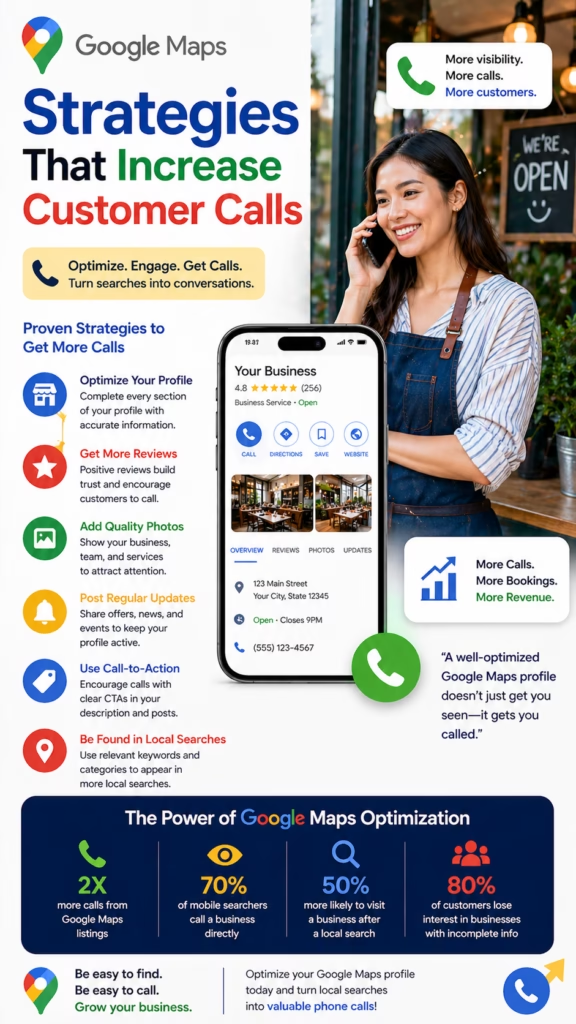
Google Maps Strategies That Increase Customer Calls
Google Maps Strategies That Increase Customer Calls explains how local businesses can improve visibility, strengthen trust, optimize their Google Business Profile, and turn nearby searches into more phone calls, appointments, visits, and leads.
Introduction
Google Maps Strategies That Increase Customer Calls are essential for local businesses that depend on people nearby taking action. When someone searches for a plumber, painter, HVAC company, mattress store, restaurant, landscaper, contractor, dentist, med spa, roofer, real estate agent, or local service provider, Google Maps often becomes one of the fastest paths from search to phone call.
That is why Google Maps is not just a visibility tool. It is a call-generation channel. Customers can search, compare, read reviews, check photos, confirm hours, visit a website, request directions, and tap the call button within seconds. If the business looks trustworthy and relevant, the customer is more likely to call.
Google Maps strategies that increase customer calls focus on visibility, trust, relevance, profile completeness, reviews, and easy contact actions.
Many businesses lose calls because their Google Business Profile is incomplete, outdated, inactive, or poorly optimized. They may have weak photos, missing services, few reviews, wrong categories, inconsistent information, or no clear reason for a customer to choose them. These problems reduce trust and lower the chance of getting the call.
The best Google Maps strategies combine profile optimization, review growth, photo updates, service clarity, local SEO, call tracking, website support, and fast response systems. When these pieces work together, businesses can increase the number of people who find them and the number of searchers who actually call.
Main idea: Businesses increase customer calls from Google Maps by becoming easier to find, easier to trust, easier to understand, and easier to contact.
Table of Contents
- 1) Why Google Maps drives customer calls
- 2) How local search intent turns into phone calls
- 3) Google Business Profile optimization
- 4) Categories that improve call relevance
- 5) Service details that answer customer questions
- 6) Reviews that increase call confidence
- 7) Photos and videos that build trust before the call
- 8) Local keywords that attract ready-to-call customers
- 9) Website support for call conversion
- 10) Business information accuracy and call trust
- 11) Posts and offers that create call urgency
- 12) Response speed after the call
- 13) Tracking calls from Google Maps
- 14) Common mistakes that reduce calls
- 15) Final thoughts
- 16) FAQs
- 17) Extra keywords
1) Why Google Maps Drives Customer Calls
Google Maps drives customer calls because it connects local search intent with immediate contact options. A person searching for a nearby business often wants help soon. They may need a quote, appointment, repair, reservation, product, consultation, or visit. Google Maps places the call button directly in front of that customer.
This makes Google Maps different from many other marketing channels. Customers are not always passively scrolling. Many are actively searching for a solution. When a business appears with strong reviews, clear services, good photos, accurate hours, and a working phone number, it has a better chance of earning the call.
Google Maps can increase calls by improving:
- Local visibility
- Customer trust
- Review confidence
- Service clarity
- Contact convenience
- Mobile search conversions
- Nearby customer awareness
- Urgent service discovery
- Appointment requests
- Lead generation
Google Maps strategies that increase customer calls work because they help businesses appear at the exact moment customers are ready to act.
2) How Local Search Intent Turns Into Phone Calls
Local search intent is powerful because it often shows immediate need. A customer searching “emergency plumber near me,” “best mattress store near me,” “interior painter nearby,” “HVAC repair open now,” or “Google Maps SEO agency” may be close to making a decision.
That search can quickly turn into a call if the business profile gives the customer enough confidence. The profile must answer key questions quickly: Does this business offer what I need? Is it nearby? Is it open? Do other customers trust it? Can I call now?
Local search happens
Customer sees Google Maps results
Customer compares reviews, photos, hours, and services
Customer chooses the most trusted option
Customer taps the call button
The more clearly a Google Maps profile matches customer intent, the more likely it is to generate phone calls.
3) Google Business Profile Optimization
The Google Business Profile is the foundation of Google Maps call generation. A complete profile gives customers the information they need before calling. An incomplete profile creates hesitation. If hours are missing, services are unclear, photos are poor, or the phone number looks unreliable, customers may choose a competitor.
Profile optimization should focus on accuracy, clarity, trust, and action. Every section of the profile should help customers understand the business and feel comfortable calling.
A call-focused Google Business Profile should include:
- Correct business name
- Accurate phone number
- Current business hours
- Website link
- Strong primary category
- Relevant secondary categories
- Complete services or products
- Clear business description
- Recent photos and videos
- Review responses
Businesses increase calls from Google Maps by making their Google Business Profile complete, accurate, trustworthy, and easy to contact.
4) Categories That Improve Call Relevance
Categories help Google understand what the business does and which searches it should appear for. A strong primary category can improve the relevance of the profile. Relevant secondary categories can support additional services without confusing the business identity.
For example, a business that primarily handles HVAC repair should choose a category that reflects HVAC services instead of a vague or unrelated category. A mattress store should use categories that clearly match retail mattress buying intent. A local marketing agency should select categories aligned with marketing, advertising, or internet marketing services.
Better category selection can increase calls by helping the business show up for searches that match what customers actually need.
5) Service Details That Answer Customer Questions
Service details help customers decide whether to call. If a customer needs cabinet painting, emergency AC repair, same-day mattress delivery, roof inspection, drain cleaning, or local SEO services, they want to know quickly whether the business provides that exact service.
Businesses should list core services clearly. Each service should use customer-friendly language. The goal is to remove uncertainty and make the call feel like the obvious next step.
Call-focused service detail example:
Service: Emergency HVAC Repair
Description: Fast local AC and heating repair for nearby homeowners.
CTA: Call now to check availability.
Specific service details increase calls because customers are more likely to contact a business that clearly solves their exact problem.
6) Reviews That Increase Call Confidence
Reviews are one of the biggest drivers of customer confidence on Google Maps. Before calling, customers often compare star ratings, review count, recent reviews, written feedback, and business responses. Strong reviews reduce risk and make the business feel safer to contact.
A business should create a consistent review request process. Happy customers should be encouraged to leave honest feedback after a successful service, purchase, appointment, or visit. The business should also respond to reviews professionally.
Review strategies that support more calls:
- Ask satisfied customers for reviews
- Send a simple review link
- Respond to every positive review
- Respond calmly to negative reviews
- Mention services naturally in responses
- Build reviews consistently over time
- Use feedback to improve operations
Reviews increase customer calls because they give searchers confidence before they tap the call button.
7) Photos and Videos That Build Trust Before the Call
Photos and videos can influence whether a customer calls. A profile with recent, authentic visuals feels more active and reliable. A profile with no photos, outdated images, or low-quality visuals can create doubt.
Businesses should upload photos that show real work, real products, real people, real locations, and real results. Service businesses can use before-and-after images. Storefronts can show interiors, products, staff, displays, and exterior signage. Local agencies can use team photos, client examples, brand visuals, and office or work environment images.
Photos that help increase calls:
- Completed project photos
- Before-and-after images
- Team photos
- Storefront exterior photos
- Product photos
- Service vehicles
- Interior business photos
- Short helpful videos
- Branded service graphics
Strong visuals help increase calls by making the business feel real, active, professional, and trustworthy.
8) Local Keywords That Attract Ready-to-Call Customers
Local keywords help connect the business with customers who are ready to call. These keywords should appear naturally in the business description, services, posts, website pages, FAQs, and local landing pages. The goal is not keyword stuffing. The goal is clear local relevance.
Businesses should think about how customers search when they need help. They may include service names, city names, neighborhood names, urgency phrases, “near me” searches, and problem-based queries.
Examples of call-focused local keywords:
AC repair near me
Emergency plumber in Dallas
Mattress store in Rochester NY
Interior painter in Fort Worth
Google Maps SEO agency for local businesses
Same-day delivery near me
Local keywords increase call opportunities by helping businesses appear for searches with strong customer intent.
9) Website Support for Call Conversion
A Google Maps profile can generate calls directly, but the website also plays an important role. Many customers click to the website before calling. If the website is slow, confusing, outdated, or missing phone numbers, the business may lose the call.
A call-focused website should clearly display the phone number, services, service areas, trust signals, reviews, photos, FAQs, and strong calls to action. Mobile usability is especially important because many Google Maps searches happen on phones.
Website features that help increase calls:
- Clickable phone number
- Strong mobile design
- Clear service pages
- City landing pages
- Customer reviews
- Fast loading speed
- Simple quote forms
- Visible call buttons
- Trust badges or proof
- FAQs that answer objections
Google Maps strategies that increase customer calls work better when the website makes calling easy from every page.
10) Business Information Accuracy and Call Trust
Accurate business information is essential for call trust. If customers see conflicting phone numbers, outdated hours, wrong addresses, or inconsistent details across the web, they may hesitate. Google may also struggle to understand which information is correct.
Businesses should keep name, address, phone number, website, hours, service areas, and categories consistent across Google, the website, directories, social profiles, and local listings.
Accurate business information increases calls because customers feel more confident contacting a business that looks reliable and current.
11) Posts and Offers That Create Call Urgency
Google Business Profile posts and offers can encourage customers to call sooner. A post can announce appointment openings, seasonal services, limited-time offers, emergency availability, delivery promotions, new products, or special service windows.
The best posts are clear, short, and action-focused. They should explain the offer, who it is for, where it applies, and what the customer should do next.
Call-focused post formula:
Headline: Local service or offer
Body: Clear benefit and urgency
Trust signal: Experience, reviews, or availability
CTA: Call today to schedule
Posts and offers increase customer calls by giving local searchers a timely reason to contact the business now.
12) Response Speed After the Call
Getting more calls is only valuable if the business answers and follows up quickly. Many local businesses lose leads because calls go unanswered, voicemails are not returned, or staff do not have a strong phone process. Google Maps can create the opportunity, but the business must convert it.
Every business should have a call-handling system. This may include call forwarding, voicemail scripts, missed-call text-back, appointment booking, CRM tracking, and clear staff training. The faster the response, the better the chance of turning a call into revenue.
Call conversion improvements:
- Answer calls during business hours
- Use missed-call text-back
- Return voicemails quickly
- Train staff on call scripts
- Track lead sources
- Confirm appointments by text
- Follow up with quote requests
Google Maps strategies that increase customer calls should always include a system for answering, tracking, and converting those calls.
13) Tracking Calls From Google Maps
Tracking is necessary because businesses need to know whether Google Maps is producing real results. Calls should be measured along with direction requests, website clicks, messages, bookings, and closed customers.
Businesses can use call tracking, Google Business Profile insights, CRM tags, landing pages, staff intake questions, or lead source reporting. The goal is to understand which searches, services, locations, and profile updates are producing calls.
Important call metrics include:
- Total calls from Google Maps
- Missed calls
- Answered calls
- Booked appointments
- Quote requests
- Closed sales
- Call time of day
- Call source
- Service requested
- Revenue from Maps leads
Tracking calls helps businesses improve Google Maps strategy based on real customer behavior instead of guessing.
14) Common Mistakes That Reduce Calls
Many businesses do not receive enough calls from Google Maps because their profile does not create confidence. Even if they appear in search results, customers may skip them if the profile looks weak, outdated, or less trustworthy than competitors.
- Incomplete Google Business Profile
- Wrong phone number
- Outdated business hours
- Poor category selection
- Missing services
- Few or weak reviews
- No review responses
- Low-quality photos
- Slow website
- No clickable phone number on website
- Inconsistent business information online
- No call tracking
- Missed calls with no follow-up
Big mistake: improving Google Maps visibility without improving the call conversion process.
15) Final Thoughts
Google Maps Strategies That Increase Customer Calls come down to one core principle: make the business the easiest and most trustworthy choice for nearby customers. When a customer searches locally, the business must appear relevant, credible, active, and simple to contact.
The strongest strategies include complete profile optimization, accurate categories, clear services, strong reviews, fresh photos, local keywords, website support, consistent business information, timely offers, and fast call response. These pieces work together to turn Google Maps visibility into real phone calls.
Final takeaway: Google Maps strategies increase customer calls when they improve visibility, trust, customer confidence, contact convenience, and follow-up speed.
16) FAQs
1) What are Google Maps strategies that increase customer calls?
They are local SEO and Google Business Profile strategies designed to help businesses appear more often, build trust faster, and encourage nearby customers to call.
2) Why does Google Maps generate phone calls?
Google Maps generates calls because customers often use it when they need nearby services, products, directions, quotes, or appointments.
3) Can Google Business Profile optimization increase calls?
Yes. A complete and optimized profile can increase visibility and make customers more likely to call.
4) Do reviews increase customer calls?
Yes. Reviews build trust and help customers feel more confident before contacting a business.
5) Do photos help generate calls?
Yes. Fresh, real photos make the business feel active, professional, and trustworthy.
6) What profile information matters most for calls?
Phone number, hours, services, categories, reviews, photos, location, and website links all matter.
7) Should businesses use call tracking?
Yes. Call tracking helps businesses understand how many calls come from Google Maps and which leads convert.
8) What categories should businesses choose?
Businesses should choose the most accurate primary category and relevant secondary categories that match their real services.
9) Can service details increase calls?
Yes. Clear service details help customers know whether the business solves their exact problem.
10) How do local keywords help?
Local keywords help the profile and website match customer searches involving services, cities, neighborhoods, and urgent needs.
11) Should the website have a phone number?
Yes. The phone number should be visible, clickable, and easy to find on mobile devices.
12) Can Google Maps help emergency service businesses?
Yes. Emergency service businesses can benefit because many customers search Google Maps when they need immediate help.
13) Can storefronts get more calls from Google Maps?
Yes. Storefronts can receive calls about hours, inventory, directions, appointments, pricing, and availability.
14) Should businesses respond to reviews?
Yes. Review responses show professionalism and can increase customer confidence.
15) Do Google Business Profile posts help calls?
Posts can help by promoting timely offers, service openings, updates, and calls to action.
16) What causes businesses to lose calls from Google Maps?
Wrong information, weak reviews, poor photos, unclear services, missed calls, and slow follow-up can reduce results.
17) How often should businesses update photos?
Businesses should add new photos consistently, especially after projects, product updates, events, or seasonal changes.
18) Is Google Maps SEO a one-time task?
No. It works best when businesses update profiles, collect reviews, post content, and track calls consistently.
19) Can missed-call text-back help?
Yes. Missed-call text-back can help recover leads that would otherwise be lost.
20) Should businesses track booked jobs from Google Maps?
Yes. Tracking booked jobs shows whether calls are turning into real revenue.
21) Can Google Maps calls turn into repeat customers?
Yes. Strong service, follow-up, and customer experience can turn Maps leads into repeat customers.
22) What role does website speed play?
A fast website helps customers quickly find information and call without frustration.
23) Can local offers increase calls?
Yes. Clear offers can create urgency and give customers a reason to call now.
24) Should businesses mention service areas?
Yes. Service areas help customers know whether the business serves their location.
25) What is the main goal of Google Maps call strategy?
The main goal is to turn local search visibility into real phone calls, appointments, visits, leads, and customers.
17) Extra Keywords
- Google Maps Strategies That Increase Customer Calls
- Google Maps SEO
- Google Business Profile optimization
- increase customer calls
- local SEO calls
- Google Maps lead generation
- local business phone calls
- Google Maps marketing
- Google Business Profile calls
- local search calls
- near me call strategy
- Google Maps ranking strategy
- local customer leads
- call tracking for Google Maps
- Google Maps profile optimization
- local business visibility
- Google reviews strategy
- Google Maps conversion optimization
- service business calls
- storefront phone calls
- local map pack SEO
- Google Maps customer acquisition
- Google Maps call button
- local lead conversion
- Google Maps customer calls