
How Businesses Generate Leads Across Multiple Marketplaces
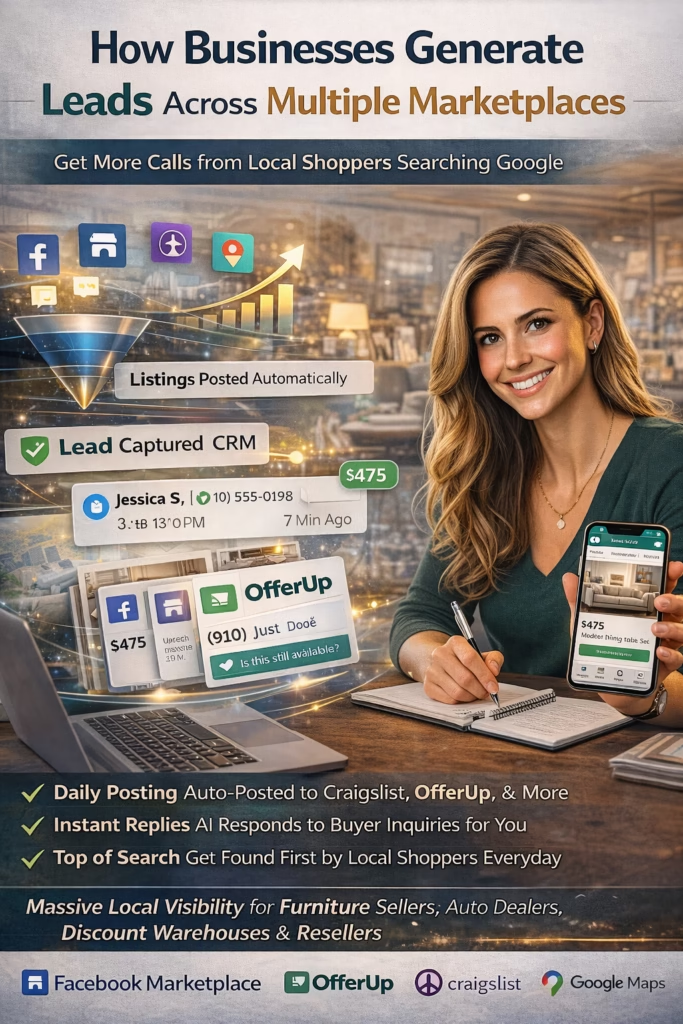
How Businesses Generate Leads Across Multiple Marketplaces explains how businesses use stronger listings, local visibility, trust signals, response systems, and cross-platform consistency to generate more leads across platforms like OfferUp, Facebook Marketplace, Craigslist, Google Maps, Nextdoor, and other local marketplaces.
Introduction
How Businesses Generate Leads Across Multiple Marketplaces is one of the most practical questions for local businesses that want more opportunities without relying on one platform alone. Many businesses post in one place and hope for steady lead flow, but marketplace behavior is fragmented. Some buyers spend time on Facebook Marketplace. Others check OfferUp. Some search Craigslist. Others go straight to Google Maps or neighborhood-focused platforms like Nextdoor. Businesses that understand this spread their visibility across more than one marketplace and create more chances to be found.
This matters because lead generation is often a visibility problem and a conversion problem at the same time. A business needs to show up where local people are looking, but it also needs to make those people feel comfortable enough to respond. That means cross-platform lead generation is not just about posting everywhere. It is about posting well, matching each marketplace to the right buyer behavior, and creating consistent trust across all channels.
Businesses generate better multi-marketplace lead flow when they combine broader local visibility with stronger listing quality and faster response systems.
For mattress stores, furniture sellers, appliance businesses, home service companies, wellness brands, movers, cleaners, painters, contractors, repair companies, and many other local businesses, multiple marketplaces can work together as one lead system. One platform may create fast product inquiries. Another may produce neighborhood trust. Another may generate high-intent phone calls. When combined well, these platforms create more daily opportunities than any single channel alone.
The businesses that usually win do not treat marketplaces like separate random posts. They treat them like coordinated lead channels. They improve titles, visuals, trust signals, local relevance, response speed, and consistency so that every platform supports the same broader goal: more qualified leads.
Main idea: Businesses generate leads across multiple marketplaces by combining strong listings, platform-specific relevance, local trust, and fast lead handling into one repeatable system.
Table of Contents
- 1) Why multiple marketplaces matter for local lead generation
- 2) The difference between visibility and real lead flow
- 3) How buyer behavior changes by marketplace
- 4) Listings that work across more than one platform
- 5) Titles and visuals that improve cross-platform lead flow
- 6) Trust signals that travel across marketplaces
- 7) Local relevance and marketplace-specific intent
- 8) Why consistency matters across multiple channels
- 9) Response speed and lead conversion across platforms
- 10) Lead handling systems that improve marketplace results
- 11) Common mistakes businesses make with multi-marketplace marketing
- 12) Platform roles: OfferUp, Facebook Marketplace, Craigslist, Google Maps, and Nextdoor
- 13) A practical workflow for multi-marketplace lead generation
- 14) Why businesses scale better with a marketplace system
- 15) Final thoughts
- 16) FAQs
- 17) Extra keywords
1) Why Multiple Marketplaces Matter for Local Lead Generation
Multiple marketplaces matter because local attention is spread across different platforms. A business that only uses one marketplace often misses nearby people who search elsewhere. By appearing across more than one platform, the business increases the number of ways local buyers or prospects can discover it.
This is especially useful because not every platform serves the same purpose. Some marketplaces are stronger for fast product inquiries. Some are better for neighborhood trust. Some are stronger for direct call intent. Businesses that use several channels well reduce dependence on one algorithm, one audience, or one type of user behavior.
Using multiple marketplaces helps businesses:
- Increase local visibility
- Reach different buyer behaviors
- Create more lead opportunities
- Reduce platform dependence
- Build broader local familiarity
Businesses grow faster across marketplaces when they stop treating local demand as if it lives in only one place.
2) The Difference Between Visibility and Real Lead Flow
Visibility alone does not guarantee lead flow. A business can appear on several platforms and still generate weak results if the listings do not build trust, clarity, and action. Real lead flow happens when visibility is paired with listings that make the next step feel worth taking.
That means businesses must think beyond impressions and views. They need to ask whether the visibility is attracting the right local people and whether those people feel comfortable enough to message, call, or schedule.
Multi-marketplace lead generation works best when businesses focus not just on being seen in more places, but on converting local attention into real conversations.
3) How Buyer Behavior Changes by Marketplace
Each marketplace attracts slightly different behavior. Buyers on OfferUp may be comparing local product options quickly. Facebook Marketplace users may be browsing items more casually but at scale. Craigslist users may respond to practical listings and direct offers. Google Maps users often have higher local intent and may be ready to call. Nextdoor users may lean more heavily on community trust and neighborhood familiarity.
Because buyer behavior changes, businesses should not use exactly the same mindset everywhere. The offer may stay similar, but the presentation and expected next step often need to match the platform.
OfferUp: quick local product interest
Facebook Marketplace: broad local browsing and product discovery
Craigslist: practical listings and direct response
Google Maps: high-intent local calls and service discovery
Nextdoor: neighborhood trust and community familiarity
Businesses lose leads when they treat every marketplace like the exact same buyer environment.
4) Listings That Work Across More Than One Platform
Strong multi-marketplace listings share a few common qualities. They are clear, useful, trustworthy, and easy to act on. Even when the platform changes, the core principles stay consistent. Buyers want to know what is being offered, whether it feels real, whether the value makes sense, and how to move forward.
This means businesses should focus on transferable strengths: better titles, better visuals, clearer descriptions, believable pricing or offer framing, and strong local relevance. These elements improve results almost everywhere.
Listings work across multiple marketplaces when they combine clarity, trust, and local usefulness in a way that fits each platform’s audience.
5) Titles and Visuals That Improve Cross-Platform Lead Flow
Titles and visuals are often the first factors that influence whether a local person clicks or scrolls past. A strong title explains the offer quickly. A strong image or visual makes the offer feel current, real, and worth opening. Across marketplaces, those first-impression elements often decide whether a lead path begins at all.
For product businesses, titles and images should highlight the item and the most useful value hook. For service businesses, they should highlight the service, the local relevance, and the practical next step. The exact wording may change by platform, but the job stays the same: attract relevant attention.
Cross-platform lead flow improves when businesses use titles and visuals that make the offer easy to understand and easy to trust at a glance.
6) Trust Signals That Travel Across Marketplaces
Trust signals help on every platform. Buyers and prospects want to feel that the business is legitimate, responsive, and worth contacting. Real photos, clear wording, honest descriptions, reviews or recommendations, local relevance, and professional tone all support trust regardless of the channel.
Some trust signals are platform-specific, but many travel well. A business that sounds clear and organized on Facebook Marketplace is more likely to sound trustworthy on Craigslist too. A business that uses strong visuals and believable descriptions on OfferUp is more likely to improve trust on other product platforms as well.
Trust signals travel across marketplaces because local buyers usually want the same basic thing everywhere: a business that feels real, clear, and safe to contact.
7) Local Relevance and Marketplace-Specific Intent
Local relevance is one of the most important parts of multi-marketplace lead generation. Businesses win more leads when the listing feels connected to the local need and the local area. That may mean service-area wording, pickup details, delivery availability, city references, or neighborhood relevance depending on the platform.
Marketplace-specific intent matters because different users arrive with different goals. Some want nearby pickup. Some want a local recommendation. Some want a fast quote. The more clearly the listing matches that intent, the better the lead flow becomes.
Businesses generate more marketplace leads when the offer feels local enough to act on and specific enough to match the reason the person is browsing that platform.
8) Why Consistency Matters Across Multiple Channels
Consistency matters because local trust often builds through repeated exposure. A buyer may see the business on Facebook Marketplace, then notice it again on OfferUp, then search it on Google Maps later. If the business looks inconsistent, trust drops. If it feels stable, clear, and coherent across platforms, confidence grows.
This consistency applies to tone, overall offer quality, clarity of message, and lead handling. It helps the business feel more established instead of random.
Cross-platform consistency improves lead generation because repeated local visibility becomes more convincing when the business feels recognizable everywhere it appears.
9) Response Speed and Lead Conversion Across Platforms
Once the lead appears, speed matters. A business may do everything right to generate the message, but if the reply is slow, the opportunity can disappear. This is especially true in multi-marketplace environments where buyers often contact more than one option.
Thanks for reaching out.
Yes, this is available.
Would you like pickup details, delivery options, or more information?

Thanks for your message.
Yes, we serve your area.
Would you like a quick quote or scheduling details?
These kinds of replies work because they are simple and easy to continue. They reduce drop-off while the person is still interested.
Businesses generate more value from multiple marketplaces when they respond fast enough to convert visibility into active conversation before interest fades.
10) Lead Handling Systems That Improve Marketplace Results
Multi-marketplace success depends not only on posting but also on lead handling. Businesses that treat every incoming message as part of one coordinated lead system usually outperform businesses that respond randomly. Organization helps protect opportunities that come from different platforms.
A stronger lead handling system usually includes:
- Fast first response
- Clear next-step messaging
- Follow-up for warm leads
- Basic tracking of source and lead quality
- Consistent communication tone
Marketplace lead generation improves when businesses manage all incoming interest like one real pipeline instead of separate disconnected inboxes.
11) Common Mistakes Businesses Make With Multi-Marketplace Marketing
Many businesses post on several platforms and still get weak results because the underlying strategy is weak. They may use poor titles, weak visuals, vague descriptions, inconsistent tone, or slow replies everywhere at once. In that case, more platforms simply create more weak exposure.
Common mistakes include:
- Posting inconsistently across channels
- Using weak listings on every platform
- Ignoring platform-specific user behavior
- Failing to build trust signals
- Having no fast response system
- Failing to follow up on warm leads
- Treating platforms as random posts instead of a coordinated system
Big mistake: assuming more platforms alone will create more leads when the listings and lead handling are not strong enough to convert attention into action.
12) Platform Roles: OfferUp, Facebook Marketplace, Craigslist, Google Maps, and Nextdoor
Each platform can play a different role in a multi-marketplace strategy. OfferUp can create local product inquiries. Facebook Marketplace can provide broad product visibility and casual discovery at scale. Craigslist can drive direct local response with practical listings. Google Maps can create high-intent local calls. Nextdoor can support neighborhood trust and relationship-based lead flow.
Businesses do better when they understand that each channel does not need to do the exact same job. Instead, each one can strengthen a different part of the local lead system.
The strongest multi-marketplace businesses assign each platform a practical role instead of expecting every channel to perform in exactly the same way.
13) A Practical Workflow for Multi-Marketplace Lead Generation
If a business wants to apply How Businesses Generate Leads Across Multiple Marketplaces in a practical way, it helps to follow a simple workflow.
Step 1: Identify the marketplaces where local buyers already search
Step 2: Match the offer to the behavior of each platform
Step 3: Strengthen titles, visuals, and descriptions
Step 4: Add trust signals and local relevance
Step 5: Keep messaging consistent across channels
Step 6: Respond quickly to all serious leads
Step 7: Follow up on warm inquiries
Step 8: Review results and improve the full system regularly
This works because it turns scattered posting into a repeatable lead-generation process.
Businesses generate stronger cross-platform lead flow when they operate with a system instead of a platform-by-platform guessing approach.
14) Why Businesses Scale Better With a Marketplace System
Businesses scale better when they treat marketplaces as a system because systems are easier to improve. A business can refine titles, visuals, lead response, trust signals, and local relevance over time. That improvement compounds across several platforms instead of being trapped inside one channel.
As the process gets stronger, visibility becomes more productive, lead handling becomes more organized, and local brand familiarity grows across the market. That is when multiple marketplaces start working together instead of competing for attention internally.
Businesses scale faster across marketplaces when the entire lead path improves together, from first impression to first response to follow-up.
15) Final Thoughts
How Businesses Generate Leads Across Multiple Marketplaces comes down to one central principle: more platforms only help when the business knows how to use them together. The strongest businesses do not simply post everywhere. They create stronger local visibility, clearer offers, better trust signals, and faster response systems across all the places their customers already search.
That is what turns scattered marketplace activity into real lead flow. OfferUp, Facebook Marketplace, Craigslist, Google Maps, Nextdoor, and similar channels can each contribute to local growth. But the real advantage appears when they are treated like one coordinated system. That system makes the business easier to find, easier to trust, and easier to contact wherever the local customer happens to be looking.
Final takeaway: Businesses generate leads across multiple marketplaces when they combine broader local exposure with better listing quality, stronger trust, and a response process built to turn visibility into real opportunity.
16) FAQs
1) How do businesses generate leads across multiple marketplaces?
They do it by combining strong listings, local relevance, trust signals, visibility across platforms, and fast lead handling.
2) Why use multiple marketplaces instead of one?
Because different local buyers search in different places, and multiple marketplaces create more opportunities to be found.
3) What marketplaces help businesses generate leads?
Platforms like OfferUp, Facebook Marketplace, Craigslist, Google Maps, Nextdoor, and similar local channels can all help.
4) What is the biggest mistake businesses make?
One of the biggest mistakes is using weak listings and inconsistent lead handling across every platform.
5) Can small businesses do this without ads?
Yes. Strong organic marketplace lead generation is possible with better listings, local relevance, and strong response systems.
6) Do all marketplaces attract the same kind of buyer?
No. Each marketplace tends to attract slightly different user behavior and local intent.
7) Do titles and photos matter across every marketplace?
Yes. Titles and visuals strongly affect first impressions almost everywhere.
8) Why is trust so important across platforms?
Because local buyers want to feel that the business is real, clear, and safe to contact no matter where they find it.
9) Does local relevance matter on every platform too?
Yes. Local relevance helps the listing feel practical and worth acting on.
10) Why is consistency important?
Because repeated local visibility becomes more convincing when the business feels stable and recognizable everywhere.
11) Does fast response really matter that much?
Yes. Leads often compare multiple options, so fast response can protect the opportunity.
12) Why do businesses need a follow-up system?
Because many warm leads do not close immediately, and follow-up helps recover them.
13) Can service businesses use multi-marketplace lead generation too?
Yes. Service businesses often benefit from mixing Maps, Nextdoor, Craigslist, Facebook, and other local platforms.
14) Can retail or product businesses use this strategy?
Yes. Product businesses often benefit from combining OfferUp, Facebook Marketplace, Craigslist, and Google Maps.
15) What weakens cross-platform lead generation?
Weak listings, poor visuals, vague descriptions, inconsistent messaging, and slow replies usually weaken it.
16) Should the same exact post be used everywhere?
Not always. The core message can stay consistent, but the presentation should fit the platform behavior.
17) What should businesses track?
They should track views, messages, calls, response speed, lead quality, follow-up outcomes, and conversions.
18) Is more posting always better?
No. Better quality and better conversion usually matter more than raw posting volume.
19) Can smaller businesses compete well this way?
Yes. Smaller businesses often compete well when they are clearer, faster, and more trustworthy across channels.
20) Do platforms need different goals?
Often yes. One platform may drive calls, another may drive product inquiries, and another may build neighborhood trust.
21) Why do some businesses get views across platforms but few leads?
Usually because the visibility is not supported by strong enough trust, clarity, or response handling.
22) What is the main goal of multi-marketplace lead generation?
The main goal is to turn distributed local visibility into more real conversations and sales opportunities.
23) Is this more about traffic or conversion?
It is about both, but conversion determines how much value the visibility actually creates.
24) Can one marketplace still matter more than the others?
Yes. A business may have one strongest channel, but multiple marketplaces usually improve total opportunity and resilience.
25) What is the core principle behind generating leads across multiple marketplaces?
The core principle is that broader local visibility plus stronger trust and faster handling creates stronger total lead flow.
17) Extra Keywords
- How Businesses Generate Leads Across Multiple Marketplaces
- marketplace lead generation
- multi-marketplace marketing
- Facebook Marketplace leads
- OfferUp leads
- Craigslist leads
- Google Maps leads
- Nextdoor leads
- local marketplace marketing
- cross-platform lead generation
- multi-channel local leads
- marketplace listing optimization
- local lead flow strategy
- marketplace trust signals
- marketplace response strategy
- local business visibility
- marketplace conversion strategy
- Facebook Marketplace marketing
- OfferUp marketing strategy
- Craigslist lead generation
- Google Maps local calls
- Nextdoor neighborhood leads
- small business lead generation
- local sales opportunities
- multi-marketplace business growth