
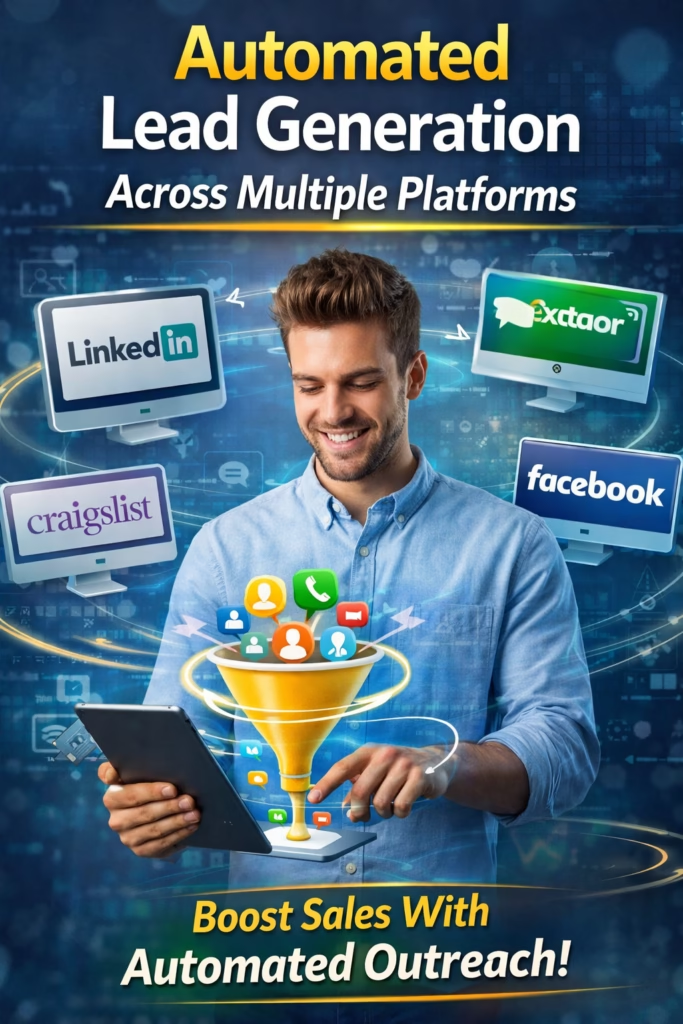
Automated Lead Generation Across Multiple Platforms
Automated Lead Generation Across Multiple Platforms explains how businesses can build a repeatable system for creating visibility, capturing inquiries, responding faster, and converting more leads across several channels at the same time.
Introduction
Automated Lead Generation Across Multiple Platforms is one of the most practical ways modern businesses create consistency in their sales pipeline. The biggest problem many companies face is not that there are no places to find leads. The problem is fragmentation. Buyers are spread across multiple channels. Some look on Craigslist. Others browse Facebook Marketplace. Others search Google, check Nextdoor, visit websites, fill out forms, send text messages, or respond through local listings and marketplaces.
If a business depends on only one platform, it limits reach. If it tries to manage every platform manually, it often becomes inconsistent, slow, and overwhelmed. That is where automation changes the game. Automation makes it possible to stay visible across multiple channels, capture incoming interest more efficiently, organize lead data, reply faster, and follow up without losing momentum.
The goal of automation is not to replace marketing. It is to make good marketing consistent at scale.
This matters for local businesses, service businesses, retailers, home service providers, wellness companies, real estate groups, and many other sales-driven organizations. The more platforms a business uses well, the more opportunities it creates. The more automated the lead-handling process becomes, the less waste happens after those opportunities arrive.
Automated lead generation is not just about posting more. It is about connecting visibility to response, response to follow-up, and follow-up to conversion. A business does not benefit much from multi-platform exposure if every new inquiry still depends on slow manual handling. On the other hand, a business that automates the right parts of the system can create faster response times, stronger organization, and a steadier flow of opportunities without adding chaos.
Main idea: Multi-platform lead generation becomes far more valuable when automation connects all the moving pieces into one repeatable system.
Table of Contents
- 1) Why multi-platform lead generation matters
- 2) Why automation becomes necessary as channels increase
- 3) The difference between manual and automated lead systems
- 4) Common platforms used in automated lead generation
- 5) Visibility automation across multiple channels
- 6) Lead capture and intake automation
- 7) Speed-to-lead and automated first response
- 8) Lead routing, tagging, and organization
- 9) Follow-up automation and nurturing
- 10) Conversion systems and appointment flow
- 11) Common mistakes in automation strategy
- 12) How businesses measure multi-platform automation performance
- 13) A simple framework for automated lead generation
- 14) Final thoughts
- 15) FAQs
- 16) Extra keywords
1) Why Multi-Platform Lead Generation Matters
Lead generation across multiple platforms matters because customer attention is fragmented. Different people search in different ways. Some buyers prefer classifieds. Some trust local search. Some engage with social marketplaces. Some react to neighborhood platforms. Some fill out forms after visiting a website. If a business shows up in only one place, it misses other groups of qualified buyers who are already looking elsewhere.
Multi-platform presence creates several advantages:
- Wider local and digital reach
- More lead sources
- Less dependence on one channel
- Stronger brand familiarity through repetition
- Higher chance of capturing intent where it happens
That is especially important for businesses that need ongoing inbound opportunities. A business that appears on multiple relevant platforms often stays in front of prospects more consistently than one that relies on a single source.
Multi-platform lead generation helps businesses:
- Reduce channel risk
- Reach more local intent
- Increase visibility frequency
- Build a larger pipeline
- Create more chances to convert
2) Why Automation Becomes Necessary as Channels Increase
As soon as a business operates across multiple channels, manual effort becomes harder to manage. Posting schedules get missed. Leads come in at different times and from different sources. Messages get delayed. Notes get lost. Follow-up becomes inconsistent. Even strong lead flow can turn into weak results if the business does not have a system to manage complexity.
Automation helps because it reduces the number of critical tasks that rely on perfect memory or constant manual effort. It allows businesses to create predictable workflows for tasks that happen repeatedly.
The more lead sources a business uses, the more valuable automation becomes.
This does not mean every step should be fully automated. It means the business should automate the repetitive, time-sensitive, and organization-heavy parts of the process so human attention can focus on better conversations and better closing.
3) The Difference Between Manual and Automated Lead Systems
A manual lead system depends on people remembering what to post, when to respond, where to store information, and when to follow up. It can work at small scale, but it often breaks under growth. An automated system uses processes and tools to keep those core actions happening consistently.
Manual system:
Post manually
Check messages manually
Sort leads manually
Follow up manually
Track results manually

Automated system:
Schedule or automate visibility
Capture leads automatically
Trigger quick response
Route and tag inquiries
Launch follow-up workflows
Track activity consistently
The benefit is not only time savings. It is reliability. Automated systems reduce dropped leads, missed follow-ups, and inconsistent response patterns. That makes the overall lead engine much stronger.
Automation improves not only scale, but operational consistency.
4) Common Platforms Used in Automated Lead Generation
Businesses use different combinations of channels depending on what they sell, who they serve, and how their market behaves. In many local and service-driven industries, lead generation may include several of the following platforms:
- Craigslist
- Facebook Marketplace
- OfferUp
- Nextdoor
- Google Business and local search
- Website landing pages
- Contact forms
- SMS and phone call entry points
- Email inquiry capture
Each platform attracts a different type of intent. Some channels are stronger for fast-response buyers. Others are stronger for trust-building or local familiarity. A strong multi-platform strategy recognizes these differences and uses automation to connect them rather than treating each platform as isolated.
Mistake to avoid: Adding more platforms without building the backend process to handle them properly.
5) Visibility Automation Across Multiple Channels
The first stage of automated lead generation is visibility. If the business is not consistently visible, the rest of the funnel has little to work with. Visibility automation helps businesses maintain presence across multiple platforms through scheduled publishing, listing rotation, content variation, and structured posting systems.
Visibility automation can help with:
- Consistent listing schedules
- Cross-platform posting
- Offer rotation
- Regional market coverage
- Content freshness
This matters because inconsistent visibility produces inconsistent leads. Businesses often blame the platform when the real problem is that they are not showing up often enough, or not showing up with enough structure, to create momentum.
Visibility automation creates the top-of-funnel consistency that manual systems often fail to maintain.
6) Lead Capture and Intake Automation
Once visibility produces interest, lead capture becomes the next critical step. Businesses need systems that collect and centralize inquiries from multiple sources so nothing important gets lost. This is where intake automation becomes valuable.
Lead capture automation can do things like:
- Pull inquiry data from forms or messages
- Organize contacts in one place
- Track source platforms
- Store timestamps and basic lead details
- Trigger next-step workflows
Without this, businesses often deal with scattered messages, inconsistent records, and weak follow-through. With proper intake automation, every new lead becomes easier to identify, respond to, and manage.
Good intake automation should answer:
- Where did the lead come from?
- When did it arrive?
- What are they asking for?
- Who owns the next step?
- What follow-up should happen next?
7) Speed-to-Lead and Automated First Response
One of the biggest advantages of automation is faster speed-to-lead. In many markets, the business that responds first wins more conversations. A prospect who reaches out today may contact several options quickly. Delayed response turns marketing spend and visibility effort into lost opportunity.
Automated first response helps by acknowledging the lead instantly and keeping the conversation alive until a human or deeper workflow takes over. That can include confirmation messages, quick qualifiers, or information-based replies.
Automation is often most valuable in the first few minutes after the lead arrives.
Fast response signals professionalism, availability, and organization. It also reduces the chance that the lead moves on before the business ever engages.
Lead arrives
→ instant acknowledgment
→ source tracking
→ qualification step
→ human follow-up or appointment workflow
8) Lead Routing, Tagging, and Organization
Once leads are coming in from different channels, organization becomes essential. Not all leads are the same. Some are local. Some are high intent. Some are early-stage. Some relate to different services or markets. Routing and tagging automation helps businesses keep that complexity manageable.
Good organization can include:
- Source tags
- Service tags
- Location tags
- Lead stage markers
- Priority levels
- Assigned owner or team handoff
These systems improve follow-up quality because they help businesses respond based on context instead of treating every inquiry exactly the same way.
Organization is part of conversion. Better structured leads are easier to close.
9) Follow-Up Automation and Nurturing
Many businesses lose leads after the first response because the follow-up process is weak. Prospects get distracted, compare options, delay decisions, or stop replying temporarily. Follow-up automation helps maintain contact without depending on someone to remember every touchpoint manually.
Follow-up automation can support:
- Reminder messages
- Scheduling prompts
- Quote follow-up
- Unanswered lead reactivation
- Multi-step nurture sequences
This is important because not every lead is ready instantly. Some need repeated, well-timed follow-up before they convert. Automation helps keep those opportunities alive.
Big mistake: Creating automated lead flow without building automated follow-up.
10) Conversion Systems and Appointment Flow
The real purpose of automated lead generation is not just to create inquiries. It is to create revenue-producing conversations and outcomes. That means the automation system should support conversion steps such as quote requests, appointment setting, phone calls, consultation scheduling, or showroom visits.
Strong conversion-focused systems often include:
- Clear next-step prompts
- Appointment booking workflows
- Calendar integration
- Sales notifications
- Lead status updates
- Follow-up after no-show or no-response events
When this is connected well, the business is not simply collecting names. It is moving people toward real action in a repeatable way.
Lead generation becomes more valuable when the system is built for movement, not just capture.
11) Common Mistakes in Automation Strategy
Automation can improve lead generation dramatically, but only if it is designed with the right goals. Many businesses automate the wrong things or automate too shallowly. They may focus only on posting, or only on message replies, while leaving the rest of the funnel weak.
Common mistakes include:
- Automating visibility but not follow-up
- Using generic responses with no qualification logic
- Failing to track lead source
- Not routing leads properly
- Ignoring response quality
- Creating automation with no human handoff clarity
- Measuring volume but not conversion
Automation should strengthen the full process, not just make one small part happen faster.
Automation without system design often creates more noise, not better results.
12) How Businesses Measure Multi-Platform Automation Performance
To improve an automated lead generation system, businesses need to track more than raw lead volume. They need to understand how each platform contributes, how fast leads are handled, and which workflows actually convert.
Useful metrics include:
- Leads by platform
- Response speed
- Appointment rate
- Conversion rate by source
- Follow-up completion rate
- Lead-to-sale time
- No-response recovery rate
Tracking these metrics helps businesses refine both the front-end visibility strategy and the backend automation system. That is how lead generation becomes more efficient over time.
What gets measured gets improved, especially in automated systems.
13) A Simple Framework for Automated Lead Generation
If a business wants to apply Automated Lead Generation Across Multiple Platforms in a practical way, the easiest path is to think in clear stages.
Step 1: Identify the most important lead platforms
Step 2: Build consistent visibility across those channels
Step 3: Capture all inquiries into one organized system
Step 4: Trigger fast first response
Step 5: Route and tag leads correctly
Step 6: Launch follow-up workflows
Step 7: Move leads toward calls, quotes, or appointments
Step 8: Measure platform and workflow performance
Step 9: Improve what converts best
Step 10: Repeat consistently
This framework works because it treats automation as an end-to-end process. It starts with visibility, but it does not stop there. It connects reach to response and response to conversion.
The strongest automated systems do not only generate more leads. They make those leads easier to manage and easier to close.
14) Final Thoughts
Automated Lead Generation Across Multiple Platforms gives businesses a practical way to scale without losing consistency. It recognizes a simple truth: prospects are spread across different channels, and manual systems often break as complexity increases. Automation helps bring structure to that complexity.
When done well, automation creates more than convenience. It creates operational strength. It helps businesses show up more consistently, respond more quickly, organize leads more clearly, and follow up more reliably. Those improvements compound. Over time, they often create better conversion rates and stronger growth.
Final takeaway: Multi-platform lead generation works best when automation connects visibility, capture, response, follow-up, and conversion into one organized system.
15) FAQs
1) What is automated lead generation across multiple platforms?
It is a system where businesses automate visibility, lead capture, response, organization, and follow-up across several channels instead of relying on just one platform or fully manual effort.
2) Why does multi-platform lead generation matter?
Because customers search in different places. Businesses reach more qualified opportunities when they appear across multiple relevant channels.
3) How does automation improve lead generation?
Automation improves lead generation by making posting, response, lead intake, follow-up, and organization more consistent and faster.
4) What kinds of businesses benefit from this approach?
Service businesses, local retailers, contractors, furniture stores, mattress stores, wellness brands, real estate groups, and many other sales-driven businesses benefit from it.
5) What is the biggest mistake with automation?
One of the biggest mistakes is automating exposure without automating lead handling and follow-up.
6) Do businesses need multiple platforms to generate leads effectively?
Not always, but multi-platform systems often create stronger resilience and wider reach than depending on a single channel.
7) What platforms are commonly used in multi-platform lead generation?
Common platforms include Craigslist, Facebook Marketplace, OfferUp, Nextdoor, Google, websites, forms, calls, text, and email inquiries.
8) What does visibility automation do?
It helps keep the business active and visible across platforms through structured posting, rotation, and scheduling processes.
9) Why is lead capture automation important?
Because leads from different sources can easily become scattered, delayed, or lost without a system that collects them centrally.
10) How important is speed-to-lead?
It is extremely important. Faster response often increases conversation rates and reduces the chance that the prospect chooses someone else first.
11) What is automated first response?
It is an instant acknowledgment or reply that keeps the lead engaged while the next step in the sales process is triggered.
12) Why should leads be tagged or routed?
Because different leads have different priorities, services, locations, and conversion paths. Tagging improves organization and follow-up quality.
13) Does automation replace human sales conversations?
No. Good automation supports and improves them by handling repetitive steps and making human follow-up faster and more informed.
14) What role does follow-up automation play?
It helps businesses keep warm leads engaged after the first response and recover opportunities that might otherwise fade away.
15) Can automation help appointment setting?
Yes. It can support booking prompts, reminders, scheduling workflows, and sales handoffs.
16) What happens if a business gets more leads but has no system?
It often creates more chaos instead of more revenue because missed responses and weak follow-up waste the increased attention.
17) What metrics should businesses track?
They should track leads by source, response speed, appointments, conversion rate, and follow-up performance.
18) Is automation useful for local businesses only?
No. It is useful for both local and broader businesses, though it is especially powerful for businesses managing many local lead sources.
19) What is the difference between manual and automated systems?
Manual systems depend heavily on memory and repeated effort. Automated systems create repeatable workflows that reduce inconsistency.
20) Can automation improve lead quality too?
Yes, when it includes better qualification, routing, and follow-up rather than just faster exposure.
21) Should businesses automate everything?
No. They should automate the repetitive and time-sensitive parts while keeping important human interaction where it matters most.
22) What makes a strong automated lead generation system?
A strong system connects visibility, capture, response, routing, nurturing, and conversion into one organized process.
23) Why do some automation systems underperform?
Because they are often incomplete, poorly connected, or focused on volume without enough attention to conversion quality.
24) Can automated lead generation support long-term growth?
Yes. Strong systems create consistency, and consistency often leads to better operational performance and scalable growth.
25) What is the core principle behind automated lead generation across multiple platforms?
The core principle is using automation to make multi-channel visibility and lead handling more organized, faster, and more conversion-friendly.
16) Extra Keywords
- Automated Lead Generation Across Multiple Platforms
- automated lead generation
- multi platform lead generation
- lead generation automation
- automated marketing systems
- local business lead generation
- cross platform lead generation
- lead capture automation
- speed to lead automation
- lead routing automation
- follow up automation
- multi channel lead generation
- automated lead funnel
- lead nurturing automation
- local marketing automation
- marketplace lead generation
- classified lead automation
- Facebook Marketplace lead generation
- Craigslist lead automation
- Nextdoor lead generation
- automated inquiry management
- lead conversion automation
- appointment automation
- multi source lead tracking
- scalable lead generation system