

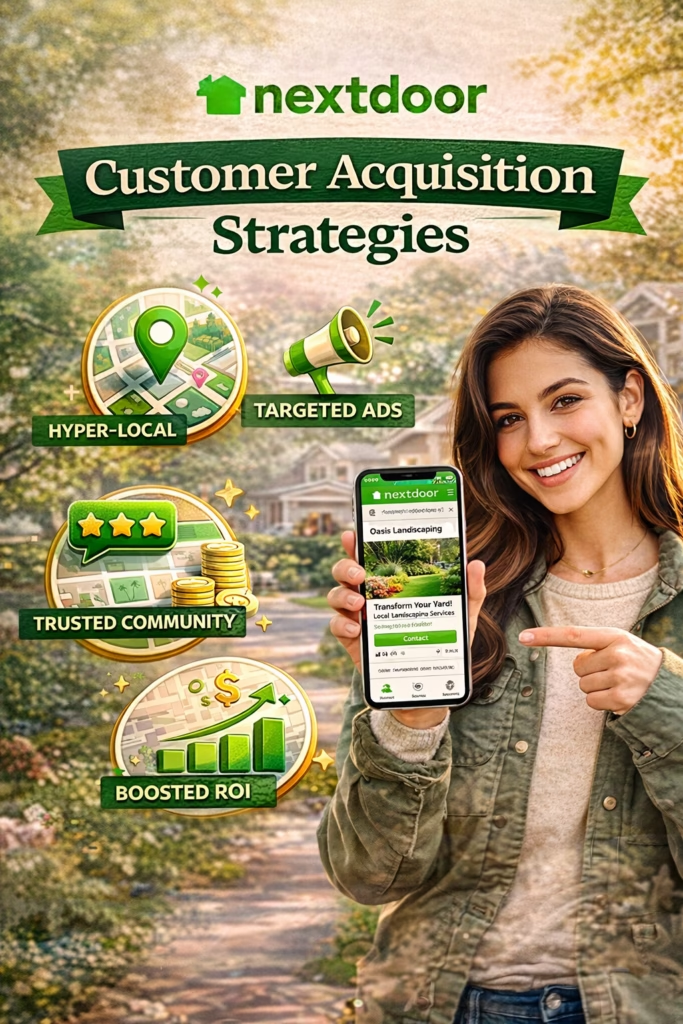
Nextdoor Customer Acquisition Strategies
Nextdoor Customer Acquisition Strategies explains how local businesses turn neighborhood visibility into real customers through stronger trust signals, better community relevance, useful posts, recommendations, offers, quick replies, and disciplined follow-up.
Note: This is general guidance. Keep all business communication truthful, useful, community-aware, and aligned with platform policies and local marketing requirements.
Introduction
Nextdoor Customer Acquisition Strategies work best when businesses understand one important difference between Nextdoor and many other marketing channels: people are not just looking for ads there. They are looking for trust.
Nextdoor customer acquisition works because neighborhood trust still influences buying decisions.
Many local businesses make the mistake of treating every platform the same way. They use the same generic promotional language everywhere, assume every audience responds to the same message, and then wonder why some channels feel weak. Nextdoor is different because it is built around neighborhoods, nearby conversations, local recommendations, and practical trust. That makes it especially valuable for businesses that solve local problems and can communicate in a more useful, community-aware way.
People on Nextdoor often care about nearby fit, real-world credibility, and whether a business feels dependable enough to invite into their home, visit in person, or contact for help. That is why customer acquisition on Nextdoor depends less on flashy advertising and more on believable, local, relevant communication. Strong businesses on Nextdoor usually win because they look trustworthy, stay useful, and make it easy for neighbors to move from awareness to action.
That action might be a message, a call, a quote request, a website visit, an in-store visit, a recommendation, or a booked service. But none of those outcomes happen consistently by accident. Businesses that acquire customers well on Nextdoor usually follow a system. They build a stronger local profile. They create useful posts instead of empty promotions. They ask for recommendations from satisfied customers. They use offers strategically. They reply quickly. They follow up professionally. They measure what works and repeat it.
Nextdoor can be especially strong for businesses where trust and proximity matter heavily. Home services, cleaning, repair, remodeling, moving, wellness, pet services, local retail, and neighborhood-relevant providers often benefit the most because neighbors want someone who feels close, dependable, and recommended. When the business communicates that clearly, Nextdoor becomes more than a visibility channel. It becomes a neighborhood-based customer acquisition system.
Big idea: Nextdoor customer acquisition works best when local businesses combine trust, neighborhood relevance, useful communication, strong recommendations, fast response, and repeatable follow-through.
Expanded Table of Contents
- 1) Why Nextdoor works for customer acquisition
- 2) Neighborhood trust as the core advantage
- 3) What types of businesses perform best on Nextdoor
- 4) Profile strategy and first-impression credibility
- 5) Recommendation strategy and social proof
- 6) Useful posting strategies that attract local customers
- 7) Offer and promotion strategies that create action
- 8) Before-and-after content and visible proof
- 9) Local relevance and neighborhood fit
- 10) Posting cadence and consistency
- 11) Fast response and conversion momentum
- 12) Follow-up strategies that recover opportunity
- 13) How businesses measure customer acquisition on Nextdoor
- 14) How to scale what works on Nextdoor
- 15) 30–60–90 day rollout plan
- 16) 25 Frequently Asked Questions
- 17) 25 Extra Keywords
1) Why Nextdoor works for customer acquisition
Nextdoor works for customer acquisition because it brings together three important forces: geographic relevance, local trust, and practical neighborhood intent. A business is not trying to reach a random audience. It is trying to reach nearby people who may actually become nearby customers.
That makes Nextdoor different from broader social platforms. The audience is usually more location-specific. The conversations often involve practical neighborhood concerns. The recommendations carry more weight because they come from a local context. For a business that depends on nearby customers, that is extremely valuable.
| Why Nextdoor matters | What it creates | Customer acquisition benefit |
|---|---|---|
| Neighborhood audience | Geographic relevance | Better local fit |
| Community-based platform | Stronger trust signals | Higher credibility |
| Recommendation culture | Social proof | Better conversion potential |
| Local problem-solving behavior | Practical discovery | More usable inquiries |
Rule: Nextdoor works best when the business uses neighborhood trust and relevance as its main customer acquisition advantages.
2) Neighborhood trust as the core advantage
Trust matters everywhere in marketing, but it matters differently on Nextdoor. On many platforms, trust is built through branding, repetition, or broad reach. On Nextdoor, trust is often built through proximity, familiarity, recommendations, and usefulness.
People using Nextdoor often want to know whether a business feels safe, dependable, nearby, and relevant to their neighborhood reality. That is why trust is not just a nice extra. It is the center of the customer acquisition strategy.
What builds trust on Nextdoor
- Recommendations
- Useful posts
- Clear local identity
- Fast professional replies
What weakens trust on Nextdoor
- Generic ad-like content
- No local context
- Weak profile details
- Slow or poor communication
Pro move: On Nextdoor, trust often matters more than polish because neighbors are evaluating whether the business feels reliable enough to choose.
3) What types of businesses perform best on Nextdoor
Not every business category performs the same on Nextdoor, but many local businesses do very well when their offer is neighborhood-relevant and trust-sensitive. This includes businesses that solve practical problems close to home or benefit from word-of-mouth style endorsement.
Business types that often perform well
- Home service companies
- Cleaning businesses
- Painters, remodelers, and contractors
- Movers and hauling services
- Local wellness and care providers
- Pet-related services
- Repair businesses
- Neighborhood retail and specialty local stores
The common thread is not just locality. It is relevance to neighborhood trust and daily life. When a business feels like a natural fit for local conversations and local needs, Nextdoor becomes a strong acquisition channel.
Rule: Nextdoor tends to work best for businesses that solve practical local needs and benefit from community trust.
4) Profile strategy and first-impression credibility
A strong profile is one of the first customer acquisition assets on Nextdoor. Before a neighbor responds, they often want to know who the business is, what it does, and whether it looks real and reliable.
A strong business profile should support
- Clear business identity
- Obvious service or offer description
- Strong local positioning
- Trustworthy visual presentation
- Easy contact path
Why profile quality matters
- Improves first impressions
- Supports recommendations and replies
- Reduces uncertainty
- Makes every post more credible
Rule: A better profile improves acquisition because it supports trust before the first conversation begins.
5) Recommendation strategy and social proof
Recommendations are one of the strongest acquisition tools on Nextdoor because they act as local social proof. A business is not just telling neighbors it is trustworthy. Actual neighbors are reinforcing that idea.
This is especially powerful for services where people care about reliability, professionalism, safety, or quality of work. A recommendation reduces uncertainty and helps shorten the distance between interest and contact.
Good recommendation strategy includes
- Asking satisfied customers consistently
- Timing the ask after positive outcomes
- Making the request simple and polite
- Treating recommendations as part of the acquisition system
Pro move: Recommendations often convert better than generic promotion because they borrow the trust of the neighborhood itself.
6) Useful posting strategies that attract local customers
Businesses that acquire customers well on Nextdoor usually post in a way that feels useful first and promotional second. That does not mean they never promote. It means their promotion is supported by relevance and value.
Post types that often work well
- Educational neighborhood-relevant tips
- Seasonal advice tied to local needs
- Service explanations that reduce confusion
- Problem-solution style posts
- Local updates tied to practical customer concerns
Why useful posts help acquisition
- Build authority
- Create familiarity
- Increase trust
- Keep the business top of mind
Rule: Useful content attracts better Nextdoor customers because it builds trust before the sales conversation starts.
7) Offer and promotion strategies that create action
Offers still matter on Nextdoor, but the best offers usually feel practical and relevant rather than overly aggressive. A neighborhood audience tends to respond better when the offer feels timely, helpful, and easy to understand.
What strong offers usually do
- Create a simple reason to act now
- Clarify what the customer gets
- Stay relevant to local needs
- Feel believable and useful
Good offer angles
- Seasonal need-based offers
- Neighborhood introductory offers
- Clear limited-time service incentives
- Value-based local promotions
Pro move: On Nextdoor, useful offers usually outperform loud offers because the audience is evaluating trust along with value.
8) Before-and-after content and visible proof
Before-and-after content can be highly effective on Nextdoor because it gives visual proof of the result. For service businesses especially, visible proof often does more than generic claims ever could.
Why before-and-after content works
- Shows real outcomes
- Supports trust quickly
- Helps neighbors imagine the result
- Strengthens recommendation-style credibility
Best use cases
- Painting and remodeling
- Cleaning and pressure washing
- Repairs and maintenance
- Landscaping or visual service improvements
Rule: Visible proof improves acquisition because it reduces uncertainty and makes the business easier to trust.
9) Local relevance and neighborhood fit
Local relevance matters heavily on Nextdoor because the platform is built around neighborhoods. Businesses that sound generic or detached from the local environment usually struggle more than businesses that clearly feel nearby, relevant, and community-aware.
Ways to improve neighborhood fit
- Use local references naturally
- Speak to real neighborhood needs
- Show awareness of seasonal local issues
- Make the service area obvious
Simple local CTA
Reply with your neighborhood or area and what you need help with so we can point you in the right direction.Rule: Customer acquisition improves when neighbors can quickly tell that the business is relevant to their area and needs.
10) Posting cadence and consistency
Nextdoor customer acquisition usually improves when the business stays visible consistently without becoming noise. A steady posting cadence helps the business remain familiar, build credibility, and create more chances for recommendations, replies, and action.
Healthy cadence
- Consistent local presence
- Useful recurring content
- Regular offer visibility
- More familiarity over time
Weak cadence
- Long inactivity gaps
- Only posting when desperate for leads
- Generic promotions only
- No rhythm or learning
Rule: Consistency helps Nextdoor customer acquisition because familiarity and trust grow over repeated local visibility.
11) Fast response and conversion momentum
Even on a trust-based platform, speed still matters. A neighbor who reaches out is showing real interest. If the business replies slowly or unhelpfully, the momentum can fade or shift to another option.
Simple first-reply template
Thanks for reaching out ✅

Happy to help. What neighborhood/area are you in, and what do you need help with most right now?
Why reply speed matters
- Shows professionalism
- Protects momentum
- Improves qualification speed
- Increases customer confidence
- Raises conversion potential
Fast, useful replies often turn neighborhood interest into real customers before that interest cools down.
12) Follow-up strategies that recover opportunity
Not every Nextdoor lead converts immediately. Some neighbors are comparing options, waiting for timing, or simply distracted. Follow-up helps turn more of that interest into actual business.
Simple follow-up sequence
Day 0: Fast reply + one useful question
Day 1: Check if they are still looking
Day 3: Offer the best next step
Day 5: Ask whether a call, quote, visit, or more details would help
Day 7: Close politely while leaving the door open
Rule: Follow-up increases acquisition efficiency because it captures more value from the trust and attention already earned.
13) How businesses measure customer acquisition on Nextdoor
Businesses should not judge Nextdoor only by views or casual engagement. The better question is whether the platform is producing qualified local pipeline and repeatable customer acquisition patterns.
| KPI | What it measures | Target direction |
|---|---|---|
| Inquiries | Initial customer interest | Up |
| Recommendations | Local social proof strength | Up |
| Median response time | Speed-to-lead | Down |
| Booked calls or visits | Pipeline creation | Up |
| Close rate | Customer conversion | Up |
| Top-performing post types | Content learning | Clearer over time |
| Offer performance | Action-driving efficiency | Clearer over time |
Rule: The best Nextdoor strategy is the one that produces repeatable, local, trust-driven customer acquisition.
14) How to scale what works on Nextdoor
Scaling on Nextdoor is not about posting more generic content. It is about expanding the parts of the strategy that already earn trust and action. That usually means documenting the best offers, best post types, strongest recommendation asks, and most effective reply patterns.
What scaling usually includes
- Documenting top-performing post structures
- Reusing strong neighborhood offers
- Systematizing recommendation requests
- Keeping reply templates ready
- Reviewing performance regularly
Nextdoor scales best when businesses expand trust-building patterns instead of expanding generic promotion.
15) 30–60–90 day rollout plan
Days 1–30: Build the foundation
- Strengthen the business profile
- Start posting useful neighborhood-relevant content
- Ask satisfied customers for recommendations
- Create one or two strong local offers
- Install a fast reply process
- Track inquiries and booked next steps
Days 31–60: Improve consistency
- Test educational vs offer-driven posts
- Review which neighborhoods or post types respond best
- Improve follow-up consistency
- Use more visible proof where appropriate
Days 61–90: Scale what works
- Document best-performing post formats
- Repeat strong offer and recommendation patterns
- Review KPIs weekly
- Double down on tactics producing real local customers
Rule: Nextdoor customer acquisition improves most when trust-building tactics become a repeatable system.
16) 25 Frequently Asked Questions
1) What are Nextdoor customer acquisition strategies?
They are the methods businesses use to attract nearby customers through local relevance, trust, recommendations, useful posts, offers, and follow-up.
2) Does Nextdoor still work in 2026?
Yes. It can still work very well for local businesses that rely on neighborhood trust and proximity.
3) Why is Nextdoor good for local businesses?
Because the audience is local and often values nearby trust and recommendations.
4) What kind of businesses do well there?
Many home services, cleaners, repair companies, movers, wellness providers, and neighborhood-relevant retailers do well.
5) What is the biggest advantage of Nextdoor?
Neighborhood trust and local social proof.
6) How do businesses get customers on Nextdoor?
By using a strong profile, useful posts, recommendations, offers, fast replies, and follow-up.
7) Do recommendations really matter?
Yes. They are one of the strongest trust signals on the platform.
8) Should businesses post offers?
Yes, when the offers are clear, useful, and locally relevant.
9) How important is local relevance?
Extremely important, because Nextdoor is built around neighborhoods.
10) Does reply speed matter?
Yes. Fast replies protect momentum and improve conversion.
11) What kind of posts work best?
Useful, clear, local, community-aware posts usually work best.
12) Can Nextdoor generate real leads and sales?
Yes. It can generate calls, quotes, visits, and real customers.
13) Should businesses use before-and-after examples?
Yes, when appropriate, because visible proof strengthens trust.
14) Does posting consistency matter?
Yes. Consistency helps build familiarity and credibility over time.
15) Can one person manage it effectively?
Yes, with templates, discipline, and fast responses.
16) What is the biggest mistake on Nextdoor?
Treating it like generic advertising instead of a trust-based local platform.
17) Should businesses ask for recommendations?
Yes. Asking satisfied customers is one of the smartest Nextdoor strategies.
18) How should businesses measure results?
Track inquiries, booked calls or visits, recommendations, response speed, and close rate.
19) Do offers help?
Yes. Clear, relevant offers can create action when they feel useful.
20) Why does trust matter more on Nextdoor?
Because neighbors often rely on community reputation when choosing businesses.
21) Can small businesses compete well?
Yes. Small local businesses can do very well because proximity and responsiveness matter heavily.
22) Should businesses create educational posts?
Yes. Educational content helps build trust and authority locally.
23) How quickly can results improve?
Often within a few weeks after improving profile quality, recommendations, post quality, and reply speed.
24) Should winning strategies be documented?
Yes. Documentation makes the best tactics easier to repeat and scale.
25) What is the main lesson behind Nextdoor customer acquisition?
That local customers are won through neighborhood trust, relevance, useful communication, and fast follow-through.
17) 25 Extra Keywords
- Nextdoor Customer Acquisition Strategies
- Nextdoor customer acquisition
- Nextdoor marketing
- Nextdoor local business marketing
- Nextdoor lead generation
- Nextdoor neighborhood marketing
- Nextdoor recommendations
- Nextdoor local customers
- Nextdoor trust strategy
- Nextdoor offer strategy
- Nextdoor posting strategy
- Nextdoor business profile strategy
- Nextdoor before and after posts
- Nextdoor local relevance
- Nextdoor response speed
- Nextdoor follow-up system
- Nextdoor booked appointments
- Nextdoor neighborhood leads
- Nextdoor customer conversion
- local customer acquisition
- 2026 Nextdoor marketing strategy
- Nextdoor home service marketing
- Nextdoor small business growth
- community-based customer acquisition
- Nextdoor business recommendations













