

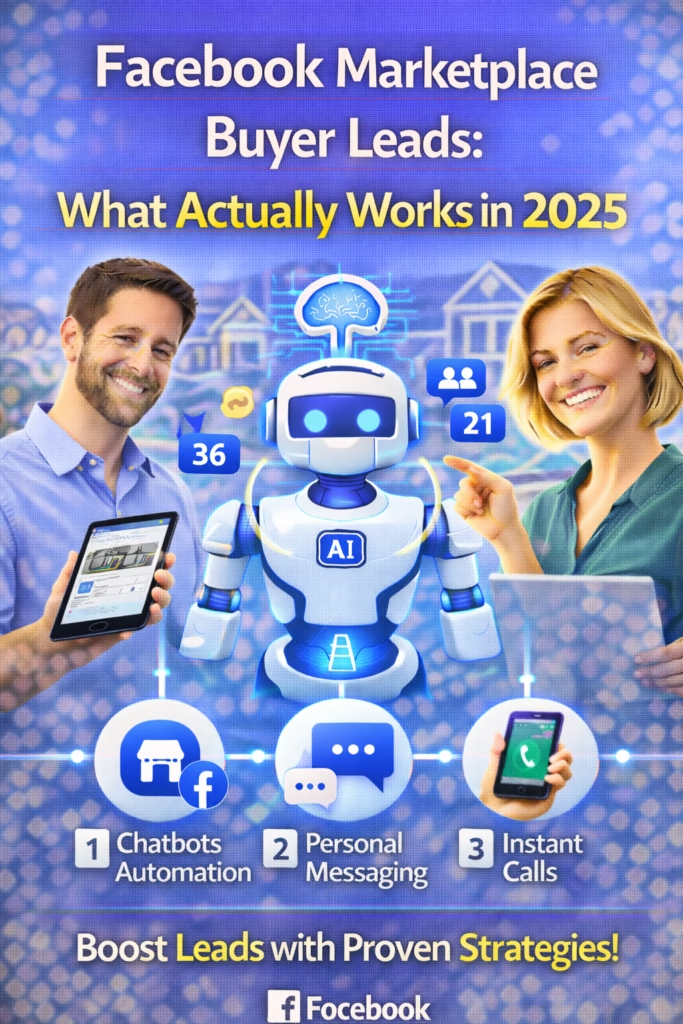
Facebook Marketplace Buyer Leads: What Actually Works in 2025
Facebook Marketplace Buyer Leads: What Actually Works in 2025 is a proven system to generate consistent, qualified buyer leads—using the right listing strategy, instant response frameworks, qualification systems, and follow-up that converts.
Note: This is general marketing guidance. Always comply with Facebook's Commerce Policies and platform rules.
Introduction
Facebook Marketplace Buyer Leads: What Actually Works in 2025 cuts through the noise and focuses on what actually drives results. There is a lot of outdated advice, theory, and "hacks" floating around. This guide focuses exclusively on tactics proven to work in 2025.
Facebook Marketplace remains one of the highest-intent lead generation platforms for local businesses. People browsing Marketplace are not scrolling for entertainment—they are searching with buying intent, budget in mind, and a timeline to purchase.
The challenge is not whether Marketplace can generate leads. It is whether your listing strategy, response system, and qualification framework are designed to capture and convert them.
Big idea: Marketplace success in 2025 comes down to five controllable variables: listings, photos, response speed, qualification, and follow-up.
Expanded Table of Contents
- 1) What changed in 2025 (and what stayed the same)
- 2) The 5-part framework that actually generates leads
- 3) Listing strategy that drives daily messages
- 4) Photo systems that build trust instantly
- 5) Title and description optimization for 2025
- 6) Response frameworks that convert "Is this available?"
- 7) Qualification systems (budget, timeline, intent)
- 8) Follow-up SOPs that recover ghost leads
- 9) Posting cadence and refresh strategies
- 10) Common mistakes that kill Marketplace leads
- 11) Tracking what matters (messages, conversions, ROI)
- 12) Scaling from 10 to 100+ leads per month
- 13) 30–60–90 day Marketplace lead system rollout
- 14) 25 Frequently Asked Questions
- 15) 25 Extra Keywords
1) What changed in 2025 (and what stayed the same)
Facebook Marketplace evolves constantly. Some tactics that worked in 2023 are dead. Others are more effective than ever.
What changed in 2024–2025
- Algorithm prioritizes response time: fast responders get better visibility and ranking
- Search is more keyword-driven: exact keyword matches in titles perform better
- Photo quality matters more: low-quality or stock photos get suppressed
- Duplicate detection improved: identical listings across accounts get flagged faster
- Business accounts face more scrutiny: compliance and quality standards are higher
What stayed the same (timeless fundamentals)
| Principle | Why it still works |
|---|---|
| Buyer intent is high | People search Marketplace when they are ready to buy |
| Local reach is massive | Marketplace dominates local search in most markets |
| Speed wins conversions | Fast responders close more deals |
| Trust signals matter | Real photos, clear pricing, and responsive communication build trust |
| Consistency beats intensity | Daily posting outperforms irregular bursts |
Bottom line: The fundamentals still drive results. Platform updates reward speed, quality, and consistency even more in 2025.
2) The 5-part framework that actually generates leads
Facebook Marketplace Buyer Leads: What Actually Works in 2025 comes down to five core components. Master these and lead generation becomes predictable.
1) Listing volume and variety
More quality listings = more search impressions = more messages. Volume matters.
2) Proof-based photos
Real photos with context (tags, store setting, condition proof) kill skepticism.
3) Response speed
Under 5 minutes is good. Under 1 minute is best. Speed converts.
4) Qualification framework
Collect budget, timeline, and intent in the first 3 messages to filter serious buyers.
5) Follow-up system
3-touch sequence recovers 20 to 40 percent of ghost leads.
Pro move: If you want more leads, start with response speed and photo quality. These have the highest ROI for time invested.
3) Listing strategy that drives daily messages
Not all listings are created equal. Some formats generate 10x more messages than others.
High-intent listing categories (prioritize these)
- Specific product + clear offer: "Queen mattress – cooling cover – delivery available – $599"
- Bundle deals: "Mattress + box spring + frame – complete set – $799"
- Service + product combo: "Furniture delivery available – same day pickup"
- Urgency positioning: "Limited stock – floor model clearance – first come first served"
Listing formats that work in 2025
| Format | Example | Why it works |
|---|---|---|
| Single product (strong offer) | Queen hybrid mattress – cooling – new – $599 | Clear, specific, easy decision |
| Product bundle | Mattress + box spring + frame – complete bedroom set | Higher perceived value, reduces decision fatigue |
| Service highlight | Same-day delivery available – all zip codes | Removes friction, increases urgency |
| Clearance / limited stock | Floor model clearance – 50% off – this week only | Creates scarcity and fast action |
What to avoid (low-performing listing types)
- Vague titles: "Great deal" or "Nice furniture" without specifics
- Stock photos only with no proof of real inventory
- Pricing that requires "message for price" (kills trust and reduces replies)
- Overly long descriptions with no formatting or structure
Rule: Every listing should answer three questions immediately: What is it? How much? How do I get it?
4) Photo systems that build trust instantly
Photos are your trust signal. In 2025, buyers assume anything that looks too perfect or generic is a scam. Your photos need to communicate "real business, real inventory" immediately.
The 2025 photo framework (6–10 images per listing)
- Hero shot: clean, well-lit, straight angle of the full product
- Detail shots: close-ups showing condition, texture, materials
- Proof elements: brand tags, labels, serial numbers, packaging
- Context shot: product in store setting or showroom (subtle, not salesy)
- Size reference: product next to common objects or with dimensions visible
- Accessories / inclusions: what comes with it (if applicable)
Proof signals that increase replies
- Brand tags clearly visible in at least one photo
- Store or business signage in background (subtle is fine)
- Consistent photo quality across multiple listings (shows legitimacy)
- New items still in packaging or with protective film
Photo mistakes that kill trust (avoid these)
- Dark or blurry images
- Stock photos with no real product images
- Messy backgrounds with clutter
- Inconsistent lighting across photos (looks like different products)
- Watermarks or text overlays that scream "dropshipper"
Pro move: Create a "photo corner" in your business with consistent lighting and clean background. Photograph all inventory in the same spot for speed and consistency.
5) Title and description optimization for 2025
Marketplace search in 2025 rewards exact keyword matches and clear, front-loaded titles.
2025 title formula
[Product] + [Key Feature] + [Condition] + [Hook] + [Location]

Examples:
✅ Queen Mattress – Cooling Cover – New – Delivery Available – Rochester
✅ 3BR House for Rent – Pet Friendly – Available Now – Downtown
✅ Sofa Set – Gray Sectional – Like New – Pickup Today – [City]
High-value keywords by industry (2025)
delivery available pickup today same day new like new brand name warranty financing payment plans limited stock clearance first come first served
Description template (works across industries)
✅ [Product Name] — [Condition]
- [Key Feature 1]
- [Key Feature 2]
- [Key Feature 3]

📍 Pickup: [Location/Availability]
🚚 Delivery: [Options]
💳 Payment: [Methods]

Reply "[KEYWORD]" and your city for fastest options.
What to include in descriptions
- Bullet points: easier to scan than paragraphs
- Clear next step: "Reply YES" or "Message with your zip code"
- Pickup and delivery options: reduces friction immediately
- Payment methods: cash, Venmo, Zelle, credit card (if applicable)
Avoid: keyword stuffing, ALL CAPS, excessive emojis, or clickbait language that reduces trust.
6) Response frameworks that convert "Is this available?"
The first message is the most important. Your goal: confirm availability, ask one qualifying question, and offer the next step.
Universal response template (copy/paste)
Yes — it is available ✅

Are you looking for pickup today or delivery this week?

What city/zip are you in? I will confirm fastest options.
Response framework (3-message conversion)
Message 1: Confirm + qualify
Yes ✅ still available.

Are you looking for pickup or delivery?

What city are you in?
Message 2: Options + pricing (if needed)
Perfect ✅

Pickup: Available today at [Location]
Delivery: $[X] to [City] — can deliver [timeframe]

Which works better for you?
Message 3: Close or next step
Great! I can hold it for you.

Reply with your name and best time to pickup/deliver, and I will confirm.
Handling common objections
"What's your lowest price?"
Price is firm at $[X], but I can include [bonus/delivery/accessory] if you pick it up today.

Does that work?
"Can I see more photos?"
Sure ✅ I will send more photos.

Quick question — are you looking for pickup or delivery?
"Is this still available?" (days later)
Yes! Still available ✅

Are you ready to pick it up or schedule delivery?

What city are you in?
Rule: Every response should end with a question or clear next step. Never leave the conversation hanging.
7) Qualification systems (budget, timeline, intent)
Qualification separates serious buyers from tire kickers. Your goal is to collect three pieces of information in the first 3 to 5 messages.
The 3-question qualification framework
| Question | Purpose | Example |
|---|---|---|
| Timeline | Separates immediate buyers from future shoppers | "Are you looking to pick this up today or this week?" |
| Logistics | Confirms pickup vs delivery and location match | "What city are you in?" |
| Budget confirmation | Confirms price is acceptable or surfaces objections | "Does $[X] work for your budget?" |
Qualification flow (inline with conversation)
Buyer: "Is this available?"

You: "Yes ✅ Are you looking for pickup today or delivery this week?"

Buyer: "Pickup today"

You: "Perfect. What city are you in?"

Buyer: "[City]"

You: "Great — pickup is available at [Location]. Does the $[X] price work for you?"

Buyer: "Yes"

You: "Awesome. I can hold it for you. What is your name and what time works best for pickup today?"
Lead scoring (prioritize follow-up)
- Hot (A-tier): immediate timeline (today/tomorrow) + budget confirmed + location match
- Warm (B-tier): this week timeline + interested but needs to coordinate
- Cold (C-tier): vague timeline, price shopping, or no clear intent
Pro move: Tag leads by tier in your CRM or spreadsheet so you know who to follow up with first.
8) Follow-up SOPs that recover ghost leads
Most leads ghost after the first exchange. A structured follow-up sequence recovers 20 to 40 percent of them.
3-touch follow-up sequence (proven)
| Timing | Message | Goal |
|---|---|---|
| Same day (2–4 hours later) | Quick check-in + restate offer | Re-engage |
| Next day | Confirm availability + add urgency | Create action |
| Day 3 | Final check-in or alternate option | Close or move to nurture |
Follow-up message #1 (same day)
Quick check-in ✅

Did you still want this?

Let me know and I can hold it for you or confirm pickup/delivery.
Follow-up message #2 (next day)
Heads up — this one is getting a lot of interest today.

If you want it, I can hold it with a small deposit or confirm your pickup time.

What works best?
Follow-up message #3 (day 3)
Last check-in ✅

If you found something else or the timing is not right, no problem.

If you still want it, reply "YES" and I will hold it.

Otherwise I will mark it available for others.
When to stop following up
- After 3 touches with no response
- If buyer explicitly says "not interested" or "found something else"
- If buyer asks for unrealistic terms (very low price, immediate delivery to distant location, etc.)
Rule: Be persistent but respectful. Three touches is enough. After that, move to monthly nurture or mark as lost.
9) Posting cadence and refresh strategies
Marketplace rewards fresh content. Stale listings drop in search visibility. Your cadence strategy determines how consistently you generate leads.
Recommended posting cadence (2025)
- Daily: 3 to 8 new or refreshed listings per day
- Weekly: refresh top 10 to 20 performers with new first photo or title variation
- Monthly: retire listings that have not generated messages in 30 days
Refresh tactics that work
| Tactic | How to execute | Frequency |
|---|---|---|
| Change first photo | Swap photo order to show different angle first | Every 7 days |
| Update title | Add new hook or keyword (e.g., "limited stock") | Every 7–14 days |
| Adjust price | Small price reduction or add bundle offer | As needed |
| Repost entirely | Delete and recreate listing with fresh timestamp | Every 30 days |
Weekly posting schedule (example)
Monday: Post 5 new listings (high-volume SKUs)
Tuesday: Refresh top 10 performers (new photo first)
Wednesday: Post 5 new listings (bundles/offers)
Thursday: Refresh top 10 performers (title updates)
Friday: Post 5 new listings (weekend traffic focus)
Saturday: Refresh top performers
Sunday: Light activity or queue Monday posts
Avoid: posting identical listings back-to-back in short timeframes. Facebook flags this as spam.
10) Common mistakes that kill Marketplace leads
These mistakes appear in almost every struggling Marketplace account. Fixing them can double or triple lead volume.
Mistake #1: Slow response time
Problem: responding 30 minutes, 2 hours, or next day
Impact: buyers move on to faster sellers
Fix: set phone notifications, use instant reply templates, or implement chatbot auto-responders
Mistake #2: Poor photo quality
Problem: dark photos, messy backgrounds, stock images only
Impact: buyers assume scam or low-quality product
Fix: create a photo corner with good lighting, use real product photos with proof elements
Mistake #3: Vague titles and descriptions
Problem: "Great deal" or "Nice couch" without specifics
Impact: listings do not rank in search and do not communicate value
Fix: use the title formula (product + feature + condition + hook + location)
Mistake #4: No qualification system
Problem: responding to every message equally without prioritization
Impact: waste time on tire kickers, miss hot buyers
Fix: use the 3-question framework (timeline, logistics, budget)
Mistake #5: Inconsistent posting
Problem: posting in bursts when you have time, then disappearing for weeks
Impact: unpredictable lead flow, algorithm deprioritizes your listings
Fix: commit to daily posting cadence (even 3 to 5 listings per day is enough)
Mistake #6: No follow-up system
Problem: letting ghost leads disappear forever
Impact: lose 20 to 40 percent of recoverable leads
Fix: implement the 3-touch follow-up sequence
Fast win: Fix response time and photo quality first. These have the highest ROI.
11) Tracking what matters (messages, conversions, ROI)
You cannot improve what you do not measure. Tracking the right KPIs reveals bottlenecks and optimization opportunities.
Essential KPIs (track weekly)
| Metric | What it measures | Target |
|---|---|---|
| Active listings | Visibility surface area | 30–100+ (industry dependent) |
| Messages per week | Top-of-funnel volume | 25–100+ |
| Median response time | Conversion leverage | < 5 min (good), < 1 min (best) |
| Qualified leads | Serious buyers (timeline + budget confirmed) | 40–60% of messages |
| Conversion rate | Messages → sales or appointments | 10–30% (varies by industry) |
| Revenue per lead | Average transaction value | Track by product category |
Simple tracking sheet (Google Sheets)
Week | Active Listings | Messages | Qualified | Conversions | Revenue
Jan 20 | 45 | 68 | 32 | 12 | $4,800
Jan 27 | 52 | 82 | 41 | 18 | $6,200
What to track per listing
- Views (if available in Marketplace insights)
- Messages generated
- Conversion rate (messages → sales)
- Days active before converting
Optimization signals (what the data tells you)
- High views, low messages: improve title, price, or first photo
- High messages, low conversions: improve response scripts and qualification
- High conversions on specific SKUs: create more listings like winners
- Declining message volume: refresh cadence or test new listing angles
Pro move: Review metrics every Monday morning. Make one optimization based on the data each week.
12) Scaling from 10 to 100+ leads per month
Scaling Marketplace lead generation is about systems, not hustle. Here is how to go from sporadic leads to predictable volume.
Scale lever #1: Increase listing volume
- Start: 10 to 20 active listings
- Growth: 30 to 50 active listings
- Scale: 60 to 150+ active listings
How: create listing templates, batch-create listings, rotate SKUs and angles
Scale lever #2: Improve response speed
- Manual: notifications on, instant reply templates saved
- Semi-auto: chatbot auto-responders (ManyChat, Chatfuel)
- Full-auto: AI responders with qualification workflows
Impact: response speed alone can double conversions
Scale lever #3: Expand to multiple accounts (compliant)
- Use team members with separate Facebook accounts
- Post from multiple legitimate business profiles
- Avoid fake accounts or automation that violates Facebook terms
Warning: always comply with Facebook Commerce Policies
Scale lever #4: Systemize follow-up
- Use CRM or spreadsheet to track follow-up sequences
- Set reminders for 3-touch cadence
- Automate SMS or email follow-up where possible
Impact: recover 20 to 40 percent more leads without additional posting
Scaling milestones
| Stage | Active Listings | Messages/Week | Qualified Leads/Month |
|---|---|---|---|
| Starting | 10–20 | 10–25 | 10–20 |
| Growth | 30–50 | 25–60 | 20–50 |
| Scale | 60–150+ | 60–150+ | 50–100+ |
Rule: scale one lever at a time. Master listing volume, then optimize response systems, then add accounts and automation.
13) 30–60–90 day Marketplace lead system rollout
Days 1–30 (Build the foundation)
- Create 20 to 30 listings using title and description templates
- Set up photo corner and photograph all inventory
- Enable Messenger notifications and save instant reply templates
- Implement 3-question qualification framework
- Post daily (3 to 5 new or refreshed listings minimum)
- Track messages, qualified leads, and conversions in Google Sheet
Days 31–60 (Optimize and scale)
- Expand to 40 to 60 active listings
- Implement 3-touch follow-up sequence
- Test different listing angles (bundles, clearance, urgency)
- Refresh top 20 performers weekly
- Reduce median response time to under 5 minutes
- Identify and replicate top-performing listings
Days 61–90 (Systemize and automate)
- Target 60 to 100+ active listings
- Implement chatbot auto-responders or AI qualification
- Build CRM or upgrade tracking system
- Systematize weekly refresh cadence
- Add team members or accounts (if applicable)
- Measure ROI and optimize platform mix
Pro move: spend the first 30 days doing everything manually. Learn what works before automating.
14) 25 Frequently Asked Questions
1) Does Facebook Marketplace still generate quality buyer leads in 2025?
Yes. Marketplace generates high-intent buyer leads when you use the right listing strategy, fast response systems, and proper qualification frameworks.
2) What makes a Marketplace listing generate leads in 2025?
Clear offers, proof-based photos, local keywords, competitive pricing, and fast response time are the core drivers.
3) How fast should I respond to Marketplace messages?
Under 5 minutes is good. Under 1 minute is best. Response speed directly impacts conversion rates.
4) What industries work best on Facebook Marketplace?
Furniture, mattresses, appliances, vehicles, real estate, home services, electronics, and anything with local pickup or delivery.
5) How many listings do I need to generate consistent leads?
Most businesses see consistent results with 30 to 60 active listings. Scale from there based on capacity.
6) Should I use stock photos or real photos?
Real photos with proof elements (tags, labels, store context) build trust and generate more replies.
7) How often should I post new listings?
Daily is ideal. Minimum 3 to 5 new or refreshed listings per day for consistent visibility.
8) What is the best time to post on Marketplace?
Mornings (7–9 AM) and evenings (6–9 PM) see the highest traffic, but consistency matters more than timing.
9) How do I handle "What's your lowest price?" messages?
Restate your price as firm, then offer value-add (faster delivery, bundle, accessory) if they commit today.
10) Should I offer delivery?
If you can, yes. Delivery options increase messages and reduce friction, especially for larger items.
11) How do I qualify serious buyers quickly?
Ask three questions in the first exchange: timeline (when), logistics (pickup or delivery), and budget confirmation.
12) What is a good conversion rate for Marketplace leads?
10 to 30 percent is typical (messages → sales), but varies by industry, pricing, and qualification systems.
13) How do I recover ghost leads?
Use the 3-touch follow-up sequence: same-day check-in, next-day urgency, day 3 final check-in.
14) Can I automate Marketplace responses?
Yes. Use chatbot tools like ManyChat or Chatfuel for instant auto-replies and qualification workflows.
15) How do I avoid getting flagged or banned?
Comply with Facebook Commerce Policies, avoid duplicate spam, use real photos, and maintain accurate listings.
16) Should I refresh listings or create new ones?
Both. Refresh top performers weekly and create new listings to expand surface area.
17) What metrics should I track weekly?
Active listings, messages received, median response time, qualified leads, conversions, and revenue.
18) Can small businesses compete on Marketplace?
Yes. Small businesses often outperform larger competitors with faster response times and better customer service.
19) How do I scale from 10 to 100+ leads per month?
Increase listing volume, improve response speed, systemize follow-up, and expand to multiple accounts (compliant).
20) Is Marketplace better than paid ads?
For local businesses with inventory, Marketplace often delivers better ROI due to high buyer intent and zero cost.
21) What is the biggest mistake that kills Marketplace leads?
Slow response time. Buyers move on if you do not reply within minutes.
22) Can I use Marketplace for services (not just products)?
Yes. Home services, rentals, and local services perform well with the right listing strategy.
23) How do I handle lowball offers?
Politely restate your price, explain value, and offer to notify them if price drops. Do not argue.
24) Should I pay for Facebook Marketplace ads?
Organic Marketplace performs well. Test organic first, then consider boosting top performers if needed.
25) What is the fastest improvement I can make today?
Set up instant reply templates and reduce your response time to under 5 minutes.
15) 25 Extra Keywords
- Facebook Marketplace Buyer Leads: What Actually Works in 2025
- Facebook Marketplace buyer leads
- how to get leads from Facebook Marketplace
- Facebook Marketplace lead generation 2025
- Marketplace buyer strategy
- Facebook Marketplace business leads
- qualified Marketplace leads
- Facebook Marketplace listing strategy
- Marketplace response time
- how to qualify Marketplace buyers
- Facebook Marketplace follow-up system
- Marketplace posting cadence
- Facebook Marketplace photo strategy
- Marketplace title optimization
- how to scale Marketplace leads
- Facebook Marketplace conversion rate
- Marketplace lead tracking
- Facebook Marketplace automation 2025
- Marketplace chatbot responders
- how to get more Marketplace messages
- Facebook Marketplace local leads
- Marketplace buyer qualification framework
- Facebook Marketplace SOP
- Marketplace ghost lead recovery
- Facebook Marketplace ROI 2025













