
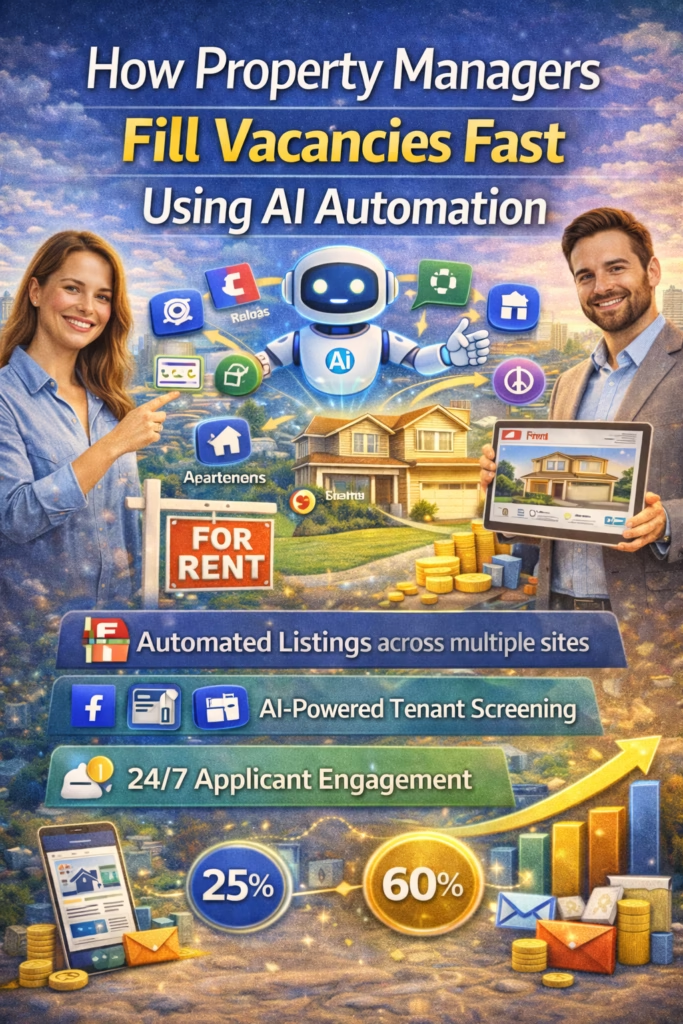
How Property Managers Fill Vacancies Fast Using AI Automation
How Property Managers Fill Vacancies Fast Using AI Automation is your 2025 playbook to reduce vacancy days with faster lead response, consistent follow-up, better listing distribution, and a simple screening system that turns inquiries into signed leases.
Note: This is general marketing guidance. If you use SMS/email outreach, confirm consent requirements and applicable privacy rules.
Introduction
How Property Managers Fill Vacancies Fast Using AI Automation comes down to one reality: vacancies don’t stay vacant because there is “no demand.” They stay vacant because leads aren’t handled fast enough, follow-up isn’t consistent, or the listing isn’t reaching enough renters where they actually search.
AI automation fixes the operational gaps that cause vacancy days to drag on: it distributes listings across platforms, responds instantly 24/7, qualifies renters with the right questions, and keeps the pipeline moving until a showing is booked and an application is submitted.
Big idea: You don’t need more inquiries. You need higher conversion from inquiry → showing → application → lease.
Expanded Table of Contents
- 1) The 5 principles of filling vacancies faster
- 2) #1 Multi-site listing distribution (reach renters everywhere)
- 3) #2 Speed-to-lead: why the fastest responder wins
- 4) #3 AI responder scripts that book showings
- 5) #4 Automated follow-up (stop losing qualified renters)
- 6) #5 Screening flows that reduce wasted showings
- 7) #6 Listing copy that increases inquiry quality
- 8) #7 Photo + video upgrades that lift conversions
- 9) #8 Scheduling: the “two time windows” method
- 10) #9 Application acceleration with automation
- 11) #10 Lead scoring: prioritize the best tenants first
- 12) #11 KPI tracking: reduce vacancy days weekly
- 13) #12 Compliance + trust: protect your brand
- 14) #13 Build a repeatable “vacancy fill SOP”
- 15) #14 7-day vacancy rescue plan (fast turnaround)
- 16) #15 The weekly routine that keeps units full
- 17) Copy/paste checklists
- 18) 30–60–90 day rollout plan
- 19) 25 Frequently Asked Questions
- 20) 25 Extra Keywords
1) The 5 principles of filling vacancies faster
Before tactics, lock in the rules. Vacancies fill faster when you consistently execute these principles:
Principle 1: Distribution beats guessing
Renters are spread across platforms. The best teams syndicate listings to reach demand everywhere.
Principle 2: Speed-to-lead is the strongest lever
Most renters contact multiple listings. The fastest responder often wins the showing.
Principle 3: Consistent follow-up recovers lost deals
Qualified renters go cold when there’s no next step. Automation fixes this.
Principle 4: Qualification improves show rate
Ask the right questions early so you book showings with the right people.
Principle 5: Make applying easy
Less friction = faster applications = fewer vacancy days.
Shortcut: Syndicate + instant reply + follow-up + screening + easy scheduling.
2) #1 Multi-site listing distribution (reach renters everywhere)
If your listing is only on one platform, your unit stays vacant longer than it should. AI automation helps you publish the same listing across multiple sites with consistent details, photos, and pricing—without manual re-entry.
What to standardize across every platform
- Address or cross-streets (based on your privacy preference)
- Rent, deposit, lease term, utilities
- Bedrooms/bathrooms, sqft, pet policy
- Availability date + showing instructions
- Consistent photo set + captions
- Clear “how to apply” steps
Goal: Same listing everywhere, updated weekly, with no conflicting details.
3) #2 Speed-to-lead: why the fastest responder wins
Speed-to-lead is the number one reason AI is changing vacancy fill rates. Renters are moving quickly. If your first response happens hours later, you’re competing for leftovers.
| Lead channel | Best practice | Outcome |
|---|---|---|
| Marketplace messages | Instant reply + questions | Higher showing bookings |
| Craigslist emails/texts | Auto-reply + follow-up | Fewer missed inquiries |
| Website forms | < 5 minutes response | More applications |
| Calls | Missed-call text back | Recovered leads |
Missed-call text back (copy/paste)
Hey! Sorry I missed your call — are you looking for the rental at [property/cross-street]?
If you tell me your move-in date + number of occupants, I’ll send availability and next steps.
Fast win: “Instant reply” + “two time windows” doubles showing volume in many markets.
4) #3 AI responder scripts that book showings
AI responders work best when they do two things: (1) confirm the unit is available, and (2) collect the minimum info needed to schedule a showing or send an application link.
AI first response (copy/paste)
Thanks for reaching out! 👋 Yes, it’s available.

Quick questions so I can schedule you:
1) What move-in date are you aiming for?
2) How many adults/occupants?
3) Any pets?
4) Best number to text you?

After you reply, I’ll send 2 showing time options.
“Two time windows” booking message
Great — I can do showings:
Option A: [Day] between [Time–Time]
Option B: [Day] between [Time–Time]

Which works better? I’ll confirm the exact time and address details.
Why this works: It creates momentum and reduces back-and-forth.
5) #4 Automated follow-up (stop losing qualified renters)
Most property managers lose renters because they don’t follow up consistently. AI fixes this by sending polite nudges and keeping leads moving.
Follow-up sequence (5 touches)
Touch 1 (Day 0): Availability + 4 quick questions
Touch 2 (Day 1): “Still looking?” + showings
Touch 3 (Day 3): Send application link + requirements
Touch 4 (Day 7): “Want to book a showing?” + two time windows
Touch 5 (Day 14): Close-the-loop message
Close-the-loop follow-up
Just checking in — do you still want to see this unit?
If not, no worries. If yes, tell me your move-in date and I’ll send the next steps.
Pro tip: Follow-up should feel helpful, not pushy. Keep it short.
6) #5 Screening flows that reduce wasted showings
Filling vacancies fast is not just about volume—it’s about quality. Screening questions prevent no-shows and reduce time wasted on unqualified leads.
Simple pre-screen (copy/paste)
To confirm this is a fit:
• Target move-in date?
• Monthly household income range?
• Any evictions in the last 7 years?
• Pets? (type/weight)
• Number of occupants?

If everything looks good, I’ll send the showing options.
Note: Be consistent and follow all applicable fair housing rules and local regulations.
7) #6 Listing copy that increases inquiry quality
AI can help your listing copy reduce low-quality inquiries by clarifying what matters: price, requirements, pet policy, and how to view/apply.
High-converting listing structure
- Headline: Beds/Baths + neighborhood + one standout feature
- Top 3 highlights: parking, laundry, updated kitchen, etc.
- Requirements: income, credit, pets, smoking
- Availability: move-in date + showing process
- CTA: “Message with move-in date + occupants to schedule”
Fast win: Put the requirements near the top so you get fewer mismatched leads.
8) #7 Photo + video upgrades that lift conversions
Most listings underperform because photos are weak. In 2025, renters make decisions fast. Better visuals increase inquiries and reduce vacancy time.
Minimum photo set
- Front exterior + entry
- Living room (wide angle)
- Kitchen (2 angles)
- Primary bedroom + closet
- Bathroom
- Any “reason to choose it” feature (yard, balcony, laundry)
Best practice: Add a 20–40 second walkthrough clip. Even basic video boosts trust.
9) #8 Scheduling: the “two time windows” method
Showings get delayed when scheduling drags out. The best vacancy-fill teams reduce back-and-forth by offering two windows and confirming quickly.
Scheduling confirmation template
Perfect — let’s do it.
I have you for [Day] at [Time]. Please reply “CONFIRMED”.

I’ll send the exact address and entry instructions next.
Showing reminder (day of)
Reminder for your showing today at [Time].
Reply YES to confirm you’re still coming. If you need to reschedule, tell me your best day/time.
Result: Fewer no-shows and faster application flow.
10) #9 Application acceleration with automation
Units stay vacant when applications stall. Automation speeds this up by sending links, requirements, and reminders in a consistent order.
Application message (copy/paste)
Great — here are the next steps:
1) Application link: (link)
2) Requirements: income, background, pet policy
3) Documents: ID + pay stubs (or proof of income)

Once submitted, we review quickly and update you by [timeframe].
Pro move: Send a “here’s what to upload” checklist to reduce incomplete apps.
11) #10 Lead scoring: prioritize the best tenants first
AI lead scoring helps your team respond faster to the most qualified renters so vacancy days shrink.
| Signal | Score | Meaning |
|---|---|---|
| Move-in within 14 days | +15 | High urgency |
| Shares full details (pets/occupants/income) | +10 | High seriousness |
| Books showing quickly | +10 | High intent |
| Asks about application | +10 | Closer to lease |
| Non-responsive after 2 touches | -10 | Lower priority |
Action rule: Leads above 25 points get a human follow-up within 15 minutes.
12) #11 KPI tracking: reduce vacancy days weekly
You can’t improve what you don’t measure. Track these weekly to shrink vacancy time.
| KPI | Target | Fix if low |
|---|---|---|
| Time to first response | < 5 minutes | AI responder + alerts |
| Inquiry → showing rate | Improve weekly | Better scripts + two time windows |
| Showing → application rate | Improve weekly | Application flow + reminders |
| Application completion rate | High | Document checklist + clarity |
| Days vacant | Down trend | Distribution + response + follow-up |
Weekly rule: Choose one KPI to improve for the next 7 days.
13) #12 Compliance + trust: protect your brand
AI can scale communication, but property management requires consistency, professionalism, and compliance. Keep messaging respectful and handle screening fairly and consistently.
- Confirm consent requirements for SMS/email outreach
- Keep screening questions consistent across applicants
- Avoid language that could be interpreted as discriminatory
- Store lead data responsibly
- Provide clear next steps and timelines
Principle: Automation should improve renter experience, not create noise.
14) #13 Build a repeatable “vacancy fill SOP”
Automation works best when you document your flow. A simple SOP prevents vacancies from depending on “who’s on shift.”
Vacancy Fill SOP (outline)
- Listing distribution checklist (platforms, refresh cadence)
- Lead capture routing (calls, texts, messages, email)
- First response templates
- Pre-screen questions
- Scheduling rules
- Application messages + document checklist
- Follow-up timeline
- KPIs reviewed weekly
Outcome: Faster leasing, less chaos, fewer missed leads.
15) #14 7-day vacancy rescue plan (fast turnaround)
If a unit is dragging, this plan improves your next 7 days immediately.
- Refresh listing copy (requirements + CTA near top)
- Replace weak photos; add a short walkthrough clip
- Repost/refresh listings on key platforms
- Turn on instant reply + 4 screening questions
- Offer two showing windows daily
- Send application link after showing confirmation
- Follow up every open lead with a short message
Fast win: Shorten scheduling and increase follow-up—vacancy days drop.
16) #15 The weekly routine that keeps units full
This routine keeps vacancy time low across your portfolio.
Weekly routine (60–90 minutes)
[ ] Refresh listings (pricing, availability, CTA)
[ ] Upload new photos or a short walkthrough
[ ] Review lead response times
[ ] Confirm follow-up automation is running
[ ] Message all open leads: showings + application link
[ ] Review KPIs: inquiry→showing and showing→application
Monthly routine (2–3 hours)
[ ] Audit platform performance by market
[ ] Improve scripts based on objections
[ ] Update screening workflow and requirements text
[ ] Review days vacant trends and bottlenecks
[ ] Train team on SOP updates
17) Copy/paste checklists
Vacancy-fill checklist (per unit)
[ ] Listing copy updated (requirements + CTA)
[ ] Minimum photo set + walkthrough clip
[ ] Published across multiple platforms
[ ] Instant reply enabled
[ ] Screening questions set (move-in, occupants, pets, income range)
[ ] Scheduling uses two time windows
[ ] Application link + document checklist ready
[ ] Follow-up sequence activated
Daily leasing ops checklist (10 minutes)
[ ] Respond to new leads (or verify AI did)
[ ] Confirm showings for the next 24 hours
[ ] Send application links to qualified leads
[ ] Follow up with anyone who didn’t reply
[ ] Update pipeline statuses
18) 30–60–90 day rollout plan
Days 1–30 (Fast vacancy reduction)
- Standardize listing template + photo requirements
- Enable instant response + missed-call text back
- Deploy screening flow + showing scheduler template
- Launch follow-up sequences for all leads
- Track response time and showing bookings weekly
Days 31–60 (Compounding improvements)
- Expand distribution + refresh cadence
- Improve listing copy per market based on inquiries
- Add lead scoring and priority rules
- Optimize application completion with checklists
- Reduce no-shows with reminder + confirmation texts
Days 61–90 (Systemize + scale)
- Document a full vacancy fill SOP
- Train team on scripts + escalation rules
- Build reporting dashboards for KPIs
- Scale workflows portfolio-wide
- Refine based on vacancy-day trends
Outcome: Lower vacancy days, fewer missed leads, and a smoother leasing pipeline.
19) 25 Frequently Asked Questions
1) How do property managers fill vacancies faster with AI?
By distributing listings across platforms, responding instantly, following up consistently, screening efficiently, and accelerating applications.
2) What’s the biggest reason vacancy days stay high?
Slow response time and weak follow-up. Qualified renters move on quickly.
3) Does automation replace leasing staff?
No. It reduces manual work and prevents leads from slipping through the cracks.
4) What should an AI responder ask first?
Move-in date, occupants, pets, and best contact number—then book a showing.
5) How many follow-ups should I send?
Usually 4–6 touches over two weeks works well if messages are short and helpful.
6) Should I include requirements in the listing?
Yes. Clear requirements reduce low-quality inquiries and wasted showings.
7) What’s the best way to schedule showings?
Offer two time windows and confirm quickly with a reminder message.
8) How do I reduce no-shows?
Send same-day reminders and ask renters to reply YES to confirm.
9) How do I increase application completion?
Send a document checklist and clear steps immediately after showing confirmation.
10) Does AI help with listing distribution?
Yes. Automation can publish and refresh listings across platforms consistently.
11) Which platforms should I prioritize?
It depends on your market, but focus on platforms where renters actively search and refresh weekly.
12) Should I add video walkthroughs?
Yes. Even a simple walkthrough increases trust and inquiry conversion.
13) What KPIs matter most for vacancies?
Response time, inquiry→showing, showing→application, and days vacant.
14) How fast should I respond to inquiries?
Ideally within minutes. Instant replies improve showing bookings.
15) Can automation feel spammy?
Yes if overused. Keep messages short, relevant, and helpful.
16) How do I prioritize leads?
Use lead scoring based on urgency, details shared, and engagement.
17) What’s the best first response for rental inquiries?
Confirm availability, ask 3–4 screening questions, then offer two showing windows.
18) How do I handle after-hours inquiries?
Use an instant reply that captures info and offers next-day showings.
19) Can I automate application reminders?
Yes. Reminders increase completion rates without manual chasing.
20) How do I keep listings consistent across platforms?
Use one standardized template and update all listings together on a schedule.
21) What’s the fastest improvement I can make today?
Enable instant reply + missed-call text back and implement follow-up.
22) How often should I refresh listings?
Weekly is a strong baseline in many markets.
23) Do I need a CRM for rental leads?
It helps, but even a simple pipeline with statuses improves follow-up and conversion.
24) How long does it take to see results?
Speed-to-lead improvements can work immediately; distribution and optimization compound over weeks.
25) What makes vacancy-fill automation succeed long-term?
Consistency: distribution, fast replies, follow-up, screening, and KPI-based improvements.
20) 25 Extra Keywords
- How Property Managers Fill Vacancies Fast Using AI Automation
- AI automation for property management
- fill vacancies fast property management
- rental lead generation automation
- multi site rental listing automation
- AI leasing assistant
- AI follow up for rental leads
- automated rental inquiry responses
- reduce vacancy days
- rental marketing automation
- Facebook Marketplace rental leads
- Craigslist rental lead system
- property manager lead capture
- AI scheduling for showings
- rental application automation
- tenant screening workflow
- lead scoring for renters
- how to lease units faster
- rental listing copy template
- increase inquiry to showing rate
- increase showing to application rate
- property management KPI tracking
- vacancy fill SOP
- 30 60 90 leasing plan
- automated follow up for property managers