
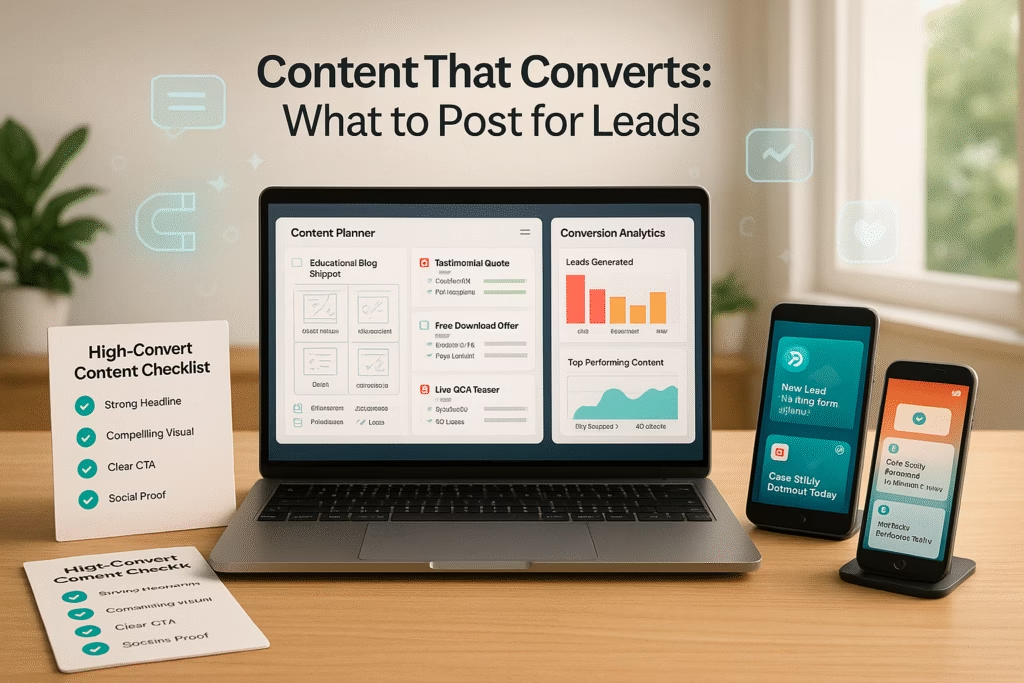
Content That Converts: What to Post for Leads
Expert Lead-Generating Content by Market Wiz AI
Table of Contents
- Introduction: Content That Converts: What to Post for Leads
- 1. Why Content That Converts Matters
- 1.1 The Psychology of Conversion
- 1.2 Establishing Audience Trust
- 1.3 Content vs. Traditional Ads
- 2. Defining Your Audience & Goals
- 2.1 Building Buyer Personas
- 2.2 Mapping the Customer Journey
- 2.3 Setting SMART Content Objectives
- 3. Types of Content That Generate Leads
- 3.1 In-Depth Blog Articles & Guides
- 3.2 Real-Life Case Studies & Testimonials
- 3.3 Webinars, Workshops & Live Q&As
- 3.4 Downloadable Checklists, Templates & Whitepapers
- 3.5 Bite-Sized Videos & Social Media Shorts
- 3.6 Personalized Email Sequences
- 3.7 Interactive Quizzes & Calculators
- 4. Distribution Channels & Strategies
- 4.1 Search Engine Optimization for Blogs
- 4.2 Video SEO on YouTube & Social Media
- 4.3 Social Platforms: LinkedIn, Facebook & Instagram
- 4.4 Email Marketing Tactics
- 4.5 Content Repurposing Across Channels
- 5. Crafting High-Impact Content
- 5.1 Keyword Research & Topic Validation
- 5.2 Compelling Headlines & Hooks
- 5.3 Storytelling Framework & Structure
- 5.4 Designing Engaging Visual Assets
- 5.5 Writing Clear, Persuasive CTAs
- 6. Measuring & Iterating for Better Results
- 6.1 Defining Key Performance Indicators
- 6.2 Conducting A/B Tests on Content Elements
- 6.3 Funnel Analysis & Drop-off Points
- 6.4 Continuous Content Improvement Loop
- 7. Conclusion & Next Steps
- 25 FAQs
- 25 Extra Keywords
Introduction: Content That Converts: What to Post for Leads
Content That Converts: What to Post for Leads is the cornerstone of a thriving inbound marketing strategy. Rather than casting a wide net with generic ads, you craft targeted, valuable content designed to guide prospects from discovery to decision. This post delves into the psychology behind effective content, pinpoints the formats that outperform for lead generation, and outlines actionable steps to build a content engine that consistently fills your pipeline with qualified leads.
1. Why Content That Converts Matters
1.1 The Psychology of Conversion
Decision-making often hinges on perceived value and trust. Content That Converts: What to Post for Leads works by addressing pain points head-on, offering solutions, and demonstrating credibility. When prospects find your material helpful—whether a detailed how-to or a candid client story—they begin to view you as a trusted advisor, making them more inclined to share contact details or request a demo.
1.2 Establishing Audience Trust
Trust is earned, not bought. Educational resources—guides, webinars, case studies—showcase your expertise and transparency. Compared to traditional advertising, which interrupts and demands attention, high-value content earns attention by providing immediate, relevant insights. This authenticity fosters a deeper connection, making leads more receptive when you ask them to take action.
1.3 Content vs. Traditional Ads
Paid ads can generate quick visibility, but they often lack depth. In contrast, content marketing builds a long-term asset that continues to attract and nurture leads over time. A well-written blog post, optimized for search, can rank for months, driving organic traffic and leads continuously—whereas an ad stops performing once the budget is exhausted.
2. Defining Your Audience & Goals
2.1 Building Buyer Personas
Not all readers are ready to convert. Develop detailed buyer personas—demographics, job roles, challenges, and preferred channels—to tailor your content. For instance, a CFO persona might prioritize ROI-focused case studies, whereas a marketing manager persona seeks practical how-to guides and templates. Persona specificity ensures each piece of content resonates with the right decision-maker at the right time.
2.2 Mapping the Customer Journey
The buyer’s journey typically passes through awareness, consideration, and decision phases. Map out content that aligns with each stage: awareness (introductory blog posts, infographics), consideration (comparisons, in-depth guides, webinars), and decision (live demos, free trials, detailed case studies). This structured approach prevents gaps and guides prospects smoothly toward conversion.
2.3 Setting SMART Content Objectives
Establish Specific, Measurable, Achievable, Relevant, and Time-bound goals for your content. Examples include “Generate 200 new email subscribers from our eBook download by Q3” or “Achieve a 10% conversion rate on our next webinar sign-up within 6 weeks.” Clear benchmarks enable you to gauge success and tweak strategies mid-campaign.
3. Types of Content That Generate Leads
3.1 In-Depth Blog Articles & Guides
Long-form blog posts (1,500+ words) that thoroughly address a specific topic—such as “The Ultimate Guide to B2B Email Marketing”—attract organic traffic and position your brand as an authority. By weaving in examples, data, and actionable steps, you deliver value while naturally embedding calls to action like “Subscribe for more insights” or “Download our free template.”
3.2 Real-Life Case Studies & Testimonials
Case studies provide social proof by showcasing measurable results from past clients. Structure them as challenge, solution, results narratives—complete with data points (“saw a 45% increase in ROI”) and quotes. Feature a prominent CTA: “See how we can replicate this success for your business—book a consultation today.”
3.3 Webinars, Workshops & Live Q&As
Interactive webinars on niche topics—like “Advanced LinkedIn Lead Generation” or “Optimizing Your Sales Funnel”—enable real-time engagement. Require registration to capture attendee information. Follow up with on-demand recordings and supplementary materials to nurture leads further down the funnel.
3.4 Downloadable Checklists, Templates & Whitepapers
Practical assets—SEO audit checklists, social media calendar templates, or whitepapers on industry trends—serve as high-value lead magnets. Gate them behind simple forms that ask for name, email, and company. The perceived value of a well-designed toolkit encourages sign-ups and fosters goodwill.
3.5 Bite-Sized Videos & Social Media Shorts
Short, 30–60 second videos—explaining a quick tip or highlighting a client success—perform excellently on social channels. For example, a quick “3 Ways to Improve Your Email Open Rates” video on LinkedIn or Instagram Reels can link back to a longer blog or gated asset. These easily digestible snippets pique curiosity and drive traffic.
3.6 Personalized Email Sequences
Once a lead is captured, nurture them with automated email sequences tailored to their interests. A new subscriber who downloaded a checklist might receive follow-up emails with case studies, video tutorials, and finally, a personalized offer or demo invitation. Segmenting based on content consumed ensures relevance and higher engagement.
3.7 Interactive Quizzes & Calculators
Engage users with interactive tools—“What Type of Marketer Are You?” quiz or “Website Conversion Rate Calculator.” Upon completion, request an email address to send personalized results or a detailed report. This approach combines engagement with valuable data capture.
4. Distribution Channels & Strategies
4.1 Search Engine Optimization for Blogs
Optimize each blog post for targeted keywords, including the focus phrase “Content That Converts: What to Post for Leads” in the title, URL, and opening paragraph. Use descriptive subheadings and include internal links to cornerstone pages. Encourage backlinks through guest posts and influencer outreach to boost domain authority and organic ranking.
4.2 Video SEO on YouTube & Social Media
Create complementary videos—tutorials, case study breakdowns, or expert interviews—on YouTube. Optimize titles and descriptions with relevant keywords. Embed videos in your blog posts to increase dwell time. On social platforms like LinkedIn and Instagram, add captions and transcripts to improve visibility and accessibility.
4.3 Social Platforms: LinkedIn, Facebook & Instagram
Distribute content where your personas are most active. Use LinkedIn for B2B whitepapers and case studies, leveraging LinkedIn Articles or SlideShare uploads. On Facebook, share infographics and webinar invitations within relevant groups. Instagram highlights bite-sized tutorials and visual testimonials, using Stories and Reels to drive traffic back to your website.
4.4 Email Marketing Tactics
Segment lists by interest and engagement. Send targeted newsletters featuring recent blog posts, upcoming webinars, and exclusive downloads. Craft compelling subject lines—“Get Our Ultimate Lead Gen Checklist Now”—and place clear CTAs within the email body. Use personalization tokens ({{first_name}}) to increase open and click-through rates.
4.5 Content Repurposing Across Channels
Maximize reach by adapting one asset into multiple formats: convert a long-form blog into an infographic, extract key points into a Twitter thread, transform a case study into a SlideShare presentation, or break a webinar into short social media clips. This strategy ensures consistent messaging across touchpoints without reinventing the wheel.
5. Crafting High-Impact Content
5.1 Keyword Research & Topic Validation
Use tools like Ahrefs, SEMrush, or Google Keyword Planner to identify relevant search terms with decent volume and manageable competition. Validate topics by checking search intent—review top-ranking pages, examine featured snippets, and study related queries. Focus on questions prospects ask at each funnel stage.
5.2 Compelling Headlines & Hooks
Your headline must promise value and ignite curiosity—e.g., “5 Proven Content That Converts: What to Post for Leads.” Use numbers, power words (“Proven,” “Ultimate”), and specific language. In the introduction, open with a surprising fact or statistic—“Did you know 65% of marketers report blog posts as their top lead source?”—to hook readers immediately.
5.3 Storytelling Framework & Structure
Structure your content using the PAS framework (Problem, Agitate, Solution) or the Hero’s Journey narrative. Begin by empathizing with your audience’s challenge, detail the consequences of inaction, and present your content as the roadmap to success. Use subheadings, bullet points, and short paragraphs to maintain readability.
5.4 Designing Engaging Visual Assets
Visuals break up text and clarify complex concepts. Use charts to illustrate data, infographics to summarize processes, and branded custom images to reinforce identity. Tools like Canva offer templates for quick, on-brand visuals. Always include alt text for accessibility and SEO benefits.
5.5 Writing Clear, Persuasive CTAs
CTAs guide readers toward the next step. Position them logically—after a valuable insight or at the end of a section where you present a solution. Use action verbs (“Download,” “Register,” “Get Your Free Copy”) and emphasize the benefit: “Get Your Free Lead Magnet Now.” Ensure buttons or links stand out visually for easy clicking.
6. Measuring Performance & Iterating for Better Results
6.1 Defining Key Performance Indicators
Track metrics that directly tie to lead generation: unique visitors, time on page, scroll depth, click-through rate on CTAs, and form submission rates. For video content, monitor view count, average view duration, and engagement (likes, shares, comments). Establish baseline metrics to measure growth over time.
6.2 Conducting A/B Tests on Content Elements
Experiment with two versions of headlines, headings, CTAs, or images. For instance, test “Download Our Free Template” versus “Get Your Free Lead Gen Template” to see which yields a higher conversion rate. Use A/B testing tools (Google Optimize, Optimizely) to gather statistically significant data before committing to one variation.
6.3 Funnel Analysis & Drop-off Points
Use Google Analytics or similar platforms to visualize user paths—from landing page to form submission. Identify where visitors exit the funnel (e.g., bounce on hero section, abandon form). Optimize those pages: simplify forms, add trust badges, or enhance introductory copy to reduce friction.
6.4 Continuous Content Improvement Loop
Review analytics data quarterly. Update underperforming content by refreshing statistics, adding new examples, or improving readability. Republish with a current date and promote updated content through newsletters and social channels. This iterative approach keeps your content relevant and improves its conversion potential over time.
7. Conclusion & Next Steps
Content That Converts: What to Post for Leads is a strategic process, not a one-off task. By understanding your audience’s needs, selecting the right content formats, optimizing distribution, and rigorously measuring outcomes, you’ll build a sustainable pipeline of qualified leads. Follow these next steps to kickstart your lead-generating content machine:
- Define Personas & Goals: Conduct research to flesh out buyer personas and set SMART objectives for each content piece.
- Create a Flagship Asset: Develop a high-value resource—such as an eBook or webinar—designed to capture leads and showcase your expertise.
- Build a Distribution Plan: Map out channels and timing—SEO-optimized blog, email sequences, social media teasers—ensuring each asset reaches its intended audience.
- Produce & Publish: Craft your content with compelling headlines, story-driven narratives, and clear CTAs. Release according to schedule.
- Analyze & Optimize: Monitor key metrics, run A/B tests, and iterate on underperforming elements to continuously improve conversion rates.
Implement these steps today to transform traffic into tangible leads. With Content That Converts: What to Post for Leads guiding your strategy, you’ll cultivate a content ecosystem that reliably drives growth and ROI.
25 Frequently Asked Questions
1. What is “Content That Converts: What to Post for Leads”?
This phrase refers to creating specific types of content—like guides, case studies, and interactive tools—explicitly designed to generate and capture qualified leads by offering value and building trust.
2. How do I identify my target audience?
Use analytics, surveys, and direct interviews to gather demographic and psychographic data. Combine this with social media insights and CRM data to create detailed buyer personas, capturing challenges and preferences.
3. Which content format is best for top-of-funnel awareness?
Long-form, SEO-optimized blog posts and short educational videos perform well for awareness. They address common questions (“What is inbound marketing?”) and attract organic search traffic.
4. How do I capture leads from a blog post?
Embed lead magnets—such as whitepapers or checklists—behind a simple opt-in form. Place CTAs strategically within the post (mid-article and at the end) to invite readers to download these resources in exchange for their email.
5. Are case studies effective for all industries?
Yes—case studies work across B2B and B2C sectors. They demonstrate real-world outcomes and provide social proof. Tailor the narrative to highlight metrics and results relevant to your audience’s industry.
6. How often should I host webinars?
Quarterly webinars strike a balance between producing high-quality content and maintaining audience interest. For fast-paced industries, consider bi-monthly sessions to stay top-of-mind.
7. What makes a great lead magnet?
A great lead magnet solves a specific problem, is easy to consume, and delivers immediate value—like a concise checklist or template. It should align with your audience’s pain points and tie into your broader service offerings.
8. How do I optimize blog posts for SEO?
Incorporate the focus keyword “Content That Converts: What to Post for Leads” in the title, first paragraph, and subheadings. Use related long-tail keywords, optimize images with descriptive alt text, and build internal and external links.
9. What metrics indicate content success?
Key metrics include organic traffic, time on page, scroll depth, CTA click-through rate, form submission rate, and social shares. These metrics reveal both engagement and lead generation effectiveness.
10. How do I A/B test headlines?
Use tools like Google Optimize or your CMS’s built-in A/B testing feature. Create two headline variations, split traffic equally, and measure click-through rates and time on page to determine which performs better.
11. How do I repurpose a blog post?
Convert blog content into an infographic, break it into a video script for YouTube or social media, extract quotes for social posts, and summarize key points in an email newsletter. This maximizes reach and reinforces messaging.
12. Is interactive content really worth the effort?
Yes—interactive quizzes or calculators engage users actively and provide personalized feedback. Because they require user input, they tend to generate higher-quality leads who are invested in the result.
13. How do I write persuasive CTAs?
Begin with an action verb—“Download,” “Register,” “Start”—and highlight the benefit—“Download Your Free Guide” or “Register for Our Webinar.” Keep CTAs concise and place them after sections where you’ve established credibility or value.
14. How frequently should I update cornerstone content?
Review and refresh cornerstone assets every 6–12 months. Update statistics, add new examples or case studies, refine guidance based on industry changes, and republish with a current date to maintain relevance and SEO value.
15. What’s the ideal length for a lead-generating blog?
Aim for 1,500–2,500 words for in-depth articles that cover a topic comprehensively. Longer posts tend to rank better in search and provide ample opportunity to include detailed insights, visuals, and multiple CTAs.
16. How do I promote my content on social media?
Create teaser posts—snippets of valuable insights, eye-catching quotes, or short video clips—and link back to the full article or resource. Use platform-specific features like LinkedIn Carousel posts, Instagram Stories swipe-ups, and Twitter threads.
17. Should I use paid ads to boost content?
Paid ads can amplify reach, especially for high-value assets like eBooks or webinars. A small budget for targeted ads on LinkedIn or Facebook can accelerate lead capture, but focus first on optimizing organic performance before investing heavily in paid promotion.
18. How do I choose the right distribution channel?
Select channels based on where your personas are most active. For B2B decision-makers, LinkedIn and email are often effective. For B2C audiences, Instagram and Facebook may yield better engagement. Use analytics to validate channel performance over time.
19. How do I maintain a consistent content schedule?
Use a content calendar—spreadsheet or project management tool—to plan topics, assign responsibilities, and set deadlines. Block out time for research, writing, editing, and design. Regular review meetings ensure accountability and help you adapt to shifting priorities.
20. Can I automate content promotion?
Yes—tools like Buffer, Hootsuite, or Later let you schedule social posts in advance. Email platforms like Mailchimp and HubSpot automate drip campaigns. However, maintain a personal touch by responding to comments and updating scheduled posts based on real-time events.
21. How do I incorporate visual storytelling?
Integrate high-quality images, infographics, and data visualizations to break up text and illustrate key points. Videos—explainer clips or animated graphs—enhance engagement. Ensure visuals align with your brand’s style and color palette.
22. How do I handle content distribution for international audiences?
Translation and localization are crucial. Adapt idioms, examples, and references to resonate with local cultures. Use hreflang tags to help search engines serve the correct language version to users in different regions.
23. What common mistakes should I avoid?- Neglecting SEO best practices—optimizing too late or not at all.
- Overloading posts with CTAs—balance value with promotion.
- Ignoring performance data—without metrics, you can’t refine effectively.
- Focusing only on top-of-funnel content—nurture mid- and bottom-funnel leads as well.
24. How do I stay updated on content marketing trends?
Follow industry blogs (Content Marketing Institute, HubSpot), subscribe to marketing newsletters, and participate in webinars. Join professional communities on LinkedIn or specialized Slack channels to exchange best practices.
25. Where can I find more resources on Content That Converts: What to Post for Leads?
Visit Market Wiz AI’s blog for deep-dive tutorials, downloadable content planners, and real-world case studies. Download our free “Lead-Generating Content Workbook” for templates and checklists to streamline your strategy.
25 Extra Keywords
- lead generation content tips
- high-conversion blog topics
- case study lead magnet
- webinar lead generation strategy
- downloadable template for leads
- interactive quiz for lead capture
- SEO-optimized lead content
- content repurposing tactics
- email nurture sequence templates
- social media lead generating posts
- video content for lead conversion
- infographic for lead magnets
- CTA best practices for blogs
- buyer persona content mapping
- A/B testing for headlines
- content calendar for lead gen
- LinkedIn content for B2B leads
- Facebook ad vs. organic content
- Instagram lead capture tips
- Google Analytics lead tracking
- Blog engagement metrics
- Optimizing CTAs for conversions
- Content workflow automation tools
- client testimonial video script
- Market Wiz AI content guide