
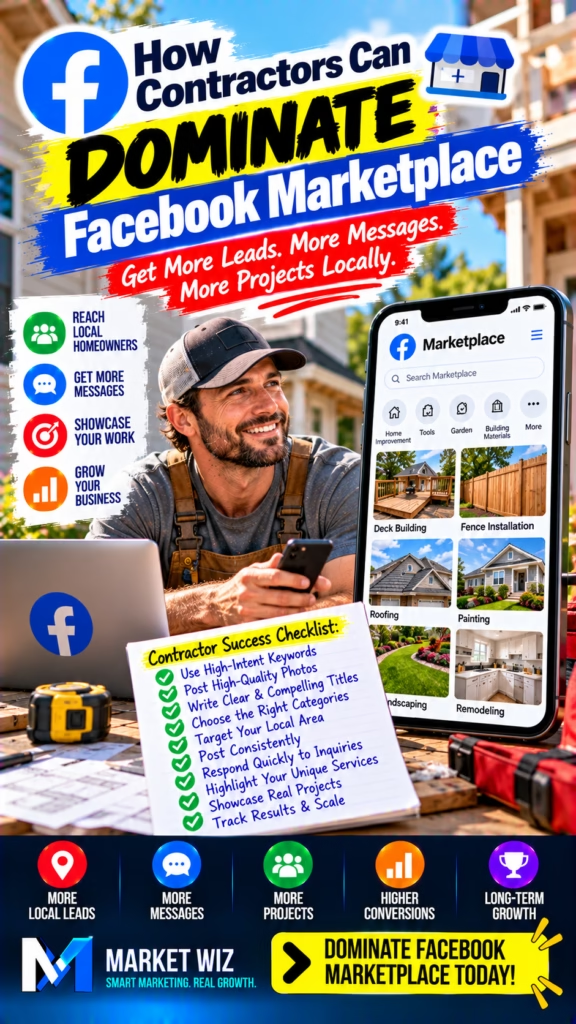
How Contractors Can Dominate Facebook Marketplace
Discover how contractors can build a stronger local presence through Facebook Marketplace, Facebook Pages, community Groups, professional project content, accurate product listings, organic customer engagement, and organized lead management. Learn how to reach nearby homeowners, improve visibility, and develop a more consistent marketing strategy without relying entirely on expensive paid advertising.
1. Why Facebook Matters for Contractor Marketing
Contractors operate in a highly competitive local market. Homeowners searching for painting, roofing, remodeling, HVAC, plumbing, electrical work, flooring, and other home improvement solutions often research multiple businesses before making contact.
Traditional advertising can help contractors reach potential customers, but it is not the only way to build local awareness.
Facebook offers several ways for businesses to connect with local communities, share examples of completed work, answer homeowner questions, and present relevant products.
Facebook Marketplace is one part of this ecosystem. It is primarily designed for eligible goods, not as a general-purpose marketplace for standalone contracting services.
That distinction matters. A contractor selling legitimate physical products may find opportunities through Marketplace, while service promotion is generally better suited to Facebook Pages, appropriate Groups, and other permitted Meta business tools.
Core strategy: Contractors should use Facebook Marketplace for eligible products and use complementary Facebook channels to market their contracting expertise, build trust, and generate qualified local inquiries.
The most effective approach combines accurate offers, strong visual content, community participation, customer responsiveness, and measurable marketing performance.
2. Understand How Facebook Marketplace Works for Contractors
Facebook Marketplace allows users to discover and evaluate listings for eligible goods.
Customers may browse by category, location, price, and other available filtering options.
For contractors, the platform can be relevant when the business offers actual physical products that comply with Meta's commerce policies.
Examples may include eligible tools, fixtures, building materials, or equipment.
However, a standalone painting, roofing, plumbing, or remodeling service should not be disguised as a physical product listing.
Businesses should review current Meta Commerce Policies and Marketplace requirements before creating listings.
Policies, supported categories, and business listing features can change over time.
A compliant strategy is essential for protecting the business's Facebook presence and maintaining customer trust.
3. Identify Local Marketing Opportunities for Contractors
Contractors usually serve specific geographic territories.
A painting company may focus on one city and nearby suburbs.
An HVAC contractor may cover a broader metropolitan area.
A flooring installer may work within a defined driving distance.
Facebook's local community features can help businesses communicate with people in these areas.
The first step is to identify where potential customers live, what types of projects they need, and which Facebook channels are suitable for reaching them.
Local Homeowners
Share useful information about common home improvement needs and available contracting work.
Relevant Product Buyers
Offer genuine, eligible tools, fixtures, materials, or equipment through appropriate Marketplace listings.
Community Members
Participate in local Groups when the rules permit professional recommendations and business posts.
Returning Customers
Maintain a useful Page presence that helps previous customers find current business information.
Local marketing should focus on genuine customer relevance rather than indiscriminate posting.
4. Define Your Ideal Contractor Customer
Not every Facebook user is a suitable customer for every contractor.
A roofing company may want to reach property owners considering roof replacement.
A painting business may focus on homeowners planning interior or exterior projects.
A flooring company may target renovation projects requiring specific materials or installation expertise.
Understanding the intended audience helps businesses create more relevant Facebook content.
Consider these customer characteristics:
- Actual geographic location.
- Type of property or project.
- Relevant product or service need.
- Typical project scope.
- Scheduling requirements.
- Decision-making concerns.
- Questions customers ask before hiring.
The objective is to develop content that addresses real needs, not to make unsupported assumptions about individual Facebook users.
5. Know What Contractors Can and Cannot List on Marketplace
A major challenge for contractors is understanding the difference between physical goods and services.
Marketplace is not intended to be a workaround for restrictions on standalone service advertisements.
A contractor should not publish a fake product, placeholder item, or misleading price to advertise labor.
Where eligible, genuine physical goods may be listed accurately.
| Offer | Recommended Facebook Channel | Important Consideration |
|---|---|---|
| Actual power tools for sale | Marketplace, if eligible | Accurate condition and pricing required. |
| Available building materials | Marketplace, if eligible | Describe the actual product and availability. |
| Interior house painting | Facebook Page or permitted Group | Do not disguise labor as a product listing. |
| Roof replacement work | Facebook Page or permitted Group | Use appropriate service marketing channels. |
| HVAC repair appointments | Facebook Page or permitted Group | Represent the service accurately. |
| Eligible physical fixtures | Marketplace, if eligible | Follow current product commerce rules. |
This separation creates a more sustainable strategy for both product marketing and contractor lead generation.
6. Improve Facebook Marketplace Search Relevance
Facebook Marketplace users often search using product names, categories, locations, and practical buying terms.
For eligible contractor-related products, clear listing information can help shoppers recognize relevant offers.
A product title should identify the actual item.
Descriptions should explain important specifications, condition, and availability.
Correct categorization also helps keep listings relevant.
No specific keyword formula guarantees higher Marketplace ranking or visibility.
Businesses should avoid repeating unrelated keywords or including terms that misrepresent the item.
Marketplace SEO principle: Write for people first. Accurate product names, relevant specifications, genuine locations, and clear descriptions are more useful than keyword-stuffed advertisements.
7. Write Strong Facebook Marketplace Listing Titles
The title should communicate the product being sold as quickly as possible.
A useful title may include the product category, size, model, material, or condition.
For example, a contractor selling a legitimate tool might identify its manufacturer and model.
A supplier selling eligible building materials may include accurate dimensions.
Practical title examples:
- 18V Cordless Drill Kit – Used, Good Condition
- Solid Wood Interior Door – 30 Inch
- New Ceramic Floor Tile – Available Boxes
- Steel Storage Cabinet – Local Pickup
These are illustrative examples. Each real listing must reflect an actual eligible item and its true specifications.
Avoid using unrelated contractor service terms to attract users searching for physical products.
8. Create Marketplace Descriptions That Build Buyer Confidence
A good Marketplace description answers the questions a serious buyer would naturally ask.
For physical products, customers may want to know dimensions, condition, included components, pickup options, and other relevant details.
The description should be specific enough to reduce confusion without becoming difficult to read.
Include information such as:
- Actual product name.
- Important dimensions or specifications.
- Condition and known defects.
- Included accessories.
- Accurate selling price.
- Realistic pickup or delivery arrangements.
- Any relevant limitations.
Contractors should not use a physical product description as a disguised advertisement for prohibited standalone services.
Service marketing belongs on suitable Facebook channels.
9. Use Professional Project and Product Photography
Contracting is a visual industry.
Homeowners often want to see the quality and style of work a business performs.
Clear photographs can communicate craftsmanship, attention to detail, and project scope.
For Facebook Pages, contractors may share genuine completed-project photographs with permission.
For eligible Marketplace goods, images should accurately show the item being sold.
Photography best practices:
- Use bright, clear photographs.
- Show the actual product or project.
- Capture important details.
- Use accurate colors and proportions.
- Obtain permission where necessary.
- Avoid misleading before-and-after edits.
- Do not present stock images as completed client work.
Professional visual content can improve understanding and support a more credible business presence.
10. Use Accurate Local Keywords in Contractor Facebook Content
Geographic relevance matters because contractors generally operate within defined service territories.
Facebook Page posts can identify the cities and communities a business actually serves.
A painting contractor may discuss a project completed in a nearby city.
A remodeling business may describe work performed in a particular neighborhood, with appropriate customer permission.
These details help readers understand where the business operates.
However, adding numerous unrelated city names does not guarantee better reach.
Businesses should prioritize natural, accurate local information over repetitive location keyword lists.
11. Build a Strong Facebook Business Page for Contracting Leads
A Facebook Page gives contractors a place to publish business information and professional content.
It can serve as a destination for customers who discover the company through community discussions, recommendations, or other marketing.
The Page should accurately describe the business and the work it performs.
Important Page elements:
- Correct business name.
- Relevant business category.
- Accurate contact information.
- Current service-area details.
- Professional profile and cover images.
- Useful project photographs.
- Clear business descriptions.
- Consistent customer communication.
An organized Page can help prospective customers evaluate the company before requesting an estimate.
12. Generate Local Awareness Through Facebook Groups
Local Facebook Groups can be useful for contractors who want to participate in community conversations.
Some Groups allow local business recommendations or promotional posts.
Others prohibit advertising entirely.
Contractors should review each Group's rules before posting.
Helpful participation may involve answering homeowner questions, sharing permitted educational information, or responding when someone requests contractor recommendations.
Repeated unsolicited promotions can damage credibility and may violate Group rules.
A respectful community presence is more sustainable than aggressive self-promotion.
13. Create Facebook Posts That Attract Local Homeowners
Homeowners often respond to content that addresses practical concerns about their property.
A painting contractor may explain how surface preparation affects finish quality.
A roofer may describe signs that a roof needs professional inspection.
An HVAC company may share general maintenance information.
A flooring contractor may compare common flooring materials.
Useful content can establish relevance without requiring every post to be a direct advertisement.
Project Education
Explain common materials, preparation steps, and realistic project considerations.
Completed Work
Share genuine examples of finished projects with appropriate permission.
Homeowner Questions
Answer common questions about project planning, maintenance, and estimates.
Business Updates
Communicate actual availability, service areas, and relevant company information.
14. Customize Facebook Marketing by Contractor Industry
Different contracting industries serve different customer needs and decision processes.
A general Facebook marketing strategy should therefore be adapted to the type of work performed.
| Contractor Type | Useful Organic Content | Customer Interest |
|---|---|---|
| Painting | Finish examples, preparation tips, project photos | Appearance, durability, and scope |
| Roofing | Material education and inspection guidance | Condition, protection, and project planning |
| HVAC | Maintenance education and equipment information | Comfort, efficiency, and reliability |
| Plumbing | General maintenance and problem-awareness content | Leaks, fixtures, and system concerns |
| Electrical | Safety education and legitimate project examples | Safety, capacity, and upgrades |
| Flooring | Material comparisons and completed rooms | Style, performance, and installation |
| Remodeling | Project planning and finished spaces | Design, functionality, and budget |
The best content addresses real customer questions rather than relying on generic advertising claims.
15. Turn Facebook Attention Into Qualified Contractor Leads
Visibility is useful, but contractors ultimately need inquiries from customers whose projects match their capabilities.
A qualified contractor lead generally involves a relevant project, an appropriate location, and a realistic opportunity for the business to perform the work.
Clear communication helps customers understand what the contractor offers before they make contact.
Useful lead qualification details:
- Project type.
- Customer city or service area.
- Approximate project scope.
- Preferred scheduling window.
- Relevant material preferences.
- Estimate requirements.
- Best permitted contact method.
Contractors should avoid requesting unnecessary personal information during initial conversations.
16. Improve Contractor Lead Response Through Messenger
Facebook Messenger can help businesses communicate with people who contact their Pages or respond through supported Facebook features.
Professional responses should acknowledge the inquiry, answer the customer's question, and identify a useful next step.
For example, a painting contractor may ask about the rooms or surfaces involved.
A flooring contractor may ask for approximate square footage and material preferences.
A seller responding to an eligible Marketplace inquiry may confirm product condition and availability.
Clear responses can reduce confusion and help move relevant inquiries toward estimates or purchases.
17. Use AI to Support Contractor Facebook Marketing
AI tools can help contractors organize content, prepare draft responses, and manage marketing information.
For example, AI may assist with turning verified project details into a professional Facebook Page post.
It may also help summarize customer inquiries and prepare internal notes for follow-up.
Businesses should review AI-generated content for accuracy before publishing.
AI should not invent project results, customer reviews, prices, or credentials.
Any automated messaging or posting workflow must use authorized methods and comply with Meta's applicable rules.
Important: AI can improve content preparation and administrative efficiency, but it should not be used to bypass Facebook restrictions, create misleading listings, or send unauthorized messages.
18. Build a Consistent Contractor Facebook Posting Schedule
Consistency helps businesses maintain an active Facebook presence.
However, posting more frequently does not automatically mean reaching more qualified customers.
A practical schedule should reflect the business's available project content and marketing capacity.
Contractors can rotate among educational posts, project examples, business updates, and permitted community participation.
Marketplace listings should be created only for genuine, eligible items.
Businesses should avoid duplicate listings and excessive repetitive posts designed to manipulate platform distribution.
A sustainable content calendar prioritizes usefulness, accuracy, and audience relevance.
19. Compare Organic Facebook Marketing With Paid Contractor Ads
Paid Facebook advertising can help contractors reach selected audiences through campaign targeting.
Organic Facebook marketing instead focuses on unpaid content, community participation, and existing audience relationships.
Both approaches have advantages and limitations.
| Factor | Organic Facebook Marketing | Paid Facebook Advertising |
|---|---|---|
| Media Spend | No required ad spend for ordinary organic posts | Campaign budget required |
| Reach | Depends on audience and platform distribution | Depends on budget, targeting, and campaign performance |
| Content | Project updates, education, community interaction | Sponsored creative and campaign offers |
| Management | Requires ongoing content and engagement | Requires campaign setup and optimization |
| Primary Goal | Awareness, trust, and qualified inquiries | Targeted awareness, traffic, or conversions |
Organic marketing may reduce reliance on paid advertising, but results are not guaranteed.
Contractors should compare channels using actual customer acquisition costs and business outcomes.
20. Build Contractor Credibility and Trust on Facebook
Home improvement projects can involve significant financial decisions.
Customers may want reassurance that a contractor is capable, professional, and reliable.
A Facebook presence can support credibility when it contains accurate business information and genuine project examples.
Trust-building elements:
- Authentic completed-project photographs.
- Accurate licensing information where applicable.
- Clear descriptions of work performed.
- Consistent business contact information.
- Professional responses to questions.
- Genuine customer feedback shared appropriately.
- Transparent project expectations.
Businesses should never fabricate testimonials, ratings, certifications, or project photographs.
21. Use Facebook Reels and Short Videos to Showcase Projects
Short videos can help contractors demonstrate workmanship and explain common home improvement topics.
A painter may show a completed room and discuss the finish used.
A flooring contractor may explain the difference between common materials.
A remodeling company may share a permitted walkthrough of a finished project.
Videos should be clear, accurate, and respectful of customer privacy.
Businesses should obtain permission before filming private homes or identifiable individuals.
Short-form video is another organic content format, not a guarantee of higher reach or lead volume.
22. Plan Seasonal Facebook Marketing for Contractors
Demand for certain contracting projects can change throughout the year.
Exterior painting, roofing, landscaping, and outdoor remodeling may be affected by seasonal weather conditions.
Heating and cooling topics may become more relevant as temperatures change.
Contractors can prepare educational content that reflects these seasonal concerns.
For example, a business may publish a project planning checklist before a busy season.
Seasonal content should avoid creating false urgency or inventing limited-time offers.
The goal is to provide timely, useful information to local homeowners.
23. Combine Facebook Marketplace With Google Maps and Craigslist
Local customers may discover a contractor through multiple digital channels.
Facebook Pages can provide project content and community engagement.
Facebook Marketplace may help businesses sell eligible physical goods.
Craigslist may offer appropriate classified categories for certain local products and services, subject to posting rules and fees.
An eligible Google Business Profile can help customers find accurate business information through Google.
A professional website can provide more detailed information about the company's capabilities.
Keeping contact information and business descriptions consistent across these channels can reduce customer confusion.
24. Organize Contractor Leads With a CRM
A customer relationship management system can help contractors track inquiries from Facebook and other marketing channels.
Without organized tracking, a business may struggle to understand which marketing activities produce customers.
A simple CRM process can record the inquiry source, project type, customer location, and next action.
| Lead Stage | Meaning | Next Step |
|---|---|---|
| New Inquiry | Customer contacts the business | Review the request |
| Qualified | Project matches business capabilities | Discuss project details |
| Estimate Scheduled | Customer agrees to an estimate process | Confirm arrangements |
| Proposal Sent | Scope and pricing provided | Answer questions |
| Job Won | Customer approves the project | Coordinate fulfillment |
| Closed | Opportunity completed or declined | Record outcome |
Organized records can improve follow-up and marketing analysis.
25. Measure Facebook Marketing Results for Contractors
Likes and post engagement can provide some insight into audience activity.
However, contractors should also measure whether their marketing produces actual business opportunities.
Important metrics:
- Customer inquiries.
- Qualified project leads.
- Estimate appointments.
- Proposals delivered.
- Completed jobs.
- Revenue from attributable customers.
- Marketing management costs.
- Customer acquisition cost.
A post with modest engagement may still produce a valuable customer inquiry.
A highly popular post may not generate any qualified projects.
Businesses should evaluate both audience activity and commercial results.
26. Avoid Common Facebook Marketplace Mistakes Contractors Make
Several mistakes can weaken a contractor's Facebook marketing strategy or create compliance problems.
Common mistakes include:
- Disguising standalone services as Marketplace products.
- Using fake placeholder prices.
- Publishing duplicate product listings.
- Advertising products that are unavailable.
- Using misleading project photographs.
- Posting promotions in Groups that prohibit them.
- Repeating identical content excessively.
- Ignoring customer inquiries.
- Inventing reviews or credentials.
- Using unauthorized automation.
- Failing to track actual lead outcomes.
Contractors should prioritize accurate representation and professional communication over shortcuts.
27. Contractor Facebook Marketing Optimization Checklist
Confirm Your Business Information
Review your Facebook Page name, contact details, service area, and business description.
Identify Your Ideal Customers
Define the local homeowners and project types that match your capabilities.
Separate Products From Services
Use Marketplace only for eligible goods and appropriate channels for contracting services.
Prepare Authentic Visual Content
Organize genuine project photographs, product images, and educational videos.
Publish Useful Local Content
Share relevant project information and homeowner education without repetitive spam.
Participate in Permitted Groups
Follow administrator rules and contribute useful community information.
Prepare Customer Response Workflows
Organize inquiries and provide clear, professional next steps.
Track Qualified Leads
Record project inquiries, estimates, and completed jobs in a CRM or similar system.
Review Performance Regularly
Evaluate customer acquisition, content relevance, and marketing costs.
28. Build a 90-Day Organic Facebook Marketing Plan
A structured 90-day plan can help contractors establish and improve their Facebook marketing presence.
Days 1–30: Establish the Foundation
- Review Meta's current commerce and posting policies.
- Optimize Facebook Page information.
- Identify target service areas.
- Organize genuine project photographs.
- Prepare educational content topics.
- Identify relevant local Groups.
- Establish inquiry tracking.
Days 31–60: Build Consistent Engagement
- Publish varied Page content.
- Share authentic project examples.
- Answer common homeowner questions.
- Participate appropriately in Groups.
- Improve response workflows.
- Review eligible Marketplace product listings.
- Monitor qualified inquiries.
Days 61–90: Evaluate and Improve
- Review customer inquiry sources.
- Measure estimate requests.
- Track completed projects.
- Compare content topics.
- Review marketing costs.
- Improve unclear business information.
- Plan the next content cycle.
This framework supports consistent evaluation rather than promising a particular number of customers or sales.
29. Build Long-Term Contractor Growth Without Relying Entirely on Paid Ads
Paid advertising can be useful, but contractors may also benefit from developing organic marketing channels.
A strong Facebook Page can provide a consistent place to share projects and business information.
Relevant Groups can support community participation when promotion is permitted.
Marketplace may provide opportunities to sell eligible products to local buyers.
A Google Business Profile and professional website can support additional local discovery.
Together, these channels can help diversify how potential customers find a contracting business.
Organic marketing still requires time, planning, content creation, and customer communication.
The goal is to build a sustainable customer acquisition process, not to assume that free posting automatically creates free customers.
30. How Contractors Can Build a Stronger Facebook Presence Than Local Competitors
Dominating a local market should not mean overwhelming Facebook with repetitive advertisements.
A stronger competitive position comes from being more useful, accurate, and responsive to prospective customers.
Contractors can differentiate themselves by explaining their work clearly, sharing authentic results, and making it easier for customers to understand the next step.
Professional customer communication is equally important.
An organized business that responds to relevant inquiries and follows through on commitments can create a better customer experience.
Businesses should also maintain consistent information across Facebook, Google, their website, and other legitimate marketing channels.
Winning contractor strategy: Combine compliant Marketplace product listings, valuable Facebook Page content, appropriate Group participation, authentic project photography, professional lead responses, and measurable customer acquisition.
This approach helps contractors build a stronger local marketing foundation without relying on prohibited listing tactics or unsupported performance promises.
30 Frequently Asked Questions About Facebook Marketplace for Contractors
1. Can contractors advertise on Facebook Marketplace?
Contractors can use Facebook Marketplace for eligible physical goods, but standalone service listings may be restricted. Contractors should use Facebook Pages, Groups where permitted, and other suitable Meta tools to promote services.
2. Is Facebook Marketplace good for contractor lead generation?
Marketplace may help contractors reach local buyers for eligible goods, while Facebook Pages, Groups, and permitted advertising tools can support inquiries about contracting services. Results vary by market and offer.
3. How can contractors get organic leads on Facebook?
Contractors can publish useful project content on their Pages, participate appropriately in local Groups, respond to inquiries, and list eligible products on Marketplace.
4. What contractor products can be listed on Marketplace?
Eligible physical goods may include tools, building materials, fixtures, and equipment, provided the listing follows Meta's commerce policies and accurately describes the item.
5. Can contractors list installation services as Marketplace products?
Contractors should not disguise standalone services as physical products. Installation or labor arrangements must be represented accurately and comply with applicable Marketplace rules.
6. How should contractors write Facebook Marketplace titles?
Use accurate product names, relevant specifications, and clear wording that matches the actual item without keyword stuffing or misleading claims.
7. Do location keywords help contractors on Facebook?
Accurate city and service-area information can help customers understand geographic availability, but no keyword guarantees higher Marketplace placement.
8. How many Marketplace listings should contractors create?
Create listings only for genuine, distinct, eligible items and follow Meta's current listing limits and commerce rules.
9. Can contractors post the same item repeatedly?
Repeated or duplicate listings may violate platform rules. Contractors should use permitted listing management features rather than posting duplicates to manipulate visibility.
10. What photos work best for contractor marketing?
Use authentic, well-lit images showing actual products or completed projects, with permission where necessary and without misleading edits.
11. How can contractors promote services on Facebook?
Contractors can use Facebook Pages, eligible local Groups, organic project posts, and Meta advertising tools that permit service promotion.
12. Are Facebook Groups useful for contractors?
Relevant local Groups may help contractors build awareness and answer community questions when promotional posts are allowed by group administrators.
13. How often should contractors post on Facebook?
A sustainable schedule of useful, varied posts is preferable to excessive repetitive content. Posting frequency should reflect available content, audience response, and platform rules.
14. Can Facebook Marketplace replace paid advertising?
Organic Facebook activity may reduce dependence on paid campaigns for some businesses, but it does not guarantee enough leads to replace advertising entirely.
15. How do contractors attract homeowners on Facebook?
Publish helpful project examples, explain common homeowner problems, communicate service areas clearly, and respond professionally to questions.
16. Should contractors include prices in Facebook listings?
Eligible Marketplace product listings should use accurate prices. Contractors should not use misleading placeholder prices for services or products.
17. How can contractors respond faster to Facebook leads?
Use organized inbox workflows, approved business messaging tools, clear response templates, and staff notifications where available.
18. Can AI help contractors manage Facebook inquiries?
AI can assist with drafting responses, organizing inquiries, and summarizing customer needs when used through authorized tools and with appropriate oversight.
19. Can contractors automate Facebook Marketplace posting?
Contractors should use only Meta-authorized posting methods and should not use unauthorized bots, scraping, or automation that violates platform rules.
20. What makes a qualified contractor lead?
A qualified lead generally matches the contractor's service area, project capabilities, scheduling availability, and other relevant business criteria.
21. How can contractors track Facebook leads?
Track inquiry sources, project types, estimates, appointments, closed jobs, and customer acquisition costs using an appropriate CRM or business record system.
22. Can roofers use Facebook Marketplace?
Roofers may list eligible physical goods, but should use appropriate Facebook channels rather than prohibited Marketplace service listings to promote roofing work.
23. Can painters promote their work through Facebook?
Yes. Painters can share project photos, preparation tips, and local business information through Pages and permitted Groups, while reserving Marketplace for eligible goods.
24. How can HVAC contractors market organically on Facebook?
HVAC contractors can share educational content, maintenance reminders, and legitimate project information on their Facebook Pages and in Groups that allow such posts.
25. How can contractors improve local Facebook visibility?
Keep business details accurate, publish useful local content, participate appropriately in communities, and respond to customer questions.
26. Does Facebook Marketplace guarantee contractor leads?
No. Lead volume depends on offer eligibility, local demand, competition, listing quality, and other factors.
27. How can contractors build trust on Facebook?
Use genuine project photographs, accurate credentials, transparent communication, and authentic customer feedback shared with permission.
28. Should contractors combine Facebook with Google Maps?
Yes. Facebook can support community engagement while an eligible Google Business Profile can help customers find accurate business information through Google.
29. What are the biggest Facebook marketing mistakes contractors make?
Common mistakes include prohibited Marketplace service listings, inaccurate prices, repetitive spam, misleading photos, slow responses, and poor lead tracking.
30. What is the best long-term Facebook marketing strategy for contractors?
Build a consistent presence using compliant product listings, useful Page content, permitted Group participation, professional lead responses, and measurable customer acquisition.
30 Additional SEO Keywords for Contractor Facebook Marketing
These search themes can support related website content, contractor marketing research, and organic content planning. Use keywords naturally and accurately.
Conclusion: Build a Stronger Contractor Marketing Presence on Facebook
Facebook can play an important role in a contractor's local marketing strategy when its different features are used appropriately.
Facebook Marketplace may be useful for eligible physical products, while Facebook Pages and permitted Groups provide opportunities to share contracting expertise and connect with homeowners.
Successful organic marketing depends on useful content, accurate business information, authentic project examples, and professional customer communication.
Contractors should also organize incoming inquiries and measure which activities lead to real projects.
Combining Facebook with Google Business Profile, a professional website, and other suitable local channels can help create a more diversified marketing presence.
Market Wiz AI helps businesses develop organic marketing content, coordinate multi-channel visibility, and organize AI-assisted lead engagement workflows.
The long-term objective is not to publish the most advertisements.
It is to build a recognizable, trustworthy business presence that makes it easier for relevant customers to discover the company and take the next step.
Turn Your Contractor Marketing Into More Local Opportunities
Discover how Market Wiz AI can help your contracting business strengthen organic Facebook marketing, improve local visibility, develop professional content, coordinate multiple marketing channels, and organize customer inquiries without depending entirely on expensive traditional advertising.
Grow Your Contractor Leads With Market Wiz AI →