
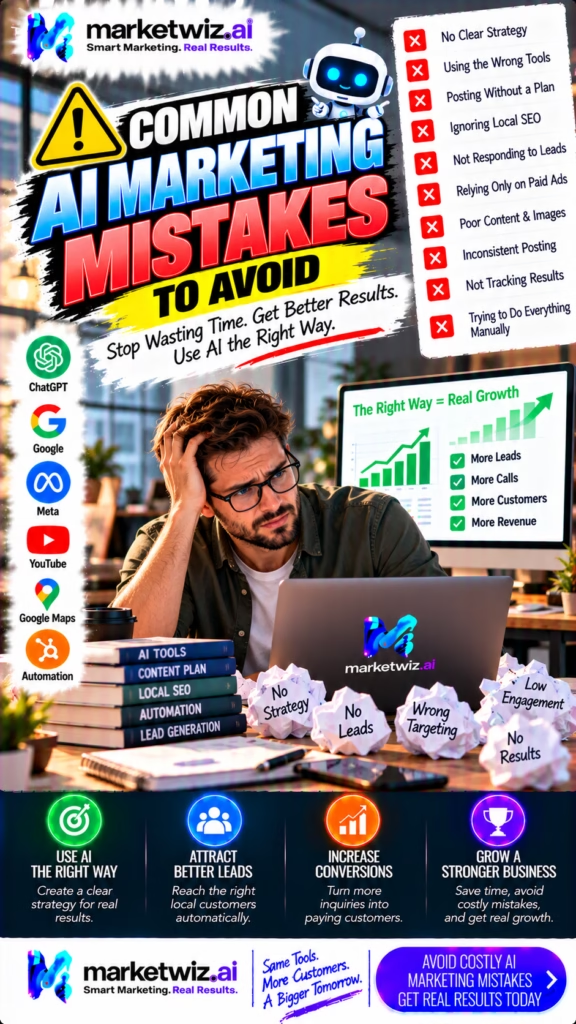
Common AI Marketing Mistakes to Avoid
Artificial intelligence can help businesses create content, manage customer inquiries, organize marketing campaigns, and automate repetitive work. But using AI without a clear strategy can introduce new problems instead of solving existing ones. Generic content, inaccurate information, poorly configured chatbots, excessive automation, weak lead qualification, and unreliable performance tracking can undermine even ambitious marketing plans. This comprehensive guide explains the most common AI marketing mistakes, why they happen, and how businesses can build smarter, more accurate, more customer-focused marketing systems.
1. Understanding Why AI Marketing Mistakes Happen
AI marketing tools have made it easier for businesses to generate promotional copy, organize information, prepare campaigns, and respond to customer questions. Tasks that previously required significant manual effort can now be supported by software and automation.
However, faster production does not automatically mean better marketing. A company can publish more posts, generate more emails, and automate more conversations without improving the relevance of its message or the quality of its customer experience.
The underlying problem is often a misunderstanding of what AI can reliably do. Artificial intelligence can produce useful drafts and identify patterns, but it can also misunderstand context, generate incorrect statements, and repeat poor assumptions.
Marketing involves judgment about customers, competition, positioning, timing, and trust. These responsibilities do not disappear when automation is introduced.
Why businesses make avoidable AI mistakes
- They adopt software before defining a marketing objective.
- They prioritize output volume over customer relevance.
- They assume AI-generated information is automatically correct.
- They automate processes that were already ineffective.
- They fail to provide accurate business context.
- They overlook platform rules and customer consent.
- They do not test workflows before launching them.
- They measure activity rather than meaningful business results.
The central lesson: AI is a tool for improving a marketing system, not a replacement for having a sound marketing system. The most effective approach combines clear strategy, reliable information, appropriate automation, and human accountability.
2. Mistake #1: Using AI Marketing Without a Clear Strategy
One of the most common AI marketing mistakes is purchasing tools or activating automations before deciding what the business actually wants to accomplish.
A company might subscribe to an AI content generator because competitors are using one. Another might launch a chatbot because it sounds modern. A third might schedule automated social posts without identifying the audience those posts should reach.
None of these activities necessarily addresses a meaningful business problem.
Define the marketing outcome first
A useful strategy begins with a specific business objective. For a local contractor, that might mean attracting more qualified estimate requests. For a retailer, it might mean improving product discovery. For a professional business, it might involve responding more consistently to inquiries.
Once the objective is clear, the business can determine whether AI will help with content creation, lead organization, customer communication, reporting, or another suitable task.
Visibility Goal
Help relevant customers discover the business through useful content and appropriate marketing channels.
Lead Generation Goal
Attract inquiries that match the company's actual offerings and geographic coverage.
Response Goal
Reduce missed inquiries while preserving accurate, respectful customer communication.
Efficiency Goal
Reduce repetitive manual work without sacrificing quality, oversight, or compliance.
A clear objective provides a basis for evaluating whether automation is working or simply generating more activity.
3. Mistake #2: Publishing Generic AI-Generated Marketing Content
AI can generate large quantities of marketing copy quickly. Unfortunately, speed can encourage businesses to publish content that sounds polished but communicates very little.
Generic marketing often relies on repeated phrases about quality, professionalism, customer satisfaction, and unbeatable results without explaining what makes the business relevant to a specific customer.
A homeowner researching roof repairs needs different information from someone shopping for furniture. A restaurant customer has different questions from a commercial property manager.
What makes AI content too generic?
- It could describe almost any competing business.
- It does not identify a meaningful customer problem.
- It lacks accurate details about actual offerings.
- It repeats promotional language without useful information.
- It ignores geographic and audience context.
- It contains broad claims unsupported by evidence.
How to improve AI-generated content
Provide verified details about the business, its audience, products, service areas, communication style, and customer questions.
Then edit the draft to include genuinely useful information. A painting company might explain surface preparation or the difference between interior and exterior projects. A flooring retailer might explain materials, dimensions, or installation considerations.
Specificity makes marketing more useful because customers can recognize whether the business fits their needs.
4. Mistake #3: Publishing AI Content Without Human Review
AI-generated content should not be treated as automatically verified. Language models can produce confident statements that are incomplete, outdated, or entirely incorrect.
This becomes especially problematic when marketing content includes prices, financing terms, product specifications, business credentials, or customer guarantees.
An inaccurate promotional claim can confuse customers and create avoidable operational problems.
Review content before publication
Verify Business Facts
Check company names, locations, contact information, hours, qualifications, and available offerings.
Confirm Product and Pricing Details
Make sure prices, dimensions, availability, payment terms, and promotional conditions match current approved information.
Remove Unsupported Claims
Do not publish invented statistics, fabricated testimonials, exaggerated guarantees, or unverifiable comparisons.
Review Platform Compliance
Confirm that the content and proposed publishing method comply with applicable platform rules.
Check Customer Usefulness
Ask whether the content genuinely helps a potential customer understand the offer or make a decision.
Human review is particularly important when a campaign makes technical, financial, health-related, or legal claims.
5. Mistake #4: Automating Everything Instead of the Right Tasks
Automation is most useful when it reduces repetitive work while preserving the quality of important decisions.
Problems arise when businesses automate every interaction without considering the customer's situation.
An automated response may be appropriate for acknowledging an inquiry or collecting basic project information.
It may be inappropriate for resolving a serious complaint, making a complex technical recommendation, or promising an outcome the business cannot verify.
Tasks that may benefit from automation
- Organizing incoming inquiries
- Preparing marketing content drafts
- Creating internal reminders
- Routing messages by topic
- Collecting basic customer requirements
- Summarizing conversations
- Preparing routine reporting
- Supporting approved scheduling workflows
Tasks that often need human judgment
- Complex customer disputes
- Unusual pricing decisions
- Technical assessments
- Contractual commitments
- Sensitive personal information
- Refund and cancellation exceptions
- High-risk customer concerns
The goal is not maximum automation. It is an appropriate balance between efficiency and customer experience.
6. Mistake #5: Ignoring Audience Research and Customer Intent
Even well-written content can underperform when it reaches the wrong audience or addresses the wrong problem.
AI tools can help organize customer segments and develop messaging ideas, but the business must understand whom it actually wants to serve.
A local HVAC company may focus on homeowners within a specific service area. A B2B software provider may need to reach decision-makers with particular operational responsibilities.
Those audiences require different information, offers, and communication.
Build useful audience profiles
- What problem is the customer trying to solve?
- What information do they need before contacting the business?
- Which geographic areas are relevant?
- What concerns might prevent a purchase?
- What questions appear repeatedly?
- Which marketing channels are appropriate?
- What makes an inquiry genuinely qualified?
AI can support the research process, but businesses should validate assumptions using actual customer conversations, available analytics, and reliable market information.
7. Mistake #6: Losing Brand Voice Through AI-Generated Copy
A recognizable brand communicates consistently across websites, social media, emails, advertisements, and customer conversations.
When AI tools operate without brand guidelines, messaging can become inconsistent.
One post may sound overly formal, another excessively promotional, and another completely unrelated to the company's personality.
Create practical brand guidelines
- Preferred tone and writing style
- Core customer audience
- Approved product and service descriptions
- Words or claims to avoid
- Geographic coverage
- Customer communication standards
- Formatting preferences
- Approved calls to action
Brand guidelines help AI produce drafts that require less editing and feel more consistent.
They also reduce the risk of publishing content that misrepresents the company.
8. Mistake #7: Using AI Content to Manipulate SEO Rankings
AI-assisted writing can support search engine optimization, but publishing large volumes of low-value content solely to influence rankings is a poor strategy.
Search engines aim to surface useful and relevant information. Businesses should focus on answering real questions rather than generating endless keyword variations.
Common AI SEO mistakes
- Publishing articles without checking accuracy
- Repeating keywords unnaturally
- Creating near-identical city pages
- Using fabricated expertise or experiences
- Publishing content unrelated to business offerings
- Failing to update outdated information
- Ignoring website navigation and usability
- Producing articles that do not answer the searcher's question
AI-assisted SEO works best when content is genuinely helpful. Use AI to organize research, develop outlines, and prepare drafts. Then add verified information, clear explanations, and real business expertise before publishing.
9. Mistake #8: Focusing on Lead Quantity Instead of Lead Quality
A marketing campaign can produce many inquiries without producing many useful business opportunities.
This happens when the campaign attracts customers outside the company's geographic area, promotes unavailable products, or encourages messages from people who are not appropriate buyers.
AI lead generation systems should help distinguish relevant inquiries from those that do not match business requirements.
Useful lead qualification questions
- What product or service does the customer need?
- Is the customer within the business's coverage?
- What is the approximate project timeline?
- What information is required for an estimate?
- Does the inquiry match the company's capabilities?
- What follow-up action is appropriate?
Qualification should be proportionate to the situation. Businesses should avoid collecting unnecessary personal information or making customers answer excessive questions before receiving help.
10. Mistake #9: Allowing AI Chatbots to Invent Answers
AI chatbots can help businesses respond to common questions, but they may generate incorrect information when operating without appropriate controls.
A chatbot might invent appointment availability, quote an unauthorized price, or promise a feature that a product does not include.
These errors can create customer confusion and damage trust.
Build safer chatbot workflows
Provide Verified Business Information
Use approved descriptions, contact details, policies, product information, and operating hours.
Define Clear Boundaries
Tell the assistant which commitments it cannot make, including unsupported prices, guarantees, and appointment confirmations.
Test Realistic Customer Questions
Include routine questions, ambiguous requests, unusual situations, and cases where the correct answer is unknown.
Provide Human Escalation
Allow customers to reach a person when the system cannot reliably resolve the issue.
Review Performance
Monitor responses and update approved information when the business changes.
A reliable chatbot should acknowledge uncertainty instead of manufacturing an answer.
11. Mistake #10: Automating Follow-Up Without Relevance or Permission
Automated follow-up can help businesses manage inquiries, but poorly designed sequences can frustrate potential customers.
A person who requested a specific estimate should not receive a stream of unrelated promotional messages.
Similarly, someone who declines further contact should not remain in an automated outreach sequence.
Better follow-up principles
- Respect applicable consent requirements
- Keep messages relevant to the inquiry
- Use reasonable communication frequency
- Honor unsubscribe and opt-out requests
- Avoid repeated messages after resolution
- Provide accurate contact information
- Escalate unusual cases appropriately
Follow-up should make customer communication easier, not create pressure or confusion.
13. Mistake #12: Using AI for Marketplace Listings Without Checking Platform Rules
Businesses may use AI to draft product descriptions, organize listing information, and prepare promotional content for review.
However, marketplace platforms often have specific eligibility, commerce, listing, and automation requirements.
A business should not assume that every type of service, product, or automated publishing method is permitted.
Marketplace content accuracy checklist
- Confirm the item or offering is eligible
- Use genuine product information
- Display accurate prices where required
- Do not invent product specifications
- Use representative images
- Avoid misleading categories
- Follow applicable automation policies
- Keep availability information current
AI can help prepare information, but businesses remain responsible for the listings they publish.
14. Mistake #13: Confusing Personalization With Intrusive Messaging
Personalization can make marketing more relevant when it reflects legitimate customer needs.
However, inserting a person's name into every message does not necessarily create a useful experience.
Personalization becomes problematic when it relies on unnecessary personal information, unverified assumptions, or unexpected data collection.
Useful personalization approaches
- Reference the customer's stated inquiry
- Provide information about relevant offerings
- Use the appropriate geographic context
- Respect known communication preferences
- Avoid guessing sensitive personal characteristics
- Explain relevant next steps clearly
Good personalization helps customers receive appropriate information without feeling monitored or manipulated.
15. Mistake #14: Feeding AI Outdated or Inaccurate Business Data
AI systems rely on the information they receive and the context available to them.
If a business provides outdated prices, incorrect operating hours, or discontinued product information, the resulting marketing output may be unreliable.
A company might also use several different spreadsheets or software systems that contain conflicting information.
Improve marketing data quality
- Identify approved sources of business information
- Maintain current product and service details
- Remove outdated promotions
- Review contact information regularly
- Document important policy changes
- Limit access to sensitive information
- Test integrations after updates
A reliable information foundation reduces the likelihood of AI-generated errors.
16. Mistake #15: Ignoring Privacy, Consent, and Customer Data Protection
Marketing systems may process names, contact details, project information, conversation histories, and other customer data.
Businesses should understand what information is collected, why it is needed, where it is stored, and which systems can access it.
Applicable privacy and communications requirements vary by location, channel, and business activity.
Privacy-conscious AI marketing practices
- Collect only information needed for a legitimate purpose
- Use appropriate access controls
- Review vendor data handling terms
- Follow applicable consent requirements
- Honor relevant customer privacy requests
- Avoid uploading confidential data unnecessarily
- Protect credentials and integration tokens
- Establish procedures for data incidents
AI marketing should not become a reason to collect more customer information than the business actually needs.
17. Mistake #16: Measuring AI Marketing Activity Instead of Results
Automated systems make it easy to count published posts, generated emails, chatbot conversations, and completed workflow actions.
These numbers can help describe operational activity, but they do not automatically demonstrate marketing success.
A business should connect its measurements to meaningful customer outcomes.
| Activity Metric | More Meaningful Business Question | Useful Measurement |
|---|---|---|
| Number of Posts | Are relevant customers engaging? | Qualified inquiries and useful interactions |
| Chatbot Conversations | Were customer questions resolved? | Resolution quality and escalation outcomes |
| Automated Follow-Ups | Did appropriate customers respond? | Relevant replies and appointments |
| Website Traffic | Did visitors find useful information? | Relevant conversions and inquiries |
| Lead Volume | How many inquiries were qualified? | Qualified lead rate |
| Campaign Output | Did marketing support business growth? | Reliable revenue and acquisition measures |
A campaign that generates fewer but more relevant inquiries may be more useful than one that produces large quantities of low-quality responses.
18. Mistake #17: Assuming AI Marketing Automatically Produces Positive ROI
AI tools can reduce some manual work, but they also introduce software costs, setup requirements, review responsibilities, and ongoing maintenance.
Businesses should not assume that adding AI automatically improves profitability.
Evaluate the full cost of automation
- Software subscriptions
- Initial configuration
- Integration expenses
- Human review time
- Content production costs
- Testing and monitoring
- Workflow maintenance
- Customer support requirements
For example, an automation that saves administrative time may still be ineffective if it creates customer confusion or requires frequent correction.
Return on investment should be evaluated using realistic costs and reliably attributed business outcomes.
19. Mistake #18: Launching AI Automation Without Testing
A workflow may look correct in a diagram but fail when it encounters real customer messages, missing information, or unexpected system behavior.
Testing helps identify errors before they affect large numbers of customers.
AI marketing test scenarios
- Customer asks a routine question
- Customer provides incomplete information
- Customer requests an unavailable product
- Customer asks for a human representative
- Customer wants to stop receiving messages
- System cannot access a required integration
- Customer provides contradictory details
- Business hours or availability have changed
- Automated action fails midway
- AI is asked to make an unsupported promise
Businesses should also test what happens when a workflow fails.
A safe failure process may involve stopping the action, recording the issue, and alerting a responsible team member.
20. Mistake #19: Connecting AI Tools Without Understanding Integrations
Modern marketing systems may connect customer relationship software, social media platforms, email systems, website forms, scheduling tools, and AI assistants.
These connections can improve workflow coordination, but they also create dependencies.
If one integration fails, customer information may not reach the intended destination.
Integration management priorities
- Document connected systems
- Use supported integration methods
- Grant only necessary permissions
- Monitor failed actions
- Prevent duplicate customer records
- Check data synchronization
- Review changes to platform access
- Maintain appropriate human fallback procedures
A marketing automation system is only as reliable as the processes and connections supporting it.
21. Mistake #20: Using Generic AI Marketing for Local Businesses
Local businesses often depend on specific geographic markets, customer needs, and operational constraints.
A generic national marketing message may not be appropriate for a company serving only a few cities or neighborhoods.
AI marketing should reflect real service coverage and business capabilities.
Local marketing details to verify
- Correct business location
- Actual service areas
- Relevant local offerings
- Current contact information
- Business operating hours
- Local customer questions
- Genuine project examples
- Accurate appointment availability
Local relevance should come from actual business information, not fabricated location references or misleading claims of local experience.
22. Mistake #21: Using Misleading AI Images and Creative Assets
AI-generated visuals can be useful for concepts, illustrations, and certain promotional designs.
However, businesses should not present synthetic images as proof of completed projects, real customers, or actual product inventory when that would be misleading.
A contractor should not claim an AI-generated renovation image represents work the company completed.
A retailer should not use a generated product image that changes important dimensions, features, or included accessories.
Responsible AI creative practices
- Use real product images when accuracy matters
- Do not invent before-and-after results
- Avoid fabricated customer endorsements
- Check visual claims against actual offerings
- Review logos and branding for accuracy
- Follow relevant disclosure requirements
- Ensure text overlays are readable
Strong creative should attract attention without misrepresenting what customers will receive.
23. Mistake #22: Writing Vague AI Marketing Prompts
A prompt such as "write a great marketing post" provides very little useful direction.
Without context, AI may produce generic copy or invent details to fill information gaps.
Better prompts define the task, audience, verified facts, platform, tone, and restrictions.
A stronger marketing prompt structure
Define the Objective
Explain whether the content should educate, introduce a product, encourage inquiries, or support another specific outcome.
Identify the Audience
Describe relevant customer needs, geographic markets, and buying considerations.
Provide Verified Facts
Include accurate business details, available offerings, prices where appropriate, and approved claims.
Specify the Channel
Explain whether the content is for a website, social post, email, product listing, or customer response.
Set Restrictions
Identify prohibited claims, formatting limits, platform rules, and information the AI must not invent.
Require Review
Treat the generated result as a draft and verify important details before publishing.
Clear prompts reduce ambiguity, but they do not eliminate the need for verification.
24. Mistake #23: Prioritizing Automation Over Customer Experience
Marketing automation should help customers find information and move toward appropriate next steps.
When systems become difficult to navigate, the technology can create friction instead of reducing it.
A chatbot that repeatedly asks the same question may frustrate a customer.
A scheduling workflow that does not recognize unavailable appointment times can create unrealistic expectations.
Customer-focused automation principles
- Make instructions clear
- Keep interactions concise
- Remember relevant conversation context appropriately
- Offer human assistance when needed
- Avoid unnecessary data collection
- Confirm important actions accurately
- Respect customer preferences
- Provide realistic next steps
Customer experience is not a secondary concern. It is part of whether a marketing system creates genuine business value.
25. Mistake #24: Failing to Assign Responsibility for AI Marketing
Automation can make responsibilities less obvious when several systems operate without clear ownership.
If an AI assistant publishes incorrect information, someone needs to identify the problem, correct the content, and prevent recurrence.
Businesses should define who approves content, maintains data, monitors workflows, and handles customer escalations.
Practical AI marketing governance
- Assign a marketing strategy owner
- Define content approval responsibilities
- Maintain verified business information
- Document automated workflows
- Review important system changes
- Establish escalation procedures
- Monitor customer complaints
- Keep appropriate records of corrections
Accountability helps prevent small automation errors from becoming larger operational problems.
26. A 90-Day Plan to Avoid AI Marketing Mistakes
Businesses can reduce AI marketing risks by introducing automation gradually and evaluating results at each stage.
The following roadmap provides a practical implementation framework rather than a guaranteed performance timeline.
Days 1–15: Audit Current Marketing
Identify active channels, customer acquisition goals, content quality issues, missed inquiries, and repetitive tasks that may benefit from automation.
Days 16–30: Establish Reliable Information
Organize approved business details, product information, brand guidelines, customer communication rules, and relevant privacy requirements.
Days 31–45: Test Limited AI Workflows
Begin with manageable use cases such as content drafts, inquiry classification, or internal reporting before expanding automation.
Days 46–60: Improve Content and Distribution
Develop useful, audience-specific content and adapt it appropriately for relevant marketing platforms.
Days 61–75: Strengthen Lead Handling
Review customer inquiry quality, response accuracy, human escalation, consent requirements, and follow-up processes.
Days 76–90: Evaluate and Refine
Measure qualified leads, customer experience, workflow reliability, costs, and business outcomes before deciding which automations to expand.
Gradual implementation helps businesses identify problems before scaling them across multiple channels.
27. AI Marketing Quality Control Checklist
A repeatable quality control process can reduce mistakes across content creation, lead generation, and automated customer communication.
Before publishing AI marketing content
- Is the information factually accurate?
- Does the content match the intended audience?
- Are product and service details verified?
- Are prices and offers current?
- Does the message follow brand guidelines?
- Is the content useful rather than repetitive?
- Are images representative and not misleading?
- Does the content follow platform policies?
- Are claims supported?
- Is the call to action appropriate?
Before activating an AI automation
- Is the workflow objective clear?
- Are the input data sources reliable?
- Are system permissions limited appropriately?
- Have normal and unusual scenarios been tested?
- Can the workflow handle missing information?
- Are customer consent rules addressed?
- Is there a human escalation option?
- Can the automation be stopped safely?
- Are failures logged or otherwise surfaced?
- Is someone responsible for ongoing review?
Use this checklist as a publishing and automation gate. A few minutes spent verifying critical information can prevent misleading content, broken workflows, and unnecessary customer frustration.
28. Building Smarter AI Marketing With Market Wiz AI
Businesses need marketing systems that create useful visibility and support real customer conversations.
Publishing more content is not enough if the content is irrelevant, inaccurate, or disconnected from customer needs.
Market Wiz AI focuses on organic digital marketing, multi-platform content distribution, and AI-supported customer engagement.
A coordinated approach can help businesses maintain a more consistent marketing presence while organizing inquiries and reducing repetitive manual work.
Priorities for a smarter marketing system
- Clear marketing objectives
- Accurate business information
- Useful SEO-focused content
- Consistent organic visibility
- Platform-appropriate publishing
- Relevant customer messaging
- AI-supported inquiry management
- Human review and escalation
- Reliable workflow monitoring
- Meaningful performance measurement
The objective is to use technology where it adds value, rather than automating every task simply because it is possible.
A well-designed marketing process should be understandable, maintainable, and aligned with the business's real capabilities.
30 Frequently Asked Questions About AI Marketing Mistakes
1. What are the most common AI marketing mistakes?
Common AI marketing mistakes include using AI without clear goals, publishing generic content, failing to review outputs, automating poor processes, ignoring customer intent, mishandling personal data, and measuring activity instead of business outcomes.
2. Why do AI marketing campaigns fail?
AI marketing campaigns can fail when strategy, audience understanding, content quality, data accuracy, automation controls, or customer follow-up are weak.
3. Can AI marketing hurt SEO?
AI-assisted content can perform poorly when it is inaccurate, unhelpful, duplicative, or created primarily to manipulate search rankings. AI use itself does not automatically violate search guidelines.
4. Is publishing AI-generated content without editing a mistake?
Yes. Unreviewed AI content may contain factual errors, generic language, misleading claims, or incorrect business details. Human review improves accuracy and usefulness.
5. Why is generic AI marketing content ineffective?
Generic content often fails to address specific customer problems, local context, product differences, and meaningful reasons to choose a business.
6. Should small businesses automate all their marketing?
Small businesses should automate suitable repetitive tasks while keeping human oversight for important decisions, sensitive communication, factual verification, and customer concerns.
7. What is the biggest AI lead generation mistake?
A major mistake is optimizing for lead volume without checking whether inquiries are relevant, qualified, and handled effectively.
8. Can AI chatbots give customers incorrect information?
Yes. AI chatbots can generate inaccurate answers or misunderstand requests. Businesses should use approved information, escalation rules, and regular testing.
9. How can businesses prevent AI chatbot hallucinations?
Businesses can reduce inaccurate responses by grounding assistants in verified information, limiting unsupported claims, testing common scenarios, and transferring uncertain cases to humans.
10. Is over-automation bad for customer experience?
Over-automation can frustrate customers when systems repeat irrelevant messages, prevent human assistance, or fail to recognize unusual situations.
11. Why does audience targeting matter in AI marketing?
AI marketing is more useful when content and outreach reflect the needs, locations, interests, and buying intentions of the intended audience.
12. Can AI marketing damage brand credibility?
Yes. Inaccurate claims, misleading images, repetitive posts, fabricated testimonials, and impersonal responses can undermine customer trust.
13. How often should businesses review AI marketing automation?
Businesses should review automation regularly and after meaningful changes to products, pricing, policies, platforms, or customer communication workflows.
14. What are common AI email marketing mistakes?
Common mistakes include irrelevant personalization, inaccurate claims, excessive messaging, poor segmentation, and failure to honor applicable consent and unsubscribe requirements.
15. What are common AI social media marketing mistakes?
Common mistakes include repetitive captions, identical posts across platforms, irrelevant hashtags, misleading visuals, weak audience engagement, and ignoring platform rules.
16. Can businesses use AI for Facebook Marketplace marketing?
AI can assist with preparing accurate product content and organizing workflows, but businesses must follow Marketplace eligibility, listing, commerce, and automation policies.
17. Is AI marketing better than traditional marketing?
AI can improve selected marketing workflows, but effectiveness depends on strategy, execution, audience needs, and human oversight. It is not automatically superior in every situation.
18. Why is data quality important for AI marketing?
AI systems depend on the information and context they receive. Outdated or inaccurate data can lead to irrelevant targeting, incorrect messages, and unreliable reporting.
19. What privacy mistakes should AI marketers avoid?
Businesses should avoid collecting unnecessary personal information, exposing confidential data, ignoring consent requirements, and using customer information beyond authorized purposes.
20. How do businesses measure AI marketing success?
Businesses can track qualified inquiries, conversion rates, booked appointments, customer acquisition costs, revenue attribution where reliable, and the quality of customer experiences.
21. Should businesses trust AI-generated marketing statistics?
No statistic should be published without verification. AI can invent numbers, misinterpret studies, or omit important context.
22. Why do AI marketing prompts matter?
Clear prompts provide audience context, business facts, tone, restrictions, and desired outcomes, helping produce more useful drafts that can then be reviewed.
23. Can AI marketing tools create duplicate content?
Yes. Reusing generic prompts and templates can produce repetitive content. Businesses should prioritize distinct, helpful information rather than superficial wording changes.
24. How can AI improve marketing follow-up?
AI can help organize inquiries, prepare relevant responses, and trigger approved follow-up workflows when systems are properly configured and communication rules are followed.
25. What AI marketing mistakes do local businesses make?
Local businesses may use generic location content, inaccurate service areas, outdated contact information, misleading offers, or automated replies that do not reflect actual availability.
26. Should AI replace a marketing team?
AI can assist teams with repetitive work and analysis, but human judgment remains important for strategy, quality control, customer relationships, and accountability.
27. How can businesses avoid AI marketing spam?
Businesses should prioritize relevance, reasonable frequency, permission where required, platform compliance, and useful communication rather than maximizing message volume.
28. What is the safest way to launch AI marketing automation?
Start with a defined use case, verified business information, limited permissions, clear approval rules, testing, monitoring, and a human escalation process.
29. How do you fix an underperforming AI marketing campaign?
Review audience targeting, message relevance, factual accuracy, lead quality, workflow failures, customer feedback, and conversion data before changing the automation.
30. What is the best way to avoid common AI marketing mistakes?
Use AI to support a clear marketing strategy, provide verified information, create useful content, protect customer data, test automation, maintain human oversight, and measure meaningful business outcomes.
30 Additional SEO Keywords for AI Marketing Mistakes and Best Practices
These keyword ideas can support AI marketing content planning, educational articles, automation strategy research, and search-focused business resources.
Final Thoughts: Avoid AI Marketing Mistakes and Build a Smarter Strategy
Artificial intelligence can support business marketing in meaningful ways, but successful implementation requires more than software subscriptions and automated content production.
The most common AI marketing mistakes often begin with unclear objectives, weak customer understanding, or inaccurate business information.
Generic content, unsupported claims, poorly configured chatbots, excessive messaging, and unreliable integrations can create problems that undermine customer confidence.
Businesses should prioritize helpful content, accurate information, relevant lead generation, and respectful customer communication.
Automation should be tested, monitored, and improved over time.
AI tools can assist with repetitive work, but important decisions, customer concerns, and factual verification still require appropriate human judgment.
Companies should also measure qualified inquiries, customer outcomes, and actual business value instead of judging success only by the volume of automated activity.
The best AI marketing strategy is not the one that automates the most. It is the one that uses automation responsibly to deliver more useful marketing, more reliable customer experiences, and better-informed business decisions.
Make Your Marketing Smarter, Not More Complicated
Build a stronger digital presence with consistent organic marketing, useful SEO-focused content, coordinated multi-platform visibility, and AI-supported customer engagement. Discover how Market Wiz AI helps businesses create more organized and effective marketing workflows.
Explore MarketWiz.ai© 2026 Market Wiz AI. This article provides general educational information about AI marketing strategy, automation, and customer communication. Businesses should review applicable platform policies, privacy requirements, and marketing regulations. No particular marketing result is guaranteed.












12. Mistake #11: Posting Identical AI Content Across Every Social Platform
Different platforms have different audiences, formats, expectations, and publishing rules.
A short educational video may be appropriate for one platform, while a detailed product description may be more useful elsewhere.
Automatically publishing identical content across every channel can reduce relevance and create unnecessary repetition.
Improve multi-platform marketing
Consistency means maintaining a recognizable brand and reliable publishing process.
It does not require posting the same wording everywhere.