

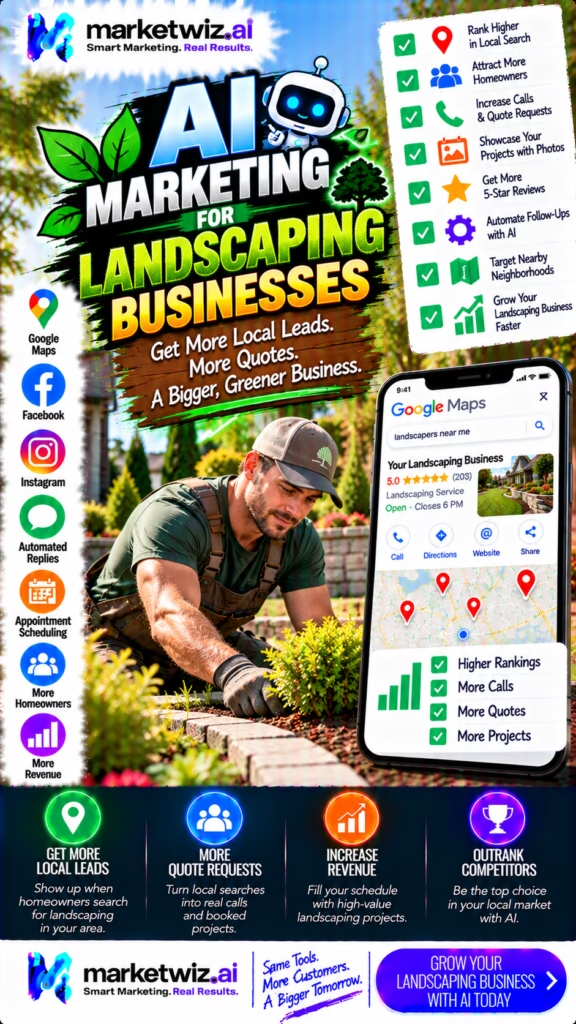
AI Marketing for Landscaping Businesses
Landscaping businesses compete for attention from homeowners, property managers, and commercial customers who need dependable outdoor improvements. Artificial intelligence can help organize marketing, support customer communication, and make consistent organic promotion more manageable. This complete guide explores how landscaping companies can combine AI-powered workflows, Google Maps optimization, local SEO, seasonal campaigns, project photography, social media, and responsible follow-up to attract more relevant inquiries and grow sustainably.
1. What Is AI Marketing for Landscaping Businesses?
AI marketing for landscaping businesses involves using artificial intelligence to assist with marketing activities such as content development, customer inquiry organization, campaign planning, and performance analysis.
A landscaping company may offer landscape design, lawn maintenance, planting, mulching, hardscaping, drainage work, or seasonal cleanup. Each service can attract customers with different needs and timelines.
AI tools can help organize these differences into more structured marketing workflows.
For example, a landscaping business might use AI to prepare educational content about spring yard preparation, draft social posts featuring real completed projects, or classify incoming inquiries by project type.
The technology can reduce repetitive administrative work, but it does not replace accurate business information, professional judgment, or genuine customer relationships.
Common AI marketing applications
- Drafting landscaping blog articles
- Preparing social media captions
- Organizing local keyword research
- Planning seasonal marketing calendars
- Sorting landscaping inquiries by project type
- Preparing routine customer responses
- Supporting appointment coordination
- Summarizing marketing performance
- Maintaining consistent messaging across channels
- Identifying gaps in service information
AI marketing works best as an assistant to a real landscaping business. It should make accurate information easier to communicate and customer requests easier to manage—not invent work, credentials, prices, or results.
2. Why Landscaping Companies Are Exploring AI Marketing
Landscaping businesses often manage marketing alongside demanding field operations.
Owners may spend the day meeting customers, supervising crews, sourcing materials, and coordinating schedules.
Marketing tasks can become inconsistent when operational work takes priority.
AI can assist with repeatable parts of the marketing process so that business owners have a clearer system for publishing content and responding to inquiries.
Common marketing challenges
Inconsistent Posting
Busy field schedules can interrupt social content, project updates, and local marketing activity.
Seasonal Demand
Customer interest changes throughout the year, requiring different messaging for different services.
Multiple Service Types
Landscape design, mowing, planting, patios, and drainage work attract different customer questions.
Inquiry Management
Potential customers may contact the business through several channels, making organization important.
AI-assisted workflows can help address these operational challenges, provided the business reviews important decisions and maintains accurate customer information.
3. How AI Lead Generation Works for Landscaping Businesses
AI lead generation does not mean that software automatically creates customers.
A practical system connects marketing visibility with customer communication and a clear sales process.
The landscaping business first needs to reach people who may be interested in its actual offerings.
Those people then need an easy way to ask questions, request estimates, or arrange consultations.
AI may help organize the information that comes in and support appropriate follow-up.
A practical lead workflow
Attract Relevant Local Attention
Publish useful content and maintain accurate business information where local customers research landscaping providers.
Explain the Available Services
Help visitors understand whether the company handles their project type and geographic area.
Capture the Inquiry
Provide accessible contact options and collect only information needed for a useful response.
Organize Customer Needs
Classify inquiries by service type, general location, desired timing, and other relevant details.
Coordinate Human Follow-Up
Route qualified inquiries to staff for site evaluations, estimates, and important project decisions.
The objective is a more organized path from customer interest to a real business conversation.
4. Generate Landscaping Leads Without Depending Entirely on Paid Ads
Paid advertising can help some landscaping businesses reach customers quickly, but it requires an advertising budget and ongoing campaign management.
Organic marketing offers additional ways to build visibility through relevant content, accurate listings, project examples, and customer engagement.
AI can support organic marketing by helping teams prepare and organize content more consistently.
Organic channels to consider
- Google Business Profile
- Local landscaping SEO
- Educational website articles
- Organic social media
- Community-oriented content
- Relevant business directories
- Genuine customer reviews
- Project portfolio pages
- Referral-supporting customer communication
Not every platform allows every type of promotional listing. Landscaping businesses should follow each platform's rules, including restrictions on service advertising where applicable.
Useful strategy: Build an organic presence that can support customer discovery over time, while evaluating paid advertising separately based on budget, demand, and business objectives.
5. Local SEO for Landscaping Companies
Local SEO helps a landscaping business make its website and business information more relevant to searches from nearby customers.
Landscaping searches often include a service and a geographic location.
For example, a homeowner may search for landscape design in a particular city, while a property manager may search for commercial grounds maintenance nearby.
Useful local SEO starts with accurate descriptions of the services a company actually performs.
Important local SEO elements
- Accurate business identity
- Relevant landscaping service pages
- Clear service-area information
- Mobile-friendly website design
- Useful local keyword targeting
- Real project photographs
- Authentic customer feedback
- Consistent contact details
- Helpful educational content
- Reliable estimate-request options
AI can assist with research and drafting, but local pages should be written for real customers rather than mass-produced around slightly different keyword combinations.
6. Google Maps Optimization for Landscaping Businesses
Google Maps can help customers discover nearby landscaping companies and compare relevant business information.
An eligible landscaping business should maintain a Google Business Profile that accurately represents its operations.
Google describes local ranking as primarily based on relevance, distance, and prominence.
Using AI does not guarantee better Google Maps rankings.
Google Business Profile priorities
- Use the real business name
- Select accurate business categories
- Follow address and service-area rules
- Maintain correct phone and website information
- Keep operating hours accurate
- Describe genuine landscaping services
- Upload representative project photos
- Respond professionally to customer reviews
- Review available profile performance data
Avoid adding city names or keywords to the business name unless they are part of the real-world name.
Do not create fictitious offices to target additional cities.
7. AI-Assisted Keyword Research for Landscaping SEO
Keyword research helps landscaping businesses understand how potential customers describe their needs.
Different landscaping services may attract very different searches.
A homeowner planning a backyard renovation may search for landscape design, while another customer may need recurring lawn maintenance.
Useful landscaping keyword themes
- Landscaping company near me
- Local landscaper
- Landscape design company
- Lawn maintenance company
- Mulch installation
- Landscape planting
- Hardscaping contractor
- Paver patio installation
- Retaining wall contractor
- Seasonal yard cleanup
AI can help group keywords by intent and service type.
However, actual keyword selection should consider what the company offers, where it operates, and whether the search matches a realistic customer need.
| Keyword Theme | Customer Intent | Recommended Content |
|---|---|---|
| Landscaper Near Me | Find a nearby provider | Business overview, coverage, contact details |
| Landscape Design | Plan an outdoor improvement | Design process, portfolio, consultation details |
| Lawn Maintenance | Arrange recurring upkeep | Maintenance offerings, scheduling, service coverage |
| Patio Installation | Build an outdoor living area | Materials, project examples, planning information |
| Fall Yard Cleanup | Prepare property for seasonal changes | Seasonal scope, availability, request process |
8. Create SEO-Focused Landscaping Service Pages With AI Assistance
A landscaping company may provide several different services, each deserving a clear explanation.
AI can help prepare initial outlines and drafts for service pages, but the final content must reflect actual business capabilities.
Potential service pages
- Residential Landscaping
- Landscape Design
- Lawn Maintenance
- Garden Bed Installation
- Mulch Installation
- Tree and Shrub Planting
- Hardscaping
- Patio Installation
- Retaining Walls
- Drainage Solutions
- Seasonal Property Cleanup
- Commercial Grounds Maintenance
Only publish pages for services the company genuinely provides.
Each page should explain the work, answer relevant questions, show appropriate examples, and provide a clear way to inquire.
9. Build Seasonal Landscaping Marketing Campaigns With AI
Landscaping demand often changes throughout the year.
Seasonal timing depends on climate, regional conditions, and the services the business offers.
AI can help organize a marketing calendar around these changing customer needs.
Seasonal campaign examples
| Season | Potential Customer Interest | Content Ideas |
|---|---|---|
| Spring | Property refresh and planting | Spring cleanup, bed preparation, planting planning |
| Summer | Outdoor living and maintenance | Landscape upkeep, patio projects, irrigation considerations |
| Fall | Seasonal property preparation | Leaf cleanup, landscape maintenance, appropriate planting topics |
| Winter | Planning or available winter work | Next-season project planning and genuinely offered winter services |
Not every region follows the same seasonal schedule.
A business in a warm climate may market services differently from a company in a region with long winters.
AI-generated calendars should be adjusted to real local conditions.
11. Use Real Landscaping Project Photos and Videos
Project photography is one of the most useful assets for a landscaping business.
Customers may struggle to understand a service from text alone.
Real images help demonstrate project scope, style, and the appearance of completed work.
Useful visual content
Landscape Design Projects
Show genuine completed designs, planting layouts, and outdoor spaces.
Hardscaping Projects
Display actual patios, walkways, walls, and other installations performed by the company.
Seasonal Maintenance
Document authentic cleanup and property maintenance work.
Project Progress
Show appropriate stages of real work when permission and privacy considerations allow.
AI-generated images may be useful for clearly labeled conceptual illustrations.
However, they should not be presented as photographs of completed customer projects.
Honest visual marketing supports better customer expectations.
12. Build a Landscaping Website That Converts Relevant Visitors
A landscaping website should help visitors quickly understand what the company does and whether it serves their area.
Customers may arrive from Google, social media, referrals, or other marketing channels.
Regardless of the source, the website should provide a clear path to useful information.
Important website elements
- Clear service descriptions
- Accurate service-area information
- Real project galleries
- Mobile-friendly design
- Readable navigation
- Accessible contact forms
- Business contact information
- Useful FAQs
- Relevant customer testimonials with permission
- Clear consultation or estimate process
AI can help identify content gaps and draft improvements, but website performance should be evaluated using actual visitor behavior and business results.
13. AI Chatbots for Landscaping Customer Inquiries
An AI chatbot can help visitors find information and begin an inquiry outside normal office hours.
For example, a customer may want to know whether the company installs paver patios or handles recurring lawn maintenance.
A properly configured chatbot can answer routine questions using verified business information.
Appropriate chatbot tasks
- Explain services actually offered
- Share general service-area information
- Describe the estimate-request process
- Collect basic inquiry details with appropriate notice
- Route questions to the correct team
- Explain business contact options
A chatbot should not invent pricing, promise project availability, or provide unsupported technical recommendations.
Customers should have a clear way to reach a human when needed.
14. Use AI to Organize and Qualify Landscaping Leads
Not every landscaping inquiry is the same type of business opportunity.
A customer asking about weekly mowing has different needs from someone planning a large outdoor living renovation.
AI can help organize inquiries so staff can review them more efficiently.
Useful qualification details
- Requested landscaping service
- General project location
- Residential or commercial property
- Approximate project scope
- Desired timing
- Preferred contact method
- Whether an on-site evaluation is needed
Only request information that is relevant and appropriate for the business process.
A human should make final decisions about project fit, technical feasibility, and estimate requirements.
15. AI Lead Scoring for Landscaping Companies
Lead scoring is a way to prioritize inquiries based on defined business criteria.
For landscaping companies, useful criteria may include whether the requested service is offered, whether the property is within the service area, and whether the business has capacity to evaluate the project.
AI may help organize these details, but scoring systems should be reviewed for errors and unfair assumptions.
Example inquiry categories
| Inquiry Type | Information Needed | Next Step |
|---|---|---|
| Landscape Design | Project goals, general scope, location | Arrange appropriate consultation review |
| Recurring Lawn Maintenance | Property location, maintenance needs | Check coverage and availability |
| Hardscaping Project | Project type, site considerations | Refer for qualified site evaluation |
| Seasonal Cleanup | Requested work, timing, property details | Review scheduling and scope |
A useful scoring system should improve organization rather than automatically rejecting potentially valuable customers based on incomplete information.
16. Improve Landscaping Lead Response With AI Assistance
Customer inquiries can arrive while landscaping crews are working on-site.
A business may not always have someone available to respond immediately.
AI-assisted workflows can help acknowledge an inquiry and organize information for staff review.
The response should make clear what has actually happened.
For example, an automated acknowledgment should not imply that an estimate has been approved or an appointment confirmed when neither is true.
Reliable response principles
- Acknowledge genuine inquiries accurately
- Set realistic expectations
- Collect relevant project information
- Avoid invented prices or availability
- Provide a human contact option
- Escalate complex requests appropriately
17. Automate Landscaping Lead Follow-Up Responsibly
Some potential customers need additional time before making a landscaping decision.
They may be comparing design options, reviewing budgets, or coordinating with other property owners.
Follow-up can help maintain communication, but it should respect the customer's preferences.
Appropriate follow-up situations
- Confirming receipt of an estimate request
- Providing requested project information
- Clarifying missing inquiry details
- Following up after a scheduled consultation
- Sharing approved next steps
- Responding to a customer-requested update
Automated outreach must comply with applicable privacy, marketing, and communication requirements.
Businesses should respect consent and opt-out requests.
18. AI Appointment Scheduling for Landscaping Estimates
Landscaping estimates often require coordination between customers and field staff.
Some projects can begin with a remote discussion, while others need an on-site assessment.
AI-assisted scheduling can help organize requests when the system has access to accurate availability.
Scheduling best practices
- Use real appointment availability
- Account for service-area travel requirements
- Confirm whether a site visit is necessary
- Collect appropriate contact details
- Provide clear confirmation information
- Allow staff to review complex scheduling situations
A scheduling system should never invent an open appointment slot.
Accurate coordination protects both customer expectations and field operations.
19. Connect AI Marketing With a Landscaping CRM
A customer relationship management system can help a landscaping company organize inquiries, estimates, customer information, and follow-up.
AI can support this workflow by categorizing information and preparing routine summaries.
Useful CRM information
- Customer contact details
- Requested service
- General property location
- Inquiry source when known
- Estimate status
- Approved next steps
- Communication preferences
- Relevant follow-up history
Customer data should be collected and stored responsibly.
Access controls, retention policies, and accurate records are important when connecting AI tools to business systems.
20. AI Marketing for Landscape Design Companies
Landscape design customers often begin with ideas rather than a fully defined project.
They may want better outdoor living space, new planting layouts, improved privacy, or a more cohesive property appearance.
Marketing should help these customers understand the company's design process and actual experience.
Useful landscape design content
- Real design project portfolios
- Consultation process explanations
- Planting and layout considerations
- Outdoor living planning ideas
- Maintenance considerations
- General design timeline information
- Customer questions about project scope
AI can assist with educational drafts and inquiry organization.
However, professional design judgment, site conditions, and applicable requirements still need qualified human review.
21. AI Marketing for Hardscaping and Outdoor Living Contractors
Hardscaping projects often involve patios, walkways, retaining walls, steps, and other constructed outdoor features.
Customers may research design, materials, maintenance, and installation considerations before contacting a contractor.
A useful marketing strategy should explain the company's actual capabilities and show genuine examples.
Hardscaping content ideas
- Patio installation project galleries
- Walkway design examples
- Outdoor living planning articles
- Material selection considerations
- Retaining wall project information where offered
- Site preparation questions
- Project estimate process explanations
AI should not provide unverified structural design advice or guarantee technical performance.
Projects involving drainage, grading, retaining structures, or permits may require qualified assessment.
22. AI Marketing for Recurring Lawn and Landscape Maintenance
Recurring maintenance customers have different priorities from one-time installation customers.
They may care about reliability, scope of work, scheduling, communication, and property appearance over time.
AI can help organize routine communication and prepare educational content about ongoing landscape care.
Marketing themes for maintenance companies
- Available maintenance plans
- Service frequency options
- Seasonal maintenance needs
- Property preparation tips
- Actual service coverage
- Customer communication process
- Commercial grounds maintenance where offered
Avoid implying that a specific maintenance schedule suits every property.
Requirements vary by landscape, climate, plant species, and customer expectations.
23. Use AI to Support Authentic Landscaping Reviews and Reputation Management
Genuine customer reviews can help potential customers evaluate a landscaping business.
Reviews may provide insight into communication, professionalism, project execution, and the customer experience.
AI can help draft responses to reviews, but the business should verify the details before publishing.
Reputation management guidelines
- Request honest feedback from real customers
- Do not buy or fabricate reviews
- Do not offer incentives for Google reviews
- Respond professionally to legitimate concerns
- Avoid exposing private customer details
- Do not invent project outcomes
- Use AI drafts only after appropriate review
Trustworthy reputation management is more sustainable than attempting to manipulate ratings.
24. Privacy, Consent, and Accuracy in AI Landscaping Marketing
AI marketing systems may process customer names, contact details, project descriptions, and other information.
Businesses should understand how their tools collect, store, and use that information.
Automated communication also requires attention to applicable marketing and privacy rules.
Responsible AI marketing practices
- Collect only information needed for a legitimate purpose
- Use appropriate consent for marketing communications
- Respect unsubscribe and opt-out requests
- Protect access to customer information
- Review AI-generated claims before publication
- Do not fabricate testimonials or project results
- Disclose AI-generated conceptual visuals when needed to prevent confusion
- Provide human review for important decisions
A reliable AI workflow should improve organization without compromising customer trust.
25. Measure AI Landscaping Marketing Performance
AI marketing should be evaluated based on useful business outcomes, not simply the amount of content produced.
Publishing more posts does not automatically mean more qualified customers.
A landscaping business should track the customer journey from inquiry to completed project where practical.
Useful performance metrics
- Relevant website traffic
- Google Business Profile interactions
- Qualified customer inquiries
- Estimate requests
- Consultations scheduled
- Projects booked
- Recurring maintenance customers
- Marketing and software costs
- Inquiry response quality
- Customer feedback
| Metric | Why It Matters | What to Watch |
|---|---|---|
| Organic Visibility | Indicates discoverability | Visibility does not guarantee inquiries |
| Qualified Leads | Reflects relevant customer interest | Define qualification consistently |
| Estimate Requests | Shows potential project opportunities | Not all requests become customers |
| Booked Projects | Connects marketing with sales outcomes | Capacity and pricing also affect results |
| Recurring Customers | Helps assess maintenance relationships | Retention depends on actual service quality |
26. Common AI Marketing Mistakes Landscaping Businesses Should Avoid
AI tools can make content production faster, but speed does not guarantee quality.
Poorly configured automation can spread inaccurate information across multiple channels.
Common mistakes
- Publishing AI-generated text without fact-checking
- Claiming services the company does not provide
- Using fabricated before-and-after images
- Inventing project prices or discounts
- Promising unavailable appointment times
- Creating repetitive location pages
- Ignoring platform posting rules
- Sending unauthorized automated messages
- Publishing fake customer reviews
- Failing to route complex questions to staff
- Measuring only likes and impressions
- Allowing outdated business information to remain online
The goal is not maximum automation at any cost. The goal is a reliable marketing system that communicates accurately, respects customers, and supports real landscaping work.
27. A 90-Day AI Marketing Roadmap for Landscaping Businesses
A landscaping company can introduce AI marketing gradually, starting with accurate business information and simple repeatable workflows.
The following plan provides an implementation framework rather than a guarantee of results within 90 days.
Days 1–15: Audit Business Information
Review service offerings, geographic coverage, website information, Google Business Profile details, and existing marketing channels.
Days 16–30: Organize Content Assets
Collect genuine project photos, approved descriptions, common customer questions, and relevant seasonal service information.
Days 31–45: Develop Organic Campaigns
Prepare useful service-page improvements, educational articles, and platform-appropriate social content.
Days 46–60: Improve Inquiry Handling
Document the customer inquiry process and evaluate AI assistance for routine responses and lead organization.
Days 61–75: Coordinate Follow-Up
Introduce appropriate scheduling or CRM workflows with consent safeguards, verified availability, and human oversight.
Days 76–90: Review Performance
Evaluate qualified inquiries, estimate requests, booked projects, customer feedback, and operational issues. Refine the process based on evidence.
Continue improving the system as seasons, customer demand, and business capacity change.
28. Advanced AI Marketing Strategies for Growing Landscaping Companies
Established landscaping businesses may benefit from more sophisticated marketing workflows once their basic information and customer processes are reliable.
Segment marketing by customer need
Residential design customers may respond to project inspiration, while recurring maintenance customers may prioritize clear service scope and reliability.
Content should reflect these different needs.
Coordinate seasonal content in advance
AI-assisted calendars can help teams prepare relevant information before seasonal demand changes.
Actual publishing should still reflect current weather, service availability, and operational capacity.
Use real project case studies
Detailed project examples can help customers understand the company's work.
With appropriate permission, case studies may describe the project goals, general scope, materials, and finished appearance.
Improve marketing-to-sales handoffs
Connect customer inquiries with the staff responsible for consultations, site evaluations, and estimates.
A strong handoff reduces confusion about what the customer requested and what the business has promised.
Review content quality regularly
Audit published content for outdated services, incorrect locations, unavailable offerings, and repeated generic wording.
AI should support a high-quality content library, not create an uncontrolled volume of low-value pages.
29. AI Landscaping Marketing and Organic Lead Generation With Market Wiz AI
Landscaping businesses need marketing that communicates their real services and helps local customers discover them across relevant channels.
Market Wiz AI focuses on organic multi-platform marketing, content distribution, and AI-supported customer communication.
Rather than treating paid advertising as the only way to reach potential customers, businesses can develop a broader organic presence through consistent, relevant content.
Marketing priorities for landscaping companies
- Accurate local business information
- SEO-focused landscaping content
- Seasonal campaign planning
- Consistent organic posting
- Platform-appropriate content distribution
- Genuine project photography
- Relevant local service targeting
- Organized customer inquiries
- AI-assisted routine communication
- Qualified lead and project tracking
The most effective approach combines technology with real business knowledge.
AI can support the marketing process, while landscaping professionals remain responsible for technical decisions, project estimates, and customer commitments.
30 Frequently Asked Questions About AI Marketing for Landscaping Businesses
1. What is AI marketing for landscaping businesses?
AI marketing for landscaping businesses uses artificial intelligence to support content creation, lead organization, customer communication, campaign planning, and marketing analysis while keeping business information accurate and human oversight in place.
2. How can AI help a landscaping company get more leads?
AI can help landscaping companies organize marketing content, respond to routine inquiries, identify relevant customer needs, and improve follow-up processes. Actual lead results depend on visibility, demand, service quality, and execution.
3. Is AI marketing useful for small landscaping businesses?
Yes. Small landscaping businesses can use AI to assist with repetitive marketing tasks, draft content, and manage routine inquiries without needing a large internal marketing team.
4. Can landscaping companies use AI without paid advertising?
Yes. AI can support organic marketing through local SEO, useful website content, Google Business Profile maintenance, social media planning, and customer communication without requiring paid ads.
5. What landscaping services should AI marketing promote?
Promote services the business genuinely provides, such as landscape design, lawn maintenance, planting, mulching, hardscaping, patio installation, drainage work, or seasonal cleanup, depending on its capabilities.
6. How does AI help with landscaping local SEO?
AI can assist with keyword research organization, content outlines, service-page drafts, and identifying gaps in local information. Business owners should verify facts and avoid mass-producing repetitive location pages.
7. Can AI improve Google Maps rankings for landscapers?
AI can support legitimate profile maintenance and relevant content, but using AI does not directly guarantee higher Google Maps rankings. Google describes local ranking as primarily based on relevance, distance, and prominence.
8. What keywords are useful for landscaping SEO?
Useful keyword themes include landscaper near me, landscaping company, landscape design, lawn maintenance, hardscaping contractor, mulch installation, patio installation, and accurate city-specific variations.
9. How can AI support seasonal landscaping campaigns?
AI can help organize seasonal content calendars for spring cleanup, summer maintenance, fall leaf removal, winter preparation, and other services actually offered in the local climate.
10. Can AI write social media posts for landscapers?
Yes. AI can draft social captions, educational posts, and project descriptions, but businesses should review them for accuracy, platform compliance, and truthful representation of completed work.
11. Should landscapers use AI-generated project images?
AI-generated images may be appropriate for clearly labeled conceptual illustrations, but landscaping businesses should not present them as photographs of completed customer projects.
12. How can AI help landscaping businesses respond to leads?
AI can help acknowledge inquiries, collect basic project information, and route requests to staff. Technical recommendations, estimates, and commitments should be reviewed by qualified people.
13. Can AI qualify landscaping leads?
AI can organize information about requested work, general location, property type, desired timeline, and customer contact preferences, but final qualification should reflect the company's actual capabilities.
14. Can AI schedule landscaping estimates?
AI-assisted scheduling can help coordinate estimate requests when connected to accurate availability and a reliable booking process. It should not invent appointment openings.
15. What is the best AI chatbot for a landscaping website?
The best chatbot depends on the company's workflow, integrations, budget, privacy requirements, and ability to provide accurate answers and transfer complex inquiries to staff.
16. Can AI help landscaping businesses follow up with customers?
AI can help draft and organize follow-up messages, but outreach must respect consent, customer preferences, applicable laws, and appropriate opt-out processes.
17. How can AI marketing help landscape design companies?
AI can assist with educational content, organizing design inquiries, explaining consultation processes, and showcasing genuine project portfolios without replacing professional site assessment or design judgment.
18. Can AI help hardscaping contractors attract customers?
AI can support relevant content about patios, retaining walls, walkways, and outdoor living projects while helping organize inquiries for services the contractor actually offers.
19. Is AI marketing useful for recurring lawn maintenance?
Yes. AI can assist with seasonal reminders, inquiry organization, customer communication, and marketing content for recurring maintenance plans, provided messages are accurate and appropriately authorized.
20. How can landscapers use AI for customer reviews?
AI can help draft professional responses to genuine customer reviews. Businesses should never use AI to fabricate reviews, invent customer experiences, or manipulate ratings.
21. Does a landscaping company need a website for AI marketing?
A website is not mandatory for every marketing activity, but it can provide detailed service information, project examples, contact forms, and a useful destination for local search traffic.
22. Can AI create landscaping service-area pages?
AI can help draft useful location content, but every page should reflect real service coverage and provide distinct value. Avoid misleading or near-duplicate doorway pages.
23. How can landscaping companies market during slower seasons?
They can publish useful planning content, promote genuinely available seasonal work, maintain their online presence, and prepare campaigns for upcoming demand without inventing availability.
24. What is the difference between AI marketing and traditional landscaping advertising?
AI marketing refers to using automation and artificial intelligence to support marketing workflows. Traditional advertising may involve paid placements. The approaches can be combined, and AI does not automatically replace advertising.
25. How much does AI marketing for landscaping businesses cost?
Costs vary depending on software, campaign scope, automation requirements, integrations, and whether the company manages marketing internally or uses an external provider.
26. How long does AI landscaping marketing take to work?
There is no guaranteed timeline. Organic visibility, customer inquiries, and business outcomes depend on competition, existing reputation, seasonality, execution, and local demand.
27. How should landscapers measure AI marketing results?
Track qualified inquiries, estimate requests, appointments, booked projects, recurring customers, relevant website traffic, and marketing costs while accounting for incomplete attribution.
28. What AI marketing mistakes should landscapers avoid?
Avoid fabricated project images, invented prices, misleading claims, inaccurate service areas, spammy content, unauthorized outreach, fake reviews, and automations that make commitments without human oversight.
29. Can AI marketing replace a landscaping company's sales team?
AI can support routine communication and organization, but site evaluations, complex estimates, customer relationships, and important project decisions still benefit from qualified human involvement.
30. What is the best long-term AI marketing strategy for landscapers?
Combine accurate local SEO, genuine project content, consistent organic marketing, responsive lead handling, responsible automation, authentic customer reviews, and ongoing performance measurement.
30 Additional SEO Keywords for AI Landscaping Marketing
These keyword ideas can support landscaping content planning, local SEO research, and relevant marketing campaigns. Use them naturally where they match real services and customer needs.
Final Thoughts: Build a Smarter AI Marketing Strategy for Your Landscaping Business
AI marketing can help landscaping companies create more organized and consistent marketing workflows.
The strongest approach begins with a clear understanding of the services the business actually provides and the customers it wants to reach.
Local SEO and Google Business Profile optimization can help customers discover relevant landscaping companies.
Genuine project photography and helpful website content can explain capabilities and build customer confidence.
Seasonal campaigns can connect marketing messages with changing property needs, while organic social content can showcase real work.
AI-assisted inquiry handling can help organize customer questions and support appropriate follow-up.
However, important project decisions, technical recommendations, estimates, and commitments still require qualified human oversight.
Avoid using AI to fabricate reviews, misrepresent project images, invent prices, or send unauthorized messages.
Measure the results that matter to the business, including qualified inquiries, estimate requests, booked projects, and customer relationships.
The best long-term AI marketing strategy for landscaping businesses combines accurate local visibility, helpful organic content, genuine project examples, responsible automation, and excellent customer communication.
Grow Your Landscaping Business With Smarter Organic Marketing
Strengthen your landscaping company's online presence with SEO-focused content, consistent organic marketing, coordinated multi-platform visibility, and AI-supported customer communication. Explore how Market Wiz AI helps businesses build more organized marketing workflows without relying exclusively on traditional paid advertising.
Explore MarketWiz.ai© 2026 Market Wiz AI. This article provides general educational information about AI marketing and organic lead generation for landscaping businesses. Platform rules, search behavior, and AI capabilities may change. Marketing results, local rankings, and customer inquiries are not guaranteed.













10. AI Social Media Marketing for Landscaping Businesses
Landscaping is a visual industry, making genuine project content especially useful for social media.
Homeowners often want to see examples of outdoor spaces, garden beds, patios, walkways, and completed landscape improvements.
AI can assist with captions, content calendars, and educational post drafts.
Organic landscaping content ideas
A consistent posting schedule can support ongoing visibility, but frequency alone does not guarantee engagement or leads.