
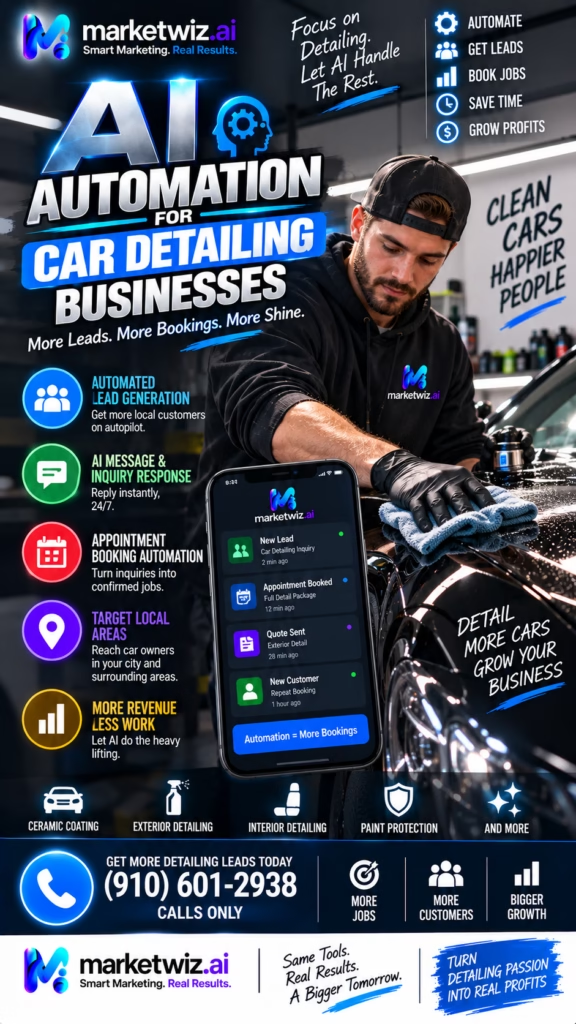
AI Automation for Car Detailing Businesses
Discover how car detailing businesses can use AI automation to improve lead response, customer qualification, appointment booking, CRM management, follow-up, review generation, local marketing, customer retention, and the systems required to grow a more organized detailing operation.
Car detailing is a highly visual local business, but the operational challenge behind growth is often invisible: inquiries arrive from different channels, customers ask the same questions repeatedly, appointments need to be coordinated, missed leads require follow-up, completed customers need to be retained, reviews need to be requested, and marketing needs to continue even while the team is busy detailing vehicles.
AI automation can help connect these moving parts into a more organized customer acquisition and retention system.
The goal is not to replace the detailer.
It is not to remove every human conversation.
It is not to automate decisions that require professional judgment.
Instead, the goal is to identify repetitive tasks that software can support so the owner, manager, salesperson, or technician can spend more time on the parts of the business where human skill matters.
For a car detailing business, that can include responding to new inquiries, collecting vehicle information, identifying requested packages, organizing customer records, supporting scheduling, confirming appointments, triggering follow-up, requesting reviews, creating marketing content, and tracking which lead sources generate actual customers.
1. Understand AI Automation for Car Detailing Businesses
AI automation combines artificial intelligence with software workflows that can perform or assist with repetitive business tasks.
Traditional automation follows predetermined rules.
For example:
When an appointment is completed, wait a specified amount of time and create a review request task.
AI can add another layer by interpreting information.
It might recognize that a new prospect is asking about ceramic coating rather than a basic interior detail.
It might summarize a conversation for the CRM.
It might identify that the prospect owns an SUV and wants mobile detailing.
It might categorize the lead before sending it to the correct workflow.
Think in Systems Rather Than Individual Tools
The real advantage comes when separate steps work together.
Each step creates information that can help the next step.
2. Automate the Car Detailing Lead Generation Process
A detailing company may receive prospects from several channels.
Google Search & Maps
Customers may search for auto detailing, mobile detailing, ceramic coating, paint correction, interior detailing, or related terms in their area.
Social Media
Before-and-after content, transformation videos, educational posts, and local promotions can generate inquiries.
Local Advertising
Appropriate local advertising channels can introduce detailing offers to additional customers.
Website Traffic
Service pages, organic SEO, paid campaigns, referrals, and branded searches can send prospects to a website.
The challenge is keeping these opportunities organized.
Automation can help tag the source, create a lead record, alert the appropriate person, and begin an approved response workflow.
3. Improve Lead Response With AI
Detailing customers often have practical questions before they book.
- How much does it cost?
- Do you detail SUVs?
- Do you come to my house?
- How long does a full detail take?
- Do you remove pet hair?
- Do you offer ceramic coating?
- Can you remove scratches?
- Do you work on luxury vehicles?
- What days are available?
An AI-supported response system can help handle common questions when it has access to accurate company information.
Build an Approved Knowledge Base
The system can be supplied with:
- detailing packages,
- approved price ranges or prices,
- vehicle categories,
- add-ons,
- business hours,
- service areas,
- mobile requirements,
- shop location where applicable,
- appointment rules,
- payment policies,
- frequently asked questions.
This creates a stronger foundation than allowing an AI system to guess.
4. Qualify Detailing Leads Automatically
Not every detailing inquiry contains enough information to schedule the job.
Qualification can gather the details required to determine the appropriate next step.
Useful Qualification Questions
- What vehicle do you have?
- What type of detailing are you looking for?
- What is the approximate condition?
- Are there specific concerns such as pet hair, stains, odor, oxidation, or paint defects?
- Are you looking for mobile or shop-based detailing?
- What area are you located in?
- When would you like the work completed?
The exact questions should be adapted to the company's actual workflow.
5. Collect Better Vehicle Information
Vehicle information can affect pricing, scheduling, labor, supplies, and package recommendations.
A compact sedan may require a different amount of time than a large three-row SUV.
A lightly maintained vehicle may require different work from a heavily soiled vehicle.
Create Structured Data Fields
Instead of storing everything inside an unstructured conversation, capture fields such as:
- year,
- make,
- model,
- vehicle category,
- interior condition,
- exterior condition,
- requested package,
- requested add-ons,
- customer location,
- preferred date.
Structured information makes future automation easier.
6. Help Customers Choose the Right Detailing Package
Too many choices can create friction.
If a detailing company has multiple packages and add-ons, an AI assistant can help explain the differences using approved information.
Start With the Customer's Goal
A customer preparing a vehicle for resale may have different priorities from someone maintaining a recently purchased luxury vehicle.
A parent dealing with stains and pet hair may have different priorities from an enthusiast researching paint correction.
The system should first understand the goal and then present relevant options.
7. Automate Pricing Carefully
Pricing is one area where automation requires strong controls.
Detailing prices can vary based on:
- vehicle size,
- vehicle condition,
- selected package,
- pet hair,
- stain severity,
- paint condition,
- travel requirements,
- specialty treatments,
- add-ons.
Use Approved Pricing Logic
If the business has standardized packages, those rules can potentially be built into the workflow.
If final pricing requires inspection, the system should say so rather than inventing an exact number.
Never Let AI Guess Prices
Incorrect automated quotes can create customer disputes and reduce trust.
8. Automate Appointment Booking
Scheduling is one of the most valuable automation opportunities for a detailing business.
Instead of repeatedly exchanging messages about availability, an integrated workflow can help move qualified customers toward available times.
The Booking System Needs Accurate Data
It should understand:
- business hours,
- available technicians,
- package duration,
- mobile travel requirements,
- shop capacity,
- buffer time,
- blocked dates,
- existing appointments.
Without accurate availability, automation can create scheduling problems instead of solving them.
9. Build AI Workflows for Mobile Detailing
Mobile detailing adds geographic complexity.
The business must account for customer location, travel time, service coverage, setup requirements, and technician availability.
Collect the Address at the Appropriate Stage
The system can first confirm whether the customer appears to be inside the service area before final scheduling.
Organize Appointments Geographically
When supported by appropriate scheduling and mapping systems, businesses can organize jobs based on location and time windows.
This can reduce unnecessary driving and create more efficient workdays.
10. Connect Detailing Leads to a CRM
A CRM creates a central record of the relationship with each customer.
Useful CRM Fields
| Field | Example Information | Purpose |
|---|---|---|
| Lead Source | Google, social, website, referral | Measures marketing performance |
| Vehicle | Sedan, SUV, truck, luxury vehicle | Supports qualification and scheduling |
| Requested Package | Interior, full detail, coating | Organizes customer intent |
| Status | New, qualified, booked, completed | Tracks sales progress |
| Appointment | Date and time | Supports operations |
| Customer Value | Completed transaction data | Supports marketing analysis |
The CRM becomes even more valuable when future maintenance and repeat business are included.
11. Recover Missed Car Detailing Leads
A detailer may be polishing a vehicle when a prospect reaches out.
A mobile crew may be driving between appointments.
The owner may be talking to another customer.
This creates opportunities for inquiries to be overlooked.
Create a Missed-Lead Workflow
The system can identify new inquiries that have not received appropriate attention and create notifications or follow-up tasks.
The purpose is simple: prevent good leads from disappearing because everyone was busy working.
12. Automate Lead Follow-Up
Not every prospect books during the first conversation.
Some are comparing packages.
Others are checking schedules.
Some may be waiting until payday or a future event.
Others are researching ceramic coating or paint correction before committing.
Use Contextual Follow-Up
A prospect who asked about ceramic coating should not receive the exact same follow-up as someone who asked about a basic interior cleaning.
CRM tags can help segment follow-up based on actual interest.
Businesses should also respect applicable communication laws, consent requirements, opt-out requests, and channel-specific rules.
13. Automate Appointment Confirmations and Reminders
Once an appointment is scheduled, communication can help reduce confusion.
Useful Appointment Information
- appointment date,
- appointment time,
- location,
- selected package,
- preparation instructions,
- mobile access requirements,
- rescheduling instructions.
The system should pull these details from the actual booking record rather than generating them independently.
14. Reduce No-Shows With Better Workflows
A missed appointment can be expensive for a detailing business because time was reserved that could have been used for another vehicle.
Automated reminders can help customers remember appointments and provide an opportunity to reschedule when necessary.
Track No-Show Patterns
If no-shows are frequent, evaluate:
- booking lead time,
- reminder timing,
- deposit policies where appropriate,
- customer instructions,
- confirmation procedures.
Automation makes these processes more consistent.
15. Use AI to Support Relevant Add-Ons
Detailing businesses often offer optional upgrades.
Examples may include:
- pet hair removal,
- odor treatment,
- headlight restoration,
- engine bay cleaning,
- paint enhancement,
- paint correction,
- ceramic coating,
- specialty protection products.
Keep Recommendations Relevant
Upselling should be based on actual customer needs.
If the customer says the vehicle has heavy pet hair, an applicable add-on can be explained.
If the customer asks about long-term exterior protection, a legitimate coating option can be discussed.
The AI should use approved descriptions and prices.
16. Automate Ceramic Coating Lead Workflows
Ceramic coating prospects often require more education than customers looking for a basic detail.
They may ask about:
- preparation,
- paint correction,
- durability,
- maintenance,
- vehicle downtime,
- package differences,
- pricing,
- warranty terms where applicable.
Create a Dedicated Coating Workflow
Instead of treating these prospects as generic detailing inquiries, categorize them separately.
This can support specialized qualification, educational follow-up, appointment types, and reporting.
17. Build AI Workflows for Paint Correction Leads
Paint correction is another category where accurate expectations matter.
The outcome depends on the paint's condition, defect severity, clear coat, previous work, customer expectations, and selected correction process.
Collect Information Before Promising Results
Automation can ask relevant questions and collect photos when the business's workflow supports them.
But the system should avoid guaranteeing that every scratch or defect can be removed.
Professional inspection may still be necessary.
18. Automate Review Requests After Completed Details
A completed job creates an opportunity to build long-term local trust.
After a job is marked complete, a workflow can trigger an appropriate review request.
Keep the Process Simple
Customers should understand where they can leave feedback and should never be pressured to provide a positive review.
Businesses should follow the current policies of Google and other review platforms they use.
Do Not Manufacture Reviews
AI should never be used to create fake customer reviews.
The goal is to make requesting genuine feedback more consistent.
19. Automate Customer Retention
One of the biggest opportunities in detailing is repeat business.
A customer who already trusted the company with a vehicle may be easier to re-engage than an entirely new prospect.
Create Maintenance Segments
Customers can potentially be organized by:
- last appointment date,
- vehicle,
- previous package,
- coating status,
- customer preferences,
- recommended maintenance cycle.
The business can then create appropriate future communication instead of treating every customer the same.
20. Reactivate Past Detailing Customers
A CRM may contain customers who have not booked in months.
Instead of allowing those relationships to disappear, businesses can create reactivation segments.
Examples of Useful Segments
- customers inactive for a defined period,
- previous full-detail customers,
- past coating customers,
- customers with multiple vehicles,
- seasonal customers,
- commercial or fleet accounts.
Any outreach should follow applicable consent and communication requirements.
21. Use AI to Support Google Maps Marketing
Google Maps can be an important discovery channel for local detailing businesses.
Potential customers may search phrases related to:
- car detailing near me,
- auto detailing,
- mobile car detailing,
- interior car detailing,
- ceramic coating,
- paint correction.
AI Can Support the Process
AI can help organize:
- local keyword research,
- content ideas,
- business information audits,
- review workflows,
- photo planning,
- FAQ content,
- performance reports.
Google Business Profile information should remain accurate and follow current Google guidelines.
22. Automate Parts of Car Detailing SEO
Organic search can complement Google Maps visibility.
A detailing website can contain useful pages around specific offerings and customer questions.
Potential Content Topics
- interior detailing,
- exterior detailing,
- mobile detailing,
- ceramic coating,
- paint correction,
- pet hair removal,
- fleet detailing,
- local service areas,
- vehicle maintenance questions.
AI Should Support, Not Flood, the Website
Publishing large amounts of generic content is not a substitute for useful information.
AI-assisted content should be reviewed, accurate, relevant, and written to help real customers.
23. Automate Car Detailing Social Media Content
Car detailing is naturally suited to visual marketing.
A dramatic transformation can communicate quality quickly.
AI Can Help Turn One Job Into Multiple Content Ideas
A single completed vehicle might support:
- a before-and-after post,
- a short-form video,
- a detailing tip,
- a process explanation,
- a customer FAQ,
- a local business update,
- a package spotlight.
This makes content production more efficient without requiring the business to invent something new every day.
24. Build AI Workflows for Fleet Detailing Leads
Commercial fleet opportunities require different qualification from individual vehicle owners.
Collect Commercial Information
The workflow may need to determine:
- company name,
- fleet size,
- vehicle types,
- location,
- frequency,
- onsite requirements,
- preferred schedule,
- decision-maker information.
Fleet leads can then be routed into a dedicated commercial sales pipeline.
25. Automate Marketing and Sales Reporting
AI automation becomes more valuable when the business can see what is working.
Track the Customer Journey
| Stage | Metric | Business Question |
|---|---|---|
| Marketing | Lead Source | Where are prospects coming from? |
| Lead | Qualified Lead Rate | Are we attracting relevant customers? |
| Booking | Booking Rate | How many qualified leads schedule? |
| Operations | Completion Rate | How many bookings become completed jobs? |
| Revenue | Average Ticket | What is the average completed transaction? |
| Retention | Repeat Customer Rate | How often do customers return? |
This data helps the owner make better decisions about marketing and operations.
26. Improve Lead-to-Booking Conversion
Generating more leads is only one way to grow.
A business can also improve how effectively existing leads become appointments.
Analyze the Funnel
Suppose 100 inquiries arrive.
If 60 are qualified and 30 book, the business can investigate what happened between qualification and booking.
Were responses too slow?
Were package explanations confusing?
Was availability limited?
Did prospects stop responding after receiving pricing?
Automation can make these stages easier to measure.
27. Use Automation Without Losing the Human Customer Experience
Car detailing is still a relationship business.
Customers are trusting someone with a valuable personal asset.
Automation should make communication easier rather than making customers feel trapped inside a rigid system.
Create Human Escalation Rules
A person should be able to take over when:
- the customer asks for a human,
- pricing is unusual,
- the vehicle has special requirements,
- there is a complaint,
- damage is discussed,
- a refund or dispute is involved,
- the AI lacks reliable information.
Good automation knows when not to automate.
28. Avoid Common AI Automation Mistakes
Mistake 1: Automating Before the Process Is Defined
If the business does not know its own workflow, software will not fix the confusion.
Mistake 2: Allowing AI to Invent Pricing
Use approved pricing rules or require human review.
Mistake 3: Using Outdated Availability
Booking automation needs reliable calendar information.
Mistake 4: Automating Every Conversation
Some situations require human judgment.
Mistake 5: Ignoring Lead Sources
Without source tracking, the business cannot accurately evaluate marketing.
Mistake 6: Forgetting Existing Customers
Retention can be as important as new customer acquisition.
Mistake 7: Sending Irrelevant Follow-Up
Segment customers based on actual interests and history.
Mistake 8: Creating Fake Reviews
Use automation to request legitimate customer feedback, never to manufacture it.
Mistake 9: Publishing Unreviewed Marketing Claims
Verify pricing, warranties, durability claims, package details, and business policies.
Mistake 10: Measuring Automation by Activity Alone
The real question is whether automation improves response, bookings, customer experience, efficiency, retention, or other meaningful business outcomes.
29. Build a Complete Car Detailing Automation Stack
A complete system can connect multiple functions instead of operating as isolated tools.
Customer Acquisition
Generate visibility through local search, Google Maps, social media, website SEO, advertising, referrals, and other legitimate marketing channels.
Lead Capture
Create a structured record of each inquiry and its source.
AI-Supported Response
Answer common questions and gather approved qualification information.
Qualification
Identify vehicle, package, location, condition, timing, and other relevant requirements.
Booking
Move qualified customers toward legitimate available appointment times.
CRM Tracking
Store the customer journey in an organized pipeline.
Completion Workflow
Update the job status after the detailing work is finished.
Reviews & Retention
Request genuine feedback and organize appropriate future customer communication.
30. Follow a 90-Day AI Automation Plan for Your Detailing Business
Days 1–30: Build the Foundation
- Document every detailing package.
- Document approved pricing.
- Document add-ons.
- Define the service area.
- Define business hours.
- Define booking rules.
- Identify common customer questions.
- Create qualification questions.
- Set up CRM stages.
- Track lead sources.
- Connect the booking process.
- Create human escalation rules.
Days 31–60: Automate Repetitive Work
- Improve new-lead notifications.
- Build approved lead-response workflows.
- Automate CRM organization where appropriate.
- Create appointment confirmations.
- Create reminder workflows.
- Create missed-lead recovery procedures.
- Create quote follow-up tasks.
- Create completed-job workflows.
- Create review-request workflows.
- Segment ceramic coating leads.
- Segment paint correction leads.
- Segment fleet opportunities.
Days 61–90: Optimize Growth
- Measure lead response time.
- Measure qualified lead rate.
- Measure booking rate.
- Measure completed jobs.
- Track average transaction value.
- Track lead sources.
- Track repeat customers.
- Improve Google Maps marketing.
- Expand SEO content.
- Build social content workflows.
- Improve customer reactivation.
- Optimize the highest-value automation opportunities.
Final Thoughts: Use AI to Build a Smarter Car Detailing Business
The biggest opportunity in AI automation for car detailing businesses is not a chatbot, one software application, or one automated message.
The opportunity is creating a connected business system.
Consider how many separate activities happen between someone discovering a detailing company and becoming a repeat customer.
The prospect first needs to find the business.
That may happen through Google Maps.
It may happen through organic search.
It may happen through social media.
It may happen through an advertisement.
It may happen through a referral.
Once the person makes contact, somebody needs to respond.
The business needs to understand what vehicle the customer has.
It needs to understand what the customer wants.
It may need to understand the vehicle's condition.
It may need to determine whether the customer is inside the mobile service area.
It may need to explain several detailing packages.
It may need to explain add-ons.
It may need to provide approved pricing information.
It may need to schedule the appointment.
Then the appointment needs to be confirmed.
The customer may need preparation instructions.
The technician needs accurate job information.
The work needs to be completed.
The customer record needs to be updated.
A review request may need to be sent.
The customer may need future maintenance.
Months later, that same customer may need another detail.
Every one of those stages creates repetitive administrative work.
That is where automation becomes valuable.
A well-designed system can capture a new inquiry and record the marketing source.
It can notify the correct person.
It can help answer common questions using approved information.
It can collect vehicle details.
It can identify customer intent.
It can organize the lead in a CRM.
It can support booking.
It can trigger appointment communication.
It can help identify missed leads.
It can organize follow-up.
It can trigger post-job workflows.
It can help request genuine reviews.
It can organize past customers for future marketing.
It can produce reports that show where business is actually coming from.
This creates leverage.
The owner no longer has to personally remember every administrative task.
The technician can spend more time detailing.
The salesperson can spend more time on qualified opportunities.
The manager can see the pipeline more clearly.
Marketing becomes easier to measure.
Customer retention becomes more systematic.
But automation needs reliable business information.
If the pricing database is wrong, automated pricing can be wrong.
If the calendar is outdated, automated booking can fail.
If the service area is inaccurate, the system can qualify customers the business cannot serve.
If package information is unclear, AI responses can confuse customers.
If nobody monitors exceptions, unusual customer situations can create problems.
This is why the first stage of AI automation is not software.
It is process design.
Document the packages.
Document the prices.
Document the service area.
Document the booking rules.
Document the common questions.
Document the qualification criteria.
Document when a human needs to take over.
Once those foundations exist, automation becomes much easier to implement safely and effectively.
The same principle applies to marketing.
AI can accelerate content production, but the content still needs to reflect the real business.
A detailing company should not publish a ceramic coating warranty it does not offer.
It should not claim paint correction results that cannot realistically be guaranteed.
It should not invent customer reviews.
It should not publish fake before-and-after transformations as evidence of actual work.
It should not claim to serve areas where it does not operate.
AI should make truthful marketing more efficient, not replace truth with volume.
Local search is another area where organization matters.
A detailing company can build visibility around the services customers actually search for.
That may include mobile detailing.
Interior detailing.
Exterior detailing.
Ceramic coating.
Paint correction.
Fleet detailing.
And other legitimate offerings.
Google Maps, website SEO, social content, customer reviews, and local advertising can all support discovery.
The important step is connecting those marketing channels to the lead-management system.
If ten leads arrive from Google and ten arrive from social media, the business should eventually be able to determine what happened to those opportunities.
How many were qualified?
How many booked?
How many completed?
What packages did they purchase?
What was the average transaction value?
Did they return later?
Without that information, marketing decisions can be based on assumptions.
With organized data, the business can improve.
Perhaps ceramic coating leads from Google produce significantly more revenue than generic social inquiries.
Perhaps mobile detailing leads convert well but travel time reduces profitability in one part of the service area.
Perhaps interior-detailing customers frequently return while one-time promotional customers rarely do.
Perhaps fleet accounts require longer sales cycles but create recurring revenue.
Automation helps collect the information needed to discover those patterns.
Customer retention should also be part of the system from the beginning.
A detailing business should not have to start from zero every month.
Completed customers create an existing audience.
Some may need regular maintenance details.
Some may own multiple vehicles.
Some may manage fleets.
Some may eventually upgrade to higher-value protection packages.
Some may refer friends or family.
CRM segmentation can help the business understand these relationships.
Automation can then support appropriate future communication.
This creates a cycle rather than a one-time transaction.
Acquire.
Qualify.
Book.
Deliver.
Request feedback.
Retain.
Reactivate.
Measure.
Improve.
That is the real potential of AI automation for car detailing businesses.
The technology should reduce repetitive work while helping the company respond more consistently, organize customers more effectively, measure marketing more accurately, and create a stronger experience from the first inquiry through the next appointment.
Start with one process.
Make it reliable.
Measure whether it saves time or improves results.
Then connect the next process.
Over time, individual automations can become a complete operating system for customer acquisition, scheduling, communication, retention, and growth.
Frequently Asked Questions About AI Automation for Car Detailing Businesses
1. What is AI automation for car detailing businesses?
AI automation uses artificial intelligence and connected software workflows to support repetitive processes such as lead response, qualification, scheduling, CRM management, follow-up, marketing, reviews, and reporting.
2. How can AI help a car detailing business?
AI can organize inquiries, answer approved FAQs, collect vehicle information, support qualification, update connected systems, assist with scheduling, create follow-up tasks, and help analyze marketing performance.
3. Can AI help car detailers generate leads?
Yes. AI can support content, campaign organization, lead capture, source tracking, response workflows, and follow-up across legitimate customer acquisition channels.
4. Can AI respond to car detailing leads?
Yes, when the system is configured with accurate packages, prices, service areas, hours, policies, and clear rules for when a human should take over.
5. Can AI book car detailing appointments?
AI can support scheduling when it is connected to reliable availability and understands package duration, staffing, mobile travel requirements, and booking rules.
6. Can AI help mobile detailing businesses?
Yes. AI workflows can collect location, vehicle, package, condition, timing, and other details needed to organize mobile detailing opportunities.
7. Can AI automate detailing quote requests?
AI can collect quote information and apply approved pricing rules, but it should not invent prices when final cost requires professional evaluation.
8. What information should an AI detailing assistant collect?
Useful information includes customer details, vehicle type, vehicle size, condition, requested package, location, desired date, and relevant add-ons.
9. Can AI reduce missed detailing leads?
AI-supported lead routing, alerts, CRM workflows, and missed-inquiry procedures can help identify opportunities that might otherwise be overlooked.
10. Can AI follow up with detailing prospects?
Yes, when appropriate and compliant with applicable communication laws, consent requirements, opt-outs, and channel rules.
11. Can AI help detailers get more reviews?
AI can trigger review-request workflows after completed jobs. Businesses should request genuine feedback and follow the current policies of each review platform.
12. Can AI help car detailers with Google Maps?
AI can support local keyword research, content planning, review workflows, reporting, and business information audits while the profile itself remains accurate and compliant.
13. Can AI help with car detailing social media?
AI can generate content ideas, captions, short-form video concepts, before-and-after descriptions, educational posts, and publishing calendars.
14. Can AI help car detailers create marketing content?
Yes. AI can assist with blogs, service-page drafts, FAQs, social posts, scripts, emails, and advertising concepts that are reviewed before publication.
15. Should car detailing leads be stored in a CRM?
A CRM can help organize customer information, lead source, vehicle, requested package, appointments, follow-up, completed jobs, and future opportunities.
16. Can AI update a detailing CRM?
When supported by the integration, AI workflows can create records, categorize leads, summarize conversations, update approved fields, and trigger tasks.
17. Can AI help sell detailing upgrades?
AI can explain legitimate add-ons based on customer needs while using accurate business information and approved pricing.
18. Can AI help promote ceramic coating?
Yes. AI can support coating education, content creation, lead qualification, follow-up, and campaign organization when all claims are accurate.
19. Can AI help promote paint correction?
AI can help explain packages, collect vehicle-condition information, organize inquiries, and support follow-up without making unrealistic guarantees.
20. Can AI help car detailing businesses retain customers?
Yes. CRM-based automation can help organize appropriate maintenance reminders, seasonal campaigns, customer segmentation, and future detailing opportunities.
21. Can AI help manage fleet detailing leads?
AI can collect company information, fleet size, vehicle types, locations, frequency, schedule requirements, and other commercial qualification details.
22. Can AI help a detailing business track marketing results?
Yes. AI can help organize lead-source, qualification, booking, completion, revenue, and retention data when reliable tracking information is available.
23. What should car detailers automate first?
Start with repetitive measurable processes such as lead capture, notifications, CRM organization, appointment communication, follow-up tasks, review requests, and reporting.
24. What should car detailers avoid automating completely?
Complex pricing, complaints, damage concerns, refunds, unusual vehicles, sensitive customer situations, and major commitments may require direct human review.
25. Can AI replace a car detailing salesperson?
AI can handle repetitive administrative work, but humans remain valuable for complex sales conversations, exceptions, relationship building, and situations requiring judgment.
26. How can mobile detailers use AI for route planning?
With appropriate mapping and scheduling integrations, automation can help organize appointments around location, travel time, technician availability, and time windows.
27. Can AI help a car detailing business improve SEO?
AI can support keyword research, content planning, FAQs, service-page drafts, internal linking ideas, local topic research, and SEO reporting.
28. How can AI help detailers compete locally?
AI can improve execution around response, follow-up, content, customer organization, review requests, retention, and marketing measurement.
29. Is AI automation useful for a small detailing business?
Yes, when it solves a real operational problem. Small businesses can begin with a few high-value workflows rather than trying to automate everything at once.
30. What is a strong AI automation system for a car detailing business?
A strong system connects marketing, lead capture, response, qualification, booking, CRM tracking, appointment communication, completed-job workflows, reviews, retention, and performance reporting while keeping business information accurate.
30 Additional SEO Keywords
These related search phrases can support future content clusters, service pages, internal links, local SEO articles, and AI marketing content for the car detailing industry.
Automate More of Your Car Detailing Growth System
MarketWiz.ai helps local businesses connect AI-powered lead generation, customer response, CRM workflows, Google Maps visibility, marketing automation, follow-up, content, and customer acquisition technology into a more organized system designed to capture, manage, and convert local opportunities.
Call MarketWiz.ai: (910) 601-2938