

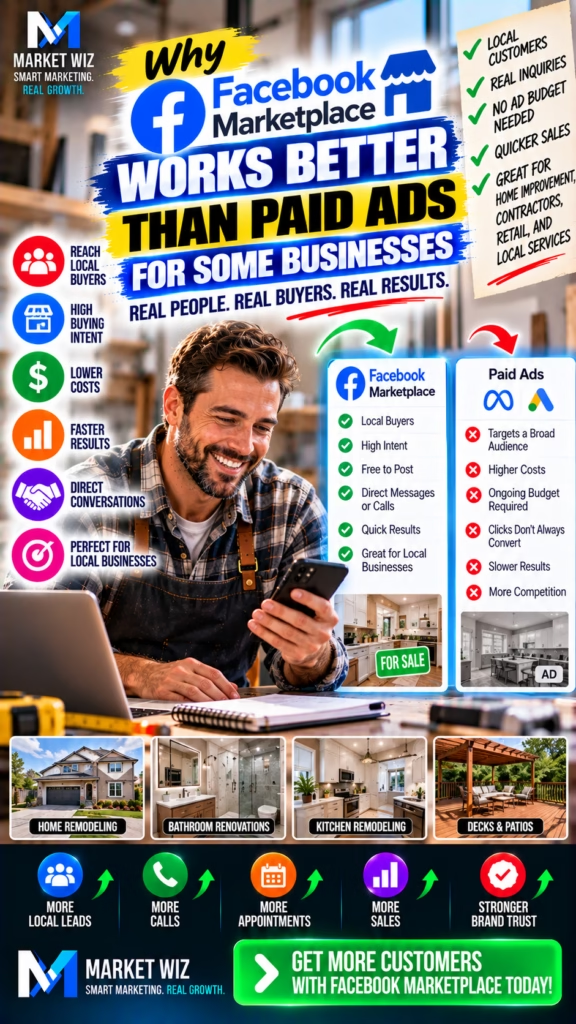
Why Facebook Marketplace Works Better Than Paid Ads for Some Businesses
Facebook Marketplace can give certain local, inventory-driven, and transaction-focused businesses another way to reach customers without depending entirely on traditional paid advertising. The advantage is not that Marketplace universally beats paid ads. It is that, for the right business, product, market, and customer journey, organic Marketplace visibility can create highly relevant conversations while becoming part of a broader, more diversified customer acquisition system.
Facebook Marketplace vs. Paid Advertising
Businesses have more ways to reach customers than ever before.
They can run paid social campaigns, purchase search ads, invest in display advertising, optimize Google Maps, build organic search visibility, publish social media content, create videos, send email, develop referral programs, and use online marketplaces.
Each channel solves a different problem.
Facebook Marketplace is particularly interesting because users often enter the platform specifically to browse things available to buy in their area.
That behavior is fundamentally different from interrupting someone with an advertisement while they are consuming unrelated content.
Marketplace can work especially well when the business has something people naturally want to browse, compare, locate, and purchase. Paid ads can create demand and targeted reach, while Marketplace can capture existing browsing behavior.
This distinction explains why some businesses discover that Marketplace produces useful customer opportunities even when previous paid campaigns struggled.
Marketplace Users Can Already Be in Shopping Mode
One of the biggest differences between Marketplace and many forms of paid social advertising is the context in which the customer sees the content.
Someone scrolling through a social feed may be watching videos, reading updates, looking at photos, or communicating with friends.
An advertisement must interrupt that experience and earn enough attention to change the user's behavior.
Marketplace is different.
People enter Marketplace because they want to browse.
They may be searching for furniture, vehicles, equipment, appliances, building materials, housing-related inventory, or another eligible category.
When a business has something that naturally matches that intent, Marketplace can place the offering inside an environment where shopping behavior is already occurring.
Marketplace Can Create Organic Customer Discovery
Traditional paid advertising usually requires continued media spending.
If the business stops funding the campaign, paid delivery generally stops as well.
Organic Marketplace activity operates differently.
Eligible listings can potentially receive visibility through Marketplace browsing and search without the business purchasing every individual impression or click.
That does not make Marketplace marketing free.
Businesses still have costs associated with employees, content creation, software, inventory management, photography, lead response, CRM systems, salespeople, and marketing operations.
However, the economics are different because organic visibility does not necessarily require the same direct media spend as a traditional advertising campaign.
Local Intent Can Make Marketplace Powerful
Marketplace has a strong local component.
That can be valuable for businesses that sell products locally, operate physical locations, deliver within specific territories, or depend on customers within practical geographic markets.
A furniture store may want buyers within delivery distance.
An equipment seller may want customers within a regional market.
A business selling large physical inventory may benefit from customers who are specifically browsing nearby options.
Geographic relevance can reduce some of the disconnect that occurs when marketing reaches people who are interested in the category but located outside the company's practical sales territory.
Marketplace Works Naturally With Visual Products
Some products are easier to market visually than through abstract ad copy.
A customer can look at a sofa and immediately understand its general style.
A buyer can see a vehicle, piece of equipment, storage building, appliance, or other physical item and quickly decide whether it deserves further consideration.
Furniture
Sofas, sectionals, dining sets, bedroom furniture, mattresses, recliners, and other eligible home furnishings are naturally visual.
Vehicles
Eligible vehicle inventory can be compared by appearance, specifications, price, location, and condition.
Equipment
Physical equipment can often be demonstrated with clear photographs, specifications, and practical use information.
Large Physical Products
Products that customers prefer to see before purchasing can benefit from visual discovery and local availability.
This can reduce the amount of explanation required before a customer decides whether to begin a conversation.
The Cost Structure Is Different From Paid Ads
Paid advertising typically operates through an auction or media buying system.
Businesses compete for impressions, clicks, leads, conversions, or other desired actions.
Costs can vary based on competition, audience, geography, seasonality, campaign objective, creative quality, conversion data, and platform conditions.
Marketplace organic visibility does not use exactly the same economic model.
This can be attractive for businesses that have substantial inventory and want to create additional customer discovery without assigning paid media budget to every individual product.
The correct comparison is not simply free versus paid. Businesses should compare the total cost of acquiring customers, including labor, software, content, response, sales, advertising spend, and operational overhead.
Marketplace Can Be Especially Useful for Inventory-Driven Businesses
Inventory creates marketing opportunities.
A business with dozens, hundreds, or thousands of individual products can potentially create many different customer entry points.
Each legitimate item has its own attributes.
It may have a different size, style, model, price, configuration, location, color, feature set, or customer use case.
Paid advertising every individual item can become expensive or operationally complex.
Organic product discovery can therefore play an important role in a diversified inventory marketing strategy.
Specific Listings Can Match Specific Customer Needs
Broad advertisements often attempt to communicate an entire business in a single creative.
Marketplace listings can be more specific.
A furniture business can highlight an individual dining set rather than simply advertising furniture.
A vehicle seller can present a specific vehicle rather than promoting an entire inventory catalog.
A physical-product business can show the exact item the customer is considering.
That specificity can make the conversation more concrete.
Marketplace Can Shorten the Path to a Conversation
Many traditional digital marketing funnels involve several steps.
A customer sees an advertisement.
The customer clicks to a landing page.
The customer reads the page.
The customer finds a form.
The customer submits information.
The lead enters another system.
Marketplace can sometimes create a shorter path because users can initiate a conversation directly from the listing environment.
Fewer steps can reduce friction, although businesses still need an effective process for turning the initial message into a qualified opportunity.
Fast Response Can Become a Competitive Advantage
Marketplace users may contact several sellers while comparing alternatives.
That makes response speed important.
A business that generates many messages but responds slowly may fail to capture the value of its visibility.
The lead generation system should therefore connect Marketplace inquiries to an organized response workflow.
A strong response workflow can include:
- Immediate lead notification
- Customer name capture
- Phone number collection when appropriate
- Email collection when appropriate
- Product or inventory identification
- Location information
- Basic qualification
- Salesperson assignment
- CRM entry
- Follow-up reminders
AI Automation Can Strengthen Marketplace Lead Handling
Businesses frequently lose leads because their marketing and sales processes are disconnected.
Marketing creates an inquiry, but nobody sees it quickly.
A salesperson responds but forgets to record the lead.
A customer asks a question after business hours and receives no response until the next day.
Another prospect expresses interest but never receives follow-up.
AI-supported systems can help reduce these operational gaps.
AI can support tasks such as:
- Lead notification
- Basic information collection
- Qualification workflows
- CRM record creation
- Lead routing
- Appointment workflow support
- Follow-up organization
- Lead source tracking
- Reporting
Human salespeople can then focus on conversations requiring judgment, negotiation, detailed product knowledge, pricing decisions, and closing.
Marketplace Lead Qualification Matters
Message volume alone does not determine marketing success.
Some inquiries will be highly relevant.
Others may be outside the sales area, interested in unavailable inventory, looking for a different price range, or simply gathering information.
Businesses need a consistent qualification process.
The questions depend on the business.
A furniture retailer may need to know which item the customer wants, delivery location, financing interest, and timing.
A vehicle seller may need to identify the vehicle, trade-in situation, financing needs, and appointment availability.
A B2B equipment seller may need company information, product requirements, quantity, location, and purchase timeline.
Marketplace Leads Should Become Trackable Sales Opportunities
Marketplace messages should not remain isolated from the rest of the company's sales operation.
Once a legitimate opportunity is identified, the business should have a process for tracking it.
A CRM or structured lead system can help.
Useful lead stages may include:
- New Marketplace inquiry
- Contacted
- Qualified
- Phone number received
- Appointment scheduled
- Quote requested
- Financing requested
- Follow-up required
- Sale completed
- Lost opportunity
This makes it possible to evaluate Marketplace based on sales rather than simply counting messages.
Why Paid Ads Sometimes Struggle
Paid advertising can be extremely effective, but it is not automatically profitable.
Campaigns can struggle for many reasons.
The creative may not capture attention.
The offer may be weak.
The audience may be too broad or too narrow.
The landing page may create friction.
The sales team may respond slowly.
The tracking may be incomplete.
The cost of reaching customers may exceed the economics of the product.
Competition may increase auction costs.
None of these problems means paid advertising is ineffective as a channel. They mean businesses must evaluate the complete acquisition system rather than assuming media spend automatically creates profitable customers.
When Paid Advertising Has Major Advantages
Marketplace does not replace the capabilities of paid advertising.
Paid campaigns can provide control that organic Marketplace activity cannot.
Paid advertising can be valuable for:
- Precise audience targeting
- Large-scale awareness
- Retargeting previous website visitors
- Promoting specific offers
- Driving traffic to landing pages
- Lead generation campaigns
- Geographic expansion
- Testing new creative concepts
- Building demand for unfamiliar products
- Scaling proven offers
The question should not be whether Marketplace or paid ads are universally better. The useful question is which channel creates the strongest economics for a specific product, customer, market, and business objective.
Facebook Marketplace vs. Paid Ads: Key Differences
| Factor | Facebook Marketplace | Paid Advertising |
|---|---|---|
| Discovery Context | Users are often actively browsing products or categories | Ads may appear while users are consuming other content |
| Media Spend | Organic visibility may not require direct payment for every impression | Campaign delivery generally requires ongoing advertising spend |
| Targeting Control | More dependent on Marketplace discovery systems and listing relevance | Can provide detailed audience, location, objective, and campaign controls |
| Product Specificity | Can highlight individual eligible inventory items | Can promote individual products or broader campaigns |
| Customer Interaction | Can lead directly into Marketplace conversations | Can route to websites, forms, calls, messages, apps, or other destinations |
| Scalability | Depends heavily on inventory, platform rules, local markets, and operational capacity | Media budgets can often scale proven campaigns more directly |
| Best Fit | Often strong for visual, local, inventory-driven discovery | Strong for controlled reach, retargeting, demand generation, and scalable campaigns |
Why Marketplace Can Work Well for Furniture Businesses
Furniture is one of the clearest examples of a category that naturally fits visual browsing.
Customers often want to compare style, size, color, configuration, price, and local availability.
A furniture business may have dozens or hundreds of individual products.
Each product creates another possible customer entry point.
Instead of advertising only the store itself, the business can build marketing around specific eligible inventory.
The customer can begin with the exact sofa, dining set, mattress, bedroom set, recliner, or other product that caught their attention.
Why Marketplace Can Work for Vehicle and Equipment Inventory
Vehicles and equipment also involve substantial comparison behavior.
Buyers may evaluate year, model, condition, mileage, specifications, features, price, financing, location, and availability.
Individual inventory listings can provide a natural way for customers to begin that comparison.
For higher-value purchases, Marketplace may create the initial discovery while the actual sale requires additional steps such as phone conversations, appointments, demonstrations, inspections, financing, trade-in discussions, or contracts.
Marketplace Can Create Discovery for Higher-Ticket Products
Higher-ticket products generally require more trust and a longer decision process.
That does not mean Marketplace cannot contribute.
It means the Marketplace listing should be understood as the beginning of a customer journey rather than the entire sales process.
The customer may discover the product on Marketplace, research the company, visit the website, call a salesperson, review financing, schedule an appointment, and complete the purchase later.
Businesses should therefore track assisted conversions rather than assuming every Marketplace-generated customer will complete the transaction directly inside the platform.
Combine Facebook Marketplace With Google Maps
Customers frequently research a business after discovering an individual product.
They may search the company name on Google.
They may check reviews.
They may look at photos, hours, directions, website information, and other business details.
Google Maps visibility can therefore reinforce Marketplace discovery.
This is particularly important for local businesses with physical locations or defined service territories.
Combine Marketplace With Organic SEO
Search engine optimization reaches customers in a different context.
Instead of browsing Marketplace, a potential customer may search Google for a product, category, company, or solution.
A business that appears across Marketplace, organic search, Google Maps, and social media has multiple opportunities to be discovered.
This reduces dependence on any single platform.
It also helps create a stronger digital footprint around the business.
Short-Form Video Can Strengthen Product Marketing
Some products are easier to understand when customers can see them from multiple angles or watch them in use.
Short-form video can demonstrate size, features, configuration, functionality, condition, design, or other important attributes.
Video can then be distributed across appropriate social platforms, websites, and other marketing channels.
This creates additional value from the same inventory and content production process.
Marketplace Is Strongest Inside a Multi-Channel Strategy
Businesses should avoid treating any single marketing platform as permanent or guaranteed.
Platform policies change.
Algorithms change.
Competition changes.
Customer behavior changes.
Costs change.
A diversified acquisition system reduces the risk of depending on one source.
Marketplace
Supports eligible product discovery and local browsing.
Google Maps
Supports local business discovery, reviews, directions, and customer research.
SEO
Captures customers actively searching for products, companies, and solutions.
Social Media
Builds awareness, education, visibility, and repeated customer touchpoints.
Paid Advertising
Creates controlled reach, retargeting, testing, and scalable campaign distribution.
CRM + Automation
Connects customer discovery to response, qualification, follow-up, and sales tracking.
Why an Organic-First Strategy Can Make Sense
Some businesses immediately turn to paid advertising before fully developing the organic channels already available to them.
An organic-first strategy asks a different question.
Where can the business create customer visibility before purchasing additional traffic?
Depending on the company, the answer may include Marketplace, Google Maps, local SEO, organic search, social media, short-form video, customer reviews, referral systems, email, and other channels.
Once those systems are operating effectively, paid advertising can be layered on strategically.
This can create a more diversified customer acquisition system rather than making paid media responsible for generating every new opportunity.
Compare Customer Acquisition Economics, Not Just Lead Cost
A cheap lead is not automatically a profitable lead.
A more expensive lead is not automatically a bad lead.
Businesses should evaluate what happens after the lead arrives.
How many leads are qualified?
How many answer the phone?
How many schedule appointments?
How many purchase?
What is the average transaction value?
What is the gross profit?
How much labor is required to manage the channel?
What is the total customer acquisition cost?
These questions create a much more useful comparison between Marketplace and paid advertising.
Track Marketplace Leads From Message to Revenue
Businesses cannot accurately compare channels without tracking sales outcomes.
| Metric | Purpose | Business Question |
|---|---|---|
| Marketplace Inquiries | Measures initial activity | How many people started conversations? |
| Qualified Leads | Measures relevance | How many inquiries matched the business? |
| Response Time | Measures sales speed | How quickly did the business respond? |
| Appointments | Measures progression | How many prospects moved to the next step? |
| Sales | Measures conversion | How many opportunities became customers? |
| Average Sale Value | Measures revenue quality | How valuable was the average transaction? |
| Revenue | Measures business output | How much revenue came from Marketplace? |
| Total Acquisition Cost | Measures efficiency | What did it actually cost to acquire customers? |
Optimize Marketplace Using Real Sales Data
Once the business tracks customer outcomes, marketing can become more intelligent.
The company may discover that certain products generate many messages but few sales.
Other products may create fewer messages but much stronger conversion.
Some locations may produce better customers.
Certain price ranges may generate stronger demand.
Particular images may produce more useful conversations.
Certain listing descriptions may reduce repetitive questions.
These insights allow the company to improve its content and inventory strategy based on actual results.
Common Facebook Marketplace Marketing Mistakes
Marketplace is not a shortcut around good marketing or platform requirements.
Businesses can weaken performance when they prioritize volume over relevance and quality.
Common mistakes include:
- Publishing inaccurate product information
- Advertising unavailable inventory
- Using misleading prices
- Using low-quality or unrelated photos
- Ignoring Marketplace eligibility requirements
- Using prohibited categories or offers
- Failing to update listings
- Responding too slowly
- Failing to collect contact information when appropriate
- Failing to qualify inquiries
- Leaving leads outside the CRM
- Failing to follow up
- Measuring messages instead of sales
- Depending entirely on Marketplace
- Ignoring Google Maps and SEO
- Stopping paid advertising without evaluating performance data
Use Marketplace and Paid Advertising Together
Businesses do not necessarily have to choose between organic Marketplace marketing and paid advertising.
The two can play complementary roles.
Marketplace can create organic discovery around eligible inventory.
Paid advertising can expand reach.
Marketplace can create direct product conversations.
Paid campaigns can retarget website visitors.
Marketplace can support local inventory discovery.
Paid advertising can introduce the brand to new audiences.
Marketplace can generate data about which products attract interest.
Paid campaigns can use those insights to inform future creative and offers.
A strong strategy does not force every marketing channel to do the same job. Each channel should be used where its strengths align with the customer's journey and the company's economics.
Build a Complete Facebook Marketplace Lead Generation System
Identify Eligible Inventory
Determine which legitimate products and offers are appropriate for Marketplace under current platform requirements.
Create Accurate Product Content
Use real product information, strong images, accurate prices, useful specifications, and clear descriptions.
Focus on Relevant Markets
Align listings with the areas where the business can realistically sell, deliver, or support customers.
Capture Customer Inquiries
Make sure Marketplace messages enter a defined lead management workflow.
Respond Quickly
Create notifications and response procedures so interested buyers do not wait unnecessarily.
Qualify the Opportunity
Collect the information required to determine whether the customer and product are a suitable match.
Move the Lead Into the CRM
Record qualified opportunities so they can be tracked beyond the initial Marketplace conversation.
Create the Next Sales Action
Move the customer toward a phone call, appointment, quote, purchase, financing discussion, or other appropriate next step.
Follow Up
Maintain organized follow-up for qualified customers who do not purchase immediately.
Measure Revenue
Track sales and revenue so Marketplace can be compared with paid advertising and other acquisition channels.
Scale What Produces Profitable Customers
Scaling marketing should not simply mean producing more activity.
The objective is to expand what produces profitable customer acquisition.
If Marketplace performs strongly for a particular inventory category, the business can improve coverage around that category.
If certain cities produce stronger sales, marketing can concentrate more resources there.
If paid retargeting converts Marketplace visitors or other prospects effectively, the channels can work together.
If organic search generates high-value customers, SEO investment can be expanded.
Scaling should follow data rather than assumptions.
Build a Customer Acquisition System That Does Not Depend on One Channel
The biggest strategic lesson is larger than Facebook Marketplace.
Businesses become more resilient when they develop multiple customer acquisition channels.
Marketplace can contribute organic product discovery.
Google Maps can capture local search demand.
SEO can create long-term organic search visibility.
Social media can build awareness and familiarity.
Short-form video can demonstrate products and educate customers.
Paid advertising can provide controlled reach and scalable distribution.
CRM systems can organize opportunities.
AI automation can improve response and follow-up.
Sales teams can convert qualified opportunities into revenue.
The business can then compare these channels based on real customer economics.
30 FAQs About Facebook Marketplace vs. Paid Ads
1. Can Facebook Marketplace work better than paid ads?
Yes. For some businesses, products, markets, and customer journeys, Facebook Marketplace can produce useful organic visibility and inquiries without requiring payment for every impression or click. Results depend on the business, offer, competition, location, platform eligibility, and execution.
2. Why can Facebook Marketplace be effective for local businesses?
Facebook Marketplace is built around browsing and local discovery, which can make it relevant for businesses whose products or eligible listings naturally match what nearby users are already looking for.
3. Is Facebook Marketplace free advertising?
Organic Marketplace visibility does not necessarily require a traditional paid advertising budget, although businesses still incur costs for staff, content, software, lead handling, inventory management, and other marketing operations.
4. Does Facebook Marketplace replace paid advertising?
Not necessarily. Marketplace and paid advertising solve different marketing problems. Many businesses can benefit from using organic channels and paid advertising together.
5. What businesses can benefit from Facebook Marketplace?
Businesses with eligible products, inventory, local offers, or other permitted Marketplace activity may benefit when their customers already use Marketplace for discovery and comparison.
6. Why can Marketplace leads have strong intent?
Some Marketplace users are actively browsing specific categories, products, price ranges, and locations, which can create useful purchase intent when the listing closely matches what they want.
7. Why are paid ads more expensive over time?
Paid campaigns generally require continued media spending to maintain delivery. Advertising costs can also change based on competition, audience, campaign objective, seasonality, creative performance, and auction conditions.
8. Does Marketplace marketing require good photos?
Strong and accurate imagery can help users understand the product or offering quickly and can improve the quality of the browsing experience.
9. How important are Marketplace titles?
Clear titles help users understand what is being offered and can improve relevance when people browse or search Marketplace.
10. How important is Marketplace lead response time?
Fast response can be important because Marketplace users may contact multiple sellers or businesses while comparing options.
11. Can AI help respond to Marketplace leads?
AI-supported workflows can help organize inquiries, collect information, create notifications, update CRM records, and support lead qualification before human follow-up.
12. Should Marketplace leads go into a CRM?
Businesses can benefit from tracking Marketplace leads in a CRM or structured lead management system so inquiries, follow-up, appointments, sales, and source performance are easier to measure.
13. Can Facebook Marketplace help businesses reduce dependence on paid ads?
For businesses that can generate meaningful organic Marketplace visibility, the channel may reduce dependence on paid media by adding another source of customer discovery.
14. Are Marketplace leads always better than paid ad leads?
No. Lead quality varies by business, product, market, listing, targeting, customer intent, and sales process. Marketplace is stronger for some situations while paid advertising is stronger for others.
15. When are paid ads better than Facebook Marketplace?
Paid advertising can be more suitable when a business needs precise audience targeting, controlled campaign delivery, large-scale reach, conversion campaigns, retargeting, or promotion of offers that are not appropriate for Marketplace.
16. Can Facebook Marketplace support local lead generation?
Marketplace can support local customer acquisition when a business has eligible listings that are relevant to users in its actual sales or service area.
17. Can Marketplace marketing scale across multiple cities?
Some businesses can build repeatable local Marketplace workflows across multiple legitimate markets, subject to platform rules, account requirements, inventory availability, and operational capacity.
18. Should businesses use the same Marketplace listing repeatedly?
Businesses should prioritize accurate, current, relevant content and follow platform rules rather than relying on repetitive low-quality or duplicative activity.
19. Can Marketplace work for high-ticket products?
Marketplace can contribute to discovery for some higher-value eligible products, although higher-ticket purchases often require additional research, trust, sales conversations, financing, demonstrations, or follow-up.
20. Can Facebook Marketplace work for furniture stores?
Furniture is a naturally visual category, and eligible furniture inventory can align well with the way consumers browse Marketplace for local products.
21. Can Marketplace work for vehicle and equipment sellers?
Eligible vehicle, equipment, and related inventory can potentially benefit from Marketplace discovery when listings comply with current category and commerce requirements.
22. Can Marketplace marketing support SEO?
Marketplace does not replace SEO, but both can contribute to a diversified acquisition strategy by creating separate paths for customers to discover a business.
23. Should businesses combine Marketplace with Google Maps?
Businesses with local customers can benefit from combining appropriate Marketplace activity with Google Maps and local search visibility so customers have multiple discovery and research paths.
24. Should businesses combine Marketplace with social media?
Social media can complement Marketplace by supporting brand visibility, customer education, product demonstrations, project content, and ongoing engagement.
25. How should businesses measure Marketplace performance?
Businesses can track listing activity, inquiries, qualified leads, response time, appointments, sales, average transaction value, close rate, and revenue attributed to Marketplace.
26. Why is lead quality more important than message volume?
A large number of irrelevant messages may create more work without increasing sales. Qualified inquiries that match the business's products, market, budget, and buying criteria are generally more useful.
27. Can automation improve Marketplace marketing?
Appropriate automation can improve operational consistency around lead notifications, CRM updates, qualification, reporting, and follow-up while businesses continue to comply with platform requirements.
28. What are common Facebook Marketplace marketing mistakes?
Common mistakes include inaccurate listings, poor images, misleading information, slow response, weak qualification, failure to track leads, policy violations, outdated inventory, and relying on Marketplace as the only marketing channel.
29. Should businesses stop paid ads if Marketplace works?
Not automatically. Businesses should compare customer acquisition cost, lead quality, sales volume, scalability, profitability, and strategic objectives before changing the role of paid advertising.
30. What is the best way to use Facebook Marketplace and paid ads together?
Businesses can use eligible Marketplace activity for organic discovery while using paid advertising for controlled reach, retargeting, audience expansion, promotions, and campaigns that require capabilities Marketplace does not provide.
30 Additional SEO Keywords
These additional keyword themes can support organic search content, local marketing pages, Facebook Marketplace strategy, customer acquisition campaigns, social content, videos, and related business marketing resources.
Why Facebook Marketplace Can Outperform Paid Ads for the Right Business
Facebook Marketplace and paid advertising should not be viewed as interchangeable marketing channels.
They operate differently.
They reach customers in different contexts.
They have different cost structures.
They provide different levels of control.
And they can play very different roles inside the customer journey.
Marketplace can be particularly useful when customers already browse the platform for the type of product a business sells.
That existing browsing behavior matters.
Instead of creating interest from scratch, the business may be positioning relevant inventory in front of someone who is already exploring the category.
That can shorten the path between discovery and conversation.
The customer sees the product.
The customer reviews the price or relevant information.
The customer looks at the photos.
The customer decides whether the item deserves further consideration.
The customer can then begin a conversation.
This is especially valuable for businesses with substantial physical inventory.
Every legitimate product can create another potential discovery point.
A furniture store may have hundreds of individual pieces.
A dealer may have many vehicles.
An equipment seller may have multiple machines, configurations, or models.
A retailer may continuously receive new inventory.
Instead of relying exclusively on broad advertisements, businesses can create customer entry points around specific eligible items.
This specificity can improve relevance.
Someone interested in a particular sectional can begin with that sectional.
Someone interested in a particular vehicle can begin with that vehicle.
Someone interested in a particular piece of equipment can begin with that equipment.
The conversation starts closer to the customer's actual interest.
Paid advertising has different strengths.
It allows businesses to build campaigns around audiences.
It allows controlled geographic targeting.
It can support retargeting.
It can drive website traffic.
It can generate leads through dedicated forms.
It can introduce customers to products they were not actively searching for.
It can create large-scale awareness.
And successful campaigns can often be expanded by increasing budget while maintaining careful performance monitoring.
Marketplace cannot duplicate all of those capabilities.
Paid advertising cannot duplicate every aspect of organic Marketplace browsing either.
This is why businesses should avoid simplistic either-or decisions.
The stronger strategy is to understand the role each channel plays.
Marketplace can create organic discovery.
Paid advertising can create controlled distribution.
Google Maps can capture local search behavior.
SEO can create long-term organic visibility.
Social media can build familiarity.
Video can demonstrate products.
Email and text workflows, where appropriate and permissioned, can support customer follow-up.
CRM systems can organize opportunities.
AI can support response and qualification.
Sales teams can move qualified prospects toward purchases.
The economics of Marketplace also deserve careful analysis.
Businesses sometimes describe organic channels as free.
That is rarely completely accurate.
Someone still has to create content.
Someone has to manage inventory.
Someone has to monitor leads.
Someone has to answer customers.
Software may be required.
CRM systems may be required.
Salespeople still need to work the opportunities.
Customer support still has a cost.
The better comparison is total customer acquisition cost.
Suppose one marketing channel produces 100 inquiries.
Another produces only 30.
The first channel is not automatically better.
If only five of the 100 inquiries are qualified while 20 of the 30 inquiries from the second channel are qualified, the economics may look completely different.
Sales conversion matters.
Average transaction value matters.
Gross profit matters.
Customer lifetime value can matter.
Operational cost matters.
Lead response time matters.
Follow-up matters.
These metrics should shape channel decisions.
Businesses should also recognize that Marketplace performance can vary dramatically by category.
A product that fits naturally into Marketplace browsing behavior may perform differently from an offering that requires extensive education before customers understand it.
Visual products can have an advantage.
Locally available inventory can have an advantage.
Products customers already search for can have an advantage.
Products with clear specifications and pricing can be easier to compare.
But businesses still need quality execution.
The photographs should be accurate.
The title should clearly identify the item.
The description should provide useful information.
The price should not intentionally mislead customers.
The inventory should actually be available when represented as available.
The business should respond to legitimate inquiries.
Leads should be tracked.
Follow-up should happen.
Sales outcomes should be recorded.
Without these systems, Marketplace can produce activity without producing predictable business results.
Lead response is especially important.
Marketplace creates an environment where comparison can happen quickly.
A customer may contact several sellers within minutes.
The business that responds effectively can begin the conversation while customer interest is still high.
This does not mean every response should be automated.
Automation should support the customer experience.
It can help make sure a lead is noticed.
It can collect basic information.
It can update a CRM.
It can route the opportunity to a salesperson.
It can help organize follow-up.
But customers should still be able to reach knowledgeable people when the conversation requires human judgment.
A customer purchasing an expensive product may have detailed questions.
They may need financing information.
They may want to negotiate.
They may need delivery details.
They may need product recommendations.
They may need an appointment.
They may need reassurance before making a significant purchase.
Human sales ability remains important.
Businesses should also protect themselves against dependence on one platform.
Marketplace may perform extremely well during one period.
That does not guarantee identical performance forever.
Platform policies can change.
Eligibility requirements can change.
Categories can change.
Customer behavior can change.
Competition can change.
Organic visibility can change.
That is why a diversified acquisition strategy is so valuable.
A business that generates customers from Marketplace, Google Maps, organic search, social media, referrals, repeat customers, email, and paid advertising has more options.
If one source weakens, the company still has other channels.
If one source becomes unusually strong, the company can capitalize on it without becoming completely dependent on it.
Organic channels can also make paid advertising more effective.
A customer may first see an advertisement and later search the business on Google.
Another customer may discover an item through Marketplace and later encounter a paid retargeting campaign.
Someone may see a social video before eventually purchasing through a different channel.
Marketing channels interact.
This makes attribution imperfect.
Businesses should track lead source carefully while also recognizing that customers may experience several touchpoints before purchasing.
The long-term objective is therefore not simply to prove that Marketplace beats paid advertising.
The objective is to discover where Marketplace creates an economic advantage for the specific business.
Does it generate relevant inquiries?
Does it reach customers in useful locations?
Does the inventory fit the platform?
Can the business respond quickly?
Can leads be moved into a structured sales process?
Can the company measure purchases?
Can Marketplace reduce reliance on paid media without reducing total sales?
Can paid advertising then be focused on the campaigns where it adds the most incremental value?
Those are much more useful questions.
For some businesses, Marketplace can become a significant organic customer acquisition channel.
For others, paid advertising will remain more important.
Many businesses may find the strongest approach is a combination.
Organic visibility creates a foundation.
Paid advertising expands reach.
AI improves operational speed.
CRM systems preserve opportunities.
Sales teams convert demand.
Analytics show what is actually working.
When those pieces operate together, businesses can build a customer acquisition system that is less dependent on any one advertising platform and more focused on measurable, profitable growth.
Build a Smarter Customer Acquisition System
Market Wiz AI helps established businesses build scalable customer acquisition systems using Facebook Marketplace marketing, Google Maps optimization, local SEO, social marketing, AI automation, rapid lead response, CRM workflows, qualification, follow-up, multi-channel visibility, and performance tracking.
Get Started With Market Wiz AI© Market Wiz AI. Facebook and Facebook Marketplace are trademarks of Meta Platforms, Inc. Market Wiz AI is not affiliated with or endorsed by Meta unless expressly stated. Marketplace eligibility, commerce policies, categories, account requirements, listing rules, features, and availability may change over time. Businesses should review current platform requirements before publishing content. Marketing performance varies by business, market, product, execution, competition, customer demand, and other factors.














Use Social Media to Reinforce Marketplace Visibility
Marketplace content can focus on specific inventory while social media supports the broader business story.
Social content can showcase new arrivals, product demonstrations, customer education, behind-the-scenes activity, FAQs, comparisons, financing information, company updates, and other relevant material.
The customer may encounter the business several times before making a purchase.
These repeated touchpoints can increase familiarity and provide additional information during the buying process.